

Here’s a stat that should change how you plan. Roughly 76% of blog traffic comes from older posts, not new ones. Yet most teams spend nearly all their energy pushing out new content while those older pages quietly leak visitors.
That’s the blind spot in almost every SEO roadmap you’ll find online. They tell you how to build. Audit the site, research keywords, publish, get links. Then they go quiet. Nobody plans for the part where the traffic you worked for starts slipping away.
A good roadmap fixes that. It isn’t a launch plan. It’s a maintenance system that keeps earning while you build. Below is a phased roadmap you can copy, plus the one phase most guides forget.
What an SEO roadmap actually is (and how it differs from strategy)
An SEO roadmap is a sequenced, time-bound plan that turns your SEO strategy into dated tasks with owners and clear success metrics. Strategy is the thinking. The roadmap is the doing.
Put it this way. Your strategy answers “what are we betting on and why,” meaning the topics, the audience, the business goal. The roadmap answers “who does what, by when, and how will we know it worked.” One is the destination. The other is the turn-by-turn directions.
Why does the distinction matter? Because a roadmap without a numerical goal drifts. “Grow organic traffic” is a wish. “Add 40% non-branded organic sessions to the money pages by Q3” is a target you can build backward from. The second one tells you what to do on a Tuesday morning. The first one just sounds nice in a meeting.
There’s a real business case for getting this right, too. SEO leads close at around 14.6%, compared with roughly 1.7% for outbound. Leadership funds plans that connect to revenue like that. Your roadmap is how you make the connection visible instead of asking people to take organic search on faith.
The five phases every roadmap needs
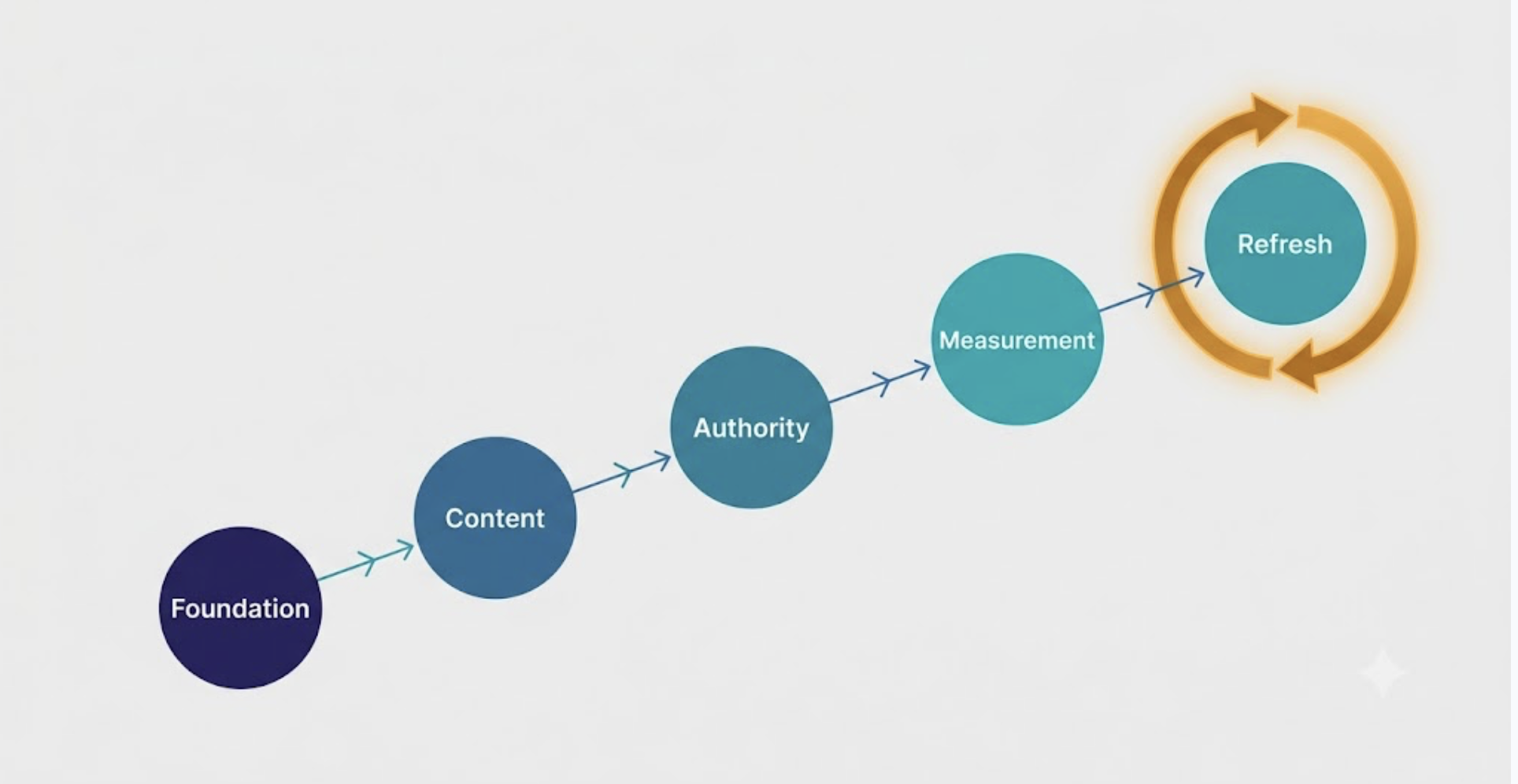
Most solid roadmaps move through the same five phases: foundation and quick wins, keyword and content architecture, authority and AI-search visibility, measurement, and the maintenance loop that keeps the whole thing alive.
They don’t run in a strict line. Foundation work overlaps with content planning, and measurement runs the entire time. Think of it as five workstreams you sequence, not five boxes you tick in order.
The cadence that works best right now is a 90-day tactical plan inside a 12-month strategic envelope. The SERP moves too fast for a rigid annual plan, and 90 days is long enough to see real movement. So plan the year loosely. Plan the quarter tightly.
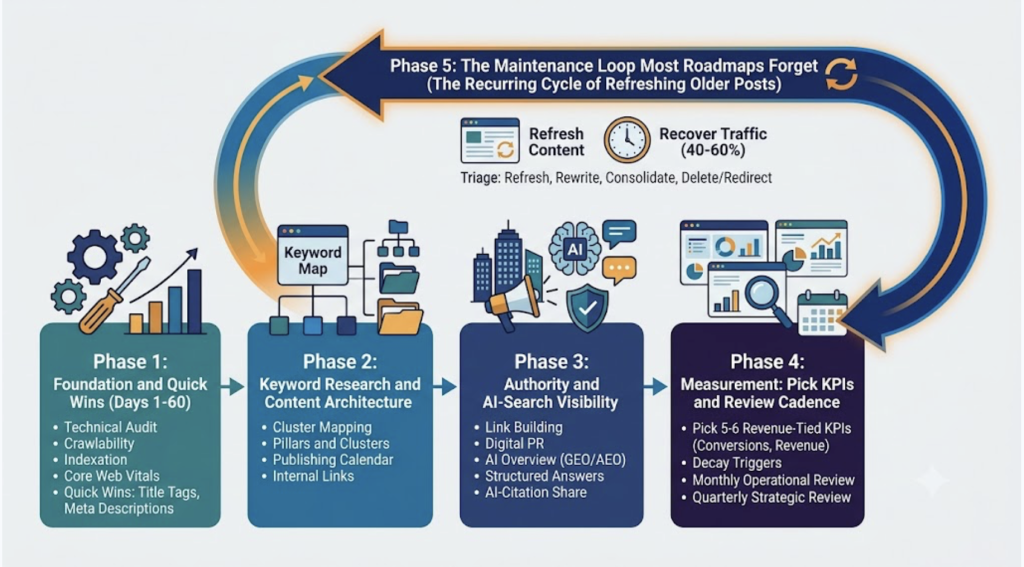
Phase 1: Foundation and quick wins (first 30 to 60 days)
Start with technical SEO. Not because it wins on its own (it rarely does), but because chronic neglect caps everything else you try. If Google can’t crawl, render, and index your pages efficiently, no amount of content will save you.
Work through the basics first. Crawlability, indexation, Core Web Vitals, and a clean sitemap that only lists live, canonical URLs. Get the floor solid before you start decorating the house.
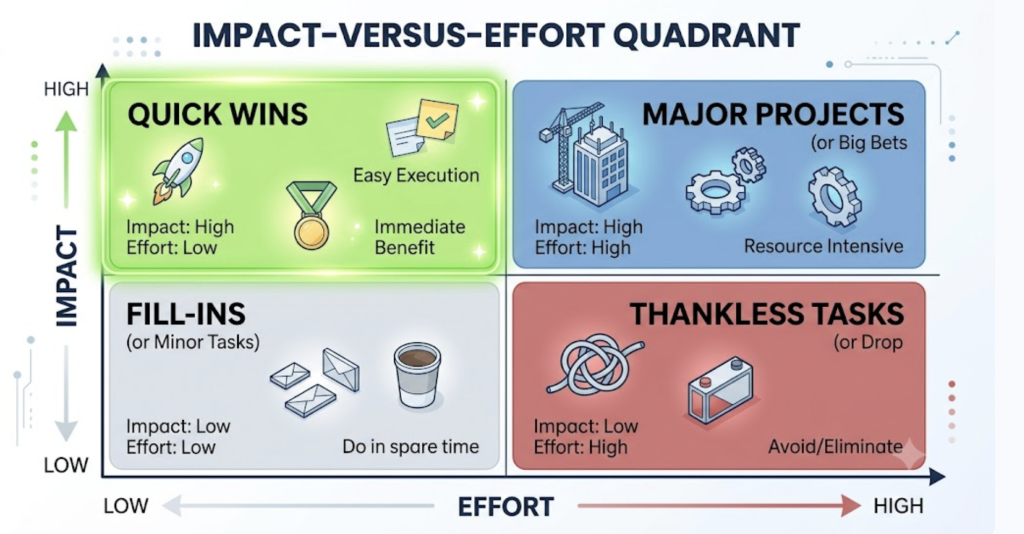
Then bank some quick wins. These are the low-effort, high-impact fixes that build momentum early, and honestly, credibility with your boss. Title tags and meta descriptions that undersell the page. Broken internal links. Posts stuck on page two that a small push could lift onto page one. The advice from planners is consistent: sequence critical blockers first, inside the first 30 to 60 days, and lead with the quick wins so you have something to show before the slow work pays off.
One thing people skip in the rush. Baseline your numbers now. Snapshot your organic traffic, rankings, CTR, and conversions before you touch anything. If you don’t, you can’t prove impact later, and proving impact is how the roadmap survives the next budget review. Nobody renews funding for work they can’t see.
Phase 2: Keyword research and content architecture
Keyword research isn’t a list. It’s a map. The goal here is to group keywords by intent and pull them into pillars and clusters, not scatter them across disconnected posts and hope something ranks.
Why clusters? Because a complete cluster outperforms a bigger pile of random articles on the same topic. A pillar-and-cluster architecture with deliberate internal links beats 200 unconnected posts. Search engines read the relationships between your pages, not just the pages in isolation. An incomplete cluster of ten strong articles usually loses to a finished cluster of six.
For each target topic, decide the pillar (the broad, high-value page you want to rank) and the supporting cluster (the specific questions and long-tail queries around it). Then wire them together with internal links so authority flows where you want it. This is also the right moment to sort out any keyword cannibalization, where two of your own pages fight each other for the same query and both lose.
The roadmap part is assignment. Every target keyword gets an owner and a slot on the calendar. Without that, your keyword research becomes a spreadsheet nobody opens again. This is where a simple SEO roadmap template earns its keep. A shared doc with columns for keyword, intent, cluster, owner, and status keeps the whole team pointed the same way, and it gives you something concrete to show stakeholders when they ask what’s coming next quarter.
Phase 3: Authority and AI-search visibility
Content that nobody trusts doesn’t rank. Phase 3 is about building the trust signals, both off-page and, increasingly, off-Google entirely.
Off-page still means earning real dofollow links. Digital PR, guest contributions on sites that actually carry authority, and brand co-mentions in places your audience already reads. Quality over volume, every single time. A handful of links from respected sites in your niche will do more than a hundred from directories nobody visits.
There’s a newer layer now, and you can’t treat it as optional. Being cited by AI answers, the AEO/GEO workstream, is its own discipline. It rewards clear entity definitions, structured answers placed right under the heading, and citations to authoritative sources the model already trusts. Ranking in the ten blue links and getting pulled into an AI Overview are related skills, but they aren’t the same skill.
Here’s why you should care. AI Overviews now show up on roughly 13% of queries, and first-position organic CTR has slid from about 28% to 19% as those features push down the real results. Worse, a page can rank fine on Google and still be absent from ChatGPT, Perplexity, or AI Overviews. Visibility now has two fronts. Your roadmap needs a line for each, or you’ll win one battle and never notice you lost the other.
Phase 4: Measurement: pick your KPIs and a review cadence
You can’t manage what you don’t measure. You also can’t measure everything without drowning. So pick five or six KPIs and tie every one of them to revenue, not vanity.
Good candidates: organic traffic to money pages, keyword rankings, CTR, conversions, assisted revenue, and (new for this year) AI-citation status. Notice what’s missing? Raw pageviews and impressions. Those feel great in a slide and prove almost nothing about whether the work is paying off.
This matters more than it sounds. Only about a quarter of marketers feel confident they track the right KPIs, with plenty still reporting impressions instead of conversions and acquisition cost. Don’t end up in the other three-quarters, presenting numbers that go up while the business wonders where the leads are.
Then set the rhythm. A monthly operational review to catch problems and adjust tactics. A quarterly strategic review to check whether the bets themselves are paying off. And define your decay triggers now, meaning the specific signals that flag a page for attention, like a traffic drop of more than 20% over 90 days or a ranking slide of more than five positions. That way your measurement drives action instead of just filling a dashboard nobody acts on.
Phase 5: The maintenance loop most roadmaps forget
This is the phase almost nobody plans for. It’s usually the highest-ROI work you can do.
Here’s the gap. Every roadmap online sequences “create content” and then stops dead. None of them schedule the work of protecting what already ranks. Which is strange, because (remember the opening stat) most of your traffic comes from older pages, and refreshing an existing page keeps its URL and all the SEO equity attached to it. You’re not building from zero. You’re recovering performance the page already proved it could hit.
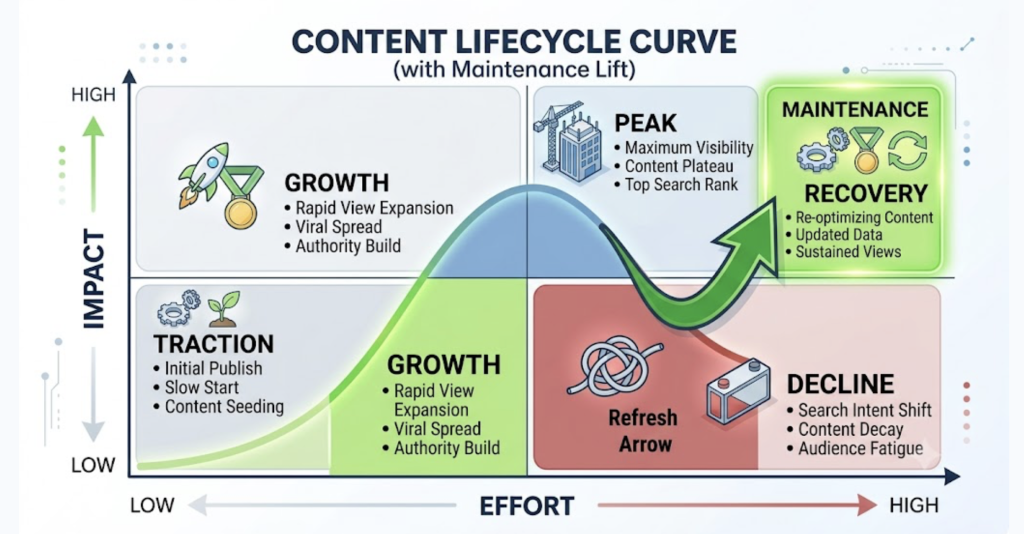
The reason it’s urgent is that content decay never stops. Pages lose roughly 1.21% of traffic per week on average, and sites typically shed 20% to 30% of organic clicks every six months. It isn’t a crash. It’s a slow leak you don’t notice until there’s a lot of water on the floor.
And the cliff is steep. Slipping from position 1 to position 2 can roughly halve your traffic, and dropping to around position 6 can shed about 90%. A few positions of drift is not a rounding error. It’s most of your traffic walking out the door while you’re busy writing the next post.
So how do you run this phase? Detection is mostly solved. Plenty of tools can flag a declining page for you. The hard part is the decision, and getting it wrong wastes budget or even costs you rankings. For each decaying page, triage it into one of four actions. Refresh it if the content is solid but dated. Rewrite it if reader expectations have changed entirely. Consolidate it with a competing page if they’re cannibalizing each other. Delete or redirect it if it has no traffic, no links, and no strategic value. On a refresh, never change the URL. That’s how you keep the equity you’re trying to protect.
A couple of things sharpen the prioritization. Pages sitting in positions 5 to 20 are the highest-ROI targets. They already hold authority and history, and they recover in weeks rather than the months new content needs to climb. Decay is also often cluster-based, not page-based. When one page in a topic cluster slips, the whole cluster may be losing authority, so look at the neighborhood, not just the one address.
This is exactly the work WordPattern is built for. It connects to your Google Search Console, watches thousands of articles for patterns of decline like losing a couple of positions a week, and then pinpoints the specific outdated paragraphs dragging a page down rather than rewriting the whole thing. The refreshes are surgical and human-in-the-loop, so this phase stops living in a neglected spreadsheet and starts running on its own.
Set your cadence by content type. Stats and data pages need a look monthly, comparison and “best of” pages quarterly, how-to guides roughly every six months, and foundational evergreen content once a year. And when you do refresh, make it real. Google folded its helpful-content evaluation into the core ranking systems, so flipping the publish date without changing the substance does nothing. Sometimes it does worse than nothing. Real refreshes update stats, realign to current search intent, and expand the sections where competitors have overtaken you on depth.
The payoff is worth the discipline. Well-executed refreshes recover 40% to 60% of lost traffic within about 60 days, with pre-decay positions often returning inside 90. Try getting that kind of return from a brand-new post that’s starting with no history at all.
A copy-able quarterly roadmap
Want the skeleton? Here’s a simple year you can adapt to your own pace.
Q1, Foundation. Technical audit and fixes, quick wins, and KPI baselines. Owner: SEO lead plus a developer for the technical items. Success metric: technical blockers cleared and a baseline dashboard live.
Q2, Content architecture. Keyword-to-cluster mapping, pillar pages, and a publishing calendar with named owners. The maintenance loop quietly starts here too, on your oldest pages. Metric: clusters mapped and first pillars shipped.
Q3, Authority and AI search. Link building, digital PR, and the AEO/GEO work of structured answers, entity clarity, and AI-citation tracking. Metric: new referring domains and AI-citation share.
Q4, Refresh sprint. Your first full content decay audit and a prioritized refresh sprint on the highest-ROI decaying pages. Metric: traffic recovered on the URLs you refreshed.
The calendar is a suggestion, not scripture. A team of one moves slower than a team of five, and that’s fine. The sequence is what matters. Get the foundation solid before you scale content, and start protecting pages the moment you have pages worth protecting.
Common roadmap mistakes
The big one: treating the roadmap as a one-time launch document. You build it, you drop it in a shared drive, and it rots there. A roadmap is a living plan you revisit every quarter, or it’s decoration.
Close behind is the all-new-content bias, where the whole budget goes into publishing while your best existing pages bleed out. Related to that is the cosmetic refresh, where someone bumps the date, changes nothing else, and calls it done. Google sees through that instantly.
Then there’s vanity measurement. If your roadmap’s KPIs don’t connect to revenue, leadership will eventually stop funding the work, no matter how green the dashboard looks. And the quiet killer: no owners and no cadence. A plan where nobody is accountable for anything is just a wish list with nice formatting.
Conclusion
The shift in thinking is small, but it changes everything. An SEO roadmap isn’t a plan for launching. It’s a system for maintaining. You sequence the build, meaning foundation, content, authority, and measurement, and then you keep the whole thing alive with a refresh loop that protects what you’ve already earned.
That’s where the compounding happens. New content plants seeds. Maintenance keeps the garden from going to weed while you plant more. Get both running on the same roadmap and organic search stops feeling like a treadmill and starts behaving like an asset that grows on its own.
FAQs
It’s a sequenced, time-bound plan that translates your SEO strategy into specific tasks, each with an owner, a deadline, and a success metric. It usually spans foundation work, content, authority building, measurement, and ongoing maintenance, organized by month or quarter so a whole team can follow it without constant meetings.
Strategy is the “what and why,” including your goals, target topics, and the bets you’re making. The roadmap is the “who, when, and how measured.” Strategy is the destination; the roadmap is the directions that get you there. You need both, and confusing one for the other is why a lot of plans stall.
Both. Plan a loose 12-month strategic envelope so everyone knows the direction, then plan tightly in 90-day cycles. Search changes too fast for a rigid annual plan, and a quarter is long enough to see whether your tactics are actually moving the numbers before you commit further.
Set the cadence by content type. Statistics and data pages roughly monthly, comparison and “best of” posts quarterly, how-to guides about every six months, and foundational evergreen pages once a year. Beyond the schedule, refresh any page right away when it shows decay signals like a sharp traffic drop or a clear ranking slide.
Pick five or six tied to business outcomes: organic traffic to key pages, keyword rankings, click-through rate, conversions, assisted revenue, and AI-citation status. Skip raw pageviews and impressions as headline metrics. They look impressive in a report and rarely tell you whether SEO is actually earning its keep.