
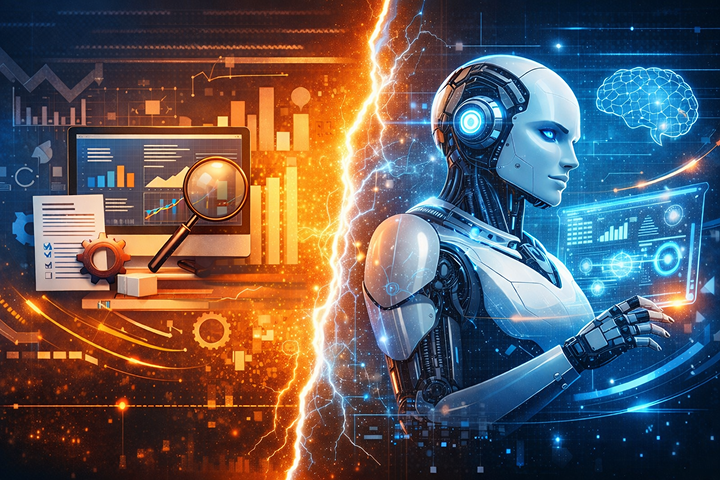
Search is no longer static. Rankings shift daily. Content loses momentum faster than most teams can react, and AI-driven search now rewards freshness, authority, and intent alignment in real time. Traditional SEO tools were built to monitor performance. They report what happened. But reporting isn’t intervention.
That gap is where agentic SEO workflows come in — systems that don’t just flag a problem but take the next step and execute the fix. As content portfolios scale into the thousands, manual refresh cycles can’t keep pace with ranking volatility. That’s what AI SEO agents solve.
In this guide, we’ll break down how AI SEO agents differ from traditional SEO tools and why proactive content decay detection and automated refresh workflows are becoming essential in 2026.
The Evolution of SEO: From Static Audits to Autonomous Optimization
For years, SEO revolved around periodic audits, keyword rankings, and backlink analysis. Teams ran crawls, exported spreadsheets, and fixed content by hand.
That model worked when search updates were slower, competition was lighter, and content volume was manageable.
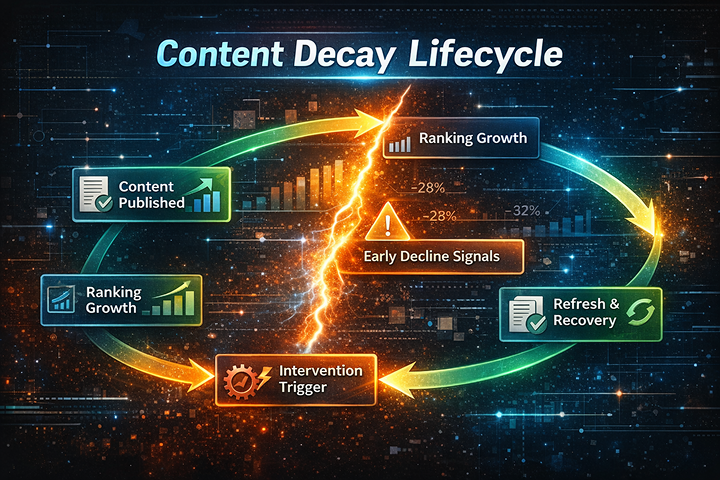
Not anymore. AI-powered results shift daily, SERP features eat organic visibility, and content lifespans keep shrinking. Ranking decay happens quietly, long before anyone notices the traffic dip.
There’s also a newer risk. As teams rushed to publish AI content at scale, Google started hitting low-effort, mass-produced pages with scaled AI content penalties, making it important for businesses to consider AI SEO cost alongside content quality and long-term search performance. The lesson isn’t “avoid AI” — it’s that strategy matters more than volume. Commodity spam gets punished; targeted, agent-driven optimization doesn’t.
So SEO is moving from periodic optimization to continuous optimization. Instead of checking dashboards weekly, brands need systems that spot decline patterns on their own and act before traffic drops. A Rankpage SEO Agency can use these continuous optimization approaches to identify ranking decay, monitor changing search patterns, and make data-driven improvements before organic traffic declines.
What Are AI SEO Agents?
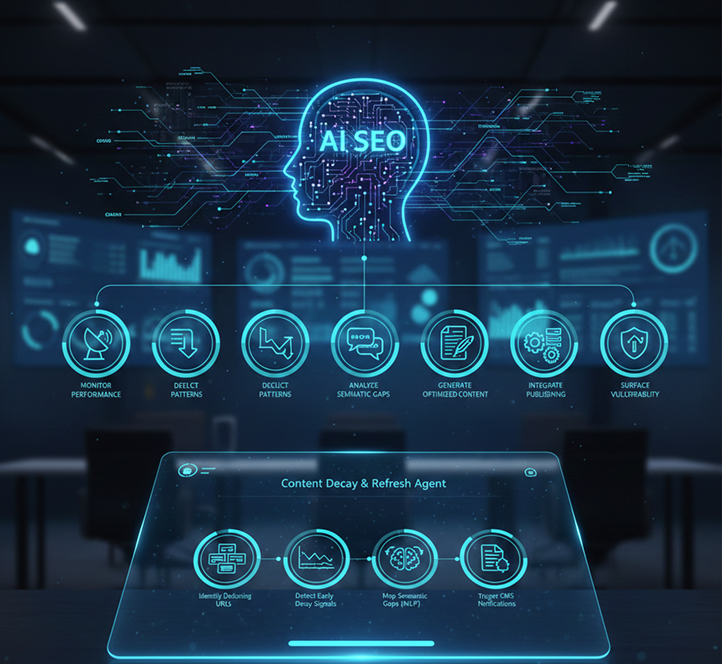
Where traditional tools diagnose, AI SEO agents act. They’re autonomous systems that run agentic SEO workflows — monitoring performance, catching ranking decline early, analyzing semantic gaps, and generating execution-ready drafts that plug into your CMS.
Take a Content Decay & Refresh Agent. It spots clusters of declining URLs, reads early decay signals across keyword groups, maps semantic gaps with NLP, and produces refreshed drafts aligned to intent — then pings your team inside the CMS.
The point: you catch vulnerability before it shows up in analytics, not after the traffic’s already gone.
SEO Tools vs. AI SEO Agents: Workflow Comparison
| Category | Traditional SEO Tools | AI SEO Agents |
|---|---|---|
| Monitoring | Scheduled audits and manual checks | Continuous real-time monitoring |
| Content Decay Detection | Identifies decline after traffic drops | Detects early decay signals before rankings collapse |
| Optimization Process | Human analyzes report and updates manually | Automated draft generation and refresh triggers |
| Keyword Strategy | Focused on ranking position tracking | Intent mapping and semantic NLP analysis |
| Data Usage | Historical dashboards and reports | Predictive analytics and pattern recognition |
| Workflow Integration | Operates in separate platforms | Integrates directly into CMS and publishing systems |
| Scalability | Monitoring scales, execution remains manual | Monitoring and execution both scale automatically |
| Response Time | Days or weeks to implement updates | Immediate intervention and refresh workflow activation |
| Enterprise Impact | Requires large teams for large sites | Supports thousands of pages without proportional team growth |
7 Critical Differences Between SEO Tools and AI SEO Agents
1. Reactive Reports vs. Proactive Content Intervention
Traditional tools alert you after rankings drop.
AI agents detect:
- Early impression decline
- SERP feature displacement
- Competitor content expansion
- Topic authority erosion
They recognize patterns of decline before revenue is impacted.
This proactive layer changes SEO from damage control to prevention.
2. Static Crawls vs. Real-Time Optimization
Most SEO tools operate on:
- Weekly crawls
- Manual refresh cycles
- Scheduled audits
AI SEO agents operate continuously.
They:
- Monitor ranking volatility
- Analyze search intent shifts
- Detect content freshness gaps
- Trigger updates dynamically
Real-time optimization matters because search engines now reward responsiveness.
3. Keyword Tracking vs. Intent Mapping and NLP Analysis
Traditional SEO focuses heavily on:
- Keyword density
- Ranking position
- Search volume
AI SEO agents incorporate:
- Natural language processing (NLP)
- Entity recognition
- Semantic topic modeling
- Intent classification
They don’t just track keywords. They understand content’s meaning.
This becomes especially important in answer-driven search ecosystems where semantic relevance outweighs exact match phrases.
4. Manual Updates vs. Automated Draft Generation
SEO tools identify issues. Humans fix them. Agents shorten that loop.
They generate updated headings, flag missing entities, tighten internal linking, and even handle schema markup generation — writing the structured data a page needs instead of leaving it on a developer’s to-do list. Each refresh draft is built around current SERP patterns.
Across thousands of URLs, that speed between detection and deployment is the whole advantage.
5. Historical Dashboards vs. Predictive Analytics
Most SEO tools show historical trends.
AI SEO agents analyze predictive signals such as:
- Gradual impression erosion
- Declining click-through rate trends
- Competitor content expansion velocity
- Shifts in query intent
Instead of asking, “What happened?”
You start asking, “What will decline next?”
Predictive decay modeling protects revenue-driving content before rankings collapse.
6. Tool Sprawl vs. Native Workflow Integration
Traditional SEO often requires:
- Rank tracker
- Technical audit tool
- Content optimization platform
- Analytics dashboard
- Project management system
AI agents consolidate workflows.
They can integrate directly into:
- CMS platforms
- Analytics tools
- Publishing pipelines
- Content management systems
This reduces friction and accelerates refresh cycles.
Cost, Scalability, and Operational Impact
Cost isn’t just subscription fees. It’s operational overhead.
Consider:
- Hours spent reviewing dashboards
- Manual refresh planning
- Revenue loss from unnoticed decay
- Team bottlenecks
AI SEO agents reduce:
- Time-to-refresh
- Manual intervention
- Lag between detection and action
For organizations managing large content portfolios, prevention delivers stronger ROI than post-decline recovery.
Conclusion
SEO used to be about growth. In 2026, protecting what you’ve already ranked matters just as much. Content lifespans are shrinking and volatility is up, so the brands that win won’t just publish more – they’ll detect decay early, refresh continuously, and defend their ranking equity. That’s the shift from static tools to autonomous agents: when rankings move faster than teams can react, prevention is the new growth.
FAQs
They analyze early signals like ranking drops, declining impressions, and intent shifts. By identifying patterns of decline, they enable content updates before traffic significantly decreases.
For large content portfolios, yes. AI SEO agents scale monitoring and refresh workflows automatically, while traditional tools rely on manual analysis and execution.
Traditional SEO tools focus on reporting. They track keyword rankings, analyze backlinks, and surface technical issues. However, they rely on manual execution to implement fixes.
AI SEO agents continuously monitor performance signals, detect patterns of content decay, analyze search intent shifts, and generate refresh-ready recommendations or drafts. Instead of simply diagnosing ranking drops, AI agents proactively intervene before traffic declines significantly.