

Artificial intelligence is transforming how businesses approach search engine optimization. AI-powered SEO agents can now perform keyword research, optimize content, analyze competitors, and even publish articles automatically. While this automation improves efficiency, it also creates a new challenge: how do you measure whether your AI SEO agent is actually delivering results? Many companies still rely on traditional metrics such as keyword rankings or impressions. However, modern search ecosystems increasingly rely on AI-powered search experiences, conversational answers, and recommendation engines. Because of this shift, evaluating performance requires a new framework built around AI SEO KPIs.
In this guide, you will learn how to audit your SEO agent effectively using a structured KPI framework. The article explains what AI SEO KPIs are, how to track them, and how to connect them to real business outcomes.
Why Measuring AI SEO Performance Is Different?
Traditional SEO focused primarily on ranking higher in search results. If a page ranked on the first page of search engines, traffic usually followed. Today, search behavior has evolved significantly.
Search engines increasingly display summarized answers, AI-generated responses, and zero-click results. As a result, users may find answers directly on the search page without visiting a website.
Because of this shift, measuring SEO success requires more than just rankings. Businesses must also track:
- Whether AI systems discover and crawl their content
- Whether AI platforms cite their content in answers
- Whether AI-driven search generates traffic or leads
Therefore, modern SEO audits must evaluate both traditional search performance and AI visibility metrics.
What Are AI SEO KPIs?
AI SEO KPIs are measurable metrics that help determine how effectively your SEO strategy performs within AI-driven search environments.
These KPIs evaluate performance across three important dimensions:
- Technical discoverability – whether AI systems can access your content
- Search visibility – whether AI engines reference or surface your content
- Business impact – whether AI visibility generates traffic, leads, or revenue
When businesses track these metrics together, they gain a clearer picture of whether their SEO automation actually contributes to growth.
The 4-Layer AI SEO KPI Framework
A structured KPI framework helps simplify the auditing process. The most effective frameworks divide performance metrics into four layers.
1. AI Discovery KPIs
The first layer focuses on whether AI systems can discover your content. If AI bots cannot crawl or interpret your pages, they cannot reference them in search responses.
Important discovery metrics include:
- AI bot crawl frequency
- AI bot fetch success rate
- Structured data coverage
- Indexable page ratio
Server logs can reveal whether AI crawlers such as GPT-related bots or other AI indexing systems regularly access your website. Increasing crawl frequency often signals stronger discoverability.
2. AI Visibility KPIs
After discovery comes visibility. This layer measures whether AI systems actually reference your content.
Key visibility metrics include:
- AI citation count
- AI-generated answer mentions
- AI share of voice for target topics
- Brand mentions in conversational search results
For example, if AI search tools frequently reference your content while answering questions about your industry, your AI visibility score improves significantly.
Tracking citations and mentions helps determine whether your content is considered authoritative by AI systems.

3. Search Performance KPIs
Although AI metrics are important, traditional search signals still carry real weight, and this is where your analytics stack does the heavy lifting. Google Search Console and GA4 together give you the four numbers that tell you whether your SEO agent is actually moving search performance.
Start with organic traffic. In GA4, track organic sessions month over month, then segment by landing page to see which of your agent’s optimized pages are pulling their weight. Organic sessions remain one of the strongest indicators of SEO performance because the metric reflects real user engagement, not just visibility.
Next, pull keyword ranking distribution and impressions from Google Search Console. Impressions tell you how often your pages surface in search; average position tells you where. Watched together in GSC, a rising impression count against a stable or improving average position is a clear signal your content is gaining ground.
Then connect the two with click-through rate. GSC reports CTR per query and per page, and it’s the metric that links visibility to actual clicks. A page climbing in impressions but flat in CTR usually points to a title or meta description your agent should revisit. If your SEO agent is optimizing effectively, organic sessions in GA4, impressions and average position in GSC, and click-through rate should all trend upward together over time.
4. Revenue and Conversion KPIs
The final layer focuses on business impact. SEO success ultimately depends on whether visibility converts into measurable outcomes.
Common conversion metrics include:
- AI referral traffic
- Lead generation from organic search
- Conversion rate from organic visitors
- Revenue attributed to SEO
By connecting visibility metrics to financial results, businesses can determine whether their AI SEO automation produces a positive return on investment.
Essential SEO KPIs: Branded vs Non-Branded Traffic
Here’s a number most dashboards hide: how much of your organic traffic is people already searching for you by name?
Branded traffic is anyone typing your company or product into search. Non-branded is everyone who found you through a problem, a question, or a category term — someone searching “how to track SEO ROI” rather than your brand. The split matters because only one of them proves your SEO is winning new demand.
Say organic sessions jump 30% this quarter. Looks great. But if that entire lift is branded searches — people who heard about you from a podcast, an ad, or a founder’s LinkedIn post — your SEO agent didn’t earn it. Your marketing team did. Non-branded growth is the honest measure of whether your content is pulling in people who didn’t know you existed yet.
You can pull this split straight from Google Search Console. Open the Performance report, add a query filter, and separate searches that contain your brand name from those that don’t. Watch the two lines over time. Non-branded climbing steadily? Your content strategy is working. Branded doing all the lifting while non-branded stays flat? Your agent is optimizing pages nobody new is finding.
This one view reframes almost every other metric. A CTR bump on branded queries means little — those people were always going to click. The same bump on non-branded queries means your titles are winning strangers. Keep them separate and every downstream number gets more trustworthy.
Technical SEO Auditing for SEO Agencies
Before an agency tracks a single visibility KPI, it runs a technical audit. There’s a reason for the order.
You can’t fairly measure whether an SEO agent is improving visibility if crawlers can’t reach half the site to begin with. Broken canonical tags, orphaned pages, bloated page weight, missing structured data — these quietly cap performance no matter how good the content is. So the audit comes first, and it becomes the baseline everything else gets measured against.
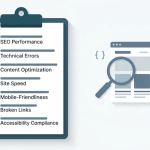
A technical audit usually checks a handful of things. Can crawlers and AI bots actually fetch the pages? Are important URLs indexable, or are they blocked by a stray noindex or robots rule? Is structured data present and valid, so search engines and AI systems understand what each page is about? How fast do pages load, and do they pass Core Web Vitals? A crawler tool handles the site-wide sweep; Google Search Console’s Pages and Crawl Stats reports confirm what Google actually sees.
For an agency managing a dozen clients, this baseline is also how you set honest expectations. If a new client’s site has 40% of its pages non-indexable, you know the first month’s job is cleanup, not ranking gains.This is especially useful for niche businesses using a p2p rental script, where technical SEO helps rental pages get discovered and indexed. You measure the fix — indexable page ratio climbing, crawl errors dropping — and only then do the visibility KPIs mean anything. Skip the audit and you’ll spend three months wondering why great content isn’t ranking, when the real answer was a misconfigured tag the whole time.
Tracking Domain Authority and Backlink Metrics
Content gets you into the game. Links are still a big part of how you win it — and an SEO agent that never earns any is capped no matter how good its writing gets.
Two backlink numbers are worth watching closely. The first is backlink velocity, the rate at which you gain (or lose) links over time. A slow, steady gain reads as natural and healthy. A sudden spike of hundreds of links can look manipulative and sometimes does more harm than good. The second is referring domain authority — not how many links you have, but how trustworthy the sites sending them are. Ten links from respected industry publications beat a thousand from scraped directories, every time.
You’ll track both in Ahrefs or Semrush. Both report your referring domain count, the authority score of each linking site, and how your link profile moves week to week. Ahrefs’ Domain Rating and Semrush’s Authority Score are the usual shorthand — imperfect, since neither is a Google metric, but useful for spotting trend direction and sizing yourself against competitors.
The trap is treating domain authority as a goal instead of a signal. It’s a third-party estimate, not something Google publishes. Chase the score directly and you’ll waste budget on links that move a vanity number without moving rankings. Watch it as one input among several — velocity, referring domain quality, and whether new links actually correlate with ranking gains — and it earns its place in the audit.
Building an Automated SEO Dashboard
Once your goals map to KPIs, the numbers need to live in one place. Chasing them across four tabs every Monday is how metrics get ignored — and how problems compound before anyone notices. A single dashboard fixes that, and the most reliable ones tie every metric back to the tool that reports it, so the data stays verifiable.
- Start with technical metrics. Track crawl rate and index coverage straight from Google Search Console’s Pages and Crawl Stats reports, and pull page speed from GA4 or PageSpeed Insights. These tell you whether AI systems and search crawlers can even reach your content.
- Next, layer in visibility. Alongside AI citation count and brand mentions, bring in impressions and topic share of voice — impressions come from Google Search Console, share of voice from a rank tracker like Ahrefs or Semrush. This layer shows whether your content is surfacing, in both traditional search and AI answers.
- Then add traffic. Organic sessions, keyword rankings, and click-through rate form the core: GA4 handles sessions, Google Search Console handles rankings and CTR. Reviewing them side by side keeps ranking movement and real traffic in one view, so a drop in one immediately flags the other.
- Finally, tie in revenue. Track leads, conversions, and SEO-driven revenue in GA4 using conversion events mapped to your organic channel. Connecting GA4 conversion data back to organic sessions is what turns a reporting screen into a genuine ROI measure.
A dashboard built this way — GA4 for sessions and conversions, Google Search Console for impressions, rankings, and CTR, a rank tracker for share of voice, and your backlink tool for referring domains — lets you read every KPI layer at a glance. Then review it on a regular cadence. Monthly works for most teams. Positive movement across several metrics at once is the clearest sign your SEO agent is doing its job.
Tools That Help Track AI SEO KPIs
The right stack makes all of this far simpler, and most teams lean on three tool types working together.
For core search analytics, Google Search Console reports impressions, CTR, and average position by query and page, while GA4 tracks organic sessions and conversions. Add a rank tracker like Ahrefs or Semrush for keyword rankings, share of voice, and backlink data, and you’ve covered most of your traffic and performance KPIs.
For AI visibility, dedicated tools measure how often AI platforms cite your content and mention your brand in conversational answers — the metrics traditional analytics can’t yet see.
For technical auditing, crawlers handle site crawl analysis, structured data validation, and indexability checks, surfacing the issues that stop AI systems and search engines from reaching you in the first place.
The Future of AI SEO Measurement
AI search keeps shifting, and measurement will follow. AI citation tracking is on its way to becoming a core KPI, cross-platform visibility monitoring is growing, and attribution models are getting better at tracing AI discovery. The winning strategies will pair traditional metrics with AI visibility signals rather than betting everything on one or the other.
In the future, successful SEO strategies will combine traditional metrics with AI visibility indicators to measure overall performance.
Conclusion
AI-powered SEO agents can dramatically accelerate content creation, optimization, and search analysis. However, automation alone does not guarantee results.
A structured KPI framework ensures that your SEO efforts produce measurable outcomes.
By tracking AI discovery, visibility, search performance, and revenue metrics, businesses can accurately evaluate whether their SEO agents contribute to sustainable growth.
Organizations that adopt strong AI SEO KPI frameworks will gain a major competitive advantage as search continues evolving toward AI-driven experiences.