

Here’s a number that should bother you: most content bleeds somewhere between 20% and 30% of its organic clicks every six months. Not because it was bad. Because the web moved and the page sat still.
That’s the part the usual topical authority advice leaves out. You’ll read a dozen guides that treat authority like a trophy — win it once, stick it on a shelf, done. It isn’t a trophy. It’s a position. And positions get taken.
So let’s do both halves. How to build topical authority properly. Then the harder part almost nobody writes about: how to keep it from rotting out from under you.
Topical authority is when search engines treat your site as the go-to expert on a subject. Not for one keyword. For the whole spread of questions people ask around that topic.
You earn it by covering a subject completely and wiring that content together so Google can see how the pieces relate. One post about email deliverability doesn’t make you an authority on email marketing. But fifteen connected posts covering segmentation, spam filters, domain warm-up, list hygiene, and re-engagement? Now you’re getting somewhere.
It’s tied closely to E-E-A-T — Google’s framework for Experience, Expertise, Authoritativeness, and Trustworthiness — except applied to a specific topic instead of your whole site. Deep subtopic coverage is how you signal that expertise at scale. The more thoroughly you answer every angle of a subject, the more Google trusts you with the next query it’s never seen you rank for. That trust is the whole prize. It’s what lets a page rank for hundreds of related terms you never wrote a single sentence targeting.
People mix these two up constantly. They’re not the same thing.
Domain authority (or Domain Rating, depending on your tool) is roughly a measure of your whole site’s backlink strength. Site-wide. One number for everything. Topical authority is subject-specific — how deeply you cover one thing.
Why does the gap matter? Because it’s the reason a tiny site can beat a giant. A specialist retailer with a handful of backlinks can outrank Amazon on a narrow niche, just by covering that niche more completely than a sprawling generalist ever bothers to. Entity SEO plays into this: when your whole site maps cleanly to one topic, search engines have an easy time associating you with it. A generalist sending mixed signals across forty unrelated categories doesn’t get that clarity.
Good news if you’re small or new. You can’t buy your way to a decade of domain age or a fat link profile overnight. But you can out-cover a bigger competitor on a focused topic. That part’s within your control starting today.
Three reasons. The third one changed the game.
First, coverage compounds. Once Google connects your site to a topic, it starts ranking you for related searches you never explicitly optimized for. Every new post in the cluster borrows a little credibility from the ones already around it. Ten posts don’t perform like ten separate pages — they perform like a neighborhood.
Second, resilience. Since March 2024, Google’s Helpful Content system stopped being a separate event and got folded into the core algorithm, running nonstop and grading your whole site rather than page by page. Google said the changes rolling out then would cut unhelpful content by around 40%. Sites with real topical depth mostly rode those updates out. The shallow, scattered ones took the hit.
Third — the new one — AI search. Whether an LLM cites you in an answer leans heavily on whether it already sees you as a trusted source on the subject. And that’s getting more important by the quarter. Gartner has predicted search query volume could drop by roughly 25% by 2026 as people move to AI assistants. Semantic SEO isn’t a nice-to-have when the answer box is quietly eating the clicks. Authority is how you stay inside the answer instead of underneath it.
This is the part every guide covers, so I’ll keep it tight. Four moves.
Do topic-based keyword research
Start by finding every talking point inside your topic – not just the head term. Want to own “content marketing”? One post on “content marketing” won’t do it. You need the questions, the comparisons, the how-tos, the awkward edge cases nobody else answered well.
Pick a seed keyword that’s specific enough to stay focused but broad enough to have real subtopics under it. “Dog care” is a good seed. “Animals” is too broad – it’ll pull in zoos and wildlife and pet insurance. “How to trim a beagle’s nails” is too narrow to hang a whole cluster on. Aim for the middle.
Organize into topic clusters
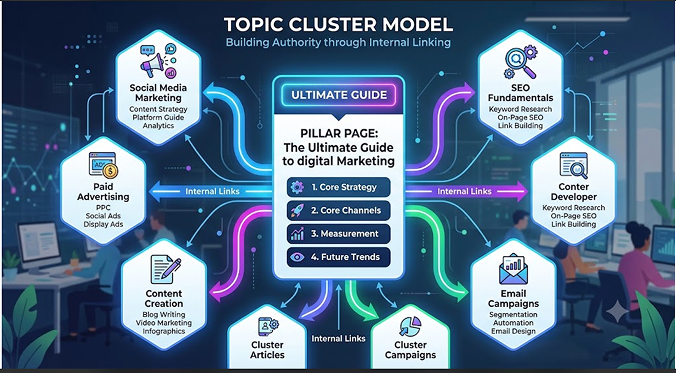
Group your keywords by search intent into topic clusters — sets of pages that hit a subject from every angle. This is the step that turns scattered blogging into a strategy. Each cluster is basically a promise to Google: we cover this, and we cover it thoroughly. A “spam filters” cluster, a “list segmentation” cluster, a “deliverability testing” cluster, each with its own supporting posts.
Build pillar pages and content hubs
Give each cluster a pillar page that covers the broad topic head-on, then cluster articles that go deep on each subtopic. Together they form content hubs — tight neighborhoods of related content that all point at each other. The pillar catches the broad, high-volume term. The cluster posts catch the long tail and funnel authority back up to the pillar. Miss the pillar and your deep posts float around unanchored. Miss the cluster posts and your pillar has nothing backing up its claim to expertise.
Connect it with internal links
Internal links are the wiring. They show search engines how your pillar pages and subtopic content relate, turning a pile of posts into a readable map. A cluster post on “email warm-up” should link up to the deliverability pillar and sideways to related posts on sender reputation.
Don’t confuse volume with depth while you’re at it. One analysis of 847 pages hit by a Google update found word count didn’t predict recovery at all — the pages that bounced back averaged about 1,400 words, while the ones that stayed down averaged 1,650. Density and structure beat padding. Every time.
Now the part the top-ranking guides wave past in a single bullet.
You build a gorgeous cluster. It ranks. And then, slowly, it starts to leak.
Competitors are the obvious culprit. Animalz has a name for the pattern — copycat content. A rival studies your best page, clones the structure, matches your depth, adds fresher data, and grinds down your ranking through sheer volume. Every ranking you hold is one somebody else is actively trying to take.
Then there’s aging, which is sneakier. Your stats get old. Search intent drifts. New subtopics appear that your cluster never covered, so holes open where you used to be complete. A guide that perfectly matched what searchers wanted in 2023 can quietly miss the mark by 2026 without a single word changing on the page. None of this sets off an alarm.
And the math turns brutal the moment slippage starts. Dropping from position #1 to #2 can cut your traffic roughly in half. Sliding to the bottom of page one can cost up to 90% of your clicks. Small ranking moves, huge traffic swings.
AI search speeds all of it up. Answer engines lean hard toward fresh sources — AI-cited URLs run about 25.7% fresher on average, and ChatGPT tends to cite pages hundreds of days newer than what ranks organically. Stand still now and you don’t just lose rankings. You lose citations too.
How to detect cluster decay early
You can’t refresh what you can’t see. So the real skill is catching decay while it’s still a leak, not a flood.
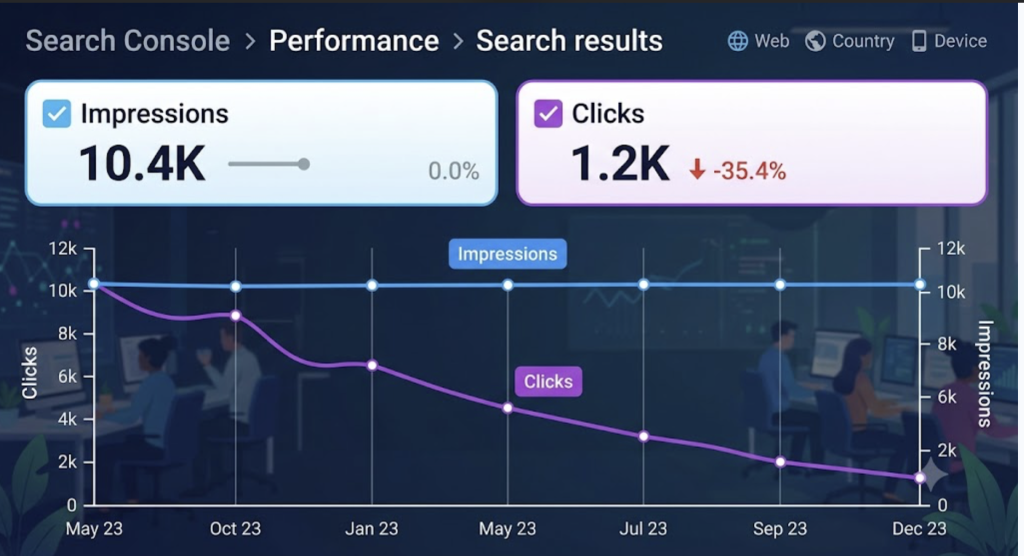
Watch leading indicators, not lagging ones. The classic early tell: clicks trending down while impressions hold flat or even rise. Translation — you’re still showing up, just lower. It’s CTR and position erosion in slow motion, and it starts long before the traffic chart looks scary.
Set thresholds so you’re not squinting at charts forever. A workable rule of thumb: flag any page with a 15–20% or larger traffic drop over 90 days, or an average position slipping three or more spots over six months. Those are your tripwires.
There’s also coverage-gap decay, which no standard dashboard shows you — the subtopics your cluster is missing because the topic itself evolved after you published. Your pages didn’t get worse. The definition of “complete” got bigger, and you didn’t move with it.
And track two curves, not one. Organic traffic is the first. AI citations are the second. A page can hold its Google rankings while quietly disappearing from AI answers, and that’s a different problem needing a different fix. Most teams only watch the first curve and never notice the second one draining.
A worked example: one cluster, two 90-day windows
Thresholds are easy to agree with and harder to apply, so here’s what this looks like on an actual export. The numbers below are illustrative: a composite cluster built to show the method, not a client’s data. The arithmetic is exactly what you’d run on your own Search Console pages report.
Take the email deliverability cluster from earlier: one pillar and four supporting posts. Pull clicks and impressions for the last 90 days and the 90 days before. Then compare each page’s average position now with where it sat six months ago.
| Page | Clicks (prior 90d → last 90d) | Clicks change | Impressions (prior → last) | Avg. position (6 mo ago → now) |
|---|---|---|---|---|
| Deliverability pillar | 2,400 → 2,280 | −5.0% | 61,000 → 62,500 | 3.1 → 3.4 |
| Spam filters | 1,150 → 890 | −22.6% | 38,000 → 39,200 | 4.2 → 7.6 |
| List hygiene | 410 → 330 | −19.5% | 12,800 → 10,100 | 6.1 → 6.4 |
| Domain warm-up | 640 → 590 | −7.8% | 15,500 → 15,100 | 5.0 → 5.6 |
| Re-engagement | 280 → 295 | +5.4% | 16,400 → 16,700 | 7.2 → 6.9 |
Run that against the tripwires and three different stories fall out.
The spam filters post is textbook displacement. Clicks are down 22.6% while impressions are up 3.2%, and average position slid 3.4 spots. It trips both thresholds. CTR tells the same story, falling from 3.0% to 2.3%. Searchers still see the page; they just see something above it first. That’s your refresh, and it goes first.
The list hygiene post also crosses the 15% line, with clicks down 19.5%. But impressions fell 21.1%, position barely moved, and CTR held at about 3.2%. You didn’t lose your spot. Fewer people are searching. Rewriting this page won’t win those clicks back. Check whether demand moved to different phrasing before you touch a word.
Domain warm-up is down 7.8%. That’s under threshold. Watch it, don’t touch it.
The third story is the one no per-page dashboard shows. Filter the cluster’s queries and you’ll find a batch of searches about the bulk-sender authentication rules Gmail and Yahoo tightened in 2024. Together they drew 4,700 impressions, landing on the pillar at an average position of 18.2. No page in the cluster actually answers them. That’s coverage-gap decay. The fix isn’t a refresh. It’s a new cluster post, linked up to the pillar and across to spam filters.
One cluster, one export, three different actions: refresh, investigate, build. That’s why “traffic is down” is never a diagnosis on its own.
Doing that for one cluster is manageable in a spreadsheet. Doing it across every cluster, every quarter, is where teams quietly give up. That’s the job WordPattern was built for: it watches your content for these decay signals and flags the pages slipping before the traffic’s gone. Its topical authority analysis goes a layer up. It maps which subtopics each cluster covers, where the gaps are, and which pages overlap, so the refresh-or-build call from the example above comes from your Search Console data instead of a guess.
Found a decaying page? Refresh it. Don’t rebuild from scratch, and please don’t just delete it.
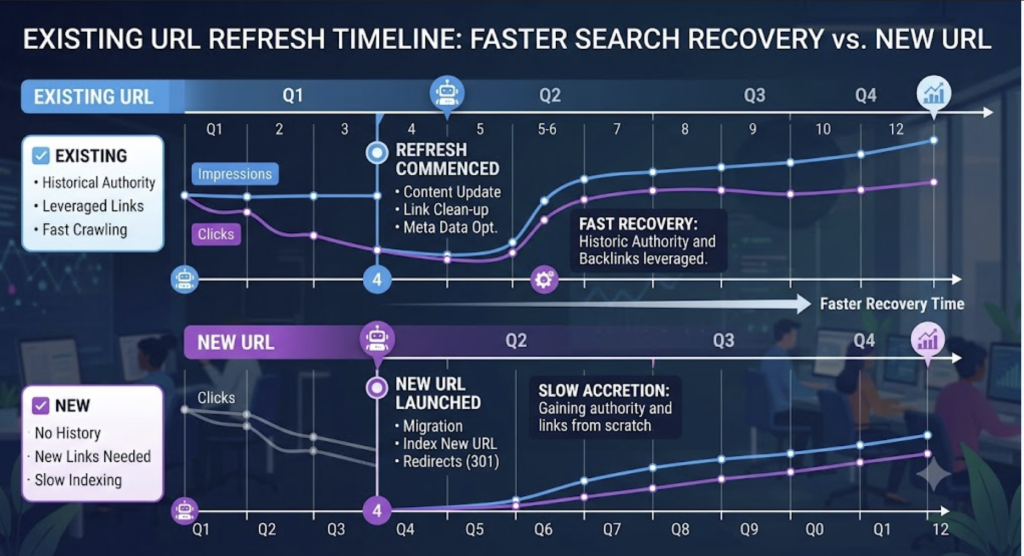
Refreshing an existing URL beats publishing new almost every time, because the page already carries its authority and its backlinks. Improvements often show up within two to four weeks of re-indexing, against the three to six months a brand-new page usually needs to climb. You’re nudging something that already has momentum, not pushing a boulder uphill.
Make it a habit, not a panic. Quarterly refreshes beat annual updates by about 42% in one playbook’s data, and a rough 70/30 split of new-to-refreshed content keeps you out of the build-and-forget trap.
When you do refresh, actually improve the thing. A quick checklist:
- Update the aging stats — but don’t just swap in this year’s version of the same number. Add a data point that didn’t exist last time. That’s information gain, and Google rewards it.
- Fix stale external links. A citation pointing at a 2023 study that’s since been superseded undercuts you with readers and AI systems both.
- Fill the coverage gap. Refresh the cluster, not just the page. Add the subtopics that appeared after you first hit publish.
- Keep the URL. Always. Changing it throws away the authority you’re trying to protect.
And prune the dead weight. One documented recovery removed about 38% of thin, near-duplicate editorial content and pushed internal links toward the pages worth keeping. Fewer, stronger pages beat a bloated archive that dilutes the whole cluster. And when you do have refresh time, start with your top earners — the pages with the most traffic to lose.
A few traps worth naming out loud.
Chasing word count. Longer doesn’t read as more authoritative — remember that 847-page finding, where the recovered pages were actually shorter on average. Padding a post to hit some arbitrary length just buries the useful parts.
Topical overreach. Publishing outside your niche to chase a trend dilutes the whole site. Since the Helpful Content signal is site-wide, a stack of off-topic filler can drag down the pages you actually care about. Stay in your lane — that’s where your authority lives.
Build-and-forget. If all your effort goes to new posts and none to maintenance, decay wins by default. Prevention is cheaper than recovery, and recovery is far from a sure thing. Of roughly 400 sites hit by one major update, only about 22% climbed back 20% or more. Most saw little or nothing. You do not want to be relying on that coin flip.
[CTA-BOX] Title: Stop losing authority you already earned Subtitle: See which of your pages are decaying right now Button: Start free Link: https://wordpattern.org/ [/CTA-BOX]
Bottom line
Building topical authority is the entry fee. Defending it is the actual game.
The teams that win the next few years won’t be the ones publishing the most. They’ll be the ones that cover a topic completely, then keep that coverage current while everyone else’s clusters quietly rot. As AI search keeps raising the freshness bar, that maintenance edge only gets sharper. Build the cluster. Then guard it.
FAQs
Usually a few months at the very least, often six to twelve. It depends on how competitive the topic is and how consistently you publish connected content. There’s no overnight version, sorry. The payoff: once a cluster gains traction, new posts inside it tend to rank faster, because they inherit the authority already built up around them.
Yes — and it’s often your best shot. Topical authority is subject-specific, not size-specific. You can’t out-domain a giant on day one, but you can out-cover them on a tight niche. Pick something narrow enough to actually own, then cover it more completely than anyone bigger can be bothered to.
Not a single named factor you can point at in the algorithm. It’s more of an outcome — the result of coverage, E-E-A-T signals, internal linking, and semantic relevance all lining up at once. Google doesn’t publish a “topical authority score,” but the behaviors that build it line up consistently with better rankings.
Quarterly is a solid default for your important pages, since quarterly refreshes have beaten annual ones. But let the data steer it. Set your decay thresholds and refresh a page the moment it crosses one, rather than waiting on a calendar date while the traffic quietly drains out.