

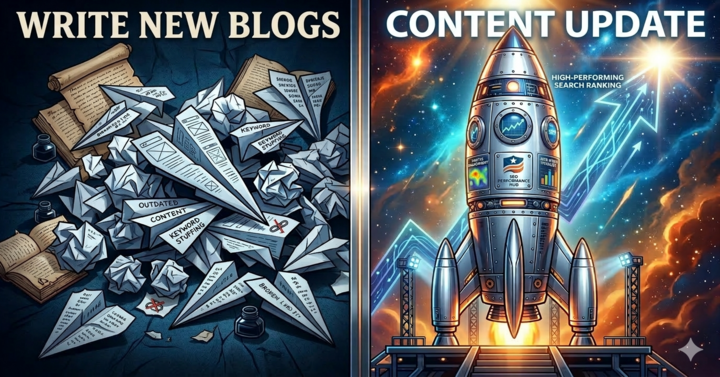
By prioritizing the optimization of your top 100 posts, you can harness the power of search engine algorithms and user engagement metrics to drive organic traffic and maximize the potential of your content library. This approach not only saves time and resources but also ensures that your content remains relevant and competitive in an ever-evolving digital landscape.
As we delve deeper into the rationale behind updating top posts versus creating new ones, it becomes evident that quality and relevance are key factors in achieving long-term success.
The “Content Treadmill” vs. The “Asset Growth” Model
Why 90% of new blog posts fail to gain traction in year one
When it comes to the world of blogging, the age-old debate between the “Content Treadmill” and the “Asset Growth” model continues to spark discussions. Many bloggers fall into the trap of constantly churning out new content, hoping that each post will be a hit. However, statistics reveal that a staggering 90% of new blog posts fail to gain traction within their first year.
The compounding ROI of “Historical Optimization.”
So, what sets the “Asset Growth” model apart from the “Content Treadmill”? The answer lies in the concept of “Historical Optimization.” Instead of solely focusing on creating new content, bloggers who follow the “Asset Growth” model understand the compounding ROI of refreshing old posts.
Data Study: How refreshing old content can double traffic in 60 days
Imagine this scenario: you have a blog with 1,000 posts, but only a handful are driving significant traffic. Instead of writing 1,000 new posts, focusing on updating your top 100 posts can yield far better results. By implementing “Historical Optimization” techniques, such as updating outdated information, improving SEO, and enhancing readability, you can breathe new life into existing content.
The key takeaway here is that quality trumps quantity. By strategically updating and optimizing your top-performing posts, you can not only maintain their relevance but also attract more organic traffic over time. This data-driven approach has been proven to double traffic within a mere 60 days, showcasing the power of maximizing the potential of your existing assets.
Why Google (and AI) Prioritize “Freshness” Over Volume
When it comes to SEO and ranking on search engines like Google, the focus has shifted towards prioritizing “freshness” over sheer volume of content. This change in algorithm signals a shift towards providing users with the most relevant and up-to-date information.
How “Content Decay” kills your rankings while you’re busy writing new drafts
“Content Decay” is a concept that highlights how older content can lose its relevance and impact on search rankings over time. This phenomenon underscores the importance of updating existing posts rather than constantly churning out new ones.
The 2026 Freshness Signal: Why LLMs cite updated data over “New” thin content
In 2026, Google’s Freshness Signal is expected to play an even more crucial role in determining search rankings. This means that search engines will increasingly favor content that is regularly updated and reflects the most recent data available.
The “Authority Trap”: Why 1,000 low-performing posts actually hurt your site’s health
The idea of the “Authority Trap” warns against having numerous low-performing posts on your site. Instead of focusing on quantity, it is essential to concentrate on quality and ensure that your top 100 posts are consistently updated and optimized for better performance.
The 80/20 Rule of Blog Traffic
The 80/20 Rule of Blog Traffic is a game-changer for content creators.
Identifying your “Unicorn” posts (The Top 100 that drive 80% of results)
By identifying your “Unicorn” posts, the top 100 that drive 80% of results, you can maximize your blog’s impact with minimal effort. Instead of starting from scratch, updating these top-performing posts is not only more cost-effective but also yields better results.
When it comes to blog traffic, focusing on the top-performing 20% of your content can lead to significant improvements. These “Unicorn” posts are the ones that resonate the most with your audience and drive the majority of your results. By identifying and updating them regularly, you can maintain their relevance and continue to attract traffic over time.
Why it’s 50% cheaper to update than to start from scratch
Updating your top 100 posts is 50% cheaper than creating new content from scratch. This cost-effective strategy allows you to leverage the success of your existing posts and drive even more traffic to your blog. By investing time and resources into updating these posts, you can see a higher return on investment compared to constantly churning out new content.
The psychology of the “Updated” timestamp on Click-Through Rates (CTR)
The psychology behind the “Updated” timestamp on Click-Through Rates (CTR) is fascinating. By indicating that a post has been recently updated, you signal to your audience that the content is current and relevant. This can lead to higher CTRs as users are more likely to click on content that appears up-to-date and valuable.
In conclusion, focusing on updating your top 100 posts can be a more strategic approach than constantly creating new content. By leveraging the 80/20 rule of blog traffic and understanding the psychology behind updated timestamps, you can drive more traffic to your blog and maximize your results.
How to Audit Your Content Library for Update Potential

To audit your content library effectively for update potential, it’s crucial to categorize your existing posts into different tiers based on their performance and relevance. By segmenting your content in this way, you can prioritize the pieces that are most in need of updates and improvements.
Tier 1: The “Falling Stars” (High traffic, declining rankings)
In Tier 1, you’ll identify posts that once shone brightly with high traffic but are now experiencing a decline in rankings. These “Falling Stars” are valuable assets that have the potential to regain their former glory with strategic updates. By refreshing the content, optimizing keywords, and adding up-to-date information, you can revitalize these posts and boost their visibility in search engine results.
Tier 2: The “Almost Winners” (Ranking on page 2 or 3)
Posts in Tier 2, the “Almost Winners,” are just a step away from reaching the top positions in search results. These posts have already demonstrated their relevance but need a little push to break into the coveted first-page rankings. By analyzing the competition, refining the content structure, and enhancing user experience, you can elevate these posts to the top spots and increase organic traffic.
Tier 3: The “Outdated Authorities” (Ranked #1 but contains 2-year-old stats)
Even though posts in Tier 3 are currently holding the top position in search results, their success might be short-lived if they contain outdated information. These “Outdated Authorities” need immediate attention to maintain their credibility and relevance. By conducting thorough research, updating statistics, refreshing visuals, and adding new insights, you can ensure that these posts remain valuable resources for your audience.
The Step-by-Step “Power Refresh” Framework:
The Step-by-Step “Power Refresh” Framework:
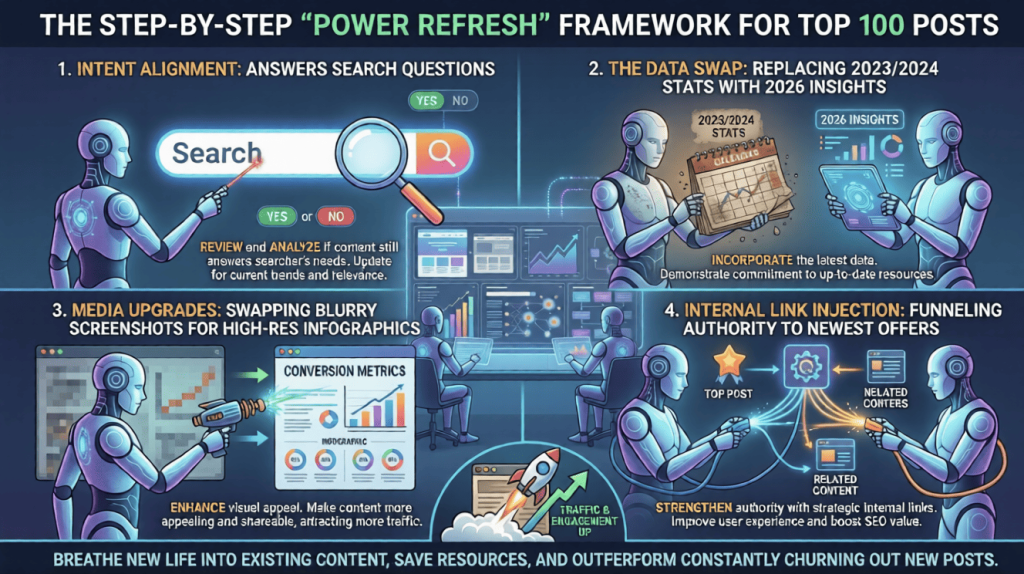
1. Intent Alignment: Does this still answer the searcher’s question
When refreshing your top 100 posts, the key is to ensure that they still align with what searchers are looking for. Take the time to review and analyze if the content still answers the searcher’s questions effectively. By updating the content to reflect current trends and needs, you enhance its relevance and visibility in search results.
2. The Data Swap: Replacing 2023/2024 stats with 2026 insights
One of the critical steps in revitalizing your top posts is to replace outdated statistics with fresh insights from 2026. By incorporating the latest data and information, you not only make the content more accurate and trustworthy but also demonstrate your commitment to providing up-to-date resources for your audience.
3. Media Upgrades: Swapping blurry screenshots for high-res infographics
Enhancing the visual appeal of your top posts can significantly impact user engagement. Swap out any blurry screenshots with high-resolution infographics or images that better illustrate your points. By improving the visual elements of your content, you make it more appealing and shareable, attracting more traffic to your site.
Strengthen the authority of your top posts by strategically injecting internal links to your newest offers or related content. By creating a network of interconnected resources within your site, you not only improve the user experience by guiding readers to more valuable information but also boost the SEO value of your top posts.
By following the step-by-step “Power Refresh” framework outlined above, you can breathe new life into your top 100 posts and outperform the strategy of constantly churning out new content. Updating and optimizing your existing posts not only saves time and resources but also maximizes the impact of your content efforts, driving more traffic and engagement to your site.
Common Pitfalls: How Not to Break Your Rankings
When it comes to maintaining your website’s rankings, there are several common pitfalls that you need to be aware of.
The “URL Rule”: Why you should rarely change your permalink
One crucial aspect is the “URL Rule.” It’s highly recommended to rarely change your permalink structure once your content is indexed. Altering URLs can lead to broken links, loss of backlinks, and a drop in search engine rankings. Therefore, it’s essential to plan your URL structure carefully from the outset.
Maintaining keyword density while improving “Helpful Content” scores
Another key factor in SEO is maintaining keyword density while improving your “Helpful Content” scores. It’s vital to strike a balance between incorporating relevant keywords naturally throughout your content and providing valuable information to your readers. Overstuffing keywords can harm user experience and lead to penalties from search engines. Focus on creating high-quality content that addresses user intent while strategically placing keywords for optimization.
When to “Prune” (delete) instead of “Refresh.”
Knowing when to “Prune” (delete) instead of “Refresh” is also critical for SEO success. While updating and refreshing existing content is beneficial, there are instances where certain posts may no longer serve a purpose or align with your current SEO strategy. In such cases, it’s better to prune outdated or irrelevant content to maintain a clean and authoritative website. Deleting low-performing posts can help search engines better understand and prioritize your valuable content.
Conclusion: Quality is the Only Scale That Matters
In the world of content marketing, it’s crucial to understand that quality reigns supreme.
Shifting your budget from “Content Creation” to “Content Curation.”
The focus should be on enhancing existing content rather than constantly churning out new pieces. This shift from “Content Creation” to “Content Curation” is where the real magic happens.
When you prioritize updating your top-performing posts, you’re investing in what already works. This not only saves time and resources but also improves the overall quality of your content. By fine-tuning and refreshing your top 100 posts, you can ensure that they remain relevant and engaging for your audience, as Foosun Moving’s blog is the best case.
Finding your “Content Refresh” rhythm (Quarterly vs. Annual)
Finding the right rhythm for your content refresh strategy is key. Whether you opt for a quarterly or annual update schedule depends on various factors such as industry trends, audience engagement, and resource availability. Experimenting with different frequencies can help you determine what works best for your brand.
By focusing on quality and strategic content updates, you can achieve greater impact with fewer resources. Remember, it’s not about the quantity of content you produce but the quality that truly matters in the end. So, shift your budget, find your refresh rhythm, and watch your content strategy soar to new heights.
Frequently Asked Questions
Updating your top 100 posts is crucial because these are already proven performers. By refreshing them with new information, keywords, and optimizing for SEO, you can leverage their existing authority and drive more traffic. In contrast, creating 1,000 new posts might not guarantee the same level of engagement or visibility.
The frequency of updating your top posts can vary based on several factors, such as industry trends, search engine algorithms, and audience preferences. It’s recommended to review and refresh your top posts at least once every few months to ensure they remain relevant and competitive in search rankings.
Updating your top posts offers several advantages, including improved SEO performance, increased organic traffic, enhanced user experience, and higher conversion rates. By keeping your content up-to-date and valuable, you can attract more visitors and retain existing readers.
Instead of deleting underperforming posts, consider updating them to enhance their quality and relevance. By revising the content, optimizing keywords, improving visuals, and adding new insights, you can potentially revive these posts and boost their performance over time.
Tracking metrics such as organic traffic, bounce rates, time on page, keyword rankings, and conversion rates can help you assess the impact of updating your top posts. Use tools like Google Analytics and SEO software to monitor the changes and make data-driven decisions for your content strategy.