
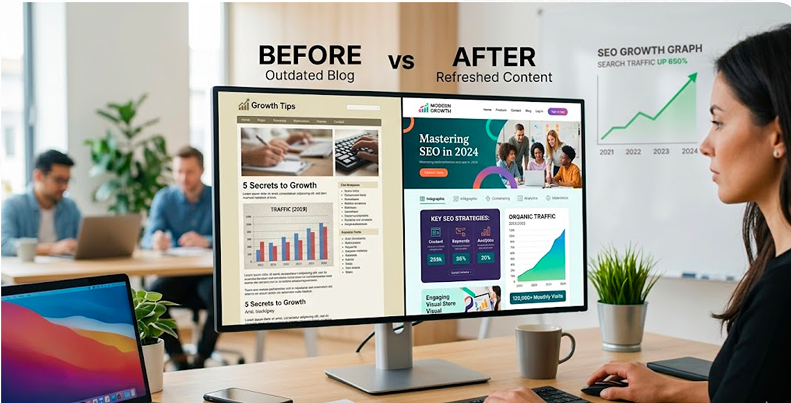
Updating old content is one of the smartest moves you can make for SEO.
It’s more efficient than creating something new from scratch, it builds from existing authority, and it can help you drive more traffic to your site. In fact, a study from Hubspot shows that optimizing old content can increase monthly search views by up to a whopping 106%.
So indeed, updating your content is a real game-changer.
However, what most marketers miss when updating is the visuals. They update the words, the numbers, the links – but not how they were all presented.
And that’s a huge problem. Because in today’s landscape, how your content visually looks is as important as what it says.
Let’s unpack why below.
Why Visual Branding Matters in Content Updates
When people do content updates, they usually focus on:
- Updating outdated information
- Linking to newer data, study, or research
- Finding and fixing broken links
- Incorporating more relevant internal links
- Adding new sections to reflect current trends
- Adding new keywords to align with the current search queries
And rightfully so, as all of these things do matter. These changes will make your content feel more relevant, up to date, and trustworthy.
However, one thing you shouldn’t forget is your visual branding. It’s equally important to update it, as:
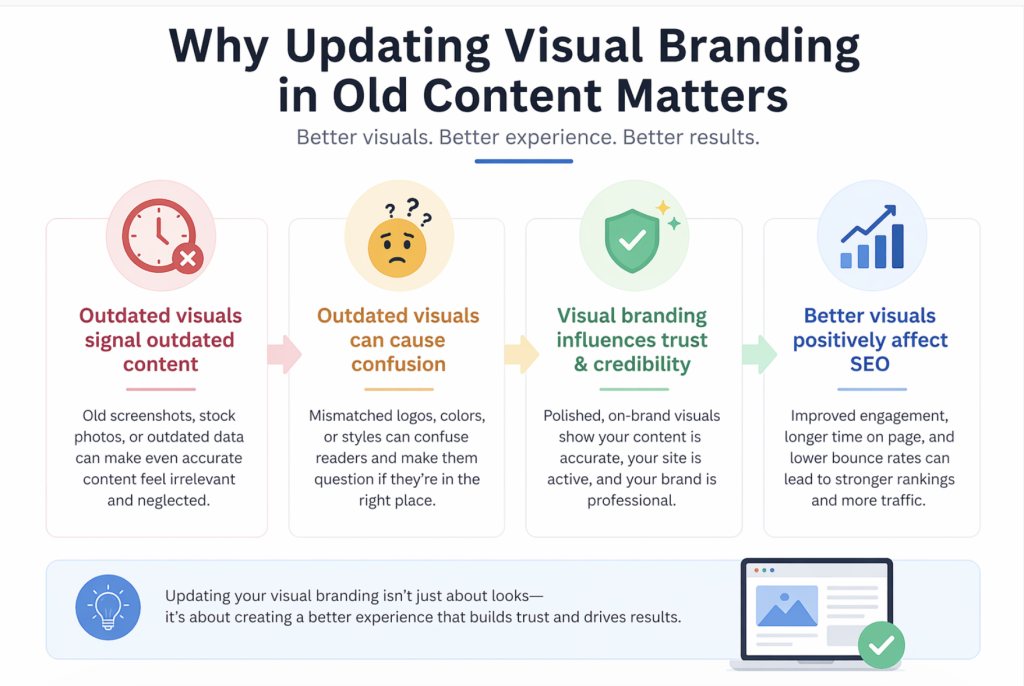
Outdated visuals can signal outdated content
Users mainly rely on visual cues when skimming your page to see if it’s worth reading. This is because people process images 60,000x faster than text.
So even if you have updated your content, if your visuals are still outdated, your users will assume that content = old, and not read it.
And visual branding can be “outdated” in multiple ways.
- Maybe you were still using stock photos in today’s era, where anyone can easily create customized visuals.
- Maybe you are using an old screenshot of a tool that has already gone through 10 website refreshes.
- Maybe you changed your color scheme and yet you still have an infographic that uses the old one.
- Maybe your pie chart still shows data from 2010. And so on.
Outdated visuals can cause confusion
Aside from making the content feel outdated, outdated visuals can simply be confusing.
Let’s say you changed your color scheme from green and white to blue and white. If someone that knows your brand as blue and white stumbles on your old content that still shows green and white, they will just get confused if they are on the correct site.
The same goes for your logo design, typography, and other branding elements like brand mascot. If you have ever refreshed any of those and people see old images that still reflect the old branding, it will just look confusing. This is especially important for businesses positioning themselves as a salesforce implementation partner, where a consistent and recognizable brand presence can help reinforce trust and credibility.
Another one is your blog visuals. Let’s say you used to create black and white doodle-style illustrations to supplement your text. If you’ve now changed to an intricate, colorful comics-style drawing, it’s going to feel jarring to your readers when they see the old style. This matters even more for niche platforms built with a secondhand marketplace script, where consistent visuals can make listings and marketplace content feel more trustworthy.
Visual branding influence trust and credibility
People tend to associate great design with professionalism and credibility.
If all your visuals are polished, clean, modern, and is aligned to your current branding, it can signal that:
The site is active and updated
The content is trustworthy and accurate
The brand is professional, organized, and detail-oriented
Which are all positive things that you want to be associated with.
Visual branding can positively affect SEO
Visuals may not have a direct factor to SEO, but it can positively influence the metrics that do have a direct impact.
Better visuals can lead to longer time on page and higher page engagement since the content is supplemented with great visuals and is much more interesting to read.
Plus points if you utilize interactive visuals (fun “playable” gifs, images that change when you hover on them, embedded videos that you have to scroll to move, etc.), since it can also lead to higher page interaction.
It can also lead to a smaller bounce rate since people won’t get confused if they are on the right page or misjudge that the content is old and not worth reading.
Over time, these improvements can lead to more stable rankings, better performance, and stronger overall visibility, which is always great for SEO. It may even help spike up the performance of your old pages that are slowly losing steam.
How to Update Your Visual Branding in Old Content?
Updating your visual branding doesn’t mean rehauling all your old content in an hour. It also doesn’t mean redesigning everything.
In most cases, small and consistent improvements can significantly enhance how your content looks, feels, and performs.
Some things to do are:
Identify your branding
First is to identify any changes in your branding. This could include:
- Changes of typography
- A new color scheme
- A logo redesign
- Shift in visual style (ex. stock photos to custom illustrations, watercolor style drawings to modernized vector illustrations)
- Updates to a brand mascot
This should help you get an idea of what changes or mismatches to look for when updating.
This is also the time to standardize your brand style moving forward. Do you want all your visual content to reflect a specific typography? A specific layout? Do you now want to place your logo on the top center instead of lower right? And so on.
Do a content audit
In an ideal world, you would want to update all your content ASAP.
But we all know it’s impossible to do so unless you have unlimited manpower and resources.
So the best course of action is to prioritize updating important pages first. These are the pages that still get a lot of traffic, rank for important keywords, is something that can be optimized for a current trend, or contains key topics for your brand.
You can then steadily work your way to the other “less” important pages after.
Start updating
Now is the time to do the work. Replace or update visuals that are:
- Still using old branding elements (logo, color palette, typography, etc.)
- Not following brand standards (logos placed on the left instead of right, images that uses an outdated frame, etc.)
- Not using the current visual style
- Old screenshots
- Old videos
- Infographics, charts, or graphs that still reflect outdated data
Updating these elements helps reinforce brand recognition and makes your content feel current.
Check mobile pages
Make sure to also review how your updated visuals will look on mobile.
Because even if your visual branding looks great on desktop, a poor mobile experience can reduce their effectiveness.
Do a thorough check if any images get cut off, if text is hard to read, if your playable gif loads on mobile, if more intricate illustrations are still legible, and so on.
A large percentage of your users are probably viewing your content on mobile. It’s wise to consider if your visuals look good on smaller screens to maximize their effectiveness.
Consider your web layout and design
While visual branding mainly focuses on elements like colors, logos, and style, there’s nothing wrong with checking the quality of your overall web design st petersburg and UI/UX.
Look out for things like:
- New branding elements don’t clash with surrounding content
- Text are properly spaced and sized, and easy to read
- Images are aligned properly (not stretched or cut-off)
- Videos and GIFs load properly and quickly
- Colors add visual interest while not making it difficult or straining to look at
- Pages visually match
The goal is to create a seamless experience where every visual feels intentional and cohesive, and not just randomly updated.
Final Thoughts
Think of it this way: will you trust a Best Of tool listicle written 7 years ago where half the tools don’t exist anymore or have different names now? Or one that is written this year, that accurately reflects tools that are active in 2026?
It’s the second, right? You will trust the one with updated information.
The same goes for your visuals. You will always prefer one that is up to date – whether that means it’s a current screenshot, an image that uses your current visual style, a poster that shows this year’s data, or those that reflect your current branding guidelines.
Outdated visual branding can make even the greatest, most accurate content feel irrelevant and untrustworthy.
By updating your visual branding alongside your content, you create a more consistent, recognizable, and credible experience across your site. Not to mention, it helps boost your SEO, which is always the end goal for all marketers.
If you’re serious about keeping your content fresh, consistent, and visually aligned at scale, tools like WordPattern can help streamline how you manage and update content across your site.