

B2B buyers consume an average of 13.4 pieces of content before they ever speak to a sales rep and 67% of that buying journey is entirely self-directed. By the time someone reaches your sales team, they’ve already formed an opinion about your brand. Content shaped it.
So why are so many businesses publishing consistently and still watching their pipeline sit untouched?
Usually, the strategy is broken. Or missing. That’s the problem a content marketing consultant is supposed to solve but most people have no idea what “solving the strategy” actually means. So before you spend a dollar on one, here’s what they actually do.
What Is a Content Marketing Consultant?
A content marketing consultant is an independent expert who helps companies build, fix, or scale their content programs. Simple title. Not-so-simple job.
Unlike an in-house hire, a good consultant works across multiple companies at once. That cross-industry exposure matters, they’ve seen what’s working across 10 different content programs, not just yours. Unlike an agency, they’re not billing for account management layers or selling you junior execution dressed up as senior strategy. You get direct access to the person who knows what they’re doing.
The scope varies by engagement. Some consultants focus purely on strategy: keyword maps, editorial calendars, audits. Others execute alongside it, writing articles or managing a freelancer team. The best ones adjust to what the engagement actually needs.
One number worth keeping in mind: content marketing budgets now represent 26% of total marketing spend on average in 2026. That’s not a small line item. Getting the strategy right has real financial stakes.
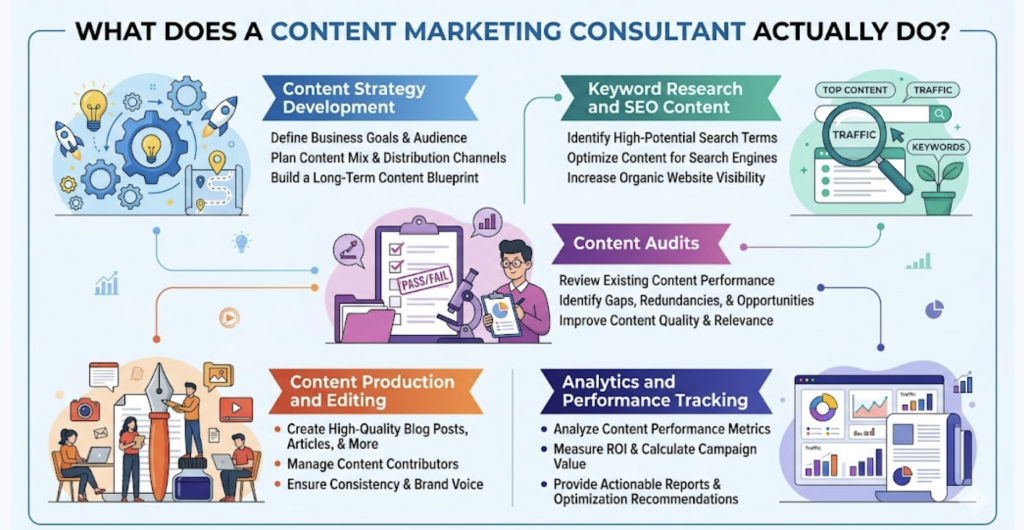
What Does a Content Marketing Consultant Actually Do?
Diagnosis before creativity. A consultant’s first job is figuring out why what you’re publishing isn’t doing what you need. Then fixing it.
Here’s what that looks like across the main service areas.
Content Strategy Development
Strategy is the foundation. That means mapping business goals to buyers, analyzing competitors, and building a documented plan: which topics to cover, in which order, targeting which keywords, for which stage of the funnel.
“Publish more content” isn’t a strategy. A real content marketing strategy specifies what gets created first and why. Most consultants start with bottom-of-funnel content, articles targeting buyers who are already evaluating options, before expanding to broader awareness content. That sequencing decision alone can separate content that generates leads from content that just generates traffic with nowhere to go.
Organizations with a documented content strategy generate 3x more leads per dollar than those without one. A consultant’s job is making sure you have that document and that it’s specific enough to actually execute.
Keyword Research and SEO Content
Not just pulling search volumes from a tool. A good consultant listens to sales calls to understand the exact language buyers use before they know your product exists. They read support tickets. They dig into Reddit threads. The goal is closing the gap between what your buyers are actually searching and what competitors have already captured.
In 2026, AI search optimization is part of this work. 94% of B2B buyers now use large language models, ChatGPT, Perplexity, Gemini, to research purchases before contacting a vendor.
Can’t explain how they approach AI search? That tells you something.
Content SEO and Site Architecture
Keyword research tells you what to create. Site architecture determines whether any of it actually ranks.
Most businesses treat these as separate conversations. They’re not. You can produce solid, well-written articles and still plateau at page two if the underlying structure is broken and the most common reason it’s broken is keyword cannibalization.
Here’s what that looks like in practice: you have three blog posts loosely targeting the same query. Google can’t decide which one to rank, so it rotates between them or ignores all three. A consultant working at this layer maps your existing content, identifies where cannibalization is happening, and either consolidates overlapping pages or differentiates them enough that each targets a genuinely distinct intent.
Internal linking is the other piece most businesses under-invest in. Link equity doesn’t distribute itself evenly. If your global site footer links to your homepage and five broad category pages from every URL on the site, those pages absorb a disproportionate share of your internal authority, including from the conversion-focused pages that actually need it. A consultant who’s diagnosed this before catches it fast.
The standard structural fix for B2B content programs is pillar-and-cluster architecture. One pillar page covers the broad topic at depth. Cluster pages handle specific sub-questions and link back to the pillar. It sounds mechanical because it is and the effect on topical authority is real. Google reads a well-structured cluster as a site with genuine expertise across a topic, not just a collection of loosely related posts.
Entity signals are the layer most consultants still skip. Schema markup – FAQ schema, HowTo schema, Article schema, tells search engines not just what your page says but what kind of thing it is. In 2026, this matters doubly because Google’s AI Overviews and third-party LLMs both draw from structured entity associations when deciding what to surface. A consultant thinking about AI search visibility will treat schema as a standard deliverable, not an optional add-on.
One thing to check when evaluating a consultant’s approach: ask them how they’d audit your internal linking before changing anything. The answer tells you quickly whether they’re thinking at the architecture level or just at the content level.
Content Audits
Most businesses with a year or more of published content have the same problem: dozens of articles sitting on page two of Google, generating almost nothing, slowly going stale. A content audit identifies those pages and makes a call on each one.
Some pages need better internal linking and a structural rewrite while others need to be merged with a weaker similar piece. Some need to go entirely. Content refreshes often produce ranking movement in weeks and faster than starting from scratch.
Content Production and Editing
Some consultants write. Others direct. Either way, the output they’re responsible for isn’t the content itself, it’s the quality signal that content sends to search engines and LLMs: genuine expertise, concrete examples, original data, a clear point of view.
A consultant managing production typically builds and oversees a small freelancer team rather than writing everything personally. Their value isn’t typing speed. It’s knowing what “good” looks like for your specific audience and being able to recognise when a draft doesn’t hit it.
At the program management level, this also means making build-vs-buy decisions on your behalf. Should this topic get a dedicated pillar page or does it sit better as a cluster article? Does this content type need a specialist freelancer, a technical writer, a data journalist, a subject-matter expert or can a generalist handle it with a solid brief? For technical projects that require Salesforce customization or integrations, you may also need to hire Salesforce Developer resources rather than rely solely on a generalist. How should the content budget be split between new creation, refreshing existing posts, and distribution.
Most in-house teams default to net-new creation because it feels productive. A good consultant redistributes that effort toward what actually moves rankings. For most established sites with 50+ published posts, the split is closer to 60–70% refresh and architecture work, 30–40% new content. That ratio feels wrong until you see the results.
Governance is the unglamorous part of this work. Somebody needs to own the editorial calendar, enforce the brief format, QA drafts before they publish, and decide when a post that’s been live for 18 months needs to be updated, merged, or removed. A consultant running your content program either does this directly or installs the system so your internal team can. Without it, programs drift and the output stops compounding.
Analytics and Performance Tracking
Strategy without measurement is expensive guessing. A consultant should set up tracking that tells you what’s working: keyword rankings, organic conversion rates, content’s contribution to pipeline.
Here’s a number that stings: only 12% of B2B marketers exceeded their content marketing goals last year. The ones who did are almost always the ones measuring the right things. A consultant’s job includes putting you in that group.
Consultant vs. Agency vs. In-House
Each option solves a different problem. Picking the wrong one is costly.
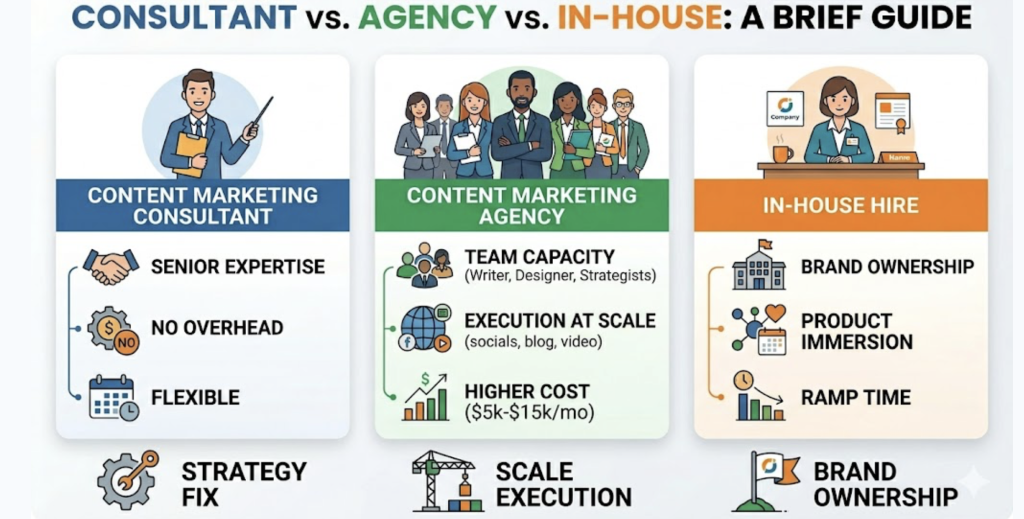
A content marketing consultant gets you direct, senior-level expertise without the overhead. No account managers. No junior writers you’ll never meet. Engagements are usually flexible and month-to-month or quarterly, so you’re not trapped in a 12-month contract if things aren’t working. The trade-off is bandwidth: one consultant can’t execute at scale.
A content marketing agency brings team capacity: writers, designers, strategists, sometimes developers. Better for high-volume execution across multiple channels simultaneously. Expect higher costs, most B2B content agencies charge $5,000–$15,000/month. And the senior strategist you pitched with? Probably not the person doing your day-to-day work. Ask directly before signing.
An in-house hire makes sense when content is a long-term, high-volume, brand-critical function that needs full-time ownership. Salary and benefits push costs to $5,000–$25,000+ per month, the ramp time is slower, and you sacrifice cross-industry exposure. But for a brand at scale that needs someone breathing the product daily, it’s the right structure.
Short version: consultants for broken or missing strategy. Agencies for execution at scale. In-house for long-term ownership.
When Do You Actually Need a Content Marketing Consultant?
“When your content isn’t working” isn’t useful. Here are concrete situations where a consultant makes sense.
- You’ve published 50+ posts and nothing ranks above page 3. Traffic is flat despite consistent output. Wrong keywords, thin content, missing authority signals, this is a strategy problem, not a writing problem.
- You get traffic but zero leads. Your content attracts the wrong audience, or it’s built around informational queries with no conversion architecture. Traffic that never enters a pipeline isn’t an asset.
- Starting from scratch with no map. Which keywords, what formats, what order and these decisions compound fast. Getting them wrong costs months of wasted output.
- Content exists but nobody owns the strategy. Everybody’s creating, nobody’s steering. A consultant installs the framework so your team executes against a documented content plan instead of guessing.
- A website redesign killed your rankings. Technical SEO and content architecture are tangled together. Untangling them usually requires someone who’s done it before.
Competitors outrank you on every term your buyers search. Solvable. Not quick. Requires someone who knows the approach.
Three-year average content marketing ROI for B2B companies reaches 844% when the execution is solid. The cost of doing it badly isn’t just wasted spend and it’s compounding opportunity cost while competitors build domain authority you’ll have to close later.
When you probably don’t need one: Your strategy is working and you just need more output. In that case, a freelancer team is cheaper and more appropriate.
How Much Does a Content Marketing Consultant Cost?
Three pricing models, three different use cases.
- Hourly: Senior consultants charge $150–$500/hour in 2026. Good for defined, scoped work: an audit session, a strategy review, a keyword research package.
- Project-based: Fixed fee for a specific deliverable. A full content strategy document runs $5,000–$15,000. A standalone audit, $2,000–$7,000. Right when you have a clear output in mind and don’t need ongoing support.
- Monthly retainer: The standard model for ongoing content marketing services. Quality B2B specialist consultants typically charge $2,500–$8,000/month. Agency retainers at comparable scope run $5,000–$20,000/month.
One red flag: “full strategy plus ongoing execution” for under $1,500/month should raise questions. At that rate, you’re almost certainly getting AI-heavy output, offshore execution, or both Senior strategic thinking doesn’t come at that price.
How to Hire a Content Marketing Consultant?
Most hiring decisions here go sideways because people evaluate consultants the way they evaluate agencies. Different model, different questions.
Here’s a practical sequence that filters out the wrong candidates fast.
Step 1: Define your problem before you talk to anyone
Are you starting from scratch with no content program? Trying to fix a plateau where traffic stopped growing six months ago? Recovering organic traffic after a core update or site migration? Scaling something that’s already working?
Each scenario calls for a different profile. A consultant who’s rebuilt post-penalty sites has a different skill set from one who architects content programs from zero. Get specific about the problem before you get on a call, or you’ll spend the first three meetings explaining context that should have been a prerequisite.
Step 2: Ask for a specific piece of content and the outcome it produced
Not a case study PDF. Not a logo wall of clients. Ask: show me an article you wrote or directed, tell me the keyword it targeted, tell me where it ranked and when, and tell me what it contributed to the pipeline.
If they can’t answer that question with specifics — real ranking positions, real traffic numbers, named outcomes — keep looking. Vague case studies protect the consultant, not you.
Step 3: Test their AI search fluency
Ask how they approach getting content cited in ChatGPT, Perplexity, and Google AI Overviews. The answer should involve entity authority, structured data, direct-answer formatting, and building brand presence across high-authority external sources.
A vague answer isn’t a minor gap. It means they’re running a 2022 playbook on a 2026 problem. 94% of B2B buyers now use LLMs to research purchases before contacting a vendor — a consultant who hasn’t updated their approach to account for that is optimising for a shrinking audience.
Step 4: Check the contract structure before you like them too much
A 90-day review point with a clear exit option is standard for a consultant who’s confident in their work. Six-month contracts upfront are an agency model in consultant clothing.
Watch how deliverables are defined. “8 posts per month” is an output metric. It tells you nothing about what those posts will do. Deliverables defined by outcomes — keyword targets, ranking movement, conversion rate on content pages — are the sign of someone who’s accountable to results, not activity.
Step 5: Run a paid audit before committing to a retainer
Ask if they offer a standalone content audit or strategy session — typically $2,000–$7,000. It shows you exactly how they think. You walk away with a real deliverable regardless of whether you continue. And it de-risks the retainer decision significantly.
Any consultant worth hiring will say yes to this. Resistance to a scoped audit is a red flag.
The Short Version
A content marketing consultant is a diagnostic and strategic hire and not a writing service. The right one connects your product to the searches your buyers are making, accounts for how those buyers research in 2026, and shows you proof of what they’ve fixed before you sign anything.
Content marketing generates over 3x as many leads as outbound at 62% lower cost. That number holds when the strategy is right. When it isn’t, the output just sits there.
Strategy broken or missing? A consultant is the fastest fix. Strategy working and you need volume? Hire writers.
FAQs
Slow content takes 3–6 months to compound into meaningful traffic — that’s normal for new content on a young domain. Broken is different: traffic that was growing has stopped or reversed, your pages are stuck on page two despite consistent publishing, or you’re getting traffic that never converts. If any of those describe you, it’s a strategy problem, not a patience problem.
A proper audit inventories every published page, checks current ranking position and organic traffic, identifies cannibalization (multiple pages competing for the same query), and makes a call on each piece: refresh, consolidate, redirect, or remove. The output is a prioritised action list, not just a spreadsheet. Most sites with 50+ posts find that 20–30% of their content is either dragging down domain authority or cannibalising pages that should rank better.
The mechanics are similar — search volume, difficulty, intent classification — but a consultant working at a strategic level also listens to sales calls, digs into support tickets, and reads forum threads to capture the language buyers use before they know your category exists. That pre-awareness language is where the least competitive, highest-converting keywords often sit. Agencies tend to pull from tools; a good consultant triangulates from tools and actual buyer conversations.
Yes, and for many businesses this is the highest-value version of the engagement. A consultant who manages production typically builds the brief format, maintains the editorial calendar, QAs drafts before they publish, and owns the governance process — so your internal team has a system to run against rather than starting from scratch on every piece. Clarify scope upfront: some consultants direct-manage freelancers, others set up the system and hand it off.
Project engagements – a content strategy document, a standalone audit, a keyword map — make sense when you have a specific output in mind and don’t need ongoing oversight. Retainers make sense when your content program is active and needs consistent strategic direction: prioritising what gets created next, monitoring what’s ranking, adjusting based on performance. Most engagements start with a project, then move to a retainer once there’s enough mutual understanding to make ongoing work efficient.