
You publish a blog post. It performs well. Traffic grows. Rankings stabilize. Then, without warning, things start slipping. At first, it’s barely noticeable – a small dip in traffic. But over time, that decline becomes harder to ignore. What you’re experiencing isn’t random. It’s content decay. And in 2026, content decay isn’t just common – it’s inevitable if you’re not actively maintaining your content.
The Silent Killer: Content Decay
Content decay refers to the gradual decline in traffic, rankings, and engagement of previously high-performing content.
It’s not a sudden drop. Instead, content decay happens quietly in the background until your once top-ranking post is buried under fresher, more relevant results.
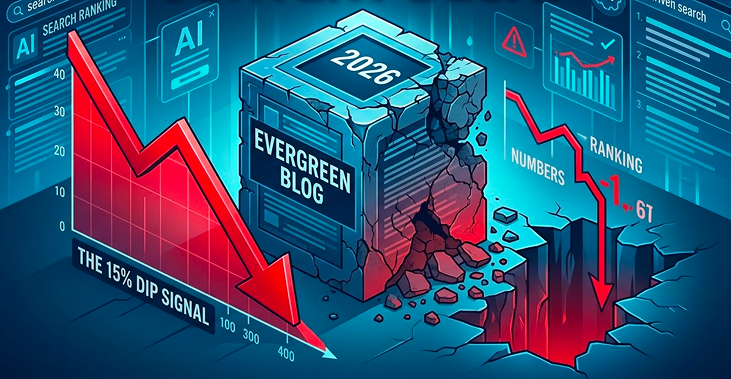
Defining the 15% traffic dip that signals content decay
In most cases, content decay begins with a small drop, around 10–15% in organic traffic.
Many site owners ignore this early signal. However, that initial dip is often the beginning of a larger decline. Left unchecked, content decay can cut your traffic in half within months.
Why “Evergreen” is a myth in the age of AI search?
For years, marketers believed evergreen content could rank forever.
That’s no longer true.
In today’s AI-driven search environment, even “evergreen” content is vulnerable to content decay. Search engines constantly prioritize freshness, updated insights, and relevance.
If your content doesn’t evolve, it slowly becomes invisible.
The 2026 reality: If you aren’t gaining information, you’re losing rank
Content decay doesn’t just happen because your content gets worse.
It happens because other content gets better.
Competitors update their posts, improve structure, and align with new search intent. If you’re not doing the same, your rankings decline—even if your content is still “good.”
4 Reasons Your Content is Decaying (and Losing Rankings)
Understanding why content decay happens makes it easier to fix.
1. The Freshness Gap: Outdated stats and broken “2024” references
One of the fastest triggers of content decay is outdated information.
Old statistics, expired trends, or references to past years signal to both users and search engines that your content is no longer current.
Even small details can accelerate content decay.
2. Search Intent Shift: A major cause of content decay
Search intent is constantly evolving.
A post that once ranked for a “how-to” keyword might now need to answer deeper “why” or “which is better” questions. When your content no longer matches intent, content decay begins.
3. Semantic Dilution: How content decay happens in weak topic coverage
Content decay also occurs when your content lacks depth.
Today, search engines favor topic clusters and comprehensive coverage. If your post only scratches the surface, it loses to competitors with more detailed, interconnected content.
4. The AI Summary Trap: Accelerating content decay in 2026
AI summaries are changing user behavior.
If your content only provides basic information, users may never click through. This creates a new form of content decay—where impressions remain high, but clicks drop significantly.
How to Diagnose Content Decay (The Audit Checklist)?
Before fixing content decay, you need to identify where it’s happening.
Using Search Console to spot content decay early
Look for pages where impressions are stable or increasing but clicks are declining. This gap is one of the clearest indicators of content decay. You can investigate it manually in Google Search Console or use an SEO content audit tool to prioritize affected pages automatically.
The 12-Month Rule for identifying content decay
If a post hasn’t grown—or has declined—over the past 12 months, it’s likely affected by content decay.
High-authority posts are especially important to review, as they have the most to lose.
Competitive Gap Analysis: Who is winning the content decay battle?
Search your target keywords and analyze competing pages.
If another site has taken your position or featured snippet, study their content. Often, they’ve already solved the content decay problem you’re facing.
The “Resuscitation” Framework: How to Fix Content Decay?
The good news? Content decay is reversible.
Here’s a simple 3-step framework to recover lost rankings and traffic.
Phase 1: The Content Refresh (The 20% Rule)
You don’t need to rewrite everything to fix content decay.
Instead, focus on improving the most important sections.
Start by:
- Updating outdated stats and references
- Refreshing year-based headlines
- Replacing old screenshots
Then go further by removing generic filler and adding real insights, examples, and first-hand experience. This is one of the most effective ways to reverse content decay.
Phase 2: Technical Tightening to prevent further content decay
Technical issues can accelerate content decay.
Fix:
- Broken links and outdated references
- Weak internal linking structures
- Slow page speed and poor Core Web Vitals
Improving these areas not only prevents further content decay but also strengthens your overall SEO performance.
Phase 3: Structural Re-Optimization for long-term content decay control
Structure plays a major role in preventing content decay.
To improve performance:
- Add FAQ sections to capture long-tail queries
- Include quick summaries for AI and mobile users
- Break content into smaller, scannable sections
This makes your content easier to read—and harder to replace.
How to Protect Your Content from Decay?
Fixing content decay isn’t just about rewriting text.
Why video reduces content decay?
Adding a short video can significantly improve engagement.
It increases time-on-page and helps users understand your content faster—both of which reduce the impact of content decay.
Turning static content into interactive experiences
Interactive elements like charts, tools, and calculators make your content more engaging.
This reduces bounce rates and signals higher value—helping prevent content decay.
E-E-A-T signals: The long-term defense against content decay
Experience matters more than ever.
Content built on real-world insights, case studies, and personal expertise is far less likely to suffer from content decay.
Case Study: Recovering from Content Decay in 30 Days
Let’s look at a real-world example.
How one post reversed content decay quickly
A blog post from 2022 had lost over 50% of its traffic due to content decay.
Instead of rewriting it, the team:
- Updated outdated information
- Improved structure and readability
- Added new sections aligned with current intent
- Included a short video
Within 30 days, the post regained its top ranking—and traffic increased significantly.
Why fixing content decay beats creating new content?
Recovering from content decay is often faster and more cost-effective than publishing new posts.
You’re building on existing authority instead of starting from scratch.
Build a System to Control Content Decay
Content decay in 2026 isn’t something you can avoid—but it’s something you can manage.
From publishing to maintaining: A smarter approach to content decay
Instead of treating content as a one-time task, think of it as an ongoing process.
Regular updates and improvements are the key to preventing content decay.
Your 90-day plan to stay ahead of content decay
- Every 30 days: Review top-performing content
- Every 60 days: Update stats and links
- Every 90 days: Perform a full content refresh
This simple system keeps your content relevant, competitive, and visible.
Final Thought
Content decay happens to every website.
The difference is simple:
Some ignore it—and lose traffic.
Others fix it—and grow faster than ever.
Once you start treating content as a living asset, content decay stops being a problem… and becomes an opportunity.