
HubSpot once took a pile of old blog posts, updated them, and republished them. The result? Organic search views to those posts jumped by an average of 106%. They didn’t write anything new. They promoted what they already had.
That’s the part most content promotion advice skips.
Almost every guide out there is a list of channels. Post it on LinkedIn, email your list, boost it on Meta, tag an influencer. Useful stuff. But it all assumes one thing: that the piece you should be promoting is the one you published this morning. Launch day, big push, then silence. Two days later the post is dead and you’re onto the next one.
Here’s the thing. Your best promotion target usually isn’t your newest post. It’s a page that already ranked, already earned links, and then quietly slipped. Fix what to promote first, and where gets a lot easier.
What content promotion actually is (and where most teams get it wrong)
Content promotion is just getting content you’ve already made in front of the right people. You do that across three buckets: channels you own (email, your site, your social accounts), channels you earn (mentions, shares, links), and channels you pay for (ads, boosts). That owned earned paid media split is the backbone of any content promotion strategy.
Nothing controversial so far.
The mistake is treating promotion as a one-time event welded to new content. You publish, you blast, you move on. But content promotion isn’t a launch. It’s ongoing amplification of your best assets, and your best assets aren’t always the newest ones.
Ahrefs put it well. Most teams pour effort into the growth and peak phases of a post’s life and spend almost nothing on the decline phase. That’s backwards. The decline phase is where your cheapest wins are hiding.
Why “what to promote” beats “where to promote”
Let’s do some uncomfortable math.
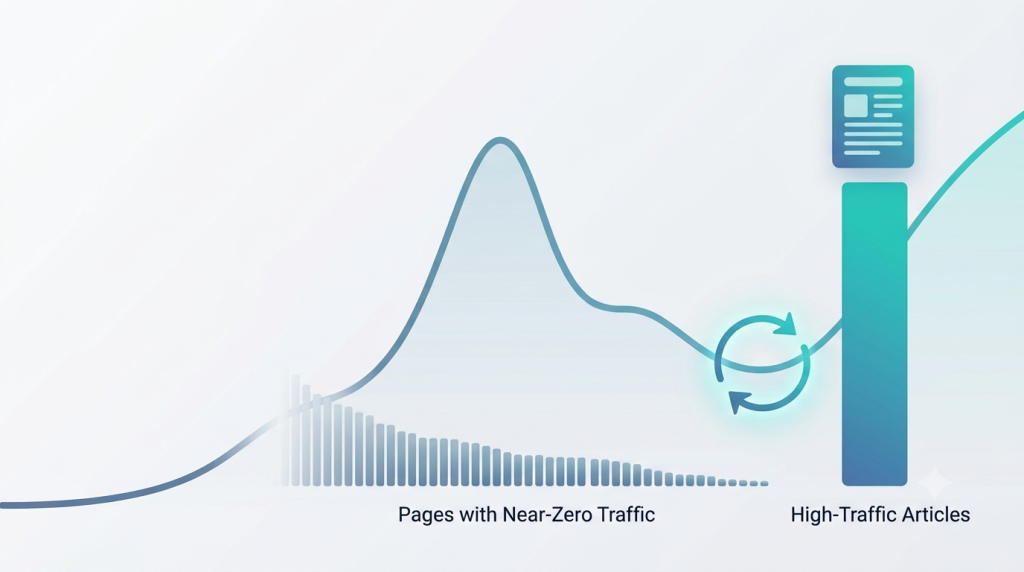
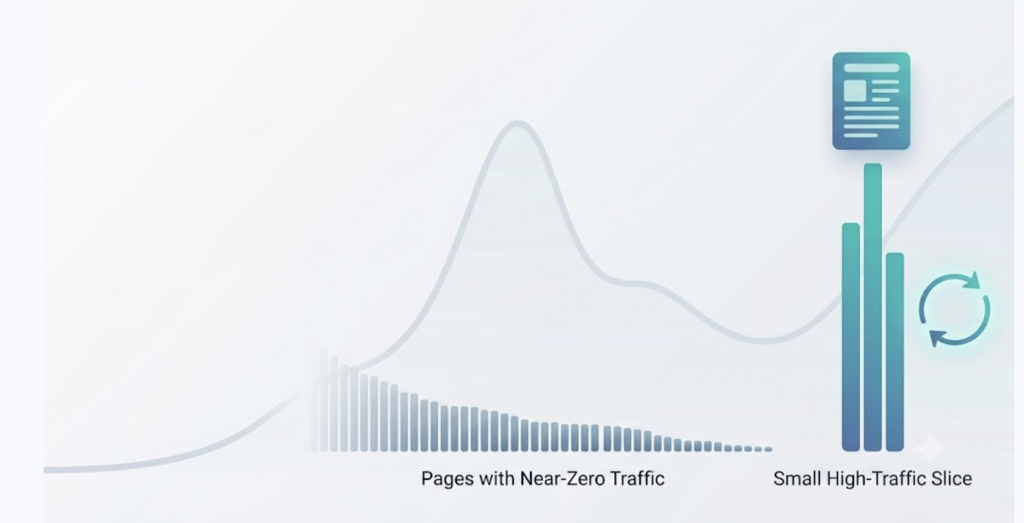
Roughly 90% of pages get near-zero organic traffic at all. Promoting a page nobody wants harder doesn’t make it good. You’re just pouring gas into a car with no engine.
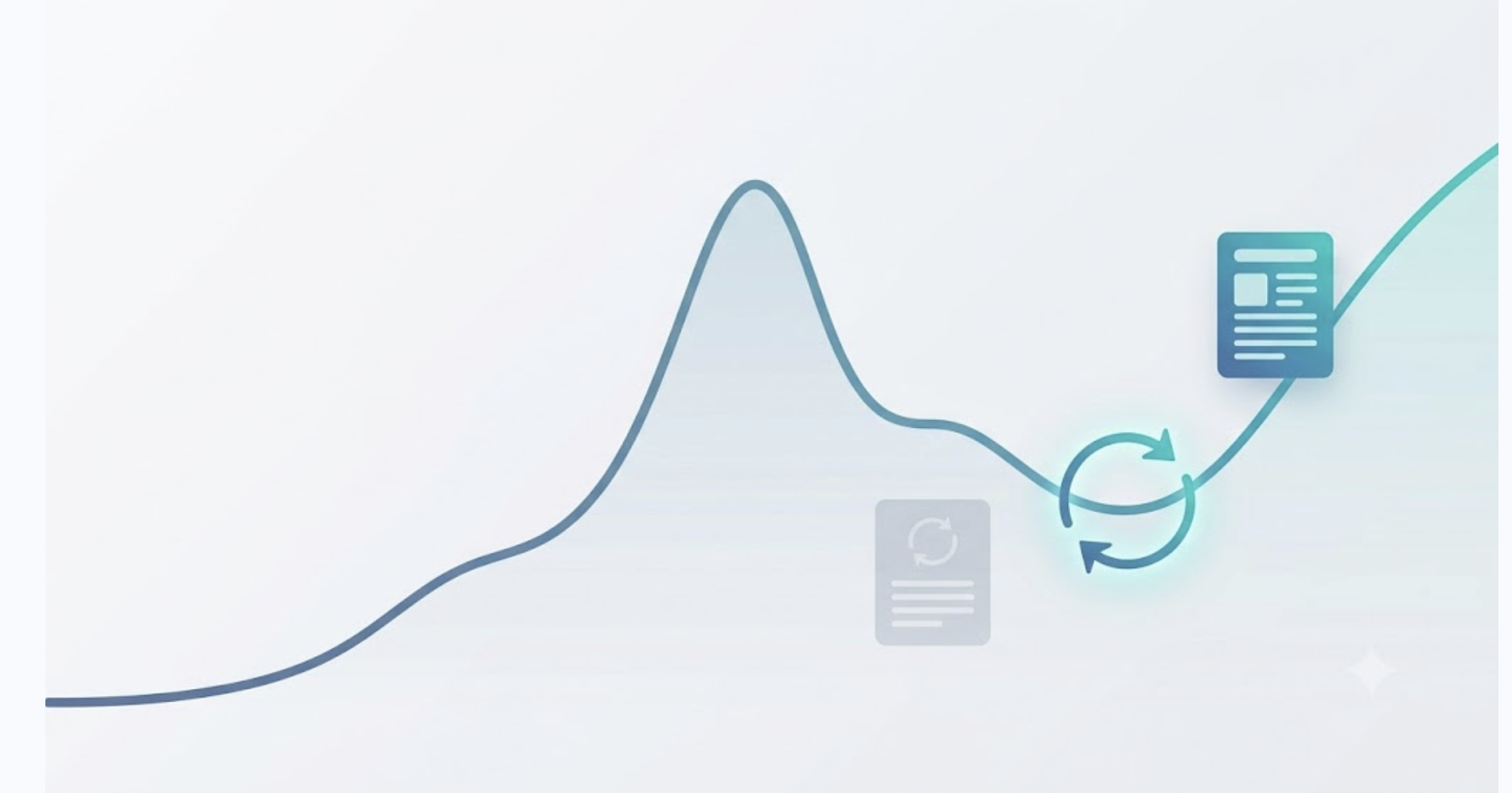
So which pages deserve the fuel? Often the ones that used to run fine and then stalled. This is content decay, the slow and quiet loss of traffic and rankings on a page that once performed well. It doesn’t announce itself. There’s no penalty email. A few clicks vanish this month, a couple of ranking spots slip next month, and a year later a post that anchored your pipeline is barely breathing. (If you want the full breakdown of how it happens, WordPattern has a guide to spotting and fixing content decay.)
Ignore it and it compounds. Sites that neglect aging content can bleed up to 20% of their organic traffic a year, according to Conductor.
And there’s a huge backlog sitting there. One 2026 analysis found 52% of articles published before 2025 have never been refreshed once. That’s half your library. Pages with existing authority, existing links, existing relevance, all waiting for someone to promote them properly.
Databox’s John Bonini said the quiet part out loud. Your fastest short-term win in organic isn’t publishing more, it’s updating what you’ve already got.
So before you open your social scheduler, ask a different question. Not “where do I promote this?” but “which page is worth promoting at all?”
A 3-step way to decide what to promote first
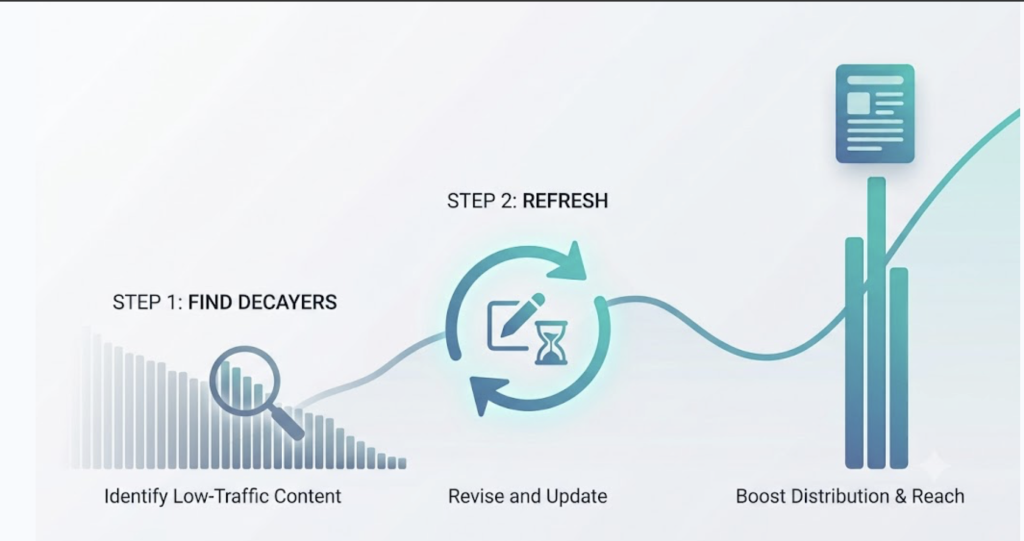
Here’s a simple loop you can run this week. Find, refresh, re-promote.
Step 1 – Find the decayers
Open Google Search Console or GA4. Pull the last 12 to 14 months and compare it against the year before. Filter for pages losing traffic, then sort by the absolute drop in clicks, not percentage. That puts your highest-value bleeders at the top, so you fix the pages that actually move the number. (WordPattern’s piece on why your best posts lose traffic walks through the signals if you want them.)
Pick your top five. That’s your promotion shortlist.
Step 2 – Refresh before you re-promote
This is where people cut corners, and it’s why some “refreshes” do nothing. Changing the date in the title isn’t a refresh. Depth is what moves the needle.
How much? One Portent analysis of 60 posts found that full rewrites drove around 454% keyword growth, while surface-level edits barely registered. So do the real work. Update stale stats, re-check the search intent (maybe people now want a video, not a wall of text), fix dead links, and add internal links to newer posts. If the piece leans on old numbers, refreshing those statistics alone can reclaim a ranking.
Step 3 – Re-promote the refresh like it’s new
Once it’s genuinely better, treat it like a launch. Email it. Share it. Boost it. A single republish cycle can produce a serious lift. One Ahrefs post reportedly saw a 302% traffic jump off one round.
One caveat. Not every page deserves this. Some should be cut, not saved. Audits routinely find 30–50% of a site’s content can be actively suppressing rankings, and pruning the dead weight can lift total traffic within a couple of months. Promote the winners. Bury the losers. Don’t confuse the two.
The channel playbook: where to promote once you know what
Alright. You’ve got a refreshed page worth pushing. Now where does it go? Sort your channels by the owned earned paid media buckets and work outward.
Owned channels first. These are warmest and you control them. Email your newsletter, because nothing beats a list that already likes you. Then add internal links from your strongest existing pages to the refreshed one. That’s free authority you already own. And repurpose it: turn the post into a short video, a carousel, a thread. When you repurpose content, one asset quietly reaches four different audiences instead of one.
Earned channels next. Tag anyone you quoted or cited when you share it, because people love resharing the thing they’re in. Drop it (genuinely, not spammily) into the Slack groups, Discords, and forums where your people actually hang out. If the content naturally relates to salesforce consulting services, share it with communities where those conversations are already happening. And reach back out to sites that already linked to the older version so they know it’s better now. That’s content distribution that costs time, not money.
Paid channels last, and sparingly. Put a small boost behind the posts that already convert on their own. Paid amplifies what works. It doesn’t rescue what doesn’t.
Then there’s the 2026 wrinkle. Content decay now has two dimensions. A page can slip in Google and vanish from AI-generated answers separately. And AI Overviews are eating clicks even when you rank first. One analysis clocked organic CTR at 0.61% with an AI Overview versus 1.62% without. So “getting cited by the AI” is now its own promotion surface. Fresh, well-structured content gets pulled into those answers more often, which is part of why helping AI engines read your site matters more every quarter.
Close the loop: promote, watch, refresh, repeat
Do this once and you get a nice bump. Do it on a rhythm and it compounds.
Set a monthly review. Keep a rolling baseline for each important URL and flag anything where clicks fall 30% or more, or positions drop by two. Catch the slip early and the fix is cheap. Wait until the page is a corpse and it’s a full rebuild.
Need proof it matters at scale? Even HubSpot, the company that basically invented this playbook, later lost most of its blog traffic by leaning on sheer volume instead of maintaining what worked. Nobody’s too big to skip the upkeep. A steady content audit rhythm is what keeps the loop turning.
Each refreshed, re-promoted asset resets its own lifecycle. That’s the whole game. Not a bigger launch. A loop that never fully stops.
Wrapping up
Decide what before you decide where. That one switch changes everything downstream.
Your existing library is the cheapest content promotion inventory you’ll ever own. It’s already written, already indexed, already trusted by Google in ways a brand-new post has to earn from scratch. Most of it is just sitting there decaying while you chase the next blank page.
So here’s your one action for today. Pull the last-12-months-versus-prior-year report and find your five biggest decayers. Refresh one. Promote it like it’s new. Then do it again next month.
FAQs
Content promotion is the work of actively getting your existing content in front of the right audience, through channels you own (email, social, your site), earn (shares, mentions, links), and pay for (ads). It’s what happens after you hit publish, and it applies to old content just as much as new.
They overlap, but distribution is mostly about getting content out onto channels, while promotion is the active push to amplify a specific piece: boosting it, pitching it, tagging people, putting spend behind it. Distribution is the pipes. Promotion is the pressure you send through them.
Run a monthly review of your top pages and let the data decide. When a page shows decay signals, like clicks down 30% or more or a couple of lost ranking spots, that’s your cue to refresh and re-promote it. You’re reacting to slippage, not following a rigid calendar.
No. Some posts don’t earn the effort, and a few are actively dragging your site down. Prioritise by business value and by which pages are decaying but recoverable. The rest should be improved, merged, or pruned, not pushed harder.