

Businesses that blog consistently pull in 55% more website visitors than those that don’t. And yet most ecommerce stores publish a handful of posts, watch the traffic flatline, and quietly shelve the whole thing.
The difference isn’t effort. It’s structure.
Publishing content without a strategy is like stocking inventory with no idea who’s buying. You’ve got product. The right buyer just can’t find it — and when they do, they don’t convert. A real ecommerce content strategy maps what you publish to who needs it and when.
What Is an Ecommerce Content Strategy?
An ecommerce content strategy is a plan for creating, distributing, and maintaining content that moves shoppers toward a purchase — at every stage of the buying journey, not just at the top of the funnel.
It’s different from general content marketing in one key way: the end goal is always a transaction. A SaaS company publishes content to build awareness and trust. An ecommerce brand does the same thing, but every piece has to connect back to product discovery, comparison, or conversion. Blog posts feed into product pages. Email sequences close carts. UGC content builds the trust that spec sheets can’t.
Content marketing for ecommerce also has to account for channels most B2B content strategies ignore — social commerce, product page copy, post-purchase sequences. A skincare brand’s content strategy looks nothing like a consulting firm’s. The mechanics are completely different.
Three things separate a real ecommerce content strategy from a random publishing schedule:
- Intent mapping: every piece of content is assigned to a specific stage of the buyer journey before it’s written, not after
- Product integration: blog content connects directly to product and category pages through internal links and contextual CTAs
- Refresh planning: a maintenance schedule sits alongside the new content calendar, so older posts don’t quietly lose traffic while you’re focused on publishing new ones
If your current content plan doesn’t have all three, you’re not running a strategy. You’re running a schedule.
What a Content Strategy Does for an Ecommerce Store
Here’s the honest pitch, minus the fluff: content marketing reduces how much you spend on ads to acquire the same customer.
Global ecommerce sales are forecast to surpass $6.8 trillion in 2026. That market is real. So is the competition inside it. Paid search costs keep climbing. ROAS is harder to maintain quarter over quarter. Content, built well, becomes an asset — a page that earns traffic for years with no media spend attached.
And it’s not a niche play anymore. 82% of businesses now actively use content marketing. You’re not early. You’re behind if you’re not running it deliberately.
What a strong ecommerce blog strategy actually delivers:
- Organic traffic from buyers who’ve never heard of you
- Trust during the consideration stage, when shoppers are comparing options
- Fewer returns, because informed buyers make better purchase decisions
- Repeat business, because post-purchase content keeps customers coming back
None of that happens by accident. You build it, or it doesn’t happen.
Map Your Content to the Buyer’s Journey
The most common content mistake in ecommerce? Treating all buyers the same.
Someone who just Googled “what moisturizer should I use” needs different content than someone who already added your serum to their cart and abandoned it. Obvious in theory. Ignored in practice.
The classic funnel – TOFU, MOFU, BOFU – maps to this directly.
- Top of funnel (TOFU) is where people are problem-aware, brand-unaware. Your job: show up when they search. Blog posts, buying guides, and educational social content live here. A skincare brand might rank for “how to fix dry skin in winter.” Nobody’s buying yet. But you’ve entered their world.
- Middle of funnel (MOFU) is where buyers are comparing. Comparison posts, product tutorials, how-to videos, email sequences — all MOFU. “Best moisturizers for dry skin” is a MOFU article. “How our ceramide formula works” is a MOFU video.
- Bottom of funnel (BOFU) is where the decision happens. Product pages, reviews, UGC galleries, on-page FAQs. This is the content that closes. Most brands spend everything at TOFU. Then wonder why product pages don’t convert. (Sound familiar?)
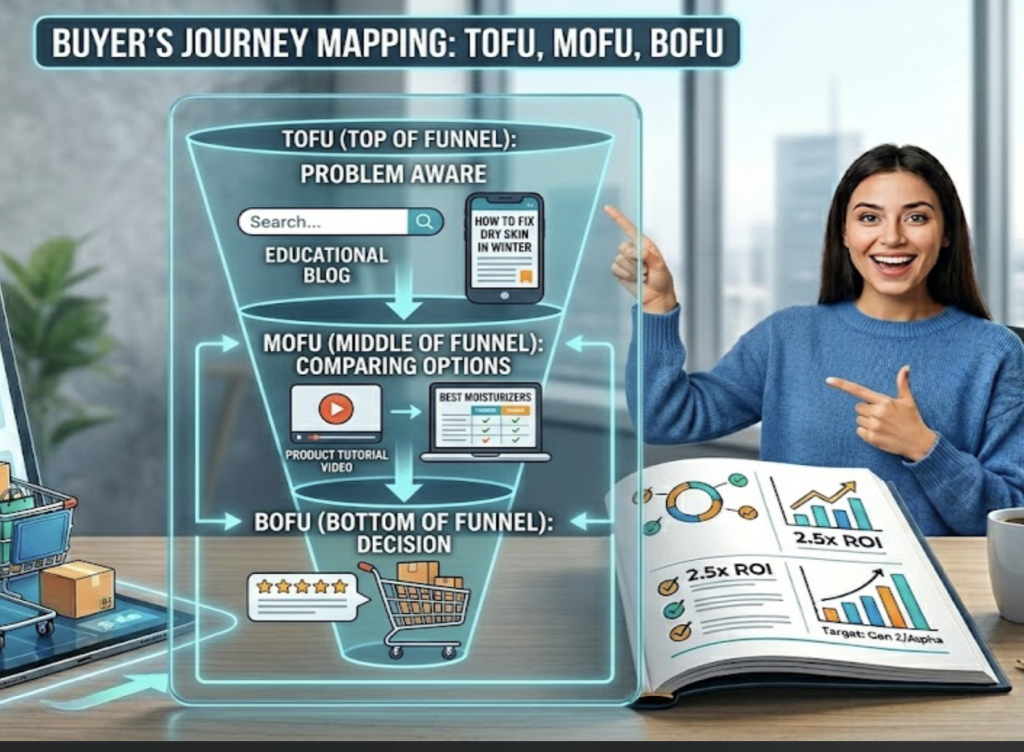
Map every piece you create to one of these three stages. If you can’t place it, that’s a signal.
The Best Content Types for Ecommerce (Ranked by ROI)
Not all content formats perform equally and for most ecommerce brands, the gap between the best and worst return on effort is wider than you’d expect. Here’s how the main content types rank, and why the order might surprise you. Not everything pulls equal weight. Here’s what actually works, by format.
Blog posts and buying guides
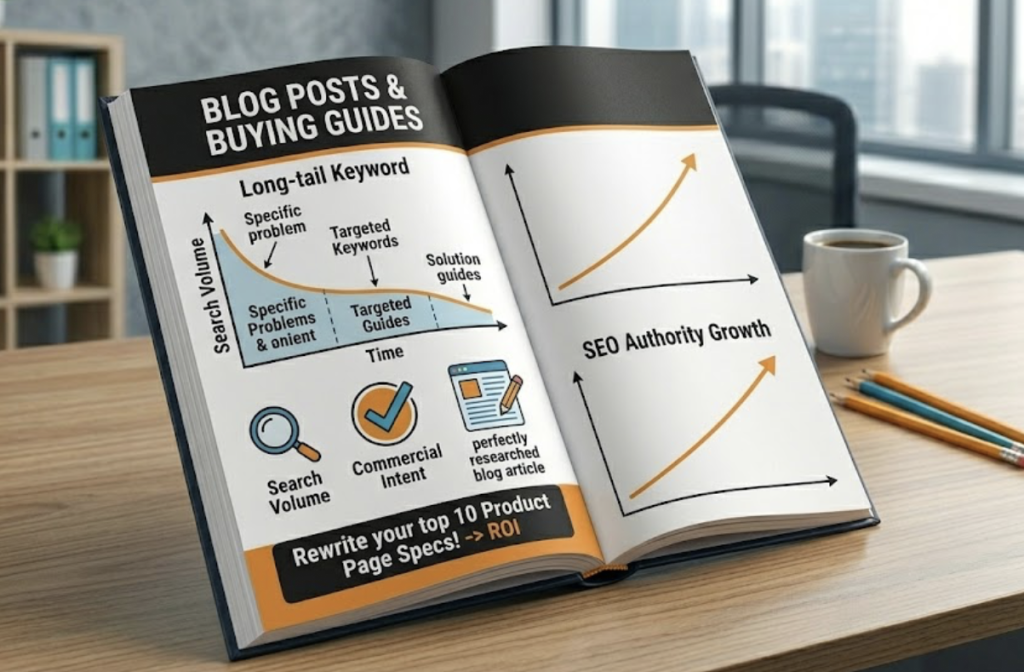
Your SEO backbone for top-of-funnel buyer journey content. A single well-researched guide targeting a long-tail keyword can drive consistent organic traffic for years. The trick is picking topics with real search volume and clear downstream commercial intent.
Don’t write for your industry. Write for your buyer’s problem.
Product page copy
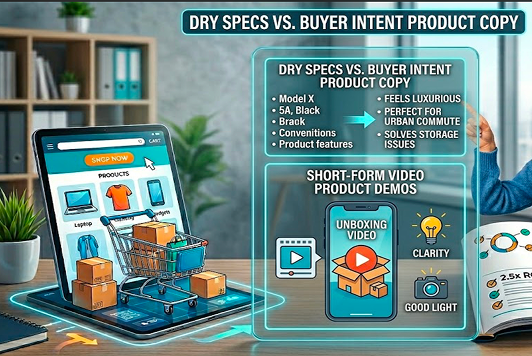
Most ignored, highest-converting. The average global ecommerce conversion rate sits around 2.95%. Better product page copy moves that number. Most product pages are just a bullet list of specs — that’s not copy, it’s a spreadsheet. Great product page content answers: what does this feel like? Who is this actually for? What does it solve? What does it pair with?
Rewrite your top 10 product pages before you write your next blog post. Faster ROI, almost guaranteed.
A product page isn’t just content — it’s the last sales conversation your brand has with a buyer before they either convert or leave. The copy has to close.
That means addressing every objection a buyer might have before they think to raise it. What’s the return policy? Does this work for my skin type/use case/size? What do other buyers say? What does it pair with? For products that rely on demos or live interactions, brands can also embed video conferencing APIs or SDK to let customers connect with experts, get personalised guidance, or see the product in action. Each of those unanswered questions is a leak in your conversion funnel. Spec sheets don’t close sales. Answers do.
For ecommerce brands tracking conversion rate by page, the product pages with the highest-converting copy share three characteristics: they lead with the outcome (what the buyer gets), not the feature (what the product does); they surface social proof close to the buy button; and they pre-empt the top two or three objections in the copy or FAQ section below the fold.
Average ecommerce conversion rate is around 2.95% globally. The top-quartile stores running well-optimised product page copy consistently hit 4–5%. That difference — on the same traffic — is the highest-leverage content investment most ecommerce brands aren’t making.
Short-form video
Short-form video is the #1 ROI-driving content format, cited by 49% of marketers. For ecommerce that means product demos, before-and-afters, unboxing clips, how-to content. Production quality doesn’t matter as much as you think. Clarity and good natural light will carry you.
User-generated content
72.9% of consumers globally research brands on social media before buying. Their content sells better than yours — full stop. Collect it actively: ask for it post-purchase, run campaigns that invite submissions, feature it prominently on product pages.
Email and SMS
Email returns between $36 and $79 for every dollar spent — nothing else is close. For ecommerce, the real money is post-purchase: onboarding sequences, reorder reminders, loyalty content. Here’s why that matters: repeat customers account for 44% of total ecommerce revenue. If your content strategy ends at acquisition, you’re leaving nearly half your potential revenue behind.
Build Your Ecommerce SEO Content Foundation
Keyword research for ecommerce SEO content isn’t just about search volume. It’s about intent.
“Best running shoes” → wants a comparison. “Buy Nike Air Zoom 15” → ready to purchase. “How to break in running shoes without blisters” → early, informational, TOFU. Three searches, three completely different content types. Build the wrong one and you’re invisible at the moment it matters.
The structure that works best: topic clusters. One strong pillar post on a broad topic, supported by focused posts that go deep on subtopics. A “skincare routines” pillar links to “how to layer serums,” “best moisturizers for dry skin,” “when to use face oils.” Build the cluster and you build topical authority – search engines start to see you as the expert.
There’s a newer layer too. AI-driven discovery is changing how ecommerce content gets found. Buyers are querying LLMs, not just typing keywords. Content structured clearly, answering questions directly, with specific product data – that’s what gets surfaced in AI responses. Worth building for. It’s not a phase.
Technical basics still matter: schema markup on product pages, descriptive image alt text, clean internal linking across your catalog. For ecommerce teams using account based marketing services, aligning these product pages with the needs of high-value accounts can make that content even more effective.
The Tools That Support an Ecommerce Content Operation
You don’t need an expensive stack to run ecommerce content well. But you do need the right tools in each category.
For keyword research and competitive analysis: Ahrefs or Semrush. Both surface keyword gaps, show what your competitors rank for that you don’t, and track ranking changes over time. Start with GSC if budget is tight — it’s free and shows you exactly what you already rank for.
For email marketing and automation: Klaviyo is the standard for ecommerce — it integrates directly with Shopify and WooCommerce, segments by purchase history, and handles triggered sequences (post-purchase, reorder, win-back) without manual setup. Omnisend is a strong alternative at a lower price point.
For CMS and blog management: If you’re on Shopify, the native blog handles basic content publishing. For more SEO control — custom slugs, schema markup, redirect management — WordPress or Webflow give you more flexibility. Most high-volume ecommerce content operations eventually migrate off native CMS to one of these.
For content performance monitoring: The gap most ecommerce brands don’t close until they’ve already lost significant traffic. Manual GSC reviews catch decay late. Automated monitoring tools flag declining pages before they fall off page two, so refreshes happen proactively rather than reactively.
The software category that moves the revenue needle most: your email platform and your content monitoring tool. Everything else is secondary.
How to Plan Your Ecommerce Content Strategy?
Most ecommerce brands skip straight to “what should we write?” That’s the wrong starting question. The right one is: what does your buyer need at each stage, and do you have content that meets them there?
Here’s a five-step process that works for a solo marketer running a Shopify store and a 10-person team managing a mid-market catalogue.
Step 1: Audit what you already have:
Export every page on your site – blog posts, product pages, category pages, landing pages. Tag each one: which funnel stage does it serve (TOFU, MOFU, BOFU)? What keyword does it target? Is it ranking, declining, or untested? You’ll almost always find you have plenty of TOFU content and almost nothing at MOFU and BOFU. That gap is where most ecommerce conversion leaks.
Step 2: Map your buyer’s questions by stage:
For each funnel stage, list the 3–5 most common questions your buyers have. A useful shortcut: look at your site search data and your customer service inbox. What do people ask before they buy? What do they ask after? Those questions are your content brief.
Step 3: Assign one content type to each stage:
You don’t need every format. Pick what your buyers actually use:
- TOFU: long-tail blog posts and buying guides for organic discovery
- MOFU: comparison posts, how-to videos, email sequences, product tutorials
- BOFU: optimised product pages, review integration, FAQ sections, live chat scripts
One format done well beats five formats done badly.
Step 4: Build a 90-day calendar, not a 12-month one:
Twelve-month content calendars look good in decks. They’re useless in practice. Plan 90 days out. Block specific weeks for new content and specific weeks for refreshes of existing posts. Ratio that works for most teams: 60% new content, 40% refreshes. For smaller teams, flip it — older posts with existing authority recover faster than new posts starting from zero.
Step 5: Set measurement baselines before you publish anything new:
Pull your current organic traffic, top-10 keyword rankings, and average conversion rate from GSC and GA4. Write them down. You need a before snapshot to prove a content investment is working at the 6-month mark – because it won’t look impressive at 3 months, and you’ll need the data to justify continuing.
That’s it. No 47-step framework. No three-month discovery process. Audit, map, assign, calendar, measure.
Distribute Content – Not Just on Your Blog
Publishing on your blog is step one. Most brands stop there. That’s the mistake.
Multi-channel ecommerce brands generate 26% more qualified traffic than single-channel brands. One piece of content can live in a lot of places: the blog, an email sequence, an Instagram carousel, a TikTok clip, a product page FAQ update.
The platform shift is real. 49% of Gen Z consumers use TikTok to discover their next purchase. Social isn’t just brand awareness anymore — it’s where buying decisions start. Your ecommerce content marketing has to show up where buyers already are.
A lean content calendar for ecommerce distribution might look like this: publish a blog post → cut it into a 3-email sequence → turn the main takeaway into a social carousel → pull one stat for a short Reels or TikTok clip → update the relevant product page FAQ.
That’s five touchpoints from one piece of work. You don’t need more headcount. You need a better system.
One thing to protect: owned channels. Build your email and SMS lists before you need them. Organic social reach can disappear overnight. Your list can’t be taken from you.
Treat Each Channel as a Separate Campaign
Distribution isn’t just about reach. It’s about matching the right message to the right channel at the right moment in the buying cycle — and tracking what actually converts.
A blog post driving organic traffic operates on a completely different timeline from a paid social campaign running against a product launch. Trying to measure them the same way produces misleading numbers and bad budget calls.
Here’s how high-performing ecommerce marketing teams think about channel-specific content:
Email:
The highest-return channel in ecommerce — returns between $36 and $79 for every dollar spent. But most brands only use it for promotions. The real value is in triggered sequences: post-purchase onboarding, reorder reminders at the right interval, win-back campaigns for lapsed buyers. Each sequence is a mini-campaign with its own objective, audience segment, and conversion metric.
Organic content that’s already proven engagement — posts with above-average saves, shares, or click-throughs — is your best candidate for paid amplification. Don’t run paid behind content you haven’t tested organically first. Boost what’s already working. The ad spend goes further, and you’re not guessing at creative.
Social commerce:
Shoppable posts on Instagram and TikTok are collapsing the distance between discovery and purchase. A skincare brand running product tutorials on TikTok Shop and linking directly to product pages is running a full-funnel campaign in a single video. Track it by revenue attributed per post, not just views.
Performance tracking across channels:
UTM parameters on every distributed link — email, social, paid, partnership. Without them, GA4 shows you traffic but not source. With them, you know which campaign drove which buyer, which lets you kill underperforming channels early and double down on what’s working.Integrating this data with salesforce consulting services can further help ecommerce teams making it easier to optimize channel-specific marketing decisions.
Marketing spend without attribution data is just guessing at a higher budget. Tag everything.
Plan for Content Decay Before It Hits You
Here’s something most ecommerce content guides skip entirely: content ages.
Search intent shifts. Competitors publish better versions of your articles. Stats get stale. Screenshots date themselves. When this happens, rankings slide, traffic drops, and you’re left wondering what went wrong. This is content decay. It’s predictable. It’s preventable. And almost every brand ignores it.
The fix isn’t publishing more. It’s refreshing strategically.
Set a review schedule: top-performing posts every 12 months, declining posts every 6 months. For each one – update outdated statistics, replace dated screenshots, adjust for any keyword intent shifts, and tighten the copy based on what you’ve since learned about your buyer.
Refreshed content typically recovers lost rankings faster than brand-new posts. It has existing authority; it’s not starting from zero. The ROI-to-effort ratio is high.
Your ecommerce blog strategy needs a content refresh queue sitting alongside the new content calendar. If all you’re doing is publishing new, you’re filling a bucket with a hole in it.
Measure What Actually Matters
Only 41% of marketers actively measure content marketing ROI. More than half are guessing. Publishing on a schedule, hoping something sticks.
You don’t need a complex analytics setup to track ecommerce content performance. Three things will cover it:
Organic traffic by page — Google Search Console shows which posts rank, for what queries, and whether that traffic does anything useful after landing. If a post drives traffic but no product page visits, the content-to-product connection is broken.
Assisted conversions — GA4 shows which content appeared in a buyer’s journey before they purchased, even when it wasn’t the last touch. This is how you justify TOFU investment to skeptical stakeholders.
UTM tags on everything distributed — email links, social posts, partnership features. Tag them all. Know which channel actually sent the buyer.
The patience part: content takes 6 to 18 months to generate meaningful returns. Evaluate it at 3 months and it will almost always look like a failure. The compounding effect is real — it just isn’t fast.
Running Ecommerce Content as a Business Operation
Most content teams are set up like a publishing operation: brief a writer, edit the draft, publish, repeat. That model works fine at low volume. It breaks down fast once you’re managing 50+ pages, a multi-channel distribution workflow, and a refresh queue running in parallel with new production — at that point, content needs the same operational management as any other business function: defined roles, accountable owners, and a repeatable process rather than ad hoc execution.
The ecommerce brands with the strongest organic presence treat content as an operational function — with defined processes, clear ownership, tooling, and review cycles. Not just a creative output.
Roles and ownership
Even a small team needs clear operational ownership across four business functions, structured the way any well-run department assigns accountability:
- Strategy and prioritisation: who decides what gets written and refreshed, in what order, based on GSC and GA4 data
- Production: writing, editing, and visual asset creation
- Publishing and distribution: CMS management, UTM tagging, email scheduling, social posting
- Performance monitoring: monthly GSC reviews, quarterly content audits, keyword ranking checks
In a two-person team, one person owns strategy and monitoring; the other owns production and publishing. In a larger team, each is a separate role. The mistake most small ecommerce brands make is having one person do all four without a defined process — which means monitoring gets dropped first, and content decay goes unnoticed until traffic has already fallen significantly.
Tools and workflow
A lean but functional ecommerce content stack covers four categories:
- CMS (Shopify Blog, WordPress, or Webflow) — where content lives
- SEO platform (Ahrefs, Semrush, or GSC with a tracking sheet) — where keyword and ranking data lives
- Email platform (Klaviyo, Omnisend, or Mailchimp) — where post-purchase and nurture sequences run
- Content performance monitoring — where you catch decay before it becomes a traffic problem
That last category is the one most brands skip entirely. Manual GSC checks every few months catch decay after it’s already serious. A monitoring system that flags declining pages automatically — before positions drop below page two — keeps the whole operation running efficiently without requiring constant manual review.
Review cadence
Content operations only compound if you actually review performance on schedule — this is where content stops being a creative function and becomes a managed business operation with defined checkpoints:
- Monthly: pull top 30 pages from GSC, log clicks and position changes, flag anything down more than 15% month-over-month
- Quarterly: full content audit — tag each post as healthy, at risk, needs refresh, or needs merge/remove
- Annually: strategy review — are you covering the right topics? Are there new keyword clusters your competitors have moved into that you haven’t?
Miss the monthly reviews for two quarters and you’ll spend the following quarter recovering traffic instead of building it.
A System, Not a Sprint
The brands winning in ecommerce content aren’t publishing more. They’re publishing smarter.
They know which content goes where in the funnel. Their product pages actually convert, not just describe. They’re building email lists instead of renting attention from platforms. And they’re refreshing their best content on a schedule, keeping it sharp.
Start at one stage of the funnel. Pick the format your buyers actually consume. Measure it honestly over 12 months.
That’s the whole thing.
FAQs
Consistency beats frequency every time. Two well-researched posts a month will outperform eight thin ones. Start with a cadence you can sustain, then scale from there. For most small ecommerce teams, one to two posts per week is realistic. And a refresh of an existing post counts – don’t discount the work
Product page copy. It’s the last piece of content a buyer sees before they decide. Most product pages are copy-pasted from a manufacturer’s spec sheet. Rewriting them around buyer intent – what it feels like, who it’s for, what problem it solves – is the fastest conversion win available to most ecommerce stores.
Do fewer content types, done well. A solo marketer can’t maintain a blog, YouTube channel, TikTok, and email program simultaneously. Pick the channel where your actual buyers spend time, build a 90-day content calendar, and repurpose each piece across secondary channels before creating anything new.
Give it 6 months before drawing conclusions. In the first 90 days, track leading indicators: are keyword rankings moving for your target pages? Are new posts being indexed within 2 weeks of publishing? At 6 months, check assisted conversions in GA4 — which blog posts appeared in a buyer’s path before a purchase, even when they weren’t the last click. That’s how you prove content ROI to stakeholders who only see last-touch attribution.
Ecommerce marketing covers everything you do to drive traffic and sales — paid ads, email campaigns, social, influencer, SEO. Content strategy is one component of that: the plan for what content you create, for which audience, at which stage of the funnel, and on what schedule. A strong ecommerce marketing operation uses content strategically across every channel rather than treating it as a standalone blog function.