
Pipedream showed up in 59% of ChatGPT answers. It also showed up in 0% of them.
Same prompts. Same dates. The only thing that changed was how the answers were collected. In a September 2026 test by Windsor.ai, one set came through ChatGPT’s developer API and the other came from the real, logged-in ChatGPT app. Those are the two routes almost every ChatGPT rank tracker picks between.
So if your tracker and your agency’s tracker report different numbers for your brand, neither one is necessarily broken. They may just be measuring different things.
That’s why this comparison starts with methodology, not features.
What a ChatGPT rank tracker actually measures
A ChatGPT rank tracker runs a list of prompts through ChatGPT on a schedule, then reads each answer. Most record four things:
- Mentions. Did the answer name your brand?
- Citations. Did it link to your site as a source?
- Position. Were you first in the list, or seventh?
- Competitors. Who else got named instead of you?
Some add sentiment on top. The output usually rolls up into a “visibility” percentage per prompt, per engine.
Sounds a lot like Google rank tracking. It isn’t. Google shows most people a similar page of links for the same query. ChatGPT writes a fresh answer every time, so a ChatGPT rank tracker is really sampling a moving target. How it samples decides what it sees.
Why ChatGPT rank trackers disagree
Three choices drive most of the gap. Every tool makes all three, and few explain them on the pricing page.
API calls vs the real interface
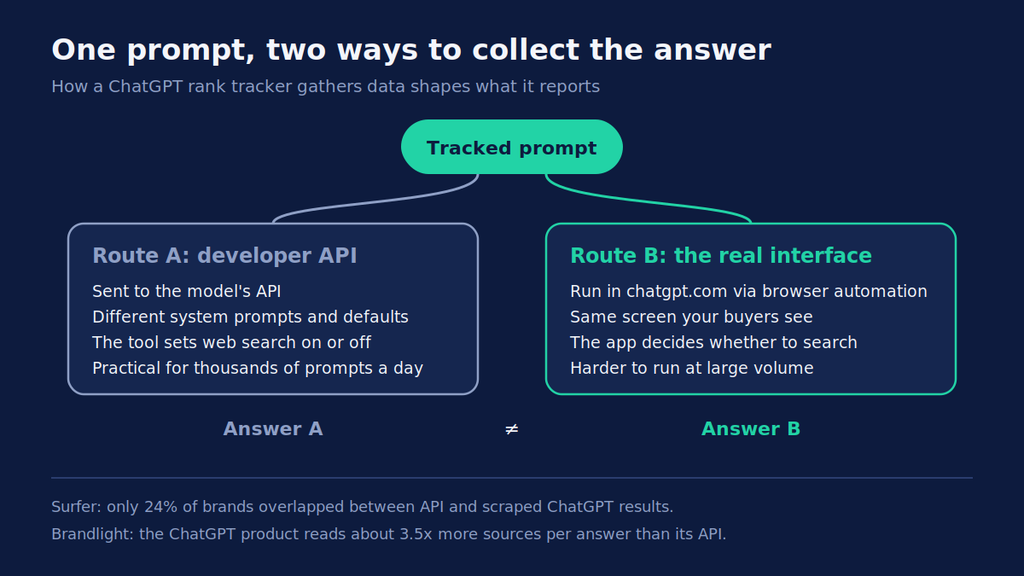
A tracker either sends your prompt to the model’s developer API, or it runs the prompt through the consumer product (chatgpt.com, perplexity.ai) using browser automation.
These aren’t the same product. Windsor’s write-up notes the API and the app ship with different system prompts and defaults, and the ChatGPT app decides for itself whether to search the web. An API-based llm rank tracker is describing the API. Your buyers use the app.
The gap is wide in every study we found. Surfer’s comparison saw only 24% of brands overlap between API and scraped ChatGPT results. A UK banking study by Genezio found bank-owned sites made up 36% of API citations but just 6.1% in the interface, while comparison sites flipped the other way (32.2% in the interface, 11% via API). And Brandlight’s research found the ChatGPT product reads about 3.5 times as many sources per answer as its API.
One honest caveat: Surfer, Genezio and Brandlight all sell interface-based tracking, so they have a horse in this race. Windsor doesn’t sell a tracker. That’s why its data anchors the worked example below.
One answer is mostly noise
Even with a perfect method, a single response tells you very little.
When SparkToro and Gumshoe had 600 volunteers run 12 prompts nearly 3,000 times, the odds of getting the same brand list twice were under 1 in 100. Same list in the same order? Closer to 1 in 1,000. What did hold steady was how often a brand appeared across many runs.
So a ChatGPT rank tracker that samples once a day and one that samples twenty times will drift apart by chance alone. Neither is lying. They’re just rolling the dice a different number of times.
Where the prompts come from
Some trackers run the prompts you write. Others mine huge prompt databases from search data. Ahrefs builds Brand Radar’s index from Google’s People Also Ask questions and its keyword database, and Semrush sources prompts from AI clickstream and keyword data. Those prompts read like search queries, not like the messy, chatty way people actually talk to ChatGPT.
Different prompts, different answers. Different numbers.
The worked example: same brands, two trackers
Here’s the disagreement in actual numbers.
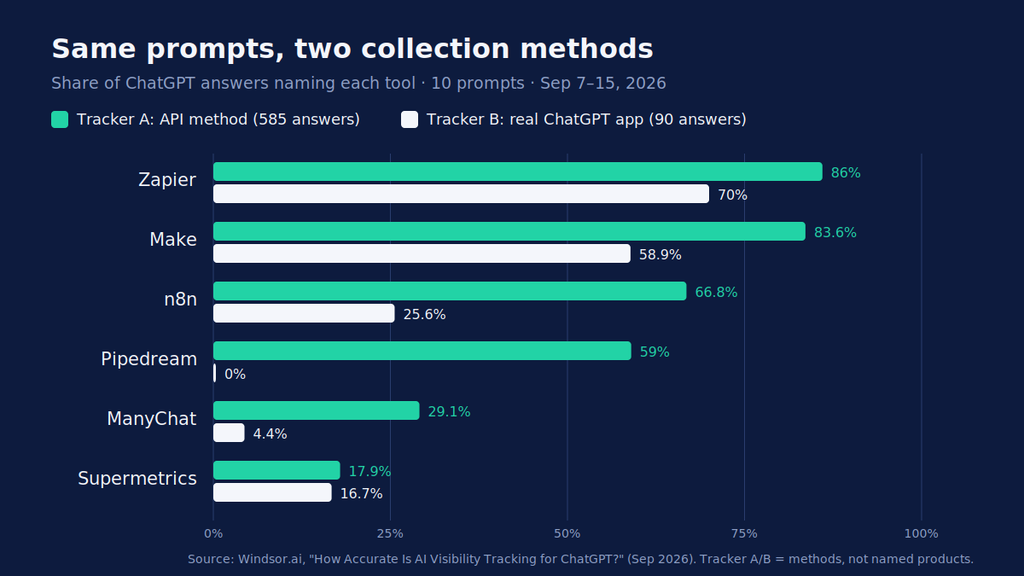
The setup. Windsor ran 10 direct prompts (“best tools to connect [platform] to ChatGPT”) from September 7 to 15, 2026. One side used the API (gpt-5-mini, web search on) and collected 585 answers. The other used a real logged-in ChatGPT account in fresh temporary chats and collected 90.
Now picture two trackers. Tracker A collects through the API, the cheap and scalable route. Tracker B collects from the app, the route Profound, Peec AI and Otterly say they use. To be clear: Tracker A and B are labels for the two methods, not named products. Every figure below is what Windsor measured for that method.
| Brand | Tracker A (API method) | Tracker B (app method) |
|---|---|---|
| Zapier | 86% of answers | 70% |
| Make | 83.6% | 58.9% |
| n8n | 66.8% | 25.6% |
| Pipedream | 59% | 0% |
| ManyChat | 29.1% | 4.4% |
| Supermetrics | 17.9% | 16.7% |
Put yourself in Pipedream’s marketing seat for a second. Tracker A says you’re in roughly six of every ten answers. Nice. Tracker B says ChatGPT never names you. Both reports are accurate about what they measured.
n8n has a similar problem in a quieter way. A 41-point gap is the difference between “we’re a category leader” and “we’ve got work to do.”
Position flips too
Mention rate isn’t the only thing that moves. Zapier’s average position was 3.5 on the API side and 2.1 in the app. When the app named Zapier, it opened the answer with it 51% of the time. The API did that just 27% of the time.
And which method “favors” a brand changes from prompt to prompt. On the Google Ads prompt, the API opened with Zapier 75% of the time versus 17% in the app. On the LinkedIn prompt it reversed: 62% API, 89% app.
Neither tracker agrees with itself
Here’s the part most tool pages skip. Repeat answers to the same prompt shared, on average, only 29% of their named tools on the API side and 36% in the app. Zapier’s API position moved by 1.7 places between calls made hours apart on the same day.
Prompt wording matters just as much. When Windsor used open phrasing (“how do I connect [platform] to ChatGPT”), 57% of app answers named no tool at all, often because the app asked a clarifying question instead. Only 7% of API answers named no tool.
What to take from it
Look at Supermetrics: 17.9% versus 16.7%. Its number barely moved between methods. That’s what a trustworthy signal looks like.
If your brand holds steady across methods and prompt phrasings, believe it. If it swings 40 points, you’re hearing the method talk, not the model.
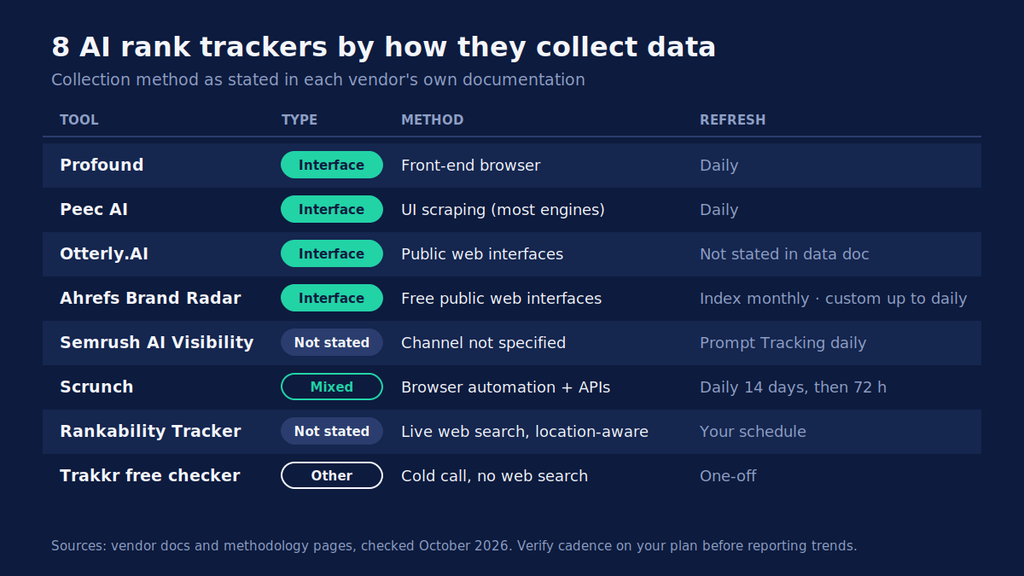
8 ChatGPT and Perplexity rank trackers, compared by methodology
Every ChatGPT rank tracker below covers ChatGPT, and most also cover Perplexity. The methodology column comes from each vendor’s own documentation, because third-party lists get this wrong. One comparison site we read describes Profound as API-based, while Profound says the opposite.
| Tool | How it collects (vendor-stated) | Refresh | Prompt source | Best fit |
|---|---|---|---|---|
| Profound | Front-end browser, not API | Daily | Your prompts | Enterprise teams |
| Peec AI | UI scraping for most engines | Daily | Your prompts | Multi-market brands |
| Otterly.AI | Public web interfaces, not API | Not stated in its data doc | Your prompts | Small teams starting out |
| Ahrefs Brand Radar | Free public web interfaces | Index monthly (90-day window); custom prompts up to daily | People Also Ask + keyword database | Existing Ahrefs users |
| Semrush AI Visibility | Channel not specified | Prompt Tracking daily; database monthly | Clickstream + keyword data, or your prompts | Existing Semrush users |
| Scrunch | Browser automation and official APIs, per platform | Daily for 14 days, then every 72 hours | Your prompts | Teams wanting a mix |
| Rankability Tracker | Live web search enabled, location-aware | Your schedule | Your keywords | ChatGPT citation position |
| Trakkr free checker | Cold model call, no web search | One-off | Derived from your site | Quick free gut check |
Profound
Profound says it runs prompts daily through each engine’s front-end, not through APIs. It’s aimed at large brands, and it pairs tracking with extras like AI crawler analytics. Pick it if you need breadth across engines and markets.
Peec AI
Peec’s docs are refreshingly blunt. It uses UI scraping, runs prompts daily, and on most platforms lets the platform decide which model to use and whether to search. That’s closer to a real user session. It also means your data inherits the app’s moods.
Otterly.AI
Otterly says it posts prompts through each platform’s website rather than an API. It’s a sensible entry point for a small team testing a handful of prompts. Confirm the run cadence on your plan before you build a weekly report on it.
Ahrefs Brand Radar
Brand Radar runs prompts through the free public interfaces but sources them from search data, and its main ChatGPT and Perplexity index refreshes monthly. Great for market-level share of voice. Weaker for “did last week’s update move us?” Use custom prompts for that.
Semrush AI Visibility Toolkit
Semrush’s Prompt Tracking checks your chosen prompts daily on a target platform and location, much like its classic Position Tracking. Its documentation doesn’t say whether that’s API or interface collection. Ask before you compare its numbers with anything else.
Scrunch
Scrunch openly mixes browser automation and official APIs depending on the platform. That’s honest, but it means two engines in one dashboard may be measured two different ways.
Rankability Tracker
Rankability’s ChatGPT rank tracker queries ChatGPT with live web search on and records where you sit among cited sources, at $99 a month. Useful if citation position is your KPI. Just remember the worked example: an API-style reading can diverge from the app.
Trakkr free AI rank checker
Trakkr’s free checker polls the model cold, with no web search. Handy for a two-minute gut check. It’s a third kind of measurement, though, so don’t compare it with either tracker above.
Want tools that go beyond tracking? We’ve covered it in our roundup of the best LLM optimization tools for AI visibility.
Perplexity rank tracking needs a different lens
Perplexity behaves more like a search engine that writes. It shows its sources as numbered citations. But there’s no fixed “position 1” to rank for.
So good perplexity rank tracking asks a simpler question. Is your URL in the cited set? And how often, across many runs?
Mentions still matter. Citations matter more here, because that’s where the clicks come from. A tracker that only scans the answer text for your brand name misses half the story.
The API trap shows up here too. Brandlight tested Perplexity’s Sonar Pro API against perplexity.ai and saw the same kind of mismatch. Surfer found API and interface gaps on Perplexity that looked a lot like its ChatGPT results. So when a tool reports Perplexity citations, ask where they came from. The API? Or the site your buyers use?
How to pick (and test) a ChatGPT rank tracker
Start by asking any ChatGPT rank tracker vendor the questions its sales page avoids. A methodology guide on metehan.ai suggests asking for the collection method channel by channel, and how many runs sit behind each rate.
Then test it yourself. Take five of your prompts and run each one five times in the real products, from a clean profile in your target country. Compare what you see with the dashboard. If they don’t line up, you’ve learned something useful before signing an annual contract.
A few rules make the data usable:
- Track visibility rate, not position. SparkToro’s research shows rate is the more stable number.
- Keep one tool per trend line. Mixing an API tracker and a UI tracker in one chart creates fake movement.
- Write prompts the way buyers talk. Open versus direct phrasing changed Windsor’s results dramatically.
Finally, close the loop. A tracker only tells you that you’re missing. Fixing it means changing what ChatGPT can find and cite, which is where knowing what content LLMs actually cite helps. If visibility drops on topics you used to own, stale content is a usual suspect, and that’s the problem WordPattern was built to catch.
Pick the method first, then the tool
Every ChatGPT rank tracker is making a measurement choice on your behalf. API or interface. One sample or many. Your prompts or someone’s database.
None of those choices is wrong. Mixing them up is. Decide which surface you care about (for most marketers, it’s the app your buyers open), pick a tool that measures that surface, and read its numbers as rates over many runs.
Then spot-check it. Monthly. It takes an hour, and it’s the only way to know the number on your dashboard means what you think it does.
FAQs
It’s a tool that runs a set of prompts through ChatGPT on a schedule and records whether your brand is mentioned, whether your site is cited, and where you appear in the answer. Most also track competitors. Since answers vary run to run, the useful output is a rate across many runs, not a single rank.
They’re accurate about what they measure, which isn’t always what your customers see. API-based tools describe the API, and interface-based tools describe the app. Ask how a tool collects data and how many runs it uses, then compare its numbers with a few manual checks.
A few. Trakkr offers a free checker that asks the model cold, without web search, and several paid tools offer trials. Free checks are fine for a quick look. For trends you’ll report on, you need scheduled, repeated runs, which is what paid plans sell.
Google returns a fairly stable list of links, so “position 4” means something. An LLM rank tracker deals with answers that change almost every time you ask. It measures how often you appear across many runs, plus which sources get cited, rather than one fixed position.