

Here’s something most content teams haven’t fully internalized: 57% of all LLM citations in branded queries go to reviews, forums, and third-party social proof, not your blog, not your product pages, and definitely not your About Us page. Omniscient Digital held that number up against 23,000+ AI citations. It held.
Meanwhile, 93% of AI Mode sessions end without a click. The AI answer is the entire brand impression. If your content isn’t surfacing inside ChatGPT, Perplexity, or Gemini responses, you’re invisible at exactly the moment someone decides what they think of your brand.
So what earns an LLM citation? Less about writing more. More about writing the right kind.
How LLMs Actually Choose What to Cite?
AI models don’t browse the internet and pick what they like. They run a retrieve-rank-extract-attribute pipeline. The model retrieves candidate pages, ranks them on relevance and how cleanly they can be pulled from, extracts the facts, and tags the source. Rankio’s research team breaks this down in detail – structure is a primary ranking signal, not a styling preference.
Pages with direct answers, tables, bullet points, and clear headers get cited more often. The RAG pipeline lifts from them cleanly. A dense wall of prose forces the model to paraphrase on the fly, and when it does that, it often just moves on.
There’s a second filter. ZipTie.dev calls it the information gain mechanism: content that repeats what other sources already say scores lower. Original analysis and proprietary data create a moat aggregators can’t replicate. Write original things. Structure them clearly.
The Content Types LLMs Cite Most
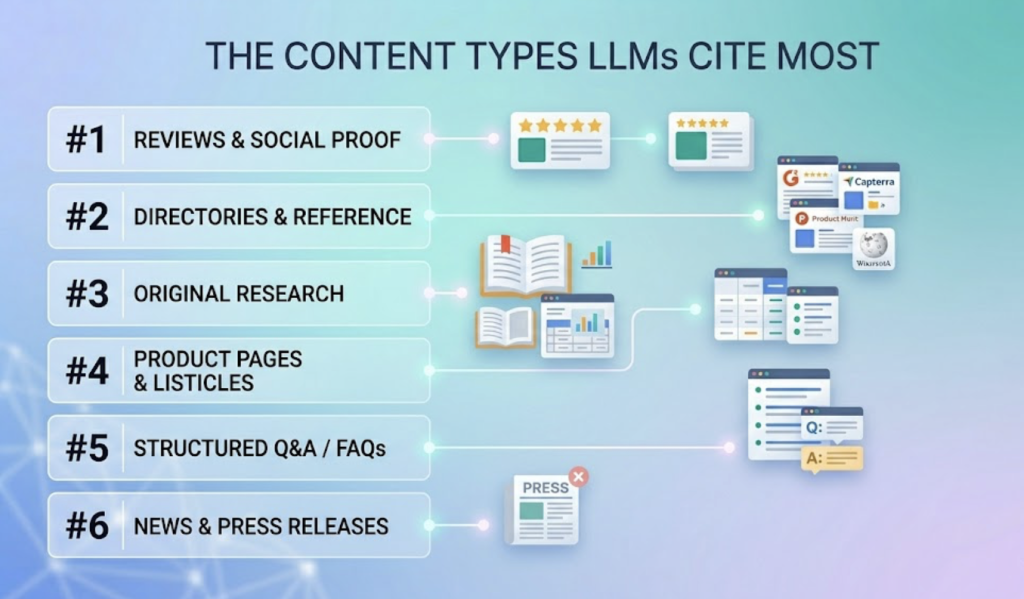
Here’s the actual citation hierarchy, drawn from large-scale studies across 2025 and 2026.
1. Reviews, Listicles, and Social Proof – ~57% of Branded Citations
This surprises people every time.
When Omniscient Digital analyzed 23,000+ citations, reviews and social proof content took the top spot by a wide margin – customer reviews, forum discussions, comparison listicles, G2/Capterra profiles, and case studies. Combined: 57% of branded query citations. Not brand-owned content. Third-party validation.
Makes sense when you think about it. When someone asks “is X worth it?” the model needs evidence, not marketing copy. Reviews carry trust signals it can actually use.
Perplexity takes this furthest. 17% of its citations come from discussions and community platforms, more than double any other LLM. Reddit threads, user Q&As, and community forums are real currency there.
2. Directory Sites and Reference Pages – ~17% of Branded Citations
Wikipedia, Product Hunt, G2, Capterra, software documentation hubs – places that summarize brands in structured, neutral language. These rank second.
Brand profiles on third-party sites regularly get cited over the brand’s own homepage. The brand’s About page is promotional; a G2 profile is structured data. Claim your listings, fill out every field with specific language, and treat those profiles as citation targets, not administrative tasks.
3. Educational Content and Original Research
For informational queries, articles and how-to guides get cited 2.7x more than other content types. That’s Wix AI Search Lab’s finding across 75,000 AI answers.
Original data is the differentiator here. Content with proprietary research or original statistics earns 30–40% higher visibility in LLM responses. If your post synthesizes what everyone else already wrote, you’re competing against the primary sources. Publish the primary source.
One data-backed piece can earn citations across dozens of AI queries for months. And if you’re tracking which content is losing momentum, refreshing those pages with current data is a fast way to stay in the citation pool.
4. Product and Commercial Pages
Purchase-intent queries look different. Listicle and comparison formats account for 40% of citations for commercial queries, nearly double what they earn elsewhere. Product and pricing pages get cited when they contain extractable answers: exact pricing, clear feature lists, direct comparisons.
“The leading platform trusted by thousands” gives the model nothing. “$49/month for up to 5 seats, API access included” does. Products with schema markup appear in AI recommendations 3–5x more frequently than those without.
5. Structured Q&A and FAQ Content
90% of LLM-cited content uses bullet points or lists. Not because LLMs appreciate good design — because the extraction pipeline lifts structured content cleanly.
FAQ sections do particularly well because each question-answer pair is a standalone extraction target. AI systems frequently cite individual FAQ answers without referencing the rest of the article. Write them self-contained. Direct answer in the first sentence, context after.
40% of content with Q&A formatting gets cited by AI. That’s a real lift from a structural choice that costs nothing.
6. News and Press – Consistently the Lowest Performer
Brand press releases and funding announcements show up least in citation data. They’re not evergreen, and AI retrieval windows move fast. A Series B announcement is buried within days.
Major news coverage on Bloomberg or TechCrunch is different – domain authority from those publications carries citation weight. But the press release your comms team published on your own domain? Omniscient Digital’s study places it among the lowest-performing content types for AI citations.
What the Data Says About Each LLM?
Most GEO advice treats all AI models as one. They’re not.
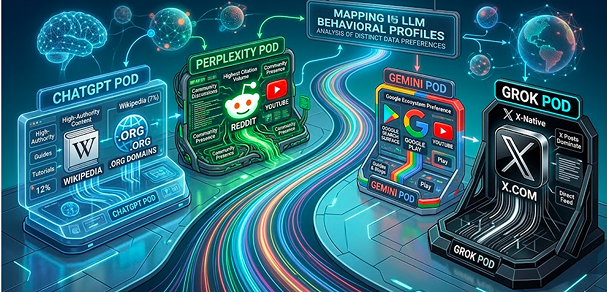
Spotlight analyzed 1.2 million citations across 8 LLMs and found distinct behavioral profiles:
- ChatGPT over-indexes on Wikipedia and .org domains. 7% of its citations come from Wikipedia alone. High-authority, well-sourced content wins here. Guides and tutorials account for 12% of its citations.
- Perplexity has the highest citation volume of any model in the dataset. Reddit dominates its citation profile, YouTube follows. Community presence isn’t optional if Perplexity visibility matters to you.
- Gemini favors the Google ecosystem — Google Play, YouTube, Google Search surfaces. Blogs and guides do well here (16–17% of Gemini citations).
- Grok is X-native. Its citation of X.com posts runs at a rate no other model matches. Brands with an active, authoritative X presence have a real Grok advantage.
Practical takeaway: find out which model your audience uses most. Optimize for that model’s behavior specifically.
The Surprising Losers
FAQ pages show up constantly in GEO advice. The logic sounds right: your questions match user queries, you’ve got schema, you’ve got direct answers. But Omniscient Digital’s data puts FAQ pages and brand foundation content among the lowest citation earners for branded queries.
Why? When someone asks an AI about your brand, they want to know if it works, how much it costs, and whether real people use it. Your FAQ doesn’t answer “how does it compare to competitors?” Reviews, directories, and product pages do.
Video follows the same pattern. The model can’t extract text from a video. User-generated review videos build indirect social proof that eventually gets cited, but publishing brand videos specifically to boost LLM citations is a weak strategy based on current data.
The Signals That Actually Unlock Citations
Content type is half the equation. These signals run across all of them:
Freshness: 76.4% of ChatGPT’s most-cited pages were updated within the last 30 days, per Digitaloft research. Updating means substantive changes – new data, revised examples, added context. A year swap in the headline doesn’t register. This is exactly where a content decay monitoring workflow helps: catching which pages are losing citation-readiness before they drop off entirely.
Author credentials: 74.76% of LLM-cited content shows explicit author credentials. Named experts, linked bios, credentials in schema – these E-E-A-T signals travel directly into AI citation selection. Anonymous content is at a structural disadvantage.
Topical authority over raw domain authority: A focused specialist site can outrank a major publication for LLM citations in its niche. AI models are getting better at recognizing expertise. A supply chain logistics blog can beat Forbes for supply chain queries. Depth in one area beats surface coverage of everything.
Extractable structure. Tables, bullets, numbered steps, labeled sections. Every formatting choice that makes a reader’s life easier also makes the RAG pipeline’s extraction cleaner. Format for extraction first. If you want to signal your best-structured pages to AI crawlers directly, building an llms.txt file is a useful technical step on top of content quality.
Conclusion
The citation hierarchy rewards specific things: third-party trust signals, original data, structured formatting, named expertise, and recently updated content.
Two investments unlock the most LLM visibility for most brands – building review and community presence on third-party platforms, and publishing original, data-backed content at least quarterly. The structural work (bullets, schema, FAQ formatting) is table stakes. Do it. But don’t mistake structure for substance.
Content that earns citations has something worth citing.
FAQs
Not reliably. Google and LLMs share some signals, domain authority, freshness, E-E-A-T — but their behavior diverges. LLMs over-index on reviews, directories, and structured content because they need extractable evidence, not ranking-worthy pages. A page that ranks #1 on Google might not be the one an LLM cites.
It can, but only if it has original data or analysis that can’t be found elsewhere. Generic synthesis posts lose to the primary sources they’re summarizing. Proprietary benchmarks, original surveys, and data-backed how-tos consistently outperform.
Tools like Peec AI, Rankio, Wellows, and Spotlight track brand citations across ChatGPT, Perplexity, Gemini, and others. Running your brand name as a monitored query shows which content types earn references and where competitors are taking citations you’re missing.
Yes, significantly. ChatGPT favors Wikipedia and high-authority .org domains. Perplexity over-indexes on Reddit and community content. Gemini leans into the Google ecosystem. Knowing which model your audience uses most changes where you focus your content investment.