
Semrush keeps your daily keyword positions for 60 days. After that, it collapses them into one weekly data point, and it holds those weekly points for 140 weeks. That’s right there in Semrush’s own help docs.
Not a scandal. Just a detail.
But try explaining it to a CFO who wants day-level rankings from last year’s Black Friday week.
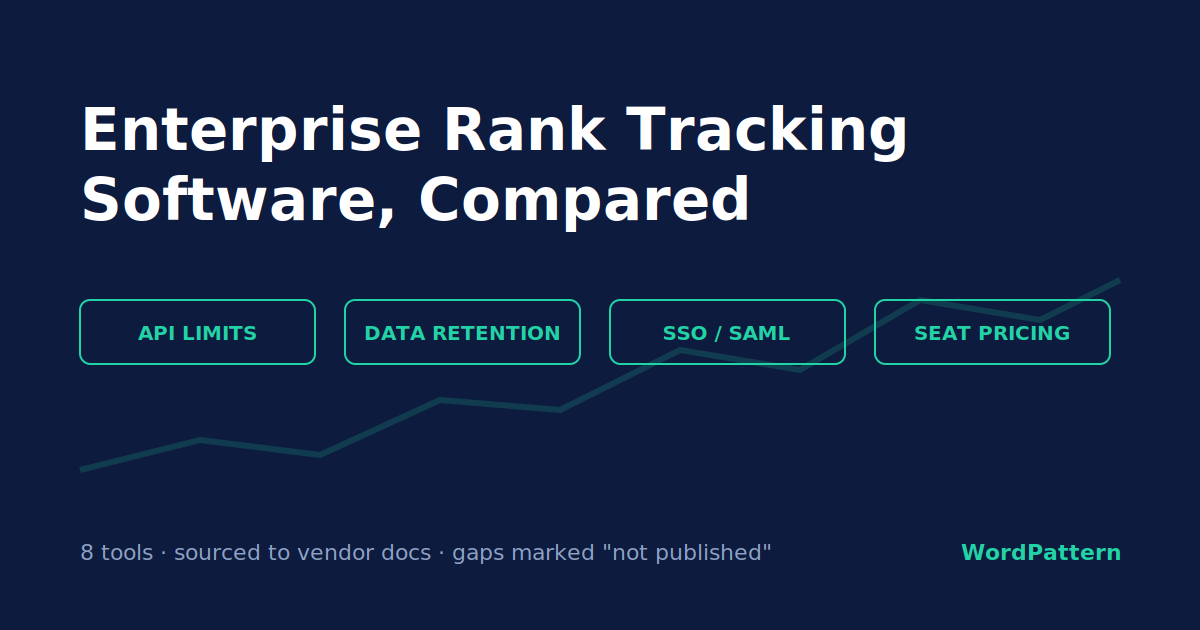
That’s the kind of detail that decides enterprise rank tracking software deals. Not a shinier dashboard. It comes down to four questions your IT, security and finance teams will ask anyway: How many API calls do we get? How long is history kept? Is SSO included? And do we pay per seat?
Almost nobody puts those in a table. So we did, using vendor docs and pricing pages, and we wrote “not published” wherever a vendor makes you ask sales.
The four criteria, side by side
Here’s how eight popular enterprise rank tracking software options stack up. We checked every cell against the vendor’s own documentation or pricing page in late September 2026. Prices are list prices in USD per month. “Not published” means we couldn’t find it in public docs, not that the feature is missing.
| Tool | API rate limit | Data retention | SSO / SAML | Seat pricing | Starting list price |
|---|---|---|---|---|---|
| AccuRanker | 100 requests/min; one request can return a full keyword set with history | Full history retrievable via API; no cap stated | Not published | Unlimited users and domains (listed on Enterprise) | $224 (Professional); Enterprise custom above 25K keywords |
| Advanced Web Ranking | 2,000 calls/hour; no per-call fees (Agency plan and up) | Data deleted 90 days after cancellation; unlimited history reported on Ent Plus | Ent Plus 50k only | Unlimited users on every plan | $139 (Pro); $980 for SSO tier |
| STAT (Moz) | 1,000 calls/day by default | Not published | Not published | Not published | From $720 for 6,000 keywords, standard API included |
| seoClarity | Not published; API is a paid add-on below top tiers | Deleted keywords keep their history | Not published | Unlimited users | Rankings: custom (2,000-query minimum); Enterprise from $4,500 |
| Conductor | 5,000 calls/day and 2 calls/sec per key | Not published | SAML, SP-initiated only | No user limit | Custom |
| BrightEdge | Not published | Not published | Not published | Not published | Custom |
| Semrush (Business) | 10 requests/sec, 10 at once; API units bought separately | Daily for 60 days, then weekly for 140 weeks | SAML on Guru and Business, enabled by support | $100 per extra user | $499.95 |
| Ahrefs Enterprise | 60 requests/min default, plus load-based throttling | Unlimited historical data | Included | Unlimited extra users | From $1,499 |
Two things jump out. Seat pricing is mostly a non-issue at the top end (Semrush is the only one here with a published per-seat fee). And API limits are all over the map, partly because every vendor counts them differently.
Why these four columns matter more than features
Feature lists for SEO search engine rank tracking software have converged. Daily updates, mobile and local tracking, SERP features, some flavor of AI Overview tracking. Everyone has a version.
The four columns above are where enterprise rank tracking software actually diverges, and where year-two surprises come from.
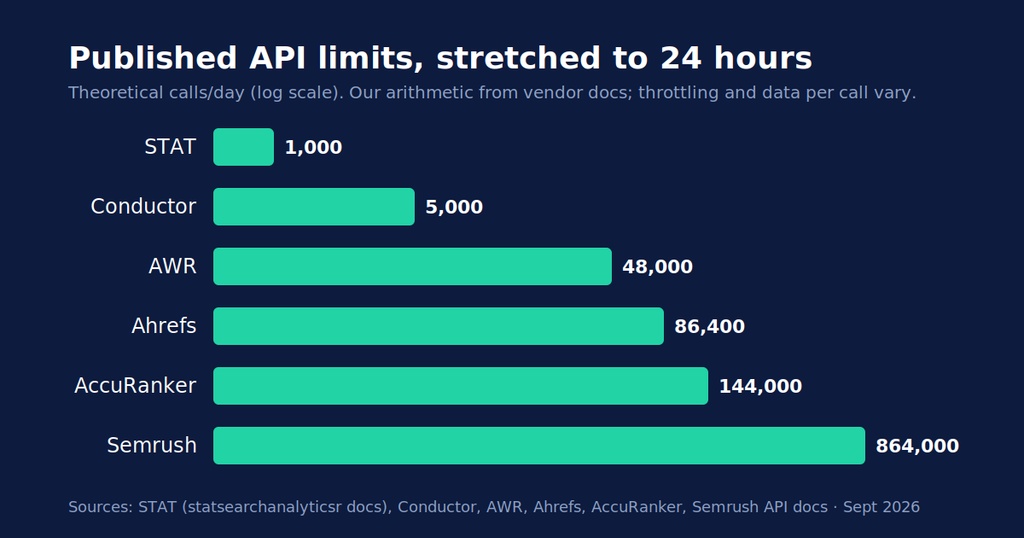
API limits. Most enterprise teams don’t live in the rank tracker’s UI. Data flows into BigQuery, Looker or a homegrown dashboard. So the limit matters, and you need to normalize it. Conductor allows 5,000 calls a day. STAT’s default is 1,000 a day. AWR allows 2,000 an hour, which works out to as many as 48,000 a day.
The catch? A call isn’t a fixed amount of data. AccuRanker says a single request can pull your entire keyword set with full history. So ask how much one call returns, not just how many you get.
For a rough sense of scale, here’s each published limit stretched to a 24-hour ceiling. These are our arithmetic, not vendor promises, and throttling will usually bite first:
| Tool | Published limit | Theoretical calls per day |
|---|---|---|
| STAT | 1,000/day | 1,000 |
| Conductor | 5,000/day (and 2/sec) | 5,000 |
| AWR | 2,000/hour | 48,000 |
| Ahrefs | 60/min | 86,400 |
| AccuRanker | 100/min | 144,000 |
| Semrush | 10/sec | 864,000 (each call also spends paid API units) |
Retention. Year-over-year reporting needs at least 13 months at the same granularity. Also check what happens when someone deletes a keyword. In Semrush, its history goes with it. In seoClarity, the history stays and you can still view it with a filter.
SSO. This is about offboarding as much as convenience. When someone leaves, IT wants one switch. Also check the flow type: if your team launches apps from an IdP portal, an SP-initiated-only setup (like Conductor’s) behaves differently.
Seats. Rank data is most useful when merchandising, content and regional teams can all see it. Per-seat pricing quietly discourages that.
The tools, one by one
Each entry below sticks to what the vendor documents. Where a claim only shows up on third-party sites, we say so.
AccuRanker
AccuRanker is a pure rank tracker, and its API is the strongest argument for it. The pricing page lists Professional at $224/month, Expert at $764/month with unlimited read API, and custom Enterprise pricing above 25,000 keywords. Enterprise adds the write API, BigQuery, raw SERP HTML, unlimited users and domains, and a dedicated CSM.
The rate limit is 100 requests per minute. That sounds tight until you remember one request can return everything.
Gap: we found no public statement on SSO. Ask.
Advanced Web Ranking (AWR)
AWR has the most transparent pricing here. Every plan includes unlimited users and projects. The API comes with Agency ($279) and up, at a default of 2,000 calls per hour with no per-call fees.
Read the fine print on keywords, though. AWR’s pricing page defines one keyword unit as one weekly check. Daily tracking uses 7x the units. So the Ent Plus 50k plan ($980) covers about 7,100 keywords checked daily at default depth, not 50,000.
SSO, custom MSAs and SLAs, and security audits only show up at Ent Plus. Third-party pricing trackers also list unlimited historical rankings at that tier; confirm it in your contract.
STAT (Moz)
STAT is built for big keyword portfolios with daily SERP data. Moz’s vendor listing on GetApp puts pricing from $720/month for the first 6,000 unique keywords, with standard API access included.
The default API allowance is 1,000 calls per day, according to the statsearchanalyticsr package docs. Bulk exports get around much of that. Higher limits go through STAT support.
We couldn’t find public answers on SSO, seats or retention.
seoClarity
seoClarity offers unlimited users and a rank-tracking-only package. Its pricing page lists Rankings as custom-priced with a 2,000-query minimum, and Enterprise from $4,500/month. API access can be added to lower tiers for a fee.
One caution. The page’s own footnote says those package prices were representative as of October 2022. Treat them as a floor, not a quote.
Retention behavior is friendly: deleted keywords keep their history. API rate limits and SSO weren’t in the public docs we checked.
Conductor
Conductor publishes its API limits plainly: 5,000 calls per day and 2 per second, per key. Polling an async query counts against both. That’s fine for nightly syncs. It’s tight if several teams share one key.
There’s no cap on users. SSO runs on SAML, but only SP-initiated flows are supported. Pricing is custom.
BrightEdge
BrightEdge is a long-standing enterprise platform. But for this table, it’s four blanks. We couldn’t find public figures for API limits, retention, SSO or seat pricing.
That doesn’t make it a bad pick. It means every one of the questions in the next section belongs in your RFP.
Semrush
Semrush is the one most teams already have. On Business ($499.95/month) you get 5,000 tracked keywords across 40 projects, per Semrush’s limits page. Each extra user costs $100 a month on that plan.
The API allows 10 requests per second and 10 at once, but units are bought separately. SAML SSO is available on Guru and Business, switched on by Semrush support.
Then there’s the retention rule from the intro. Daily for 60 days, weekly after that.
Ahrefs Enterprise
Ahrefs Enterprise is the cleanest on governance. Per Ahrefs’ pricing guide, it starts at $1,499/month and adds SSO, unlimited extra users and unlimited historical data.
The trade-off is volume. Rank Tracker tops out at 10,000 keywords on Enterprise (more can be bought). The API runs at 60 requests per minute with load-based throttling on top. Rank Tracker endpoints don’t eat API units, which is a nice touch.
The sticker price on enterprise rank tracking software is rarely the bill. Four line items tend to show up later.
Keyword units. AWR prices in weekly checks, so daily tracking costs 7x. Ahrefs Enterprise includes 10,000 Rank Tracker keywords and sells more as an add-on.
API units. Semrush sells API units separately, in packages from 2 million to 20 million units. Budget them alongside the plan.
API access itself. seoClarity can add API access to lower tiers, but for an extra fee.
History imports. Switching tools? seoClarity notes that importing your old ranking history may cost extra. Ahrefs and AWR both offer import tools. Ask what’s free.
Model these against your real keyword count and refresh schedule. A cheap plan at weekly refresh can turn expensive at daily.
What to ask when a vendor says “contact sales”
Blanks in an enterprise rank tracking software comparison aren’t a dealbreaker. They’re a to-do list. Put these in writing before you sign:
- What’s the API rate limit per key, per day and per second? Can we have more than one key?
- How much data does one call return? Is there a bulk export?
- How long do you keep daily granularity? When does it roll up to weekly?
- What happens to history when a keyword is deleted, or when we cancel?
- Is SAML SSO included at our tier? SP-initiated, IdP-initiated, or both? Is SCIM supported?
- Are seats unlimited? If not, what does each added user cost at renewal?
- Is the price on your website current?
Get the answers in the order form, not just the sales deck.
Which enterprise rank checker fits which team
There’s no single best enterprise rank tracking software. There’s a best fit for how your team works.
If your rank data lives in a warehouse, start with AccuRanker or AWR. Both publish real API limits and don’t charge per seat. Just do the AWR keyword-unit math for daily tracking.
If IT governance is the gate, Ahrefs Enterprise gives you SSO, unlimited users and unlimited history on one plan. Conductor is the other option with documented SSO and no user cap.
If you want rank tracking inside a full SEO platform, seoClarity, Conductor and BrightEdge are the usual shortlist. Budget time for the RFP, since much of their spec sheet sits behind sales.
Already on Semrush? It can work as your enterprise rank checker if weekly history beyond 60 days is acceptable and your seat count is small.
For the wider stack, see our guide to the best enterprise SEO tools for 2026. And if you’d rather hand the whole program to a partner, here’s our breakdown of enterprise SEO firms.
Rankings show what dropped, not why
A rank tracker is a smoke alarm. It tells you a page slipped from position 3 to 11. It won’t tell you whether the page went stale, got outranked by a fresher competitor, or started fighting another page on your own site.
That’s a content problem, and it needs a page-level answer. When the alarm goes off, an enterprise content audit shows which pages are decaying and what to refresh first.
Pick the enterprise rank tracking software that passes procurement. Then make sure someone owns what happens after the alert.
How we built this comparison
We started from the brief’s four criteria and went straight to primary sources: pricing pages, API docs and help centers. Where only a third-party site had a number, we either labeled it (“reported”) or left the cell as “not published.” We dropped claims that conflicted with the vendor’s own page.
Prices change often. Every figure here reflects what was live in late September 2026. If a vendor updates its docs, the table should change too.
FAQs
Enterprise rank tracking software is a rank tracker built for large keyword sets across many markets, devices and domains. What separates it from standard tools is less about features and more about operations: API access for warehouses and BI tools, long history retention, SSO for IT, and pricing that doesn’t punish wide team access. Daily updates are table stakes now.
It depends on how much data each call returns. A nightly sync of one bulk export needs very few calls. Pulling keywords page by page needs thousands. Published defaults range from 1,000 calls a day (STAT) to 2,000 an hour (AWR), so map your workflow to calls before comparing.
Most on our list don’t. AWR, seoClarity, Conductor and AccuRanker’s Enterprise plan advertise unlimited users, and Ahrefs Enterprise allows unlimited extra users. Semrush is the only one that publishes a per-user fee: $100 per added user each month on its Business plan. STAT and BrightEdge don’t publish seat terms.
Sometimes. Both cover rank tracking inside a wider SEO suite. The limits are volume and history: Semrush Business tracks 5,000 keywords and rolls daily data to weekly after 60 days, while Ahrefs Enterprise includes 10,000 Rank Tracker keywords. Past that, a dedicated tracker is usually cheaper per keyword.
It varies, and some vendors don’t say. Semrush keeps daily data for 60 days, then weekly points for 140 weeks. Ahrefs Enterprise lists unlimited historical data. AWR deletes account data 90 days after you cancel. Ask whether deleting a keyword also deletes its history.