
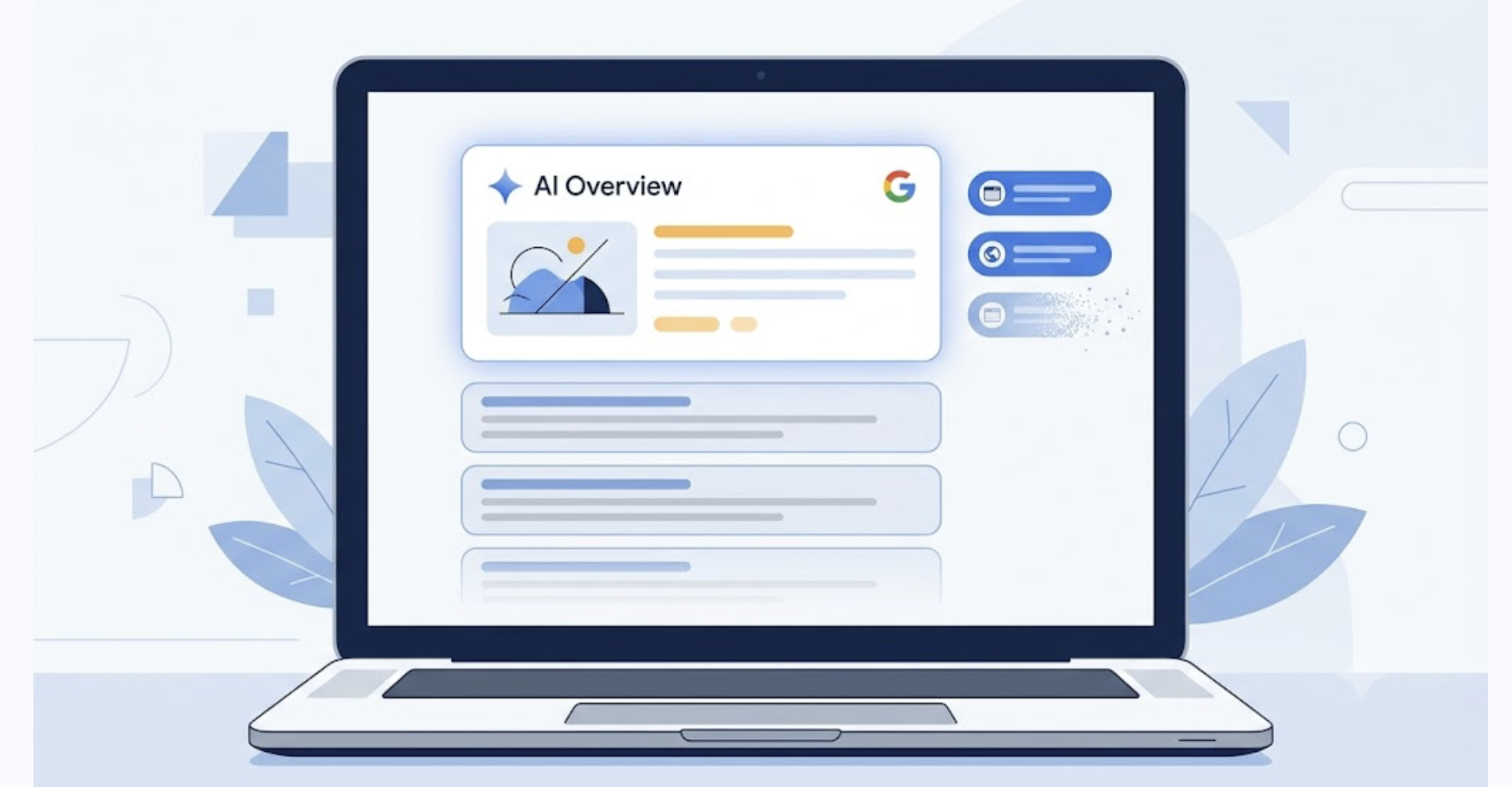
AIO stands for AI Overview, the AI-generated answer Google shows above its organic results, built from several sources and linking to the pages it cites. Some marketers also use AIO to mean “AI Optimization,” the wider practice of making content easy for AI systems to understand and quote. In SEO conversations, though, AIO almost always means Google’s AI Overviews.
That’s the easy part. The hard part is staying in that answer box. About 70% of the pages cited in a Google AI Overview get swapped out within two or three months, and those swaps don’t follow your organic rankings (Authoritas, via iPullRank). So you can earn a citation, do nothing wrong, and quietly lose it anyway.
This post covers both meanings and compares AIO with SEO, AEO, and GEO. Then it gets into the thing that actually matters: staying cited, not just getting cited.
What Does AIO Mean?
AIO stands for AI Overview. It’s Google’s AI-generated summary that appears above the classic blue links for a lot of searches, pulling from several sources and citing them.
That’s the definition most of the industry uses. But you’ll also run into writers who use AIO to mean “AI Optimization,” the broader work of making your site understandable and quotable by AI systems in general. Both meanings float around because they describe two halves of the same shift, so they get mashed together.
Quick myth to kill. AIO is not some new ranking algorithm sitting on top of Google. Google has confirmed that AI Overviews run on the same Search index and core ranking systems it already uses (Total Web Company, citing Google). No secret AI file. No proprietary markup. Your page still has to be crawlable, indexed, and actually useful before it can show up in an Overview at all.
The acronym soup around it, though? That’s worth untangling.
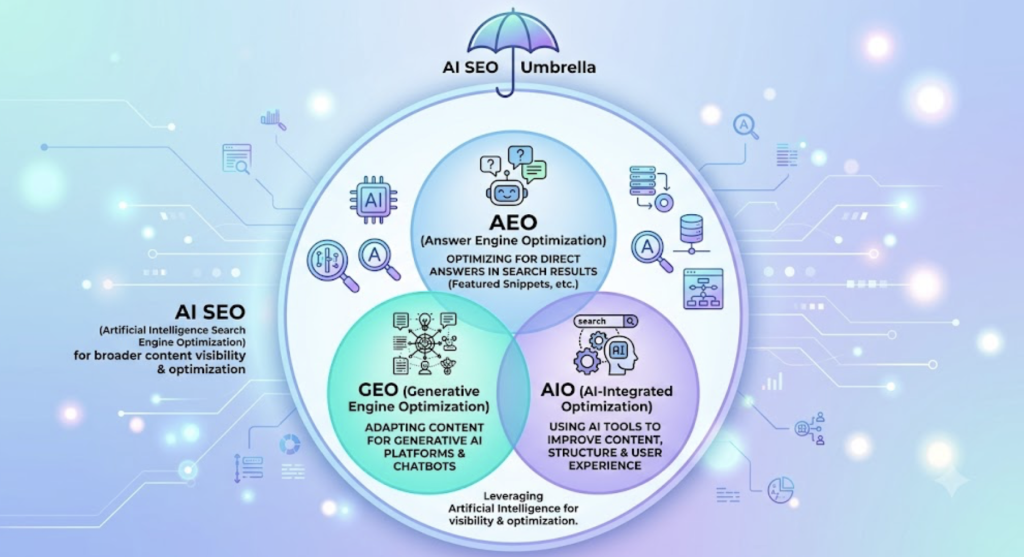
AIO vs SEO vs AEO vs GEO
Four acronyms, and each one answers the same question differently: where does your content show up, and what makes an engine pick it? Here’s how they compare.
| Term | Stands for | Focus | Where you show up | What winning looks like | How it relates |
|---|---|---|---|---|---|
| AIO | AI Overview (sometimes “AI Optimization”) | Google’s AI Overviews specifically | The AI-generated summary above Google’s organic results | Your page is cited as a source in the Overview | A Google-specific subset of AEO |
| SEO | Search Engine Optimization | Organic rankings in traditional search | The blue links on Google, Bing, and other search engines | Higher rankings and more clicks to your page | The foundation the other three depend on |
| AEO | Answer Engine Optimization | Any search surface that gives a direct answer | AI Overviews, featured snippets, People Also Ask, voice results | Your content is the answer pulled into the result | The parent category that AIO sits inside |
| GEO | Generative Engine Optimization | Generative AI tools as a category | ChatGPT, Perplexity, Gemini, Claude | Your brand or page is mentioned or cited in AI-generated responses | Overlaps with AEO but reaches beyond Google |
AI SEO is the umbrella over all of this: any optimization aimed at AI-driven search. AIO is the narrowest term in the set. And none of them replaces SEO, because AI Overviews run on Google’s existing index and ranking systems. A page that can’t rank can’t be cited.
What about featured snippets vs AI Overviews, since they look similar?
A featured snippet lifts one passage from one page. An AI Overview synthesizes an answer from several sources and links out to multiple. Different mechanics, same real estate above the blue links.
The practical takeaway is almost boring. You don’t need a separate playbook for each acronym. You need content that’s clear, easy to extract, genuinely authoritative, and fresh. That satisfies all of them at once.
How AI Overviews Actually Work
They didn’t appear out of nowhere. Google first showed this as the Search Generative Experience (SGE) at Google I/O in May 2023, then rebranded it to AI Overviews and rolled it out in the US in May 2024 (Wikipedia).
Which searches trigger one? Overwhelmingly informational ones. Ahrefs found that about 99% of keywords that surface an AI Overview carry informational intent (Ahrefs). That’s the exact intent good SEO has always chased, which is why AIO isn’t really a break from SEO so much as a new layer on it.
Now the counterintuitive bit. Getting cited in an Overview is not the same as ranking. A page can be cited without sitting in the top 10, and a page can rank top 10 without being cited at all (Stridec). And showing up in the AI Overview matters because information from AI has influenced real-world decisions by 78.5% of internet users (Clear Spark Digital).
One more mechanic worth knowing, because it changes how you write. Roughly 44% of citations get pulled from the first 30% of a page (Wix/Evertune, via Digital Applied). Your intro is doing almost half the citation work. Treat it that way.
What AIO Means for Your Traffic
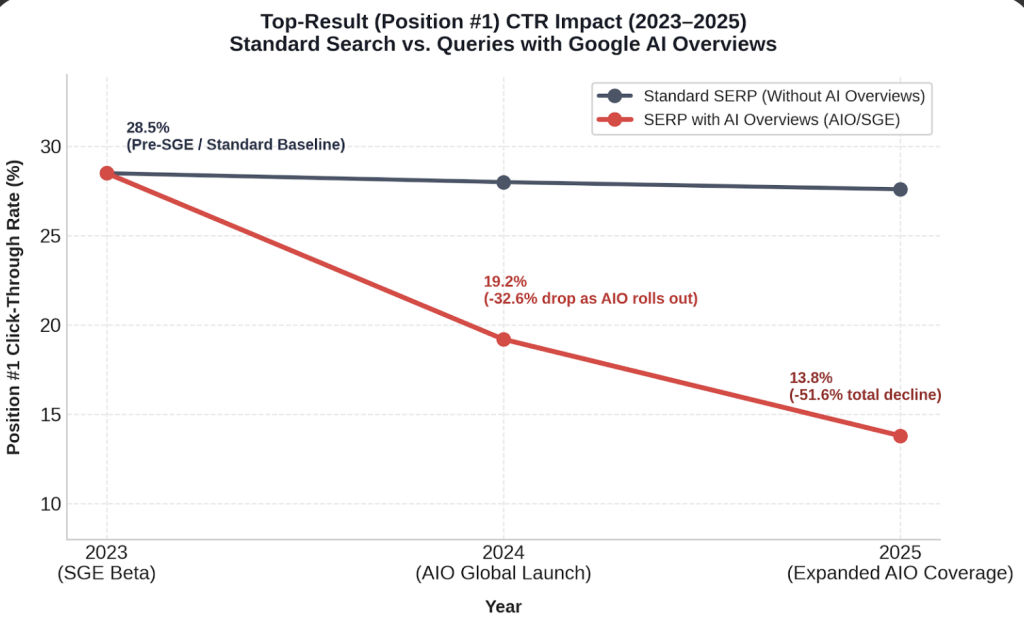
Here’s the uncomfortable number. When an AI Overview shows up, the top organic result loses roughly 34.5% of its clicks. That was Ahrefs’ April 2025 finding across 300,000 keywords (Ahrefs). Their December 2025 update put the hit at around 58% (Ahrefs update, via BusinessWire).
Ahrefs’ Ryan Law put it plainly: AI Overviews are already taking the majority of the clicks that used to reach top-ranking pages, and businesses are feeling the loss.
Don’t spiral, though. Informational queries take the hardest hit, and there’s a flip side. If you’re the source the Overview cites, you’re sitting in the new position zero. The click math changes, but visibility inside the answer becomes the prize. So the game isn’t “rank number one” anymore. It’s “be the cited source, and stay the cited source.” Which brings us to the part most guides skip entirely.
Why AIO Visibility Decays (The Part Everyone Misses)
Getting cited once feels like a win. It is. It’s also temporary.
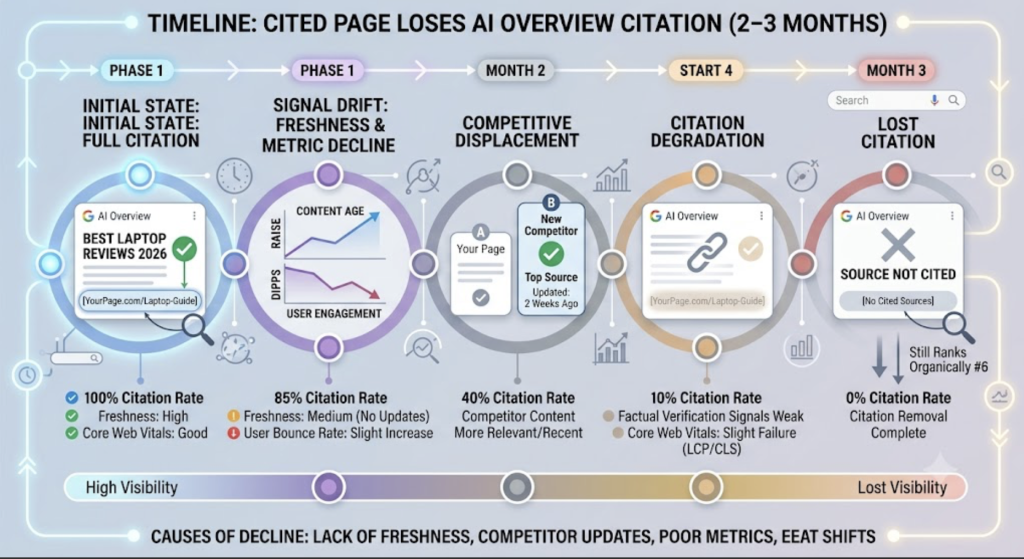
Remember that opening stat? Around 70% of the pages cited in AI Overviews rotate out over a two-to-three-month window, and the churn doesn’t track organic rankings (Authoritas). Your blue-link position can hold steady while your citation vanishes.
Why does this happen? Because AI citation works nothing like classic ranking. Rankings move slowly over a stable index. Citation sets rotate constantly as models reweight their preferred sources and lean toward fresher content (Profound). A different clock entirely.
There’s a nuance that makes it sneakier. Week to week, most citations actually hold steady. But when a domain does move, BrightEdge found the change is overwhelmingly a loss rather than a gain. Roughly 87% of the movement is decline (BrightEdge). So decay isn’t loud. It’s a slow leak you won’t notice unless you’re watching.
This is exactly why teams that treat AIO as a one-time project watch their early wins erode within a quarter or two (Knecht Strategies). AIO isn’t a task you check off. It’s a monitor-and-refresh habit.
How to Rank in AI Overviews (and Stay There)
So how do you actually get cited, then keep the citation? A handful of moves do most of the work.
Lead with the answer:
Put a clear, self-contained response to the query in your opening lines, and start each section the same way. That’s not a style preference. It’s where 44% of citations get extracted from (Wix/Evertune).
Structure for extraction:
Short, bounded paragraphs. Clean H2 and H3 hierarchy. A real FAQ with substantive answers, marked up with FAQPage schema. Overviews love pulling from tidy, clearly labeled chunks.
Build entity clarity and topical depth:
Name things explicitly, cover the topic across a cluster of pages instead of one lonely keyword page, and link out to authoritative sources. Overviews use topical authority to decide who’s trustworthy enough to quote.
Skip the word-count arms race:
This one surprises people. Ahrefs found almost no correlation between length and citation position (a Spearman coefficient around 0.04). The average cited page runs about 1,282 words, and more than half are shorter (Ahrefs, via Digital Applied). Padding your post to 4,000 words does nothing. Clarity does.
Now the part that closes the loop:
Freshness and refresh. AI systems strongly favor recently updated content, and refreshing an existing page often pays off faster than publishing something new. Some teams see movement in two to four weeks versus three to six months for fresh content to land (Stackmatix).
That’s the whole operating system for beating decay. Track which of your pages hold their citations and which are slipping, prioritize the ones losing ground, refresh them, and measure again. Doing that by hand across a big content library is brutal, which is the gap tools like WordPattern’s content decay detection are built to fill: spotting pages that are losing traction and refreshing them at the paragraph level before the citation disappears.
Common Misconceptions About AIO
A few myths worth putting down.
“AIO is a new ranking algorithm.” No. It runs on Google’s existing index and ranking systems. A presentation layer, not a new engine.
“AIO replaces SEO.” Also no. It sits on top of SEO. If your page isn’t crawlable, indexed, and useful, it can’t be cited in the first place. The fundamentals still gate everything.
“Once I’m cited, I’m done.” The most expensive myth of the bunch. Citations rotate out constantly, and the change is usually a quiet loss.
“Longer content wins citations.” Nope. Length barely correlates with anything here. Depth and clarity win every time.
Conclusion
So, AIO meaning, settled: it’s Google’s AI Overviews, the AI answer block above the results, and occasionally the broader idea of AI Optimization. Either way, it’s a layer on top of solid SEO, not a replacement for it.
The real lesson isn’t in the definition. It’s that citations get won and lost on a rolling basis. Treat AIO as something you check off once and you’ll watch your visibility leak away over a couple of months. Treat it as an ongoing loop of tracking, refreshing, and re-measuring, and you’ll be one of the few sources that actually sticks. The answer box is the new front page. Earning your place there is step one. Keeping it is the real work.
FAQs
AIO most often stands for AI Overview, Google’s AI-generated answer box that appears above the standard search results and cites its sources. Some marketers also use AIO to mean “AI Optimization,” the broader practice of making content easy for AI systems to understand and quote. Context usually tells you which one is meant.
Not quite. AIO is a layer that sits on top of SEO, not a replacement for it. Google’s AI Overviews run on the same index and ranking systems as regular search, so a page still has to be crawlable, indexed, and genuinely useful before it can be cited. Good SEO is the prerequisite; AIO is the extra visibility on top.
AEO (Answer Engine Optimization) targets answer surfaces broadly, including AI Overviews, featured snippets, and voice. GEO (Generative Engine Optimization) targets generative tools like ChatGPT and Perplexity. AIO is the narrow one, focused specifically on Google’s AI Overviews. Think of AEO as the parent category and AIO as a focused subset of it.
Lead with a clear, direct answer, since most citations get pulled from the top of the page. Keep paragraphs short and well-structured, add an FAQ with FAQPage schema, cover your topic in depth across related pages, and keep the content fresh. Clarity and recency matter far more than length.