
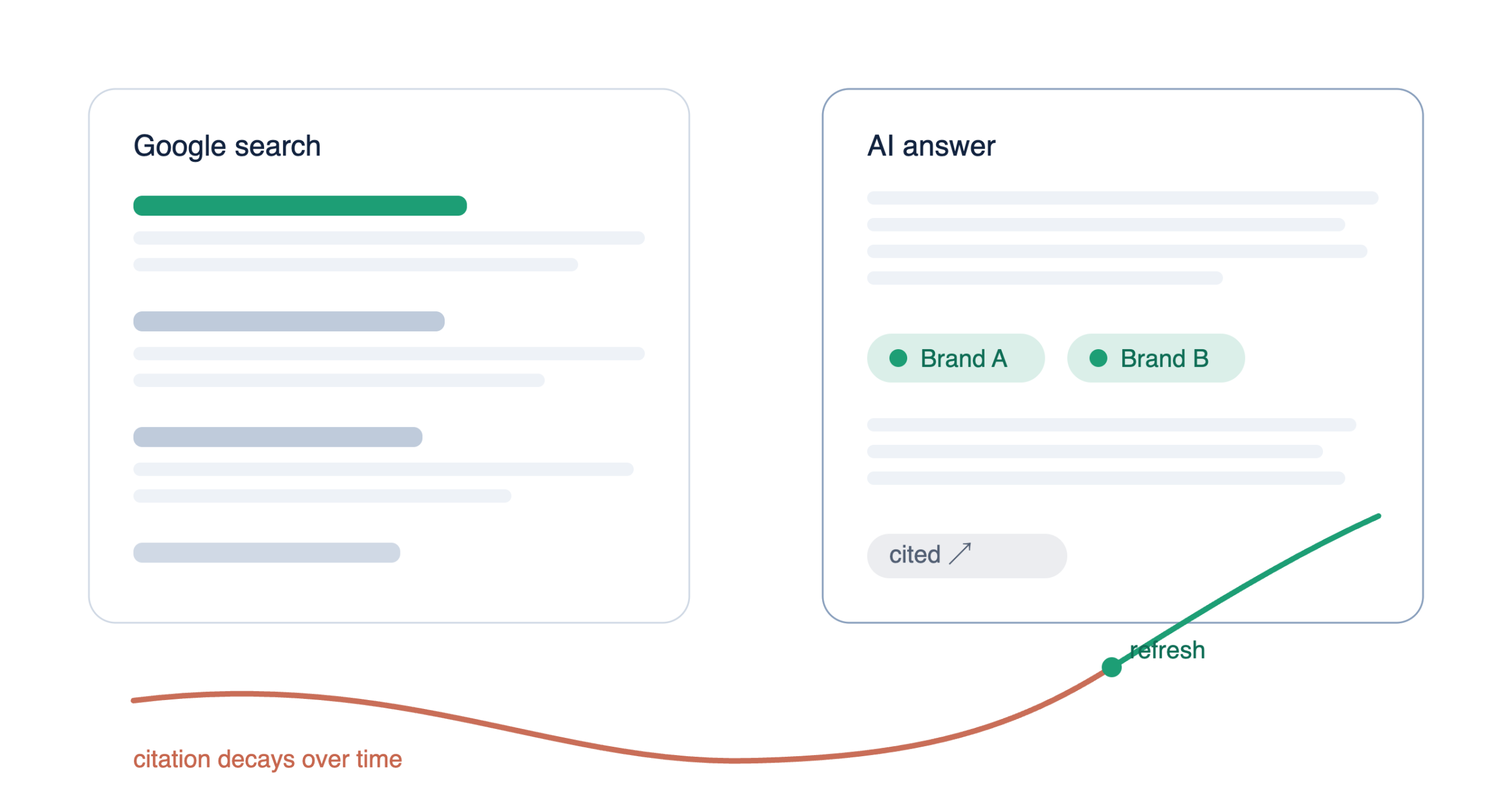
Run a question through ChatGPT five times and watch what happens to the brands in the answer. Only about 30% of them show up again in the very next response. Push to five runs and roughly 20% survive, according to the 2026 State of AI Search report from AirOps and Kevin Indig.
So here’s the problem you’re probably staring at. You rank fine on Google. Then someone asks Perplexity or ChatGPT the exact question your page was built to answer, and your brand isn’t there. You go looking for a fix, and you find eight nearly identical “best tools” lists that all recommend the same dashboard.
The thing those lists skip: these tools aren’t all doing the same job. Some measure. Some execute. And almost none deal with the fact that an AI citation you win today can quietly disappear by next quarter.
This guide sorts the best LLM optimization tools by the job you actually need done, with real pricing and a maintenance cadence so your visibility doesn’t slide out from under you.
What is LLM optimization?
LLM optimization is the practice of improving whether and how AI engines — ChatGPT, Perplexity, Gemini, and Google’s AI Overviews — mention and cite your brand in their generated answers. It’s the AI-era counterpart to SEO: instead of ranking blue links, you’re earning a place inside the answer itself. Practitioners also call it generative engine optimization (GEO) or answer engine optimization (AEO) — the goal is the same.
Two things set it apart from classic SEO. First, the target keeps moving: a citation you win this quarter can vanish the next as models re-retrieve fresher sources. Second, Google rank barely predicts it — Ahrefs found roughly 80% of LLM citations don’t appear in Google’s top 100 for the original query.
If you meant model-side work — fine-tuning, quantization, prompt engineering — that’s a different field. This guide is about your brand’s visibility in AI answers.
What is AI visibility?
AI visibility is how often, and how prominently, your brand appears in the answers generated by AI engines like ChatGPT, Perplexity, Gemini, and Google’s AI Overviews. Where traditional search visibility measures your position in a list of links, AI visibility measures whether you make it into the synthesized answer at all — and whether you’re named as a source.
It’s rarely one number. The engines disagree sharply: about 91% of citations show up in only one of ChatGPT, Perplexity, or AI Overviews (Growth Memo), so a single blended score can hide the fact that you’re missing from the one engine your buyers actually use. Useful AI visibility tracking breaks the metric out per engine, per prompt, and over time — because a citation you hold today can decay within a quarter.
| Tool | Price (starting) | Best for | Engines tracked | Free tier |
|---|---|---|---|---|
| Profound | ~$99/mo (ChatGPT-only); full coverage enterprise/custom | Enterprise, regulated | 10+ (top tier) | No — no free trial |
| Writesonic | ~$99–199/mo; optimization ~$399 tier | Mid-market, track + fix in one seat | 8+ | No for GEO* |
| Otterly.ai | $29/mo | Solo / SMB | ~6 | No — 7-day trial, no card |
| Peec AI | ~€82/mo (~$95) | EU agencies, client reporting | 3 (base) | No — 7-day trial, no card |
| Surfer SEO | $99/mo (Standard) | SEO-first teams | Fewer (newer) | No — 7-day money-back only |
| Semrush AI Toolkit | ~$99/mo solo; ~$139.95/mo bundled | Existing Semrush users | Varies | No — trial only via Semrush One† |
| AthenaHQ | ~$295/mo ($95 first month); enterprise $2,000+ | Growth teams, gaps → content | 8+ | No — $95 paid first month |
| Scrunch AI | ~$100–500/mo | Multi-brand enterprise, crawler behavior | 7+ | No — 7-day trial, no card |
*Price, Best for and Engines carried from the post’s July–Aug 2026 verified data. “Free tier” cells marked Confirm need verifying before publish.
The 30-second verdict
If you want the answer before the reasoning, here it is. Match the tool to the job:
- Deepest data, enterprise budget → Profound
- Track and fix in one seat (mid-market) → Writesonic
- Cheapest credible entry / solo operator → Otterly.ai
- Clean EU/GDPR mid-market analytics → Peec AI
- Already living inside an SEO suite → Surfer SEO or Semrush AI Toolkit
- Execution plus content outlines from your gaps → AthenaHQ
- How AI crawlers actually read your site → Scrunch AI
- Catch cited pages as they decay and refresh them → WordPattern
Most teams don’t buy one tool. They pair a tracker that tells them where they stand with an execution or refresh layer that does something about it. Keep that split in mind as you read.
What LLM optimization tools actually do
An LLM optimization tool tracks and improves whether AI engines mention or cite your brand in their answers. That’s the whole category. It sits next to your classic SEO stack, not inside it, because it measures something your rank tracker was never built to see.
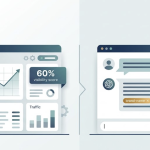
How different are the two games? Pretty different. Ahrefs found that only about 12% of AI-cited URLs appear in Google’s top 10, and roughly 80% of LLM citations don’t rank in Google’s top 100 at all for the original query (Ahrefs). AirOps and Indig put it another way: around 60% of AI Overview citations come from pages outside the top 20 organic results.
Read that again. You can own page one and still be invisible in the answer.
A quick note on terms, because the acronyms multiply fast. Generative engine optimization (GEO) and answer engine optimization (AEO) get used interchangeably. Both describe the same goal: earning a spot inside AI-generated answers rather than only in the blue links. When people say LLM SEO, they usually mean the same thing.
One more clarification. If you searched “LLM optimization” hoping for RAG pipelines, prompt engineering, or fine-tuning, this isn’t that guide. That’s model-side engineering. This is about your brand’s AI visibility, and the tools that track and defend it.
Why AI visibility isn’t a number you set once
Here’s the part the other lists gloss over.
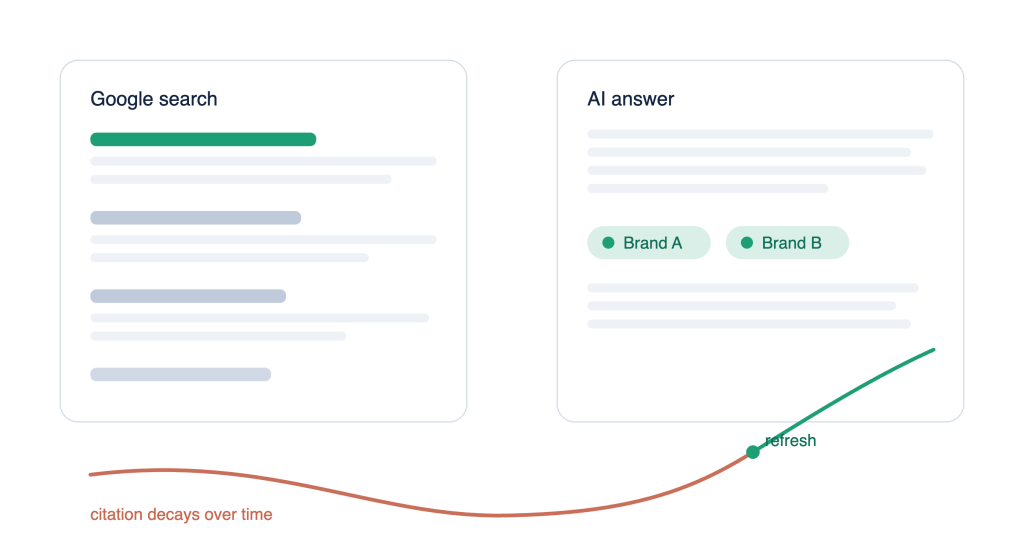
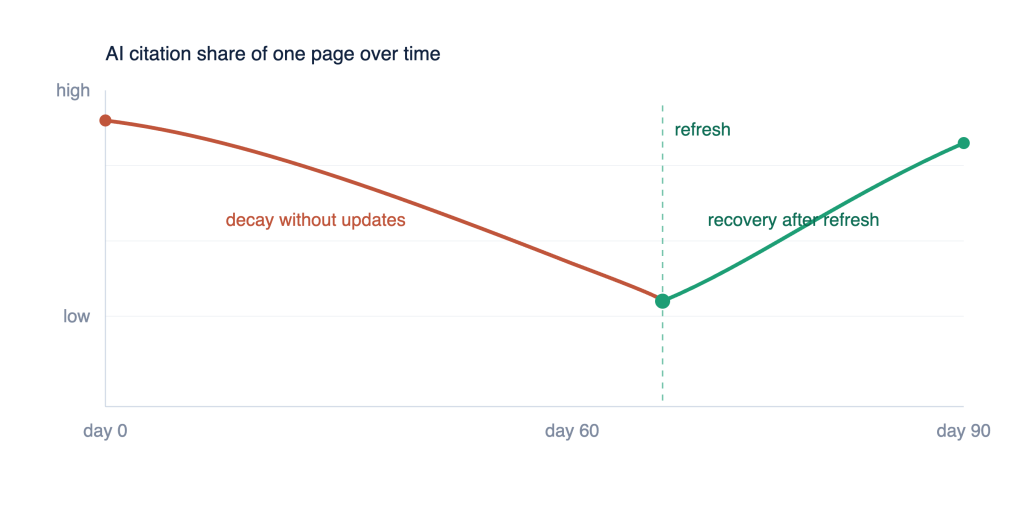
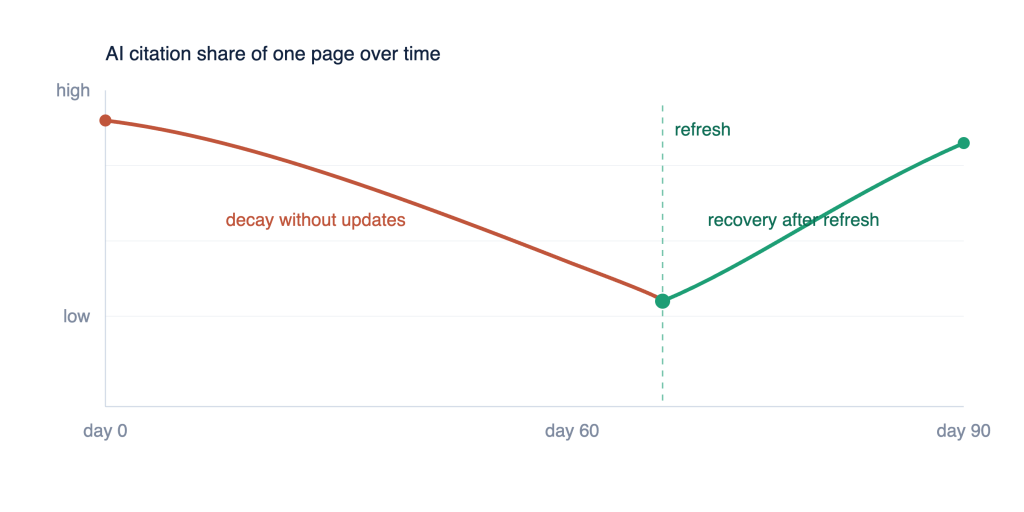
This continuous process of evaluation and refinement is closely related to recursive self-improvement, where AI systems progressively improve their capabilities using feedback and new information. Pages that go more than three months without an update are about 3x more likely to lose their AI citations entirely, per Kevin Indig’s State of AI Search Optimization 2026. Flip it around and the same pattern holds: content less than three months old is roughly 3x more likely to get cited in the first place.
Freshness is the gate. Seer Interactive analyzed thousands of cited URLs and found that around 65% of AI bot hits target content published in the past year, with 89% landing on content from the last three years (Seer Interactive).
Now the counterintuitive bit, and it’s the one that changes how you should spend your time. In Seer’s 2026 follow-up, more than a quarter of the pages that looked fresh were originally published two or more years ago. They earned their freshness by being maintained.
So think about what a pure dashboard actually gives you here. It shows you a visibility score. Next month the score is lower, and you’re back where you started, re-measuring a number that keeps sliding. That’s the specific job WordPattern is built for: content decay detection and AI-driven refresh, aimed at the pages you’ve already earned visibility on. (If you want the mechanics, we break down what content decay is and how to catch it separately.) It’s a different function from a tracker, and the two work best together.
The 8 best LLM optimization tools for AI visibility
I’ve grouped these by primary job. Prices were verified in July–August 2026. This category reprices constantly, so confirm on the vendor’s own site before you commit to anything.
1. Profound — enterprise monitoring heavyweight
Profound is the tool the analysts keep pointing enterprise teams toward. It tracks visibility across 10+ engines on its top tier and runs a proprietary dataset of hundreds of millions of real user prompts, which is what powers its Conversation Explorer.
Pricing: entry around $99/mo for ChatGPT-only; full engine coverage is enterprise/custom. Best for: Fortune-500 and regulated industries that need SOC 2-grade reporting and deep prompt intelligence. The catch: it’s monitoring-first. It shows you what’s happening and gives you little to fix it, so you’ll pair it with a content workflow. No free trial, either.
2. Writesonic — track, diagnose, fix in one seat
Writesonic grew from an AI writer into a full GEO platform. Its Action Center is the differentiator: it turns visibility data into a prioritized queue of fixes (content gaps, technical issues, citation opportunities) and it has AI crawler analytics showing which bots actually visit you.
Pricing: roughly $99–199/mo to start; content and optimization features sit on the higher (~$399) tier. Best for: mid-market teams that want tracking and content production without buying two products. The catch: the feature depth comes with a learning curve, and its refresh capability is shallower than tools built specifically for it.
3. Otterly.ai — the cheapest credible tracker
At $29/mo, Otterly is the most affordable entry point that still delivers real citation tracking across the major engines. It was named a Gartner Cool Vendor in 2025 and has a sizable user base. Setup takes minutes.
Pricing: from $29/mo. Best for: freelancers, solo marketers, and SMBs just starting to monitor. The catch: monitoring only, and prompt limits are tight on the entry plan.
4. Peec AI — clean mid-market analytics with an EU accent
Peec tracks brand visibility, sentiment, citations, and competitors with a genuinely nice interface and fast onboarding. European teams gravitate to it for the GDPR-first architecture and multi-language support, and it offers unlimited seats.
Pricing: from about €89/mo (~$99). Best for: EU agencies and SMBs that need clean, client-ready reporting. The catch: monitoring only, with three engines on the base plan and add-ons for more.
5. Surfer SEO — the bridge from classic SEO
Surfer is one of the few established content-optimization platforms that expanded into AI tracking without abandoning what it’s good at. Its AI Tracker watches mention rate and position, and its content-scoring engine is well tested.
Pricing: from $99/mo (Standard). Best for: teams still spending most of their time on traditional SERP work who want one tool for both. The catch: the AI tracking is newer and covers fewer engines than dedicated GEO platforms.
6. Semrush AI Toolkit — no second contract
If you already pay for Semrush, its AI Toolkit layers visibility tracking onto your existing setup. It won’t match a specialist tool for depth, but it removes the friction of adding another vendor.
Pricing: around $99/mo standalone, or bundled from ~$139.95/mo with Semrush plans. Best for: existing Semrush users who want AI tracking without a new line item. The catch: shallower than purpose-built GEO tools.
7. AthenaHQ — monitoring that hands you an outline
AthenaHQ pairs enterprise-grade visibility tracking with a content strategy layer. Its Outlines feature spots underperforming topic clusters and generates content outlines to fill the gaps, which is a step most trackers never take.
Pricing: about $295/mo self-serve (a $95 introductory first month softens the trial); enterprise from $2,000+. Best for: growth teams that want to connect visibility gaps directly to content production. The catch: premium pricing, no true free trial, and a smaller integration ecosystem than the legacy SEO suites.
8. Scrunch AI — how the bots read your site
Scrunch is built on a thesis most tools ignore: your next visitor might be an AI agent, not a person. Its Agent Experience Platform monitors how AI crawlers actually move through your site, where they read, and where they error out.
Pricing: roughly $100–500/mo depending on tier. Best for: multi-brand enterprises focused on brand safety and crawler behavior. The catch: steeper learning curve, no content creation, and data refreshes every few days rather than in real time.
Notice the shape of this list. Every one of these is built to measure your visibility or to help you produce net-new content. None is built primarily to watch your already-cited pages and catch them the moment they start slipping. That’s the gap decay-focused tools fill, which is why WordPattern sits in its own column below rather than competing head-to-head with the trackers. (We compare the options in our roundup of the best content decay tools if that’s the lane you’re in.)
How to choose the right LLM optimization tool
Skip the feature-comparison spreadsheet for a minute and answer one question first.
Start with your job, not the feature list
Where are you right now? At the awareness stage, you don’t even know if you appear in AI answers. At the optimization stage, you know you have gaps and need to close them and at the maintenance stage, you’re already cited and your problem is staying that way. Awareness needs a tracker. Optimization needs an execution layer. Maintenance needs decay detection and a refresh habit. Most teams are in two of these at once.
Mind the monitoring tax
A dashboard that only measures has a hidden cost: the human hours it takes to turn its charts into shipped work. If your tool flags that you’re missing from 40 high-value prompts, someone still has to figure out why, plan the content, produce it, and check whether it worked. Price that time in when you compare a $29 tracker against a $199 tool that also acts.
Ask how it tracks, not just what
There’s a real quality gap between tools that read AI responses through the actual user interface and tools that only hit the API. API-only tracking misses web citations, live retrieval, and the formatting real users see. Ask the vendor directly which one they do.
Don’t trust a single visibility score
One global number lies to you. The engines barely agree: about 91% of citations appear in only one of ChatGPT, Perplexity, or AI Overviews (Growth Memo). A blended score can look healthy while you’re absent from the one engine your buyers actually use. Pick a tool that breaks visibility out per engine.
Set a refresh cadence, not just a tracker
Buying the tracker is the easy part. The habit that keeps you visible is updating priority pages on a schedule. Quarterly is the floor. For Perplexity-heavy or fast-moving topics, monthly is closer to right, since content older than about 90 days starts losing retrieval priority there. Slower categories can stretch to six or nine months. This is the piece of AI search optimization that most tool comparisons never mention, and it’s the one that compounds. Not sure what a real refresh involves? Start with how to refresh outdated stats without losing your existing rankings.
AI visibility checker: how to see where you stand
An AI visibility checker queries AI engines with the prompts your customers actually use, then reports whether your brand appears, where, and against which competitors. Most of the trackers above — Otterly.ai, Peec AI, Profound — are AI visibility checkers at their core, differing mainly in depth and price.
You can run a rough manual check in ten minutes: list 10–15 buying-intent questions in your category, run each through ChatGPT, Perplexity, and Google’s AI Mode, and note where you show up and who gets cited instead. That tells you whether you have a problem. It won’t tell you how the picture shifts week to week, which prompts to prioritize, or when a citation you had quietly drops — that’s the job of a dedicated checker plus a refresh habit. Start with a manual pass; move to a tracker once AI search is a channel you can’t afford to guess at.
What doesn’t move the needle
A quick myth-check, because two “fixes” get oversold.
Start with schema markup. Google’s May 2026 guidance says structured data isn’t required for AI Overviews or AI Mode, a 2026 study found adding JSON-LD produced no measurable citation lift, and Google deprecated FAQ rich results on May 7, 2026. Structure your questions and answers in the page content itself. Don’t expect the markup to do the work. (If you’re weighing the newer signals, our llms.txt guide covers what’s worth your time and what isn’t.)
Then there’s fake refreshing. Changing “2025” to “2026” in a title is not an update. A real refresh changes the evidence, the recommendations, and the substance of the page. The models can tell the difference, and so can your readers.
Wrapping up
Pick your tool by the job in front of you, not by whichever vendor bought the top of this keyword. If you’re just starting, Otterly at $29 gets you looking. If you’re enterprise, Profound has the depth or if you want tracking and fixing in one place, Writesonic earns the look.
But the edge in 2026 isn’t a prettier dashboard. It’s treating AI visibility as something that decays and building the habit of catching cited pages as they slip and refreshing them on cadence. Measure with one tool, defend with another, and re-audit on a schedule. That’s the whole game.
FAQs
There isn’t one best pick, because they solve different problems. For enterprise depth, Profound leads. For the cheapest credible tracking, Otterly.ai starts at $29/mo or for tracking and content fixes in a single seat, Writesonic is the strongest option. Choose by your team’s stage and budget, then confirm current pricing on the vendor’s site.
SEO tools measure Google rankings, backlinks, and keyword positions. LLM optimization tools measure whether AI engines cite your brand, which is a separate signal. Ahrefs found roughly 80% of LLM citations don’t rank in Google’s top 100, so your rank tracker gives you an incomplete picture of your AI visibility.
Both have added AI visibility modules, and if you already pay for one, that’s a low-friction starting point. The trade-off is depth: bolted-on modules track fewer engines and offer thinner competitive intelligence than dedicated GEO platforms. Start with what you have, then upgrade if AI search becomes a serious channel for you.
Quarterly at minimum. Pages that go more than three months without an update are about 3x more likely to lose their AI citations. For Perplexity-heavy or fast-moving topics, aim for monthly on priority pages. Slower categories can stretch to six to nine months.