
Ask ten people for the best AI for writing and you’ll get ten answers, all confident, most useless to you specifically. That’s because 97% of content marketers now plan to use AI in some form this year, up from 90% in 2025. When almost everyone uses the same tools, the tool stops being the advantage.
So the real question isn’t “which AI writes best.” It’s “which AI writes best for the thing you’re doing.” And then the part nobody talks about: how do you keep that writing ranking once it’s live?
Here’s the honest version, sorted by the job in front of you.
Short on time? Here’s the whole list at a glance.
| Tool | Price | Best for | Free tier |
|---|---|---|---|
| ChatGPT | Free; Plus ~$20/mo | Brainstorming, rough drafts, unsticking intros | Yes |
| Claude | Free; Pro ~$20/mo | Long-form guides and thought leadership | Yes |
| Jasper | ~$59/mo (billed annually) | Brand-consistent marketing copy at volume | No (7-day trial) |
| Copy.ai | ~$29/mo | Short-form ad, email, and social copy | Limited free plan |
| Frase | ~$49/mo | Research-led SEO briefs and drafts | No (paid trial) |
| Surfer SEO | ~$99/mo (billed annually) | Real-time on-page SEO scoring | Limited free plan |
| Koala AI | ~$9/mo | Budget SEO drafts for small teams | Trial only (5,000 words) |
| Sudowrite | ~$10/mo (billed annually) | Fiction and creative writing | Trial only (credits) |
There’s No Single Best AI for Writing — There’s a Best Tool for the Job
The best AI for writing isn’t a single product. It’s a category. A tool that drafts a gorgeous long-form essay might be hopeless at punchy ad copy. A keyword-obsessed SEO drafter will strangle a short story. The mistake most roundups make is pretending these are all interchangeable and the only difference is price.
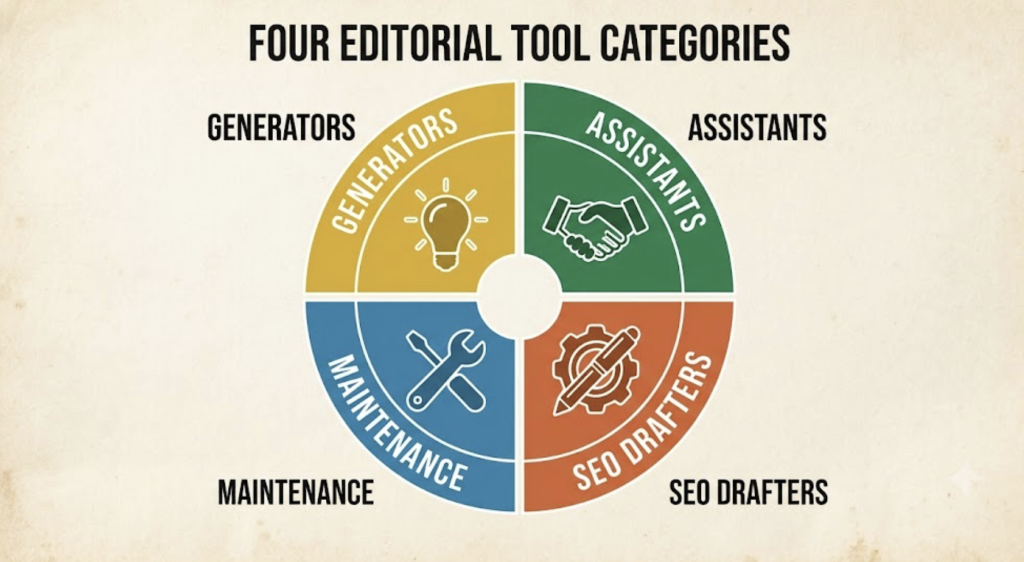
It helps to think in four buckets instead.
Generators start from a blank prompt and hand you a draft. ChatGPT, Claude, and the SEO drafters all live here. Writing assistants sit next to you and improve what you already typed, catching clarity issues and enforcing a style guide as you go. SEO-focused tools bolt keyword research and content scoring onto the drafting step, so the draft is shaped by what’s already ranking. And the fourth bucket, the one almost every roundup forgets, is maintenance: the tools that keep content alive after you hit publish.
That last one matters more than it used to. Teams now ship around 47% more content per month thanks to AI. More content means more pages that can quietly rot later. Hold that thought, because it’s the whole back half of this article.
The list below is organized by what you’re trying to do, not by some arbitrary ranking of who’s “number one.”
Best AI for General Drafting and Thinking: ChatGPT and Claude
Want an AI content generator that goes anywhere? Outlines, rough drafts, rewrites, thinking out loud? This is the pair to reach for.
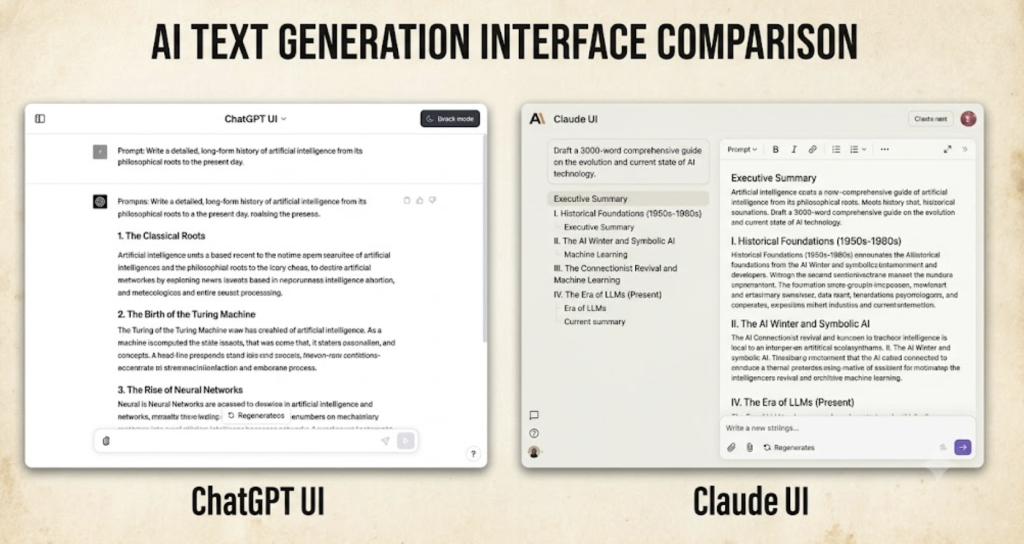
ChatGPT is the one that got everybody hooked. It’s flexible to a fault. There’s no keyword field, no brand-voice setting, and no SEO score anywhere in the interface. That openness is the point, because you can take it in any direction you want. It’s brilliant for the messy early stage of a piece, when you’re wrestling an angle into shape or unsticking an intro you’ve rewritten four times and stopped seeing clearly. The catch? It forgets your brand between sessions unless you’ve set up custom instructions or a saved project. For one-off tasks that’s fine. For a whole content team trying to hold one voice, it needs more babysitting than people expect. Free plan available, and Plus runs about $20/month.
Claude leans into long-form content. Where some tools lose the thread halfway through a 2,000-word draft, Claude tends to hold a coherent point of view from the first paragraph to the last. Thought leadership, detailed guides, anything with an argument that needs to build slowly and pay off at the end. It handles length without the structural collapse you sometimes see elsewhere, where the back half of a piece forgets what the front half promised. It also takes direction well, so you can hand it an angle and a set of constraints and it stays on track. Same pricing shape as ChatGPT: free tier, with Pro around $20/month.
Both are excellent drafters. Both produce text that still needs a human on top. That’s not a knock. It’s just how it works right now. Over 86% of marketers already edit AI output before it goes live. The draft is a starting line, not a finish line.
Best AI for Marketing Copy: Jasper and Copy.ai
Marketing copy plays by different rules. It needs to sound like you, it needs to convert, and it needs to stay consistent across a hundred different pieces. General chat tools weren’t built for that. These two were.
Jasper’s whole pitch is brand voice. You feed it a batch of your existing content, it learns your tone, and then it holds that tone across everything it generates afterward. It also routes your request across several underlying models so you don’t have to think about which one suits the task. The trade-off is setup. Jasper rewards teams who treat it like infrastructure, with brand voices, templates, and campaigns all configured before you start. If you just want to open a tool and go, that upfront work can feel like friction. The teams who get the most out of it are the ones who set it up properly and then reuse that groundwork for months. Plans start around $59/month.
Copy.ai comes at it from the short-form side. Ad headlines, email subject lines, product descriptions, social captions, the stuff that has to land in a single line. It’s genuinely good at pulling you into a back-and-forth, iterating on your feedback until the copy tightens up. You push, it adjusts, you push again, and the final line reflects that. Watch it for cliché marketing filler, though. “In today’s fast-paced digital landscape” has no business in your final draft, and Copy.ai will occasionally try to sneak it in. Starts around $29/month, with a limited free plan.
Picking between them is simple. High volume plus brand consistency, go Jasper. Punchy multichannel short-form, go Copy.ai.
Best AI for SEO Content: Frase, Surfer SEO, and Koala AI
Now the tools built for AI writing for SEO, where the goal isn’t just words on a page. It’s words that rank, and keep ranking.
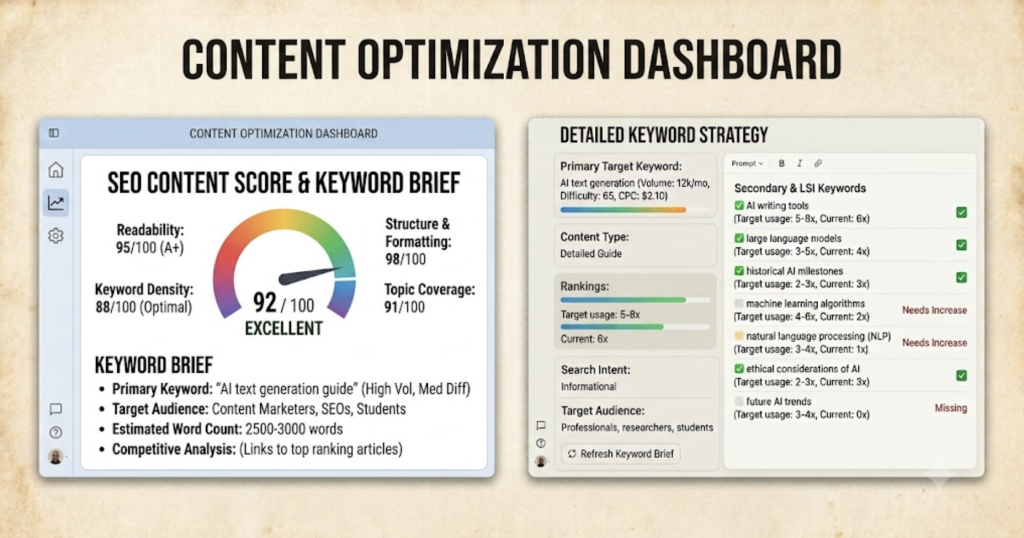
Frase starts with research. Give it a target keyword and it builds a content brief from what’s already ranking: competitor outlines, the questions people keep asking, related topic clusters. Then you draft against that brief instead of staring at a blank page and hoping. It’s a tidy research-to-draft workflow for teams who want both steps in one place. Around $49/month.
Surfer SEO sits inside your document and scores your content in real time against the top-ranking pages. Word count targets, terms to include, structural suggestions, all updating as you type. The feedback loop is immediate, which is great when you’re building something from scratch with rankings as the goal. It’s less useful for diagnosing why a page you published last year has started slipping, since its whole design points at fresh content. Plans from about $99/month billed annually.
Koala AI is the budget-friendly newcomer. It’s fast, it’s keyword-aware, and the drafts need less cleanup than you’d expect at the price. It has a lighter track record than the others on this list, but for solo creators and small teams working without a big tool budget, it punches well above its cost. Starts around $9/month.
One honest caveat ties all three together. They help you produce AI content for SEO. Producing is not the same as ranking, and ranking is not the same as staying ranked. In a sample of 487 top-ranking results, 83% still read as human-written. The SEO drafter gets you a strong first pass. The human layer is what earns the position, and a maintenance habit is what keeps it.
Which AI Is Best for SEO Content Specifically?
If your writing exists to rank, “best AI for writing” is the wrong question. The better question is which part of the SEO job you’re stuck on. Each tool above handles one part. None of them handles all of it.
Starting from a keyword with nothing on the page? Frase builds the brief and Koala gets you a fast first draft. Already have a draft and need to know if it can compete? Surfer scores it against what’s ranking right now. Sitting on pages that ranked well last year and are quietly sliding? That’s a different problem, and none of the drafting tools are built to catch it. They’re all aimed at the next article, not the ones already live.
For SEO teams with a real back catalog, that third job often matters more than the first two. Drafting tools fill the pipeline. Something else has to protect what the pipeline already produced, and that’s the part most roundups never mention.
Best AI for Fiction and Creative Writing: Sudowrite
Different job entirely, so it gets its own line.
Sudowrite is built for novelists, not marketers. Its Story Bible walks you from a rough idea to an outline to actual chapters, Describe adds sensory texture to a flat scene, and its Write feature continues your story in your own voice. If you’re drafting fiction, it understands scene structure and pacing in a way general chat tools don’t even attempt.
If you’re drafting a landing page, though? Wrong tool. Don’t try to make it write your SEO articles or your sales emails. That’s not what it’s for, and it’ll show.
The Part Every Roundup Skips: AI Content Decays, Often Faster
Here’s where almost every “best AI for writing” list stops being useful. They end at “publish.” Reality doesn’t.
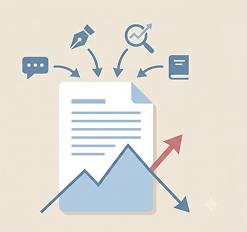
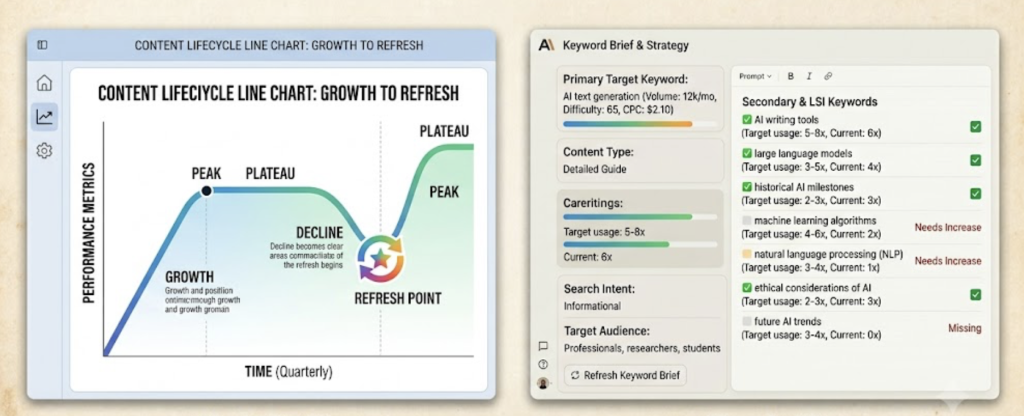
Every page you publish follows a lifecycle. It climbs, it peaks, it plateaus, and then it declines as fresher, more authoritative content pushes past it in the results. Most teams pour effort into the first three phases and almost nothing into the last two, as Ahrefs maps the content lifecycle. That neglected decline phase is content decay, and the reason it’s dangerous is that it’s quiet. No penalty notice arrives. No dramatic drop shows up on a dashboard. It’s a slow leak instead: a few clicks gone this week, a couple of ranking spots slipped next month, and a page that anchored your inbound leads is dead by the time anyone notices.
AI-written content is more exposed to this, not less. A 16-month experiment found that bulk AI-only content on new domains gets a short visibility test and then fades, while edited AI content on established sites holds its ground (SE Ranking via mean.ceo). The decline shows up fast, too. One audit found unedited AI drafts had 23% lower average time-on-page than human-edited versions, with the ranking gap visible inside 90 days. Ninety days. That’s one quarter from publish to problem.
And decay has two dimensions now!
A page can lose its Google rankings and separately vanish from AI-generated answers, and the two can happen independently of each other (per the same Ahrefs analysis). Two ways to lose visibility, both invisible at a casual glance.
The stakes are real. Neglected aging content can shed up to 20% of its organic traffic a year, and roughly 90.63% of pages already get no Google traffic at all. AI makes it cheap and fast to add to that pile of dead pages.
This is the maintenance bucket in action. Tools that watch your published pages against your Search Console data, flag the ones that are slipping, and help you detect and refresh decaying content, like WordPattern, belong in a serious AI writing stack for exactly this reason. The generator writes the draft. Something has to keep it alive afterward.
How to Choose — and Build a Workflow That Keeps AI Content Ranking
Choosing the best AI for writing comes down to two moves. A quick decision map first, then the part that actually protects your rankings.
- For drafting and thinking, reach for ChatGPT or Claude.
- For brand-consistent copy at volume, Jasper.
- For short-form conversion copy, Copy.ai.
- For SEO drafts, Frase or Koala.
- For real-time SEO scoring while you write, Surfer.
- 6. For fiction, Sudowrite.
That’s the tool half of the decision, and honestly it’s the easy half.
The workflow is what most teams get wrong. It looks like this: draft, humanize, edit, optimize, publish, then monitor, then refresh. That last loop is not optional anymore. About 52% of marketers now run AI output through a humanization step before it ever ships, which tells you the “generate and go” era is already over.
The payoff for doing the back half is big. Teams that regularly update their old content have seen average traffic gains of around 106%. Not from writing more posts. From keeping the ones they already had alive and current.
So pick the generator that fits the job. Then budget real attention for the decline phase. A monitoring layer that catches decay early and lets you refresh a page at the paragraph level almost always beats writing a brand-new article to replace one you already ranked. That’s where the leverage hides, and it’s the part your competitors are probably ignoring.
What Actually Separates Good Teams From Busy Ones
The best AI for writing is genuinely settled, once you break it down by job. ChatGPT and Claude for drafting, Jasper and Copy.ai for marketing copy, Frase and Surfer and Koala for SEO, Sudowrite for fiction. None of that is controversial anymore, and no roundup is going to surprise you with a secret eleventh tool that changes everything.
The difference between teams isn’t the tool. It’s what happens after publish. One team ships its AI drafts and moves on to the next one. The other ships, watches, and refreshes before the slide even starts. Same tools, same starting point. Very different traffic six months later.
The tool writes the draft. The workflow keeps it ranking. Build for both.
FAQs
There isn’t one winner. It depends on the job. For general drafting and long-form, Claude and ChatGPT lead. For brand marketing copy, Jasper, for SEO content, Frase or Surfer and for fiction, Sudowrite. Match the tool to the task instead of chasing a single “best” pick that works for everything.
No, not for being AI-made. Google evaluates clarity, accuracy, experience, and intent, not the tool that produced it. Thin, low-effort pages lose ground regardless of who or what wrote them. Genuinely helpful content ranks whether a human or an AI drafted it.
Not inherently. Edited AI content on an established site can rank and hold its position. The failure mode is bulk, unedited AI content published at scale, which tends to get a short visibility test and then fade, as SE Ranking’s experiment found. Editing and real expertise are what make the difference.
That’s content decay. Rankings slip as competitors publish stronger pages, cited facts age out, and search intent shifts under you. AI content is especially prone to it when it’s thin or generic. The fix is a monitoring habit that flags declining pages early, so you can refresh them before the drop compounds into something serious.