

Pages with rich snippets get 20–40% higher click-through rates than plain blue links. Not because they rank higher, they often don’t. Just because they take up more screen space and answer user questions before the click. That’s a meaningful gain without touching your ranking position at all.
Here’s what most guides written before 2025 miss: 65% of pages cited in AI-generated answers also use structured data. Schema markup is now doing two jobs at once. If your site isn’t set up for both, you’re leaving traffic on the table.
Most SEO teams still treat schema like a checkbox exercise. Add some JSON-LD, run it through the Rich Results Test, call it done. That worked in 2022. The March 2026 core update and the May 2026 FAQ rich result deprecation and changed the rules in ways worth understanding before you spend hours on implementation.
This guide covers what structured data is, which schema types still matter (and which Google just demoted), how to implement them in JSON-LD, and how to keep them earning visibility as AI search continues to reshape what “ranking” means.
What Is Structured Data (and How Does It Differ from Schema Markup)?
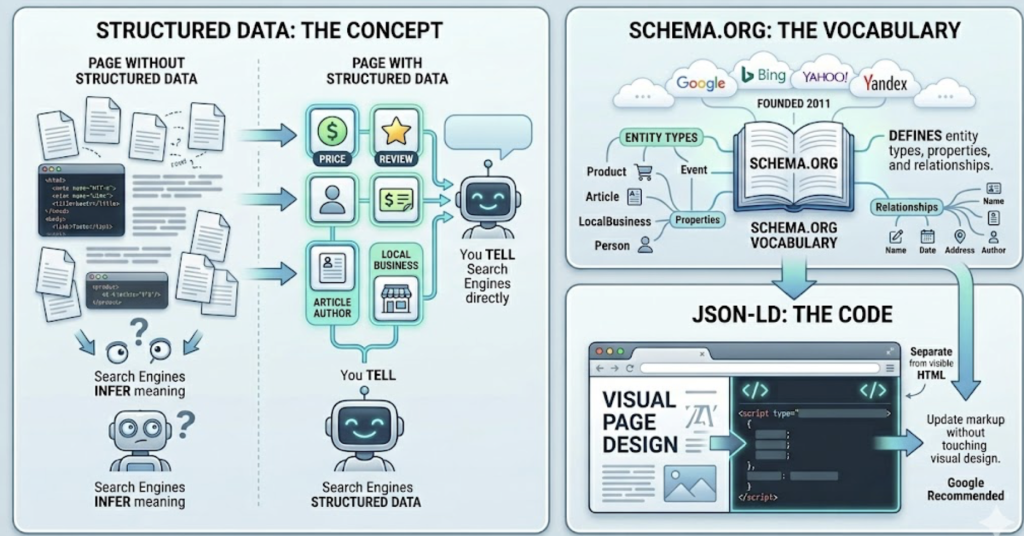
Structured data is machine-readable formatting that explicitly labels your page’s content. Without it, search engines infer meaning from HTML, text patterns, and link signals. With it, you’re telling them directly: “this number is a price, this text block is a review, this person wrote the article.”
Schema markup is the vocabulary used to do that. The standard comes from Schema.org – a shared project that Google, Bing, Yahoo, and Yandex launched in 2011. Schema.org defines entity types (products, events, articles, local businesses, people) along with their properties and relationships.
JSON-LD is how you write it. It lives in a <script type=”application/ld+json”> tag, separate from your visible HTML. That separation is the practical appeal – update or add markup without touching your page’s visual design. Google explicitly recommends it, and it’s what most SEO professionals use today.
Short version: structured data is the concept, schema markup is the vocabulary, JSON-LD is the code.
Why Structured Data Matters for SEO in 2026?
Three things structured data does for your SEO. Most people only know one.
- Rich snippets. The most visible benefit. When Google chooses to show your markup, your result gets enhanced: star ratings, price, availability, cooking time, event date. Enriched listings get 20–40% higher click-through rates compared to plain results — not from ranking higher, but from occupying more SERP real estate and surfacing relevant details before the click.
- AI search citations. The newer one — and increasingly, the more important one. In March 2025, Google, Microsoft, and ChatGPT all confirmed they use schema markup when selecting sources for AI-generated answers. (If you’re also thinking about AI search optimization, structured data is one of the foundational steps.) Research by Alhena AI found that 65% of pages cited in Google AI Mode use structured data, and 71% of ChatGPT-cited pages use it. AI Overviews now appear on 14% of shopping queries. That’s a 5.6x increase in four months. Sites missing proper schema are increasingly invisible to these systems.
- Entity clarity. Schema helps Google understand your brand as a named entity, not just keywords. Organization schema with sameAs links to your social profiles and Wikipedia page tells Google exactly who you are. That matters for brand queries, knowledge panels, and AI systems trying to attribute content to a credible source.
The Schema Types That Matter Now (Post-March 2026)
Here’s where things got messy. Google’s March 2026 core update produced the biggest shift in structured data strategy since rich snippets launched in the first place.
FAQ rich result impressions dropped by nearly half across tracked sites. How-To rich results disappeared entirely from pages where the markup described supplementary rather than primary content. Review schema on editorial comparison posts got algorithmically demoted at scale. Then in May 2026: FAQ rich results fully deprecated.
A lot of schema types people relied on – gone or reduced.
What still earns rich results:
- Article: for editorial content; powers Top Stories and Google Discover
- Product + Review: product pages with review markup are 4.2x more likely to appear in Google Shopping results
- BreadcrumbList: arguably the best return on effort for content sites; replaces raw URLs with readable paths in the snippet
- Event: date, time, location data for event listings
- LocalBusiness: business hours, address, phone for local search
- VideoObject: thumbnails, duration, and structured descriptions for video content
- Recipe: cooking time, calories, ratings for food content
What now primarily serves AI citations (no traditional rich result, but still valuable):
- Article + Person schema: authorship attribution helps AI systems cite your content correctly
- Organization + sameAs: entity disambiguation for brand trust
- FAQPage markup: the rich result is gone, but the markup still improves AI comprehension of Q&A structure
One note on Review schema: adding it to product pages can still boost organic traffic by 20%, per Search Pilot data. The demotion targeted editorial comparison posts gaming the system. Genuine product review markup wasn’t the target.
How to Implement Schema Markup in JSON-LD (Step by Step)?
Step 1: Match the schema type to the page. Blog posts → Article. Product pages → Product. Homepage → Organization. Service pages with a physical location → LocalBusiness. Event announcements → Event. The rule is obvious but gets broken often: match the type to the content on the page, not to what your business does.
Step 2: Build the JSON-LD block. Here’s a minimal Article schema example:
<script type=”application/ld+json”>
{
“@context”: “https://schema.org”,
“@type”: “Article”,
“headline”: “Your Article Title”,
“author”: {
“@type”: “Person”,
“name”: “Author Name”
},
“datePublished”: “2026-06-01”,
“dateModified”: “2026-06-01”,
“publisher”: {
“@type”: “Organization”,
“name”: “Your Site Name”
}
}
</script>
Paste it in the <head> section or just before </body>. Placement doesn’t affect interpretation.
Step 3: Match your markup to visible content. This is where most implementations go wrong. If your Article schema says “datePublished”: “2025-01-01” but your page shows something different, that’s a trust signal problem – both for Google’s validators and for AI systems scanning for accuracy. Every property in your JSON-LD should reflect what a visitor can actually see on the page.
Step 4: Use your CMS tools where practical. For WordPress, Yoast SEO and RankMath output baseline schema automatically — Article, BreadcrumbList, Organization for most setups. The limitation: they’re harder to customize at the property level. For detailed Product schema or nested Person schema, you’ll want custom code or a dedicated schema plugin.
Step 5: Test before you publish. Run the URL or code through Google’s Rich Results Test and the Schema Markup Validator. Both tools flag errors and warnings. Errors prevent rich result eligibility. Fix those first, then work through the warnings.
Structured Data and AI Search: The 2026 Priority Shift
Structured data used to have one audience: Google’s traditional crawler. Now it has a second — the AI systems generating answers across Google, ChatGPT, Perplexity, and Bing.
These two audiences want different things. That distinction matters.
The traditional crawler wants valid markup that matches your page content. AI systems want entity clarity and who made the page, what it covers, and whether the information can be trusted.
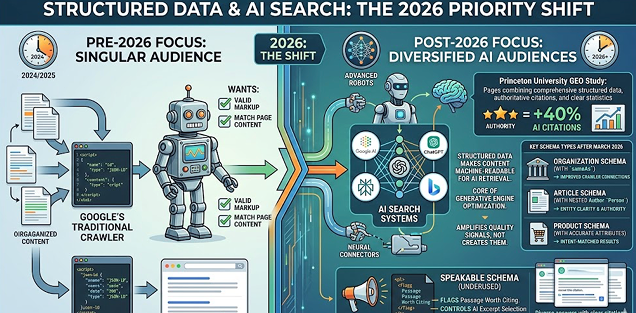
A Princeton University GEO study found that pages combining structured data, authoritative citations, and clear statistics earned AI citations 40% more often. This is the core of generative engine optimization, and structured data is the layer that makes your content machine-readable for AI retrieval. Structured data amplifies your other quality signals. It doesn’t create them.
After March 2026, sites with clean entity schema saw improved AI Mode citation rates. The pattern held across site types: Organization schema with full sameAs declarations, Article schema with nested Person (author) data, Product schema with accurate attributes. Accurate, intent-matched markup outperformed generic or manipulative schema every time.
One underused type: Speakable schema. It flags the specific passage within a longer page that’s most worth citing. Without it, AI systems pick their own excerpt — and they don’t always choose well.
How to Test, Validate, and Maintain Your Schema?
- Testing: Google’s Rich Results Test checks a URL or code block for rich result eligibility. The Schema Markup Validator catches syntax errors and property misuse. Run both before pushing any live implementation.
- Monitoring: Google Search Console’s Enhancements reports track rich result impressions, clicks, errors, and warnings by schema type. Check these monthly. When impressions drop suddenly, it usually means a schema update broke something, or a type got deprecated.
- The maintenance piece is where most sites fall short. Stale markup — schema that no longer matches visible content — erodes trust with AI systems. Stackmatix’s structured data research found that AI engines encountering stale schema may reduce confidence in your content across all pages, not just the one with outdated markup. That’s a site-wide penalty for a page-level oversight.
Run a full audit quarterly. Tools like WordPattern’s content refresh agent can flag pages where content has drifted from their original markup — a common source of stale schema. Between audits, update schema immediately when content changes: prices, business hours, staff listings, publication dates, service offerings. Update dateModified every time you revise an article. Small habits, real consequences.
The Bottom Line
Structured data for SEO is now a dual-purpose investment. It earns rich results and the star ratings and shopping cards that increase click-through rates. And it signals to AI systems which pages are credible enough to cite.
The March 2026 update reinforced a simple principle: schema that accurately describes genuine content held up. Schema used as a SERP shortcut got demoted. That’s not going to change.
Start this week: run your key pages through the Rich Results Test. Check that your homepage has Organization schema with sameAs links. Audit your JSON-LD blocks against visible page content. That’s most of what matters and it puts you ahead of most sites that haven’t reviewed their structured data since the FAQ era.
FAQs
Not directly. Google has confirmed that schema markup isn’t a direct ranking factor. What it does is make your content eligible for rich results (which lift CTR), improve how AI systems classify your content, and strengthen entity signals for brand recognition. The ranking impact is indirect but real.
JSON-LD. Google explicitly recommends it, it’s the most widely used format among SEO professionals, and it’s far easier to maintain because it lives separate from your page’s visible HTML. Microdata and RDFa are still technically valid but rarely used for new implementations.
Multiple, and often you should. A blog post might carry Article, BreadcrumbList, and Person (for author) on the same page. A product page could have Product, Review, and BreadcrumbList together. The rule: only add schema types that accurately describe what’s actually on the page.
Start with your highest-value pages – homepage (Organization schema), product or service pages, and top-trafficked blog posts. BreadcrumbList is worth adding site-wide. For content-heavy sites, applying Article schema at the template level covers every post at once without page-by-page effort.