

Almost every marketer has heard the same line this year: you need to show up inside ChatGPT. And yet only about 14% of marketers actually track how they perform in AI search at all (Conductor, 2026). There’s a gap between the panic and the practice, and a whole software category has rushed in to fill it.
Here’s the problem with that category. Nearly every “best generative engine optimization tools” list you’ll find is published by a company that sells one of the tools, and, surprise, ranks itself first. Worse, they cram three completely different kinds of software into one ranking. So you can’t tell what you’re actually shopping for.
This guide fixes that. We’ll sort the leading GEO tools by the job they do, give you an honest read on each, and flag the one thing most of these lists ignore.
Quick view of what’s covered, so you can skip to what you need:
| The job | What it answers | Leading tools | Starting price |
|---|---|---|---|
| Monitor AI visibility | Where do I stand right now? | Profound, SE Visible, Peec AI, Ahrefs Brand Radar | ~$95/mo–custom |
| Optimize on-page | Why am I not cited, and what do I fix? | AthenaHQ, BrightEdge, InLinks | Free tier–custom |
| Create & refresh content | What do I publish or fix next? | Writesonic, WordPattern, content-decay tools | Varies |
What generative engine optimization tools actually do
Strip away the marketing and the definition is simple. Generative engine optimization tools help you see and shape how AI answer engines — ChatGPT, Google AI Overviews, Perplexity, Gemini, Claude — describe and cite your brand.
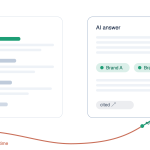
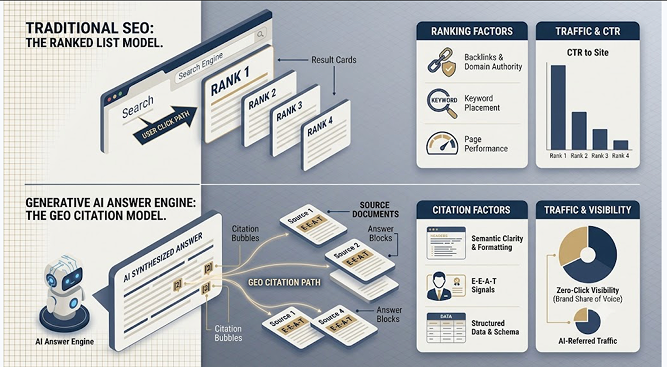
Traditional SEO optimizes for a ranked list of blue links. GEO optimizes for being named inside the answer itself, before any link gets clicked. Different game, different scoreboard.
It’s worth untangling three terms that get used interchangeably, because tool vendors blur them constantly. SEO chases rankings in the classic results page. AEO (answer engine optimization) targets the direct-answer box and voice assistants. GEO is the broadest of the three: earning citations and mentions inside fully AI-generated answers. Most “GEO tools” touch all three to some degree, but knowing which one a tool is really built for saves you money.
You might reasonably ask why your existing SEO stack can’t just handle this. It can’t, and the data is blunt about why. The overlap between Google’s top-10 results and the pages AI engines actually cite has fallen from roughly 75% in mid-2025 to between 17% and 38% in early 2026 (BrightEdge / Demand Local, 2026). Ahrefs found that 28.3% of ChatGPT’s most-cited pages have zero organic visibility in Google (2026).
Read that again. More than a quarter of the pages AI trusts most don’t rank at all. Your rank tracker is blind to them. That’s the whole reason AI citation tracking exists as a separate discipline, and it’s why these tools do.
But “these tools” isn’t one thing. They do three different jobs, and that distinction is the point of this guide.
Why AI visibility is worth paying for (and worth maintaining)
Let’s deal with the obvious objection first. AI search is still a small slice of traffic. True. It’s the quality that changes the math.
AI-referred visitors convert at rates that make traditional organic look sleepy. Seer Interactive clocked ChatGPT visitors converting around 15.9% and Perplexity around 10.5%, against a 1.76% baseline for organic search (Seer Interactive, 2025). These people arrive already deep in a decision. They asked the AI to shortlist, and you either made the list or you didn’t.
The scale is moving too. ChatGPT reached roughly 900 million weekly users by early 2026, and Gartner projects traditional search volume dropping about 25% by 2026. Being invisible here gets more expensive every quarter.
Now the part nobody wants on a sales page. Citations are volatile. High-traffic prompts churn around 23% month over month. And when you lose a citation, the median recovery takes about 45 days, with a competitor having taken your spot roughly 80% of the time (Erlin, 2026).
So AI visibility isn’t a trophy you win once. It leaks, the same way your best posts quietly lose traffic to content decay. Any tool you buy has to be judged partly on whether it helps you keep share of voice in AI answers, not just measure it on a good day.
The three jobs GEO tools do
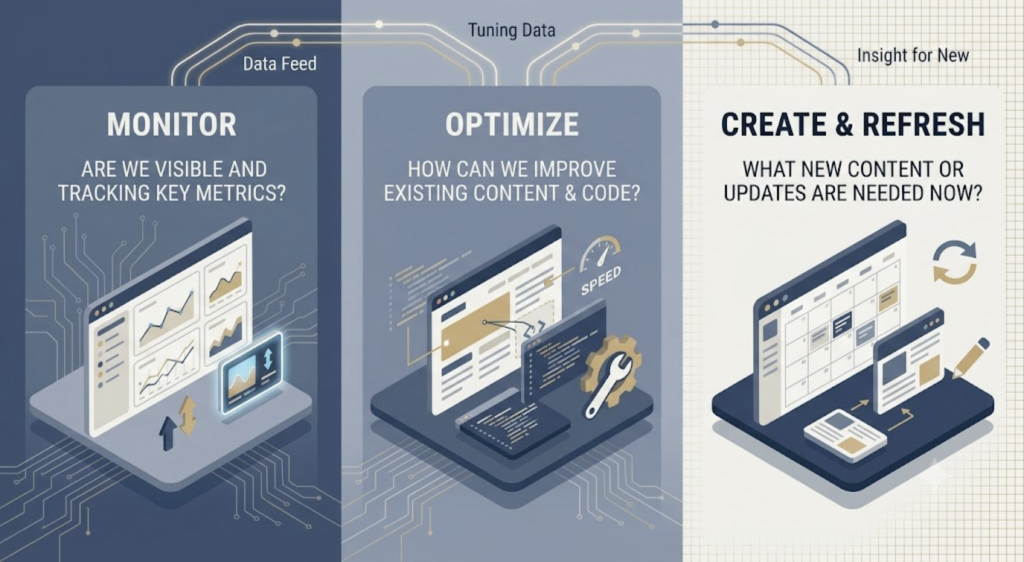
Before you compare a single price, get this framework straight. Every tool on every list is really doing one, sometimes two, of three jobs.
Job one is monitoring. These tools tell you where you stand: how often you’re cited, your share of voice, sentiment, how you stack up against competitors. They answer “where do I actually rank inside AI answers right now?”
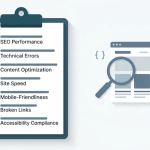
Job two is optimization. These audit your pages and tell you what to change (schema, entities, structure) so your content becomes more citable. They answer “why am I not being cited, and what do I fix?”
Job three is creating and refreshing content. These help you produce new content that earns citations, and update existing content so it keeps them. They answer “what do I publish or fix next?”
Here’s the catch most guides bury. Almost every “platform” is genuinely strong at one of these and thin on the other two. Buy on brand hype instead of job, and you end up paying enterprise money for a monitoring dashboard when what you needed was a way to actually fix your pages. Match the tool to the job and the whole decision gets easier.
GEO tools compared: who each is for and what it costs
| Tool | Job | Best for | Starting price | Pricing note |
|---|---|---|---|---|
| Profound | Monitor | Enterprise teams that want deep multi-engine observability | Custom | Self-serve brand plans withdrawn September 2026; agencies pay $399/mo per client workspace |
| SE Visible (SE Ranking) | Monitor | Mid-market teams that want AI and classic SEO reporting together | From $189/mo | Standalone AI visibility platform from SE Ranking |
| Peec AI | Monitor | Non-technical marketers who want a fast on-ramp | From $95/mo | Pro $245/mo, Advanced $495/mo; standard plans track three engines |
| Ahrefs Brand Radar | Monitor | Teams already working in Ahrefs | From $199/mo per AI index | $699/mo for all six indexes |
| Semrush AI Visibility Toolkit | Monitor | Teams already working in Semrush | $99/mo per domain | Billed annually |
| AthenaHQ | Optimize | Content-heavy sites that want fixes spelled out | Free tier; Starter $295/mo | Credit-based: one credit per AI response |
| BrightEdge | Optimize | Enterprise teams with a mature SEO process | Custom | AI features bundled inside the enterprise suite |
| InLinks | Optimize | Publishers and large content libraries | Free tier; from $49/mo | Agency plan $196/mo |
| Writesonic | Create & refresh | Teams producing and updating at volume | From $79/mo | Annual billing; GEO tracking sits on higher tiers |
| WordPattern | Create & refresh | Teams keeping existing pages citable as content decays | [INSERT] | [INSERT] |
Prices are in USD per month, checked October 2026. GEO vendors change pricing often, so confirm on each vendor’s page before you buy.
Best GEO tools for monitoring AI visibility
This is the most crowded corner of the market, so it’s where buyers get dazzled easiest. What actually matters here: coverage across multiple engines (not just ChatGPT), how often the data refreshes, whether you can see the sources behind a citation, and sentiment.
One word of caution before the names. Don’t buy a ChatGPT-only tracker. Gemini grew roughly 9x and Claude around 770% between late 2024 and early 2026, so this is a multi-platform category now (Similarweb, 2026). And remember: measurement itself is the hardest part of GEO for most teams, which is exactly why this category is so busy (Digital Agency Network, 2026).
- Profound. The enterprise heavyweight. It captures real front-end data across 10+ engines and adds genuinely novel views like query fan-out analysis and conversation-level demand. It’s very good. It’s also priced for enterprise: since September 2026 it no longer sells self-serve brand plans, so expect a custom, sales-led quote. And here’s the honest bit: it’s observability, not execution. Profound will show you exactly where you’re losing. Your team still has to do the fixing.
- SE Ranking (SE Visible). Visibility scoring, sentiment, and competitor benchmarking, sitting next to a full traditional SEO suite. Starting around $189/month, it’s the more mid-market-friendly pick, especially if you want AI and classic SEO reporting in one place.
- Peec AI. Lightweight, fast to set up, with multi-country prompt monitoring and reporting a non-technical marketer can actually read. Modular LLM add-ons mean you pay for the engines you care about, from around $95/month. A solid on-ramp.
- Ahrefs Brand Radar or Semrush AIO. The “don’t make me switch stacks” option. If your team already lives in one of these, bolting on their AI visibility module is the path of least resistance, even if it’s not as specialized as a pure-play GEO tool. Brand Radar’s AI indexes start at $199/month per platform; Semrush’s AI Visibility Toolkit is $99/month per domain.
Whichever you pick, keep the ceiling in mind. Monitors show you the gap. They don’t close it.
Best GEO tools for on-page optimization
Say the monitoring told you you’re invisible for a set of high-intent prompts. Now what? This is where optimization tools earn their keep, turning “you’re not cited” into “change these specific things on the page.”
- AthenaHQ. Leans hard into telling you what to do next. It adds schema markup for you, tags your entities, and gives you a GEO score to track. Good for content-heavy sites that want the fixes spelled out. There’s a free tier to test it, then $295/month for Starter on a credit-based model, so watch your usage.
- BrightEdge. Strong on entity work and knowledge-graph alignment. That matters more now, since engines lean on structured links between topics to decide who counts as an authority. It’s enterprise, custom-priced, and best for teams with a mature process.
- InLinks. Built around internal semantic linking. It structures how your pages connect so engines can read your topical authority. Handy for publishers and large content libraries. There’s a free tier, with paid plans from $49/month.
The useful thing here: you can sanity-check any tool’s advice against what the research already shows. Structured content (lists, stats, clear schema) earns 30–40% higher AI visibility than plain prose (Alphonso Labs, 2026). The Princeton GEO study found that just adding stats to a page lifted its visibility in AI answers by about 41%, with overall gains up to 40% (Princeton/Georgia Tech/IIT Delhi, KDD 2024). Brand mentions, meanwhile, correlate about 3x more strongly with AI visibility than backlinks do (2026 analysis). If a tool points you in those directions, it’s grounded. If it’s still chasing keyword density, it’s living in 2019.
Best GEO tools for creating and refreshing content
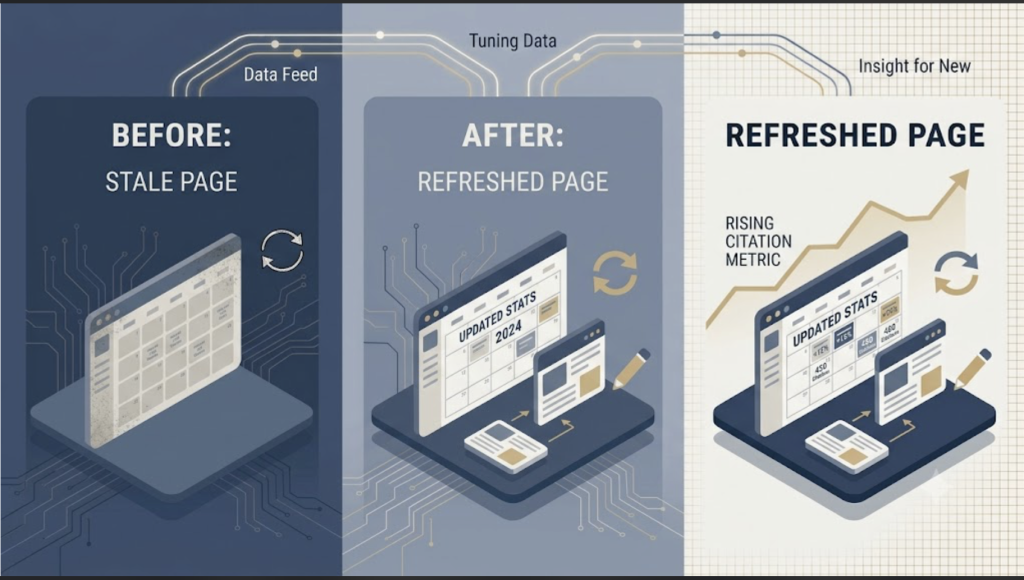
This is the job everyone underrates, and it’s the one that decides whether your visibility lasts. Because, remember the churn number, citations decay. A page that gets cited today can quietly drop out in a month while a fresher competitor slides in.
The freshness signal is real and measurable. AI-cited content is about 25.7% fresher on average than traditionally-ranked content, and 76.4% of ChatGPT’s top-cited pages were updated within the last 30 days (ZipTie, 2026). Roughly half of Perplexity’s citations come from the current year alone. AI engines treat recency as a filter.
One warning, though. You can’t fake this. Crawlers compare snapshots of your page over time, and a cosmetic date-swap (changing “2025” to “2026” in the header and nothing else) gets discounted, sometimes penalized (Authority Tech, 2026). Real freshness means new data, revised claims, a genuinely new section.
Writesonic. Bundles content creation and optimization in one place, built for velocity. Useful when you need to produce and update at pace. Just budget for editorial review, because fast AI drafts still need a human fact-check.
Content decay and refresh tooling. This is the category that actually closes the loop. Instead of just telling you a page is slipping, this class of AI SEO agent detects which pages are losing citation-worthiness and helps you refresh them on a schedule. WordPattern sits here. It’s built to spot content decay and drive the AI-focused refresh that keeps a page citable rather than letting it quietly rot, which makes it the maintenance layer the monitoring tools tend to assume you already have.
Does the refresh loop actually work? One documented workflow refreshed 33 pages and hit 3x more AI citations plus a 113% lift in organic clicks inside 12 weeks (Quattr, 2026). That’s the payoff for treating content as something you maintain, not something you publish once and forget.
How to choose the right GEO tool for your team
Start from the job, not the brand. Ask which of the three problems is most urgent right now. Do you not know where you stand (monitor)? Do you know you’re invisible but not why (optimize)? Or do you know what’s wrong and need to fix and maintain it at scale (create and refresh)?
Then run any shortlist through four practical filters:
- Engine coverage and refresh rate. Multiple engines, updated often. Answers move faster than rankings.
- Citation and source transparency. If you can’t see which sources an engine leaned on, you can’t influence the outcome.
- Actionability for non-technical marketers. A dashboard your content lead can’t act on is shelfware.
- Enterprise readiness (SSO, permissions, clean data handling) but only if you’re in a regulated industry. Otherwise don’t pay for it.
A budget reality check for smaller teams: you don’t need a custom-priced enterprise suite to start. One affordable monitor plus one refresh workflow is a legitimate starting stack. And with only 14% of marketers tracking AI search at all, even a modest setup puts you ahead of most competitors (Conductor, 2026).
The sequence that works: monitor to find the gap, optimize the specific pages that gap points to, then build a refresh cadence so your wins don’t churn back out.
The week after you buy: turning a visibility gap into a fix
Tools are where most guides stop. That’s the least useful place to stop. Here’s what the first week should actually look like.
Day one, pull your baseline. Get your share of voice across at least ChatGPT plus one other engine, Gemini or Perplexity, so you’re not optimizing for a single platform.
Next, find the openings. Isolate five to ten high-intent prompts where a competitor gets cited and you don’t. Those are your targets, not some vague “improve AI visibility” goal.
Then fix those exact pages. Lead each relevant section with a direct answer in the first 60 or so words. Add a verifiable statistic. Tighten the schema and make your entities unmistakable. None of this is guesswork; it maps to what the research says earns citations.
Finally, schedule the maintenance. Put high-value pages on a quarterly refresh and data-heavy ones more often. That last step is what separates lasting AI search optimization from a good month you can’t repeat.
Bringing it together
The “best” generative engine optimization tool doesn’t exist in the abstract. The best tool is the one that matches the job you have right now. And for most teams that’s not a single tool but a small stack: one to monitor, one to optimize, one to refresh.
Most lists will sell you a monitoring dashboard and call it a strategy. But a citation you don’t maintain is a citation you’re about to lose. Buy for the job, start smaller than the enterprise pitches suggest, and build the loop: see the gap, fix the page, keep it fresh. Do that and you’ll still be in the AI answer long after the teams who bought on hype have quietly dropped out of it.
FAQs
Traditional SEO tools measure and improve where your pages rank in Google’s list of links. GEO tools measure and improve whether AI engines cite your brand inside their answers. The signals barely overlap anymore. Plenty of pages that AI cites heavily don’t rank in Google’s top 10 at all, so a rank tracker simply can’t see them.
Both now offer AI visibility modules (Semrush AIO, Ahrefs Brand Radar), so you can start there without switching stacks. They’re convenient and decent for monitoring. If AI search becomes a serious channel for you, a specialized tool will usually go deeper on citation sources, multi-engine coverage, and the fixing side.
It ranges widely. Lightweight monitors start around $95/month (Peec AI), suite add-ons like Semrush’s AI Visibility Toolkit run $99/month per domain, mid-market options like SE Visible sit near $189/month, and enterprise platforms like Profound and BrightEdge are custom-quoted. Some optimization tools, including AthenaHQ and InLinks, have free tiers. You can assemble a workable starter stack well under enterprise pricing.
At minimum ChatGPT, since it drives the large majority of AI referral traffic. But don’t stop there. Gemini and Claude have grown fast, and buyers now expect coverage across Perplexity and Google AI Overviews too. Single-platform trackers leave real blind spots.
For high-value pages, plan on a quarterly refresh at minimum, and more often for anything data-heavy or fast-moving. The key is substance. Engines compare page snapshots over time and discount cosmetic changes, so a real update means new data or claims, not just swapping the year in the title.