
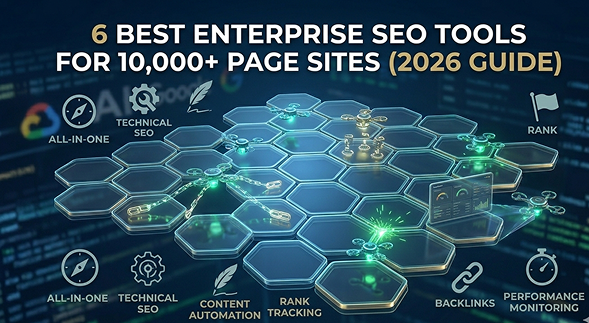
In 2026, managing a website with 10,000+ pages is no longer a manual task – it’s an engineering challenge. Between the rise of Generative Engine Optimization (GEO) and Google’s increasingly aggressive crawl budget management, large-scale publishers can’t afford to rely on weekly manual audits. To maintain dominance, you need a “set-and-forget” workflow where AI agents identify technical debt, optimize internal linking, and track brand citations in AI snapshots autonomously. In this 2026 guide, we will explore the 6 best enterprise SEO tools for 10,000+ page sites.
What Makes an SEO Tool Truly Enterprise-Ready?
Not every “Pro” plan is built for the enterprise. When you are managing tens of thousands (or millions) of URLs, the requirements shift from basic keyword tracking to infrastructure-level intelligence.
Scalability for 10,000+ to 1M+ Pages
Standard tools often “choke” or time out when crawling massive directories. Enterprise SEO tools must offer cloud-based crawling that can handle 400+ pages per second without paralyzing your local machine or triggering server-side blocks.
Automation Capabilities vs. Manual Workflows
In 2026, the best tools utilize AI Agents that don’t just find a broken 404; they suggest the most relevant redirect URL and, in some cases, push that change directly to your Edge SEO layer (via Cloudflare or Akamai). Many enterprise teams also rely on AI tools review platforms to evaluate which automation solutions deliver the most accurate recommendations and scalable workflows.
Data Accuracy, API Access & Integrations
Enterprise teams don’t live in SEO dashboards; they live in Slack, Salesforce, and Looker Studio. A true enterprise platform offers robust Read/Write APIs to pipe SEO data into your company’s internal Business Intelligence (BI) stack. While enterprise SEO tools help automate workflows and reporting, businesses still need experienced teams offering professional SEO services to implement strategy, technical fixes, and content optimization effectively.
Security, Permissions & Team Collaboration
With large sites come large teams. You need Role-Based Access Control (RBAC), SSO (Single Sign-On) integration, and audit logs to ensure that a junior editor doesn’t accidentally “noindex” a million-dollar subfolder.
Why Large Content Sites Need Enterprise SEO Tools?
At the 10,000-page mark, SEO issues compound exponentially. Here is why basic toolkits fail at this scale:
Crawl Budget & Indexation: Googlebot doesn’t visit every page of a large site every day. Enterprise tools help you prioritize “money pages” to ensure your best content isn’t sitting in the “Discovered – currently not indexed” graveyard.
Technical SEO at Scale: Manually checking Schema markup or Core Web Vitals for 50,000 blog posts is impossible. You need automated scripts that flag templates—not just individual pages—that are failing.
Internal Linking Automation: For massive sites, internal linking is the highest-leverage SEO move. Enterprise tools use NLP to automatically suggest links from old high-authority posts to new content.
Real-Time Monitoring: If a developer accidentally pushes a robots.txt change that blocks the entire site, you can’t wait for your weekly Monday report. You need instant alerts the second a site-wide anomaly is detected.
The 6 Best Enterprise SEO Tools for Large-Scale Websites
1. Semrush Enterprise: Best All-in-One Platform
Semrush remains the most versatile platform, especially with its 2026 “Copilot” updates which use predictive analytics to forecast keyword trends before they peak.
- Core Features: 25B+ keyword database, AI-powered “Share of Voice” tracking, and cross-channel competitive intel.
- Automation Strengths: The Content Toolkit automatically generates briefs and optimizes existing pages based on real-time competitor moves.
- Ideal Use Case: Large marketing teams that need one tool to handle SEO, PPC, and Social in one place.
- Integrations & Deployment: Cloud-based SaaS; connects to Google Analytics 4, Search Console, Looker Studio, and Salesforce, with team seats managed centrally.
- Pricing: The entry plan is $139.95/mo billed monthly, or $117.33/mo billed annually. Semrush Enterprise is a separate, sales-led platform with custom quotes.
- Pros: Widest all-in-one feature set; strongest keyword database; single platform for SEO, PPC, and social.
- Cons: Feature bloat you may not use; enterprise onboarding is slow; costs climb fast once you add seats and add-ons.
- Bottom line: The safest default for a large marketing team that wants one login for everything.

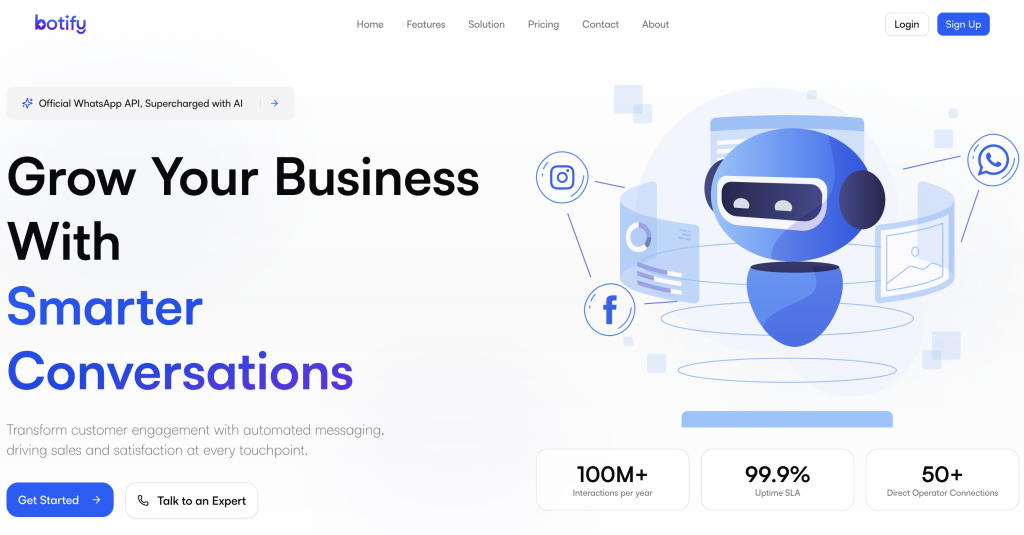
2. Botify: Best for Technical SEO & Deep Crawling
Botify is the “data scientist’s” SEO tool. It focuses on the Crawl -> Index -> Render funnel, making it essential for sites with complex JavaScript.
- Core Features: Log File Analyzer (to see exactly where Googlebot spends time) and “Botify Activation” for automated technical fixes.
- Automation Strengths: It can automatically identify “Orphan Pages” (pages with no internal links) and suggest high-authority parents.
- Ideal Use Case: Massive E-commerce or Marketplace sites (1M+ pages).
- Integrations & Deployment: Cloud crawler with connectors for Google Search Console, Adobe/GA analytics, and BigQuery data export; supports SSO and role-based seats.
- Pricing: Enterprise-only and custom-quoted. Vendr’s buyer data puts the average contract around $110,000 a year, and Botify’s AWS Marketplace packages are sold on 12-month terms.
- Pros: Best-in-class log file analysis and crawl-budget visibility; scales past 10M URLs; “Activation” pushes fixes automatically.
- Cons: Steep learning curve; overkill for content-led sites; pricing is opaque and high.
- Bottom line: Buy it if your bottleneck is Googlebot reaching your pages — not if it’s content.
3. Surfer Enterprise: Best for AI-Powered Content Automation
Surfer has evolved from a simple editor into an enterprise content powerhouse that maps entire topical clusters autonomously.
- Core Features: Auto-Optimize workflows that update old content to match new SERP/GEO requirements.
- Automation Strengths: Programmatic SEO support that can audit 1,000 pages at once for “Information Gain.”
- Ideal Use Case: Content-heavy publishers and niche site empires.
- Integrations & Deployment: SaaS editor with Google Docs, WordPress, and Jasper integrations; team workspaces with shared seats.
- Pricing: Self-serve plans start at $59/mo for Discovery ($49/mo billed annually), and Peace of Mind tops the self-serve range at $359/mo. Enterprise content plans are custom-quoted.
- Pros: Fastest content-optimization workflow; strong topical-cluster mapping; easy for editors to adopt.
- Cons: Not a technical-SEO tool; thin on backlink and log data; can encourage over-optimized writing.
- Bottom line: The content team’s tool, not the technical team’s — pair it with a crawler.
4. seoClarity: Best for Enterprise Rank Tracking & Reporting
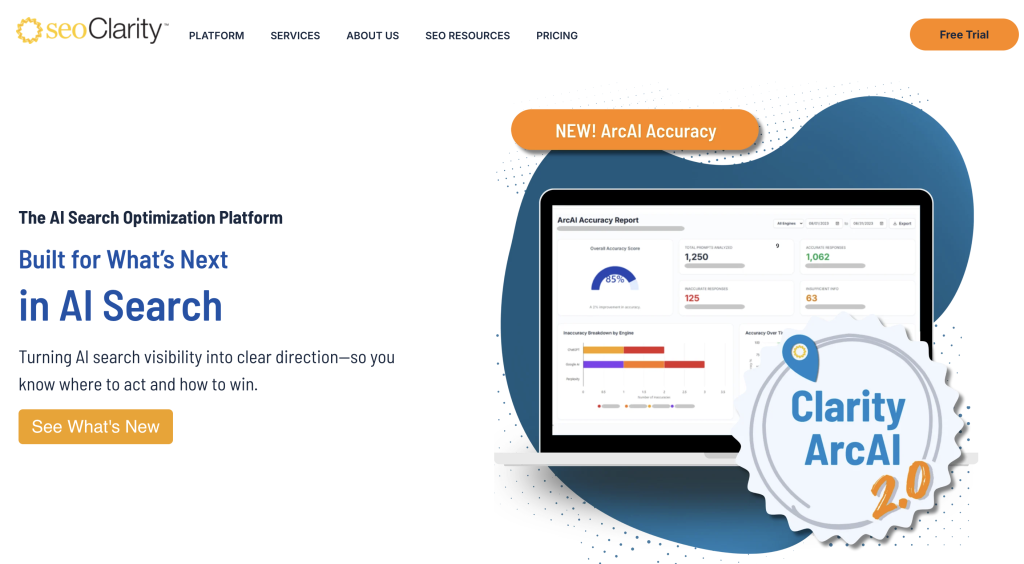
If you need a “Single Source of Truth,” seoClarity is the industry leader. It offers the most customizable dashboarding for C-suite reporting.
- Core Features: Clarity Grid for real-time site monitoring and “Content Fusion” for NLP-driven writing.
- Automation Strengths: No-limit rank tracking across 190+ countries and every search engine (including AI-based search).
- Ideal Use Case: Global corporations managing multiple international domains.
- Integrations & Deployment: Enterprise SaaS with GA4, GSC, Adobe Analytics, and BI/warehouse connectors; SSO, audit logs, and granular user roles.
- Pricing: seoClarity publishes starting floors: $2,500/mo for Research & Content, $3,200/mo for Technical SEO, and $4,500/mo for Enterprise. Rank-tracking-only plans are priced by keyword query volume, and multi-year agreements are discounted.
- Pros: Most customizable C-suite dashboards; no-limit rank tracking; genuine single-source-of-truth reporting.
- Cons: Priced for large orgs only; setup requires onboarding support; UI is dense for casual users.
- Bottom line: The reporting layer for global teams that need to prove ROI to leadership.
5. Ahrefs Enterprise: Best for Backlink & Competitive Intelligence
Ahrefs still owns the world’s most comprehensive backlink index, which is vital for sites where “Authority” is the primary ranking bottleneck.
- Core Features: Site Explorer 3.0 with hourly backlink updates and the most accurate “Content Gap” analysis.
- Automation Strengths: Automated link monitoring that alerts you if a competitor starts a massive digital PR push.
- Ideal Use Case: B2B SaaS and high-competition niches (Finance, Health).
- Integrations & Deployment: Cloud platform with GSC integration, Looker Studio connector, and API access; enterprise tier adds SSO and managed seats.
- Pricing: Lite is $129/mo, Standard $249/mo, and Advanced $449/mo. Enterprise is $1,499/mo, billed annually at $14,990/yr, and adds SSO and expanded API access.
- Pros: Deepest backlink index; excellent content-gap analysis; fast, reliable data.
- Cons: Weaker on workflow automation and content editing; per-seat model gets expensive; no free trial.
- Bottom line: The pick when link authority — not crawling or content — is what’s holding you back.

6. Lumar (formerly DeepCrawl): Best for Performance & UX Monitoring
Lumar focuses on “Website Intelligence.” It acts as a safety net for your site’s health, ensuring speed and accessibility don’t tank your rankings.
- Core Features: Lumar Protect, which integrates into your CI/CD pipeline to stop “SEO-breaking” code before it’s even deployed.
- Automation Strengths: Continuous Core Web Vitals monitoring across every single URL.
- Ideal Use Case: Agile dev teams that push code updates daily.
- Integrations & Deployment: Cloud crawler that plugs into CI/CD pipelines, GA4, GSC, and Jira; SSO and team-based access controls.
- Pricing: Enterprise-only and custom-quoted from modular packages (Analyze, Monitor, Protect, Impact). Vendr’s buyer data shows a median contract of roughly $57,500 a year.
- Pros: Continuous site-health monitoring; catches SEO-breaking changes before deploy; strong accessibility and Core Web Vitals coverage.
- Cons: Narrow scope (health/monitoring, not research); requires dev involvement to act on findings; enterprise-only pricing.
- Bottom line: A safety net for teams shipping code daily — best run alongside a research tool.

Feature Comparison: Top Enterprise SEO Tools at a Glance
| Tool | Primary Strength | Max Scale | Best Automation Feature | Starting Price (list, USD) | Contract Length | Best For |
|---|---|---|---|---|---|---|
| Semrush | Market Intel | 1M+ Pages | AI Copilot Recommendations | $139.95/mo monthly or $117.33/mo billed annually (entry plan); Enterprise custom-quoted | Monthly or annual on self-serve plans; Enterprise is sales-led | All-in-one marketing teams |
| Botify | Technical SEO | 10M+ Pages | Log File & Crawl Budget Optimization | Custom quote only; Vendr buyer data averages about $110,000/yr | 12-month terms on Botify’s AWS Marketplace packages | Massive e-commerce / JS sites |
| Surfer | Content Velocity | 10k+ Pages | AI Auto-Optimizing Workflows | $59/mo monthly or $49/mo billed annually (Discovery); Enterprise custom-quoted | Monthly or annual; no lock-in on monthly plans | Content-heavy publishers |
| seoClarity | Reporting / BI | Unlimited | Clarity Grid (Real-time Monitoring) | From $2,500/mo (Research & Content); Enterprise from $4,500/mo | Custom terms; multi-year agreements discounted | Global orgs, C-suite reporting |
| Ahrefs | Backlink Analysis | 1M+ Pages | Hourly Link Gap Alerts | $129/mo (Lite); Enterprise $1,499/mo | Monthly or annual on Lite to Advanced; Enterprise billed annually ($14,990/yr) | Authority / link-driven niches |
| Lumar | Site Health | 10M+ Pages | CI/CD Pipeline SEO Gatekeeping | Custom quote only; Vendr buyer data shows a median of about $57,500/yr | Not published; set per quote | Daily-deploy dev teams |
List prices checked October 2026. Vendors change plans often, so confirm on each pricing page before you budget. Botify and Lumar figures are third-party buyer benchmarks, not vendor list prices.
What “10,000+ Pages” Actually Changes About Your Tool Choice
This guide is written for sites past 10,000 URLs, so it’s worth being specific about what that threshold means. Below it, most SEO tools feel interchangeable. Above it, the deciding factors stop being features and become crawl capacity, contract structure, and how many people need a login.
Do the crawl math before you book a demo
Your monthly crawl volume is your page count multiplied by how often you re-crawl. A 10,000-page site crawled weekly uses roughly 43,000 crawl pages a month. At 50,000 pages, weekly crawls need about 217,000. At 250,000 pages, you’re past one million a month.
That’s where self-serve plans run out. Semrush caps Site Audit crawling at 100,000 pages a month on Pro, 300,000 on Guru, and 1,000,000 on Business, shared across every project in the account. A 50,000-page site on weekly crawls has outgrown Pro before you add a second domain.
Match the tool tier to your URL count
- 10,000 to 100,000 URLs: The self-serve tiers of Semrush, Ahrefs, or Surfer usually cover this band if you crawl weekly or less often. Upgrades here are driven by seats and historical data, not crawl limits.
- 100,000 to 1 million URLs: Self-serve crawl quotas get tight. This is where seoClarity’s published packages and Ahrefs Enterprise start to earn their price, mostly through API access, SSO, and reporting across multiple domains.
- 1 million+ URLs, or JavaScript-heavy templates: Crawl budget becomes the bottleneck. Botify and Lumar are built for this band, where log file analysis and render monitoring matter more than keyword data.
Four questions to answer before you request a quote
- How many indexable URLs do you have, not total URLs? Faceted navigation and parameter URLs inflate both your crawl count and your quote.
- How often do your templates change? Daily deploys justify continuous monitoring. Quarterly redesigns usually don’t.
- Do you need server log data? If the real question is how Googlebot spends its time on your site, only a log-file tool answers it.
- Who needs a login? Per-seat add-ons change the math on self-serve plans quickly, so price your actual team size rather than a single seat.
How to Choose the Right Enterprise SEO Tool for Your Business?
In 2026, the “right” tool isn’t just about features; it’s about alignment with your specific business model. A tool that excels at tracking 50 keywords for a B2B startup will fail a marketplace with 5 million SKU pages.
For Publishers with Massive Content Libraries
If you manage a high-volume news site or a massive blog archive, your biggest enemies are content decay and cannibalization.
- What to Look For: Tools with advanced “Content Auditing” features that flag underperforming pages for archival or refresh.
- Key Feature: Topical Authority Mapping. You need a tool that visualizes your clusters to ensure you aren’t competing against yourself for the same high-intent keywords.
- Top Pick: Semrush Enterprise or Surfer for their ability to manage editorial workflows at scale.
For SaaS & B2B Companies
In SaaS, or enterprise software development company SEO is about pipeline, not just traffic. You need to connect organic search data to your CRM (like Salesforce or HubSpot).
- What to Look For: Deep integration capabilities and Share of Voice (SoV) metrics. You need to know how often you appear in “Best [Category] Software” lists.
- Key Feature: AI Visibility Tracking. As of 2026, B2B buyers are using AI agents (like Perplexity or Claude) to research vendors. Choose a tool like Sight AI that tracks how often your brand is cited in AI-generated answers.
- Top Pick: Conductor or seoClarity for their robust executive reporting and business intelligence integrations.
For Ecommerce & Marketplace Sites
For sites with 100,000+ products, technical health is the only thing that matters. If your “faceted navigation” (filters) creates millions of junk URLs, Google will stop crawling your site.
- What to Look For: Log file analysis and Render Budget management. You need to see exactly how Googlebot interacts with your heavy JavaScript pages.
- Key Feature: Dynamic Content Optimization. Tools that can automatically inject Schema markup or update meta-tags across entire product categories based on stock levels or price changes.
- Top Pick: Botify or Lumar (formerly DeepCrawl) for their unrivaled deep-crawling power.
For Programmatic & Affiliate SEO Models
Programmatic SEO (pSEO) involves generating thousands of pages from a single database (e.g., “Best Gyms in [City Name]”), which helps large travel publishers scale location-based content efficiently.
- What to Look For: API-first architecture and Workflow Automation. You need to move data between Airtable, your CMS, and your SEO tool seamlessly.
- Key Feature: Bulk Audit Tools. The ability to check the “Indexing Status” of 10,000 URLs in a single click to ensure your pSEO pages are actually live.
- Top Pick: Ahrefs Enterprise (for its massive index) combined with Hexomatic or Airtable for data-driven scaling.
Building a “Set-and-Forget” Enterprise SEO Stack
You don’t need all six tools. Most successful 10,000+ page sites use a hybrid stack:
- The Minimalist Stack: Semrush Enterprise + Lumar. (Covers keyword research + deep technical protection).
- The Content King Stack: Ahrefs Enterprise + Surfer. (Covers authority building + massive content production).
- The “Fully Automated” Stack: Botify + seoClarity. (The ultimate choice for sites where the SEO team is small but the site is massive).
Common Mistakes When Investing in Enterprise SEO Software
Even the most expensive tool becomes “shelfware” if implemented incorrectly. Avoid these three common pitfalls:
1. Paying for Features You Don’t Use
Enterprise platforms are notorious for “feature bloat.” Many companies pay $5,000/month for a suite but only use the rank tracker.
- The Fix: Start with a gap analysis. Do you actually need an in-platform AI writer, or is your editorial team already using a dedicated tool? Don’t pay for redundant functionality.
2. Over-Automating Content Production
With the 2026 “Helpful Content” algorithm updates, Google has become highly proficient at detecting “mass-produced fluff.”
- The Mistake: Using an enterprise tool to push 1,000 AI-generated pages a week without human oversight.
- The Risk: Site-wide suppression. If Google deems a specific subdirectory as “low effort,” it can drag down the rankings of your high-quality, human-written pages. Automation should assist research, not replace the writer.
3. Ignoring Technical SEO Foundations
A common mistake is thinking a tool will “fix” your SEO. No tool can fix a fundamentally broken site architecture or a server that takes 5 seconds to respond.
- The Reality: Enterprise tools are diagnostic, not curative. If you invest in a tool like Botify but don’t have the developer resources to act on its findings, the investment is wasted.
- The Fix: Ensure your SEO tool purchase is paired with a Technical SEO Roadmap and a committed engineering sprint.
The Future of Enterprise SEO Tools
By the end of 2026, the term “Search Engine” will likely be replaced by “Answer Engine.” Enterprise tools are already pivoting to:
- AI Search Visibility: Tracking how often your brand appears in ChatGPT, Claude, and Gemini citations.
- Predictive SEO: Using machine learning to tell you which keyword will be trending 3 months from now.
- Autonomous Fixes: Tools that don’t just find an error but write the code, test it in a staging environment, and deploy it.
Conclusion
If you are managing 10,000+ pages, the choice comes down to your bottleneck:
- Struggling with Googlebot not finding pages? Get Botify.
- Struggling with competitors out-ranking you? Get Ahrefs.
- Struggling to prove ROI to your boss? Get seoClarity.