

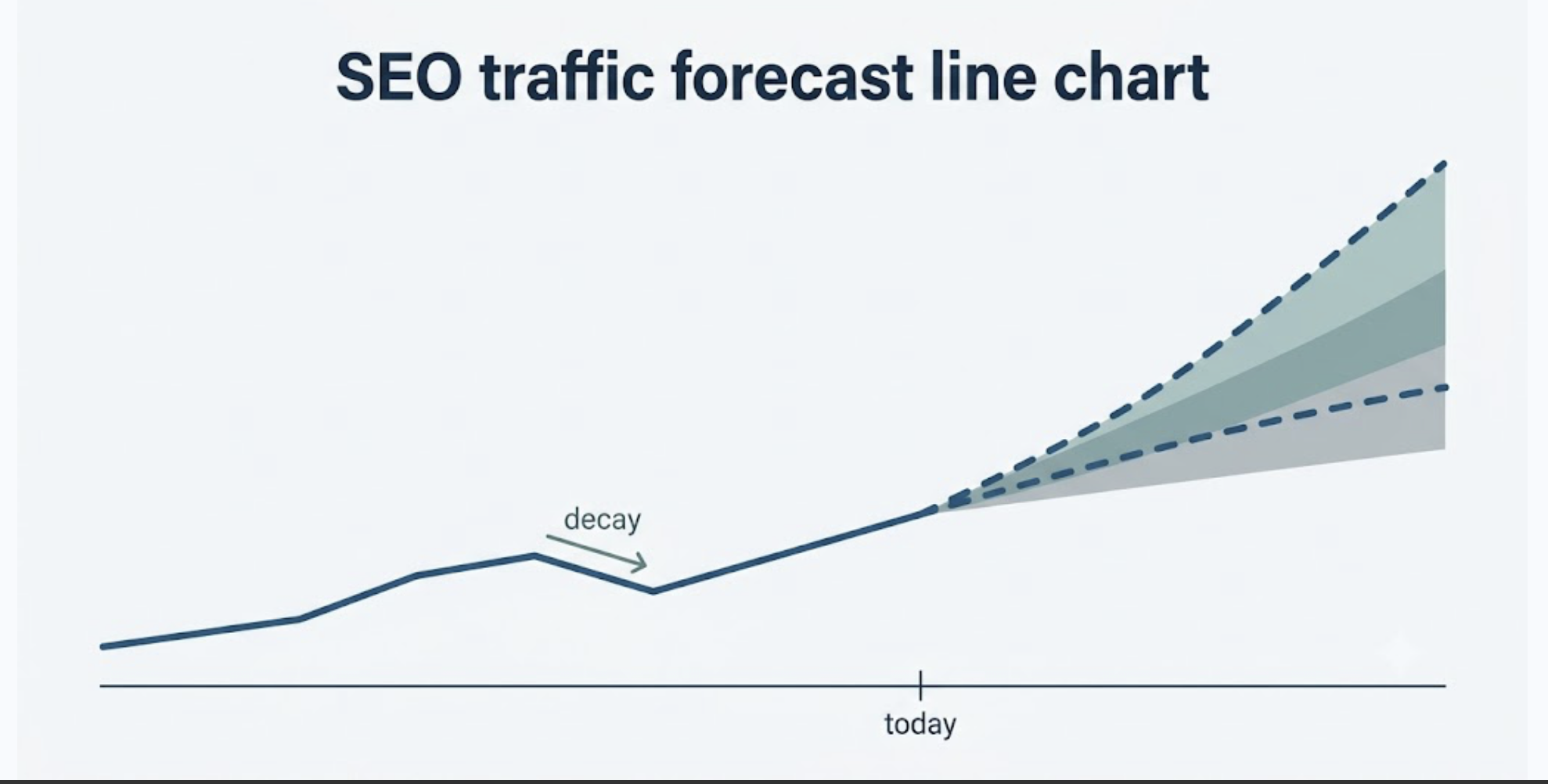
SEO forecasting helps you answer a question every SEO team eventually gets:
“If we invest in SEO today, how much organic traffic can we expect in the next 3, 6, or 12 months?”
The answer shouldn’t be a random growth percentage.
A useful SEO forecast combines your existing organic performance with keyword search demand, ranking potential, click-through rates, seasonality, conversions, and expected changes to your existing content.
At its simplest:
Forecast organic traffic = Search demand × Expected organic CTR
But a useful forecast goes further:
Forecast conversions = Forecast organic traffic × Conversion rate
And:
Forecast revenue = Forecast conversions × Average conversion value
The difficulty is that none of these inputs stay perfectly constant. Rankings move. Search demand changes. Competitors publish new content. Existing pages decay. And AI Overviews can reduce the number of searches that result in a traditional organic click.
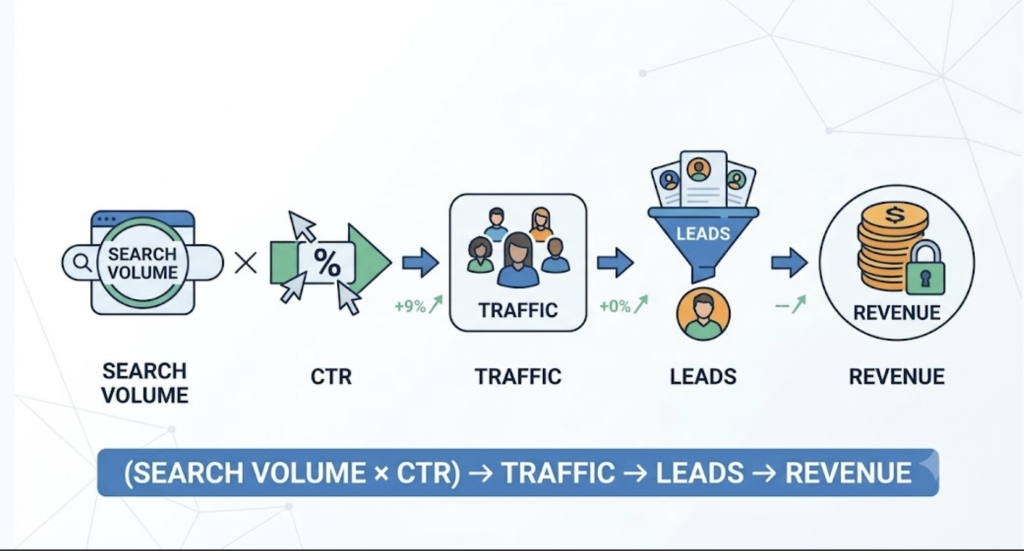
That’s why modern SEO forecasting shouldn’t produce one supposedly precise number.
It should produce a realistic range based on clearly stated assumptions.
In this guide, we’ll walk through how to forecast SEO traffic using keyword data and historical performance, build conservative, realistic, and aggressive scenarios, account for AI-driven changes in search, and turn your traffic forecast into leads and revenue.
What is SEO Forecasting?
SEO forecasting is the process of estimating a website’s future organic search performance — traffic, conversions, and revenue — using historical data, keyword search demand, expected rankings, and click-through rates. Rather than one exact number, a good forecast produces a realistic range built on assumptions you can examine, challenge, and update.
An SEO forecast can help estimate:
- Organic clicks and sessions
- Keyword ranking growth
- Leads and conversions
- Revenue from organic search
- Potential traffic from new content
- Traffic that could be recovered by refreshing existing content
For example, suppose a keyword receives 10,000 searches per month.
If you expect to rank in a position that generates an estimated 8% organic CTR:
10,000 × 8% = 800 estimated monthly organic visits
If 3% of those visitors convert:
800 × 3% = 24 conversions
If each conversion is worth $200:
24 × $200 = $4,800 in forecast monthly value
That’s the basic logic behind keyword-based SEO forecasting.
Real-world forecasting becomes more complicated because rankings, CTR, search demand, AI Overviews, competition, and existing traffic can all change.
That’s why the goal isn’t to predict the future perfectly.
The goal is to create a reasonable range that helps you make better SEO decisions.
How to Forecast SEO Traffic in 5 Steps
- Set your baseline: Pull 12 months of organic clicks, conversions, and rankings from Google Search Console.
- Build a target keyword list: Note each keyword’s search volume, current position, and a realistic target position.
- Estimate traffic at target rankings: Multiply search volume by expected CTR, then keep only the incremental gain over current traffic.
- Adjust for reality: Discount for seasonality, AI Overviews, and the traffic that decaying pages will lose.
- Translate to revenue, then model scenarios: Convert traffic into conversions and revenue, and show conservative, realistic, and aggressive ranges.
Why Is SEO Forecasting Important?
SEO results rarely happen immediately.
A page published today may take weeks or months to reach its potential, which makes it difficult for marketing teams to answer questions such as:
- How much traffic could this SEO strategy generate?
- Which keywords should we prioritize?
- How much content should we publish?
- Should we refresh existing pages or create new ones?
- What could SEO contribute to leads or revenue?
- Is the expected return worth the investment?
SEO forecasting gives you a framework for answering those questions before the results arrive.
Instead of saying:
“Organic traffic should increase after we publish these pages.”
you can say:
“Based on current rankings, search demand, expected CTR, and our conversion rate, the realistic scenario is 15,000–20,000 additional organic visits over the next six months.”
The second statement is still an estimate, but its assumptions can be examined, challenged, and updated.
That’s what makes an SEO forecast useful.
What Data Do You Need to Forecast SEO Traffic?
A forecast is only as useful as the data behind it.
Whenever possible, start with your own first-party data and use third-party SEO data to fill gaps.
Google Search Console
Google Search Console should be one of your primary data sources for an existing website.
Export:
- Organic clicks
- Impressions
- Queries
- Average ranking position
- CTR
- Page-level performance
Ideally, use at least 12 months of data so your forecast can distinguish long-term growth from seasonal fluctuations.
GA4 or Your Analytics Platform
Analytics data helps you understand what happens after someone reaches the website.
Useful inputs include:
- Organic sessions
- Conversion rate
- Leads
- Purchases
- Average order value
- Revenue from organic traffic
These numbers allow you to move beyond forecasting traffic and estimate business impact.
Keyword Data
For keyword-based forecasting, you’ll also need:
- Target keywords
- Monthly search volume
- Current ranking
- Target ranking
- Search intent
- SERP features
- Estimated CTR
Tools such as Ahrefs, Semrush, and other keyword platforms can provide this data.
Historical Performance
Historical traffic helps establish your baseline.
Ideally, collect at least 12 months of data. For businesses with strong seasonality, 24 months or more can give you a better comparison.
Conversion and Revenue Data
If you’re forecasting business outcomes, you’ll need:
Traffic × Conversion rate = Conversions
and:
Conversions × Average conversion value = Revenue
Without conversion data, you’re forecasting visibility.
With it, you’re forecasting potential business impact.
How to Forecast SEO Traffic Step by Step
There are several ways to build an SEO forecast, but a keyword-based model is often the easiest place to start.
Here’s the process.
Step 1: Establish Your Current SEO Baseline
Before forecasting growth, determine where you are today.
Export the last 12 months of organic performance from Google Search Console or your analytics platform.
Record:
- Monthly organic clicks
- Organic sessions
- Conversions
- Revenue
- Top-performing pages
- Current keyword rankings
For example:
| Metric | Current Monthly Performance |
|---|---|
| Organic clicks | 25,000 |
| Organic conversions | 750 |
| Conversion rate | 3% |
| Organic revenue | $75,000 |
This becomes the baseline against which future growth is measured.
Step 2: Build Your Target Keyword List
Next, identify the keywords that could contribute additional traffic.
Include:
- Keywords you already rank for
- Keywords ranking on page two
- Keywords ranking in positions 4–10
- New keywords you plan to target
- Keywords competitors rank for but you don’t
For each keyword, record:
| Keyword | Search Volume | Current Position | Target Position |
|---|---|---|---|
| Keyword A | 10,000 | 9 | 4 |
| Keyword B | 5,000 | 14 | 6 |
| Keyword C | 3,000 | — | 8 |
Don’t assume every keyword will reach position #1.
Your target positions should reflect your site’s authority, competitors, search intent, and existing ranking performance.
Step 3: Estimate CTR at the Target Ranking Position
Search volume tells you how often people search.
It doesn’t tell you how many people will visit your website.
For that, you need an estimated organic click-through rate.
The basic calculation is:
Estimated organic traffic = Search volume × Expected CTR
Suppose a keyword receives 10,000 searches per month.
If your target position has an estimated CTR of 8%:
10,000 × 0.08 = 800 forecast monthly clicks
Repeat this calculation for every keyword in your model.
Don’t blindly apply the same CTR curve to every keyword.
CTR can vary significantly depending on:
- Ranking position
- Search intent
- Paid ads
- Featured snippets
- Shopping results
- Local packs
- Video results
- AI Overviews
- Brand recognition
Use CTR as an assumption, not a guarantee.
Step 4: Calculate Incremental SEO Traffic
You don’t want to count all forecast traffic as growth if the page already receives clicks.
Instead calculate the difference between current and expected performance.
For example:
| Keyword | Volume | Current Traffic | Forecast Traffic | Incremental Gain |
|---|---|---|---|---|
| Keyword A | 10,000 | 200 | 800 | +600 |
| Keyword B | 5,000 | 100 | 300 | +200 |
| Keyword C | 3,000 | 0 | 120 | +120 |
Total incremental monthly traffic:
600 + 200 + 120 = 920 additional organic visits
This is much more useful than simply adding the theoretical traffic potential of every keyword.
Step 5: Adjust for Seasonality
Search demand rarely stays constant throughout the year.
A tax software company, travel business, ecommerce store, or education website can experience major seasonal changes.
Use historical GSC or analytics data to identify these patterns.
For example, if organic demand is typically 25% higher in November than the annual monthly average, your November forecast should reflect that.
Likewise, don’t use peak-season search volumes as if they’ll continue throughout the year.
Step 6: Forecast Conversions and Revenue
Traffic isn’t normally the final business goal.
Once you have forecast organic traffic, connect it to conversions.
Suppose your forecast produces:
20,000 additional organic visits
and your historical organic conversion rate is:
3%
Your forecast becomes:
20,000 × 3% = 600 additional conversions
If the average conversion is worth $150:
600 × $150 = $90,000 in potential revenue
Now your SEO forecast connects rankings to traffic and traffic to business value.
Step 7: Build Multiple Forecast Scenarios
Don’t give stakeholders one number and pretend it’s certain.
Create at least three scenarios.
Conservative forecast
Assume:
- Smaller ranking improvements
- Lower CTR
- Slower content performance
- Greater existing-content decay
- Stronger impact from SERP features
Realistic forecast
Use the assumptions you consider most likely based on historical performance.
Aggressive forecast
Assume:
- Stronger ranking gains
- Faster content performance
- Successful refreshes
- Higher CTR
- Greater keyword coverage
Your final forecast could look like this:
| Scenario | Monthly Organic Traffic | Conversions | Revenue |
|---|---|---|---|
| Conservative | 32,000 | 960 | $144,000 |
| Realistic | 38,000 | 1,140 | $171,000 |
| Aggressive | 45,000 | 1,350 | $202,500 |
The exact figures aren’t the important part.
The assumptions behind them are.
Scenario-based forecasting is also consistent with how current SEO forecasting resources increasingly approach uncertainty rather than relying on a single point estimate.
SEO Forecasting Example
Let’s put the entire process together.
Suppose you’re considering targeting five keywords:
| Keyword | Monthly Volume | Current Traffic | Forecast Traffic |
|---|---|---|---|
| Keyword A | 10,000 | 200 | 800 |
| Keyword B | 8,000 | 150 | 560 |
| Keyword C | 5,000 | 80 | 350 |
| Keyword D | 4,000 | 0 | 240 |
| Keyword E | 3,000 | 0 | 150 |
Your current traffic from these keywords is:
430 visits/month
Forecast traffic is:
2,100 visits/month
So the incremental opportunity is:
2,100 − 430 = 1,670 additional monthly organic visits
Now suppose your organic conversion rate is 3%.
1,670 × 3% = approximately 50 additional conversions/month
And the average conversion is worth $200.
50 × $200 = approximately $10,000 additional monthly value
You now have a forecast connecting:
Keywords → Rankings → CTR → Traffic → Conversions → Revenue
But this is still the optimistic version of the calculation because it assumes your existing organic performance remains intact.
That’s where historical forecasting and content decay become important.
How to Forecast SEO Using Historical Traffic
Keyword-based forecasting estimates what could happen if your rankings improve.
Historical forecasting asks a different question:
If our existing organic trend continues, where are we likely to end up?
Start by exporting at least 12 months of organic clicks or sessions.
For seasonal businesses, 24–36 months is preferable.
You can then use:
- Moving averages
- Linear trendlines
- Google Sheets or Excel forecasting functions
- Prophet
- ARIMA or SARIMA
- Other time-series forecasting models
Historical forecasting is particularly useful for websites with several years of consistent SEO data.
For example, if organic traffic has grown steadily from:
January: 50,000 visits
April: 55,000 visits
July: 61,000 visits
October: 68,000 visits
a time-series model can estimate where that trajectory may lead.
But historical forecasting has an important weakness:
It assumes patterns in the historical data remain useful predictors of the future.
Algorithm updates, new competitors, changing SERPs, AI Overviews, content decay, and changes in search demand can all break that assumption.
That’s why historical forecasts work best when they’re combined with keyword-level opportunity and scenario modeling rather than used alone.
Ahrefs similarly distinguishes keyword-level forecasting from forecasts based on historical traffic data.
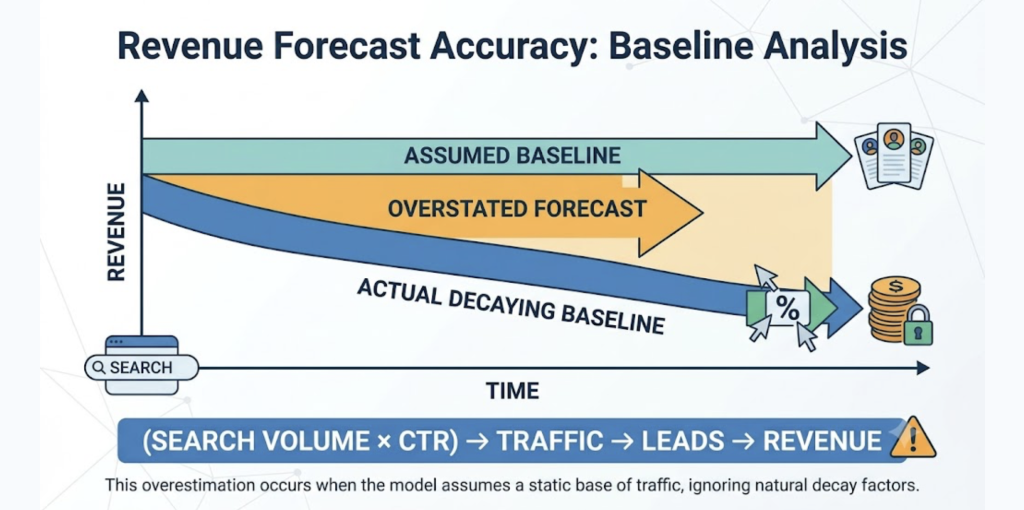
Don’t Assume Your Existing SEO Traffic Will Stay Flat
Here’s one of the easiest mistakes to make in an SEO forecast.
You calculate your current organic traffic.
Then you add all the traffic you expect from new pages and ranking improvements.
Your model becomes:
Existing traffic + New traffic = Future traffic
But that assumes your existing traffic remains unchanged.
In reality, some pages will grow, some will remain stable, and others will lose traffic.
Existing content can decline because of:
- Competitors publishing better pages
- Search intent changing
- Outdated information
- Lost rankings
- SERP changes
- Declining search demand
- Internal-link changes
- Content becoming less competitive over time
So a more useful model is:
Future organic traffic = Existing traffic − Expected losses + Recovered traffic + New traffic
This is where content decay matters.
Instead of treating your entire existing traffic baseline as permanent, separate URLs into groups:
Growing pages
Traffic is increasing.
Stable pages
Traffic is relatively consistent.
Decaying pages
Traffic has been declining over a meaningful period.
Now you can account for likely losses before adding forecast growth.
For example:
| Forecast Component | Monthly Traffic |
|---|---|
| Existing baseline | 100,000 |
| Expected decay | -8,000 |
| Traffic recovered through refreshes | +5,000 |
| New SEO growth | +20,000 |
| Forecast traffic | 117,000 |
Without the decay adjustment, the forecast would have predicted 120,000.
That difference becomes much larger when forecasting hundreds or thousands of pages.
For large content libraries, manually identifying which pages are genuinely declining can also become difficult.
This is where WordPattern can help identify content decay and prioritize URLs that may need refreshing, allowing the downside portion of an SEO forecast to be based on actual page-level performance rather than a blanket assumption.
How AI Overviews Affect SEO Forecasting
SEO traffic forecasting has become harder because ranking position is no longer the only major factor influencing organic CTR.
AI Overviews can answer part or all of a query before a user visits a traditional search result.
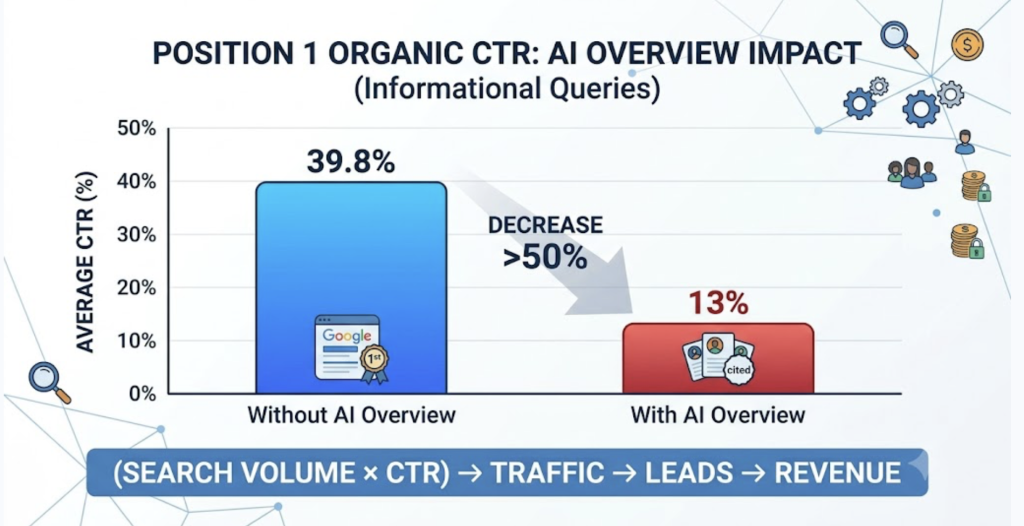
Research has already found substantial CTR differences on searches where AI Overviews appear. Ahrefs, for example, found that the presence of an AI Overview correlated with a substantially lower CTR for the top-ranking organic result.
That means this calculation:
Search volume × Traditional position CTR
can overestimate traffic for some queries.
A better approach is to segment keywords.
Queries without an AI Overview
Use an appropriate organic CTR assumption based on ranking position and SERP layout.
Queries with an AI Overview
Apply a more conservative CTR assumption.
Queries where your brand is cited in AI results
Track these separately where possible rather than assuming traditional ranking position captures all search visibility.
This gives you an AI-adjusted forecast instead of applying the same CTR curve to every keyword.
The important principle is simple:
Search volume is not the same as available organic traffic.
Your forecast should estimate the portion of that demand that could realistically result in a visit.
Forecast Traffic From Content Refreshes, Not Just New Content
SEO growth doesn’t only come from publishing new pages.
Existing pages may already have:
- Backlinks
- Internal links
- Ranking history
- Topical relevance
- Existing impressions
- Keywords ranking on pages one and two
That can make recovering lost traffic from an existing URL a meaningful part of your forecast.
Suppose a page historically generated:
5,000 organic visits/month
but now generates:
3,000 visits/month
That’s a decline of:
2,000 monthly visits
Don’t automatically forecast that you’ll recover all 2,000.
Instead create scenarios.
| Scenario | Traffic Recovered |
|---|---|
| Conservative | 500 |
| Realistic | 1,000 |
| Aggressive | 1,500 |
Now the refresh becomes a measurable component of the overall SEO forecast.
For websites with large content libraries, this can be especially important.
Publishing 50 new articles while 100 older articles are losing traffic can make overall growth look much weaker than expected.
That’s why a complete SEO forecast should model both:
New traffic acquisition
and
Existing traffic recovery/retention.
Best Tools for SEO Forecasting
You don’t necessarily need dedicated forecasting software.
Most SEO forecasts can be built using a combination of first-party analytics, keyword data, and a spreadsheet.
Google Search Console
Best for:
- Historical clicks
- Impressions
- CTR
- Rankings
- Query-level performance
- Page-level trends
For an existing website, this should usually be one of your primary sources.
GA4
Best for connecting SEO traffic to:
- Conversions
- Engagement
- Ecommerce performance
- Revenue
Google Sheets or Excel
Best for building your actual forecasting model.
A basic spreadsheet can calculate:
Search volume × CTR → Traffic
then:
Traffic × Conversion rate → Conversions
then:
Conversions × Value → Revenue
You can also build separate conservative, realistic, and aggressive scenarios.
Ahrefs or Semrush
Useful for:
- Keyword search volume
- Current rankings
- Competitor rankings
- Keyword opportunities
- SERP analysis
Third-party traffic estimates should generally be treated as directional rather than as your site’s actual traffic.
Python, Prophet and Statistical Models
For larger datasets, statistical forecasting can help model historical traffic, trends, and seasonality.
This is particularly useful when you have several years of reliable organic-performance data.
WordPattern
WordPattern is useful for the part many SEO forecasts overlook:
what happens to the traffic you already have.
Identifying declining pages can help you estimate potential baseline losses and find pages where content refreshes could contribute recoverable traffic.
That makes content decay a measurable forecasting input instead of an assumption.
Common SEO Forecasting Mistakes
Even a sophisticated forecasting model can produce misleading results if its assumptions are unrealistic.
Treating the Forecast as a Guarantee
SEO forecasts are estimates.
Algorithm updates, competitor activity, search demand, SERP features, and implementation delays can all change the result.
Use ranges rather than promises.
Assuming Every Keyword Will Rank #1
This can massively inflate traffic estimates.
Use target positions that reflect your site’s existing authority and competitive landscape.
Using Search Volume as Expected Traffic
A keyword with 10,000 monthly searches won’t automatically deliver 10,000 visits.
Search volume needs to be adjusted for ranking position, CTR, SERP features, and search intent.
Using the Same CTR for Every Keyword
A #1 result on a branded search can behave very differently from a #1 result underneath ads, an AI Overview, videos, and other SERP features.
Segment your assumptions where possible.
Ignoring Seasonality
Annual averages can hide major changes in monthly demand.
Use historical performance and search trends to adjust your forecast.
Ignoring Content Decay
New traffic doesn’t necessarily equal net growth.
If older pages lose 10,000 visits while new pages generate 15,000, your actual growth is only 5,000.
Forecasting Only Traffic
Traffic matters, but businesses usually care about outcomes.
Where possible, connect:
Traffic → Conversions → Revenue
Forecasting One Number
Avoid:
“SEO will generate 250,000 visits next year.”
Prefer:
“Based on our assumptions, we expect 200,000–280,000 visits, with approximately 240,000 representing our realistic scenario.”
Never Comparing Forecast vs. Actual
A forecast should improve over time.
Compare predicted and actual performance monthly or quarterly.
If your forecast consistently overestimates traffic, adjust your ranking, CTR, or conversion assumptions.
Build an SEO Forecast You Can Actually Use
SEO forecasting isn’t about predicting exactly how many visits you’ll get six months out — it’s about making uncertainty measurable.
Start from your existing organic performance, estimate the incremental traffic realistic ranking gains could add (search demand × expected CTR), then connect that to conversions and revenue (× conversion rate, × conversion value). Adjust for seasonality, AI Overviews, and the traffic your existing pages may lose or recover, and present a range of scenarios instead of one number.
So a useful forecast looks less like Current traffic + Expected growth and more like:
Existing traffic − Expected losses + Recovered traffic + New traffic = Forecast organic traffic
That’s a more realistic number to take into a budget conversation.
That nets the change to roughly flat, so you stay above the ranking set without padding.
FAQs
It’s predicting how much organic traffic, and ideally revenue, your site will earn from search over a future period. You use past performance, keyword search volume, and expected click-through rates to project forward, so you can set goals and justify budget with numbers rather than guesses.
Not perfectly, and anyone promising certainty is selling something. Algorithm updates, competitor moves, and shifting search behavior all interfere. A good forecast is a range with clear assumptions, treated as a compass for direction rather than a guarantee of an exact figure. Reconciling it against actuals each quarter tightens it over time.
Not a 2020 curve. Position-one CTR has fallen sharply, and any keyword triggering an AI Overview should be discounted heavily. Pull a current CTR-by-position study, check which of your keywords trigger AI Overviews, and model those with a lower floor. Use a range, since published CTR figures vary a lot by study.
Both, but forecast them separately. Refreshes are faster and more predictable because the page already has authority and history, often recovering within weeks. New content takes months and carries more risk. For near-term forecasts, weight refresh gains more heavily; they’re far likelier to land inside your window.
Yes, but you lean on third-party data instead of your own. Analyze competitor rankings, their traffic, and keyword search volumes to estimate what’s achievable, then apply realistic CTR and ranking-timeline assumptions. Expect wider uncertainty bands than an established site, since you have no first-party baseline to anchor to.