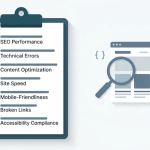


Almost everyone does content marketing now. Depending on which survey you read, somewhere between 82% and 97% of organizations run some kind of content program. And yet only about one in four marketers say their efforts are actually working well.
Read that again. Near-universal adoption. A quarter of people happy with the results.
So the problem probably isn’t that you don’t know how to make content. You can write the blog post, film the video, send the email. The frustrating part is the thing nobody warns you about: the stuff you published last year quietly stopped pulling its weight, and you’re not sure why. This guide is for content marketers who want more than the basics. It walks the whole discipline — what content marketing is, how it works, the formats, the funnel, and content marketing strategy development that actually holds up. Then it covers the part most guides skip entirely: keeping your content earning long after you hit publish.
What Content Marketing Actually Is
Content marketing is the practice of creating and sharing useful material (articles, videos, emails, whatever fits) to attract an audience and earn their trust, without leading with a sales pitch.
That last bit is the whole game. Traditional advertising interrupts people. It buys attention it didn’t earn. Content marketing does the opposite: it pulls people in by being genuinely helpful, so that when they’re ready to buy, you’re already the name they trust.
There’s a trap here, though. When everyone publishes, most of what gets made is me-too content — the fourth near-identical “what is X” post that adds nothing to the three already ranking. That kind of content doesn’t build trust; it just adds noise. The material that earns attention is the material that says something the others didn’t.
Think about the finance startup that publishes a January budgeting guide, or the skincare brand with a blog that actually explains ingredients. Neither is shouting “buy now.” They’re building a relationship along the content marketing funnel, one useful answer at a time.
Why Content Marketing Works (When It Works)
Here’s the mechanism, stripped down. A paid ad stops the moment you stop paying. A good piece of content keeps working. It ranks, it gets shared, it earns links, and it does that for years. The average page sitting in Google’s top ten is more than two years old.
That’s the compounding effect everyone loves to talk about. Write once, benefit for ages.
It’s also why the organizations that treat this seriously pull ahead. Teams with a documented content strategy earn about three times more leads per dollar than teams winging it. Not three times more leads. Three times more leads per dollar. The efficiency gap is the real story.
But notice the caveat I keep sneaking in. “When it works.” Compounding only holds if the asset stays healthy. And since 82–97% of companies are already publishing, simply having a blog isn’t an edge anymore. Everybody has a blog. The edge is in execution, and, as you’ll see later, in maintenance.
The Content Marketing Funnel
Not everyone reading your content is at the same place. Some have never heard of you. Some are comparing you against two competitors, and some are one nudge away from buying.
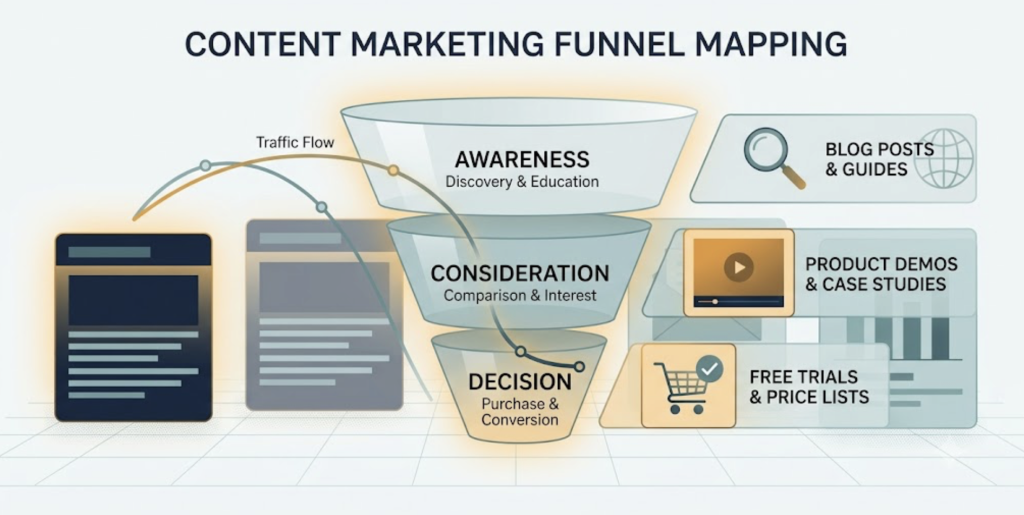
The content marketing funnel maps to three rough stages: awareness, consideration, decision. Each one wants a different kind of content, and matching content to stage is how you build a stable lead pipeline instead of a spike of traffic that never converts.
At the awareness stage, people know they have a problem but not that you exist. Educational blog posts, social content, and how-to videos do the heavy lifting. Consideration is where they’re weighing options, so in-depth guides and comparison pieces earn their attention. Decision is the closing stage — case studies, testimonials, and hard proof are what help you close high-ticket deals, where a buyer needs real evidence before committing serious budget.
The classic mistake? Pouring everything into top-of-funnel awareness content and then wondering why none of it converts. A blog full of “what is X” posts with no bridge to a decision is a very popular way to generate traffic that never turns into revenue.
The Main Types of Content (And What Each Is For)
There’s no single “best” format. There’s the format that fits your goal and the capacity you actually have. Here’s how the main types of content marketing shake out in 2026.
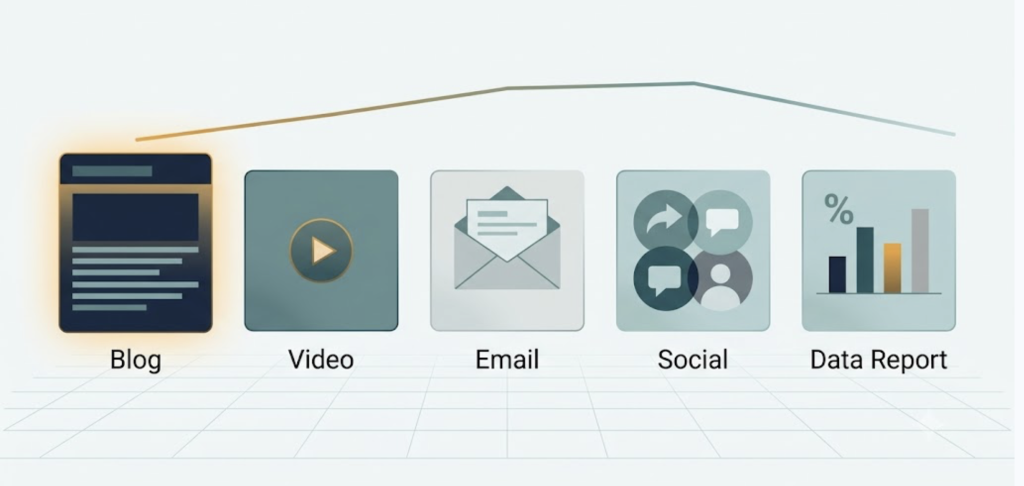
Blog and SEO articles are the workhorse. They’re how most people find you through search, and they’re the backbone of nearly every organic strategy. Slower to pay off, but they compound.
Video is having a moment that refuses to end. Short-form, long-form, and live video are the top three ROI-driving formats marketers report right now, with short-form alone leading at 49%. If you can only add one new format this year, this is probably it. With video continuing to be one of the most effective content formats, Burnwe video marketing can help businesses use engaging video content to increase brand awareness, audience engagement, and overall marketing results.
Here’s the part most teams miss: you don’t have to make everything from scratch. Content repurposing is the cheat code. One solid long-form article is really a dozen smaller assets waiting to be cut loose – turn the same text into short-form video, pull quotes into social posts, reshape the intro into an email. Tools that automatically spin written content into short-form video make this near-effortless, which is how small teams keep every channel fed without tripling their workload.
Email is the channel no algorithm can take from you. You own the list. When search traffic wobbles (and it’s wobbling, more on that soon), email is the asset that stays put and it’s where content personalization pays off most, because you can tailor what each segment sees instead of blasting one message at everyone.
Social isn’t just posting. It’s distribution and relationship-building rolled together, the place your other content goes to get discovered and shared.
And then there’s original data and research, which is quietly the highest-leverage type of all. Marketers who publish proprietary data report around 64% higher conversion rates and 61% stronger SEO performance than those churning out generic posts. Original numbers are hard to copy. That’s the point.
How to Build a Content Marketing Strategy
A content marketing strategy doesn’t need to be a 40-page document. It needs to answer a handful of questions clearly, and it needs to be written down.
Start by auditing what you already have. Before planning anything new, inventory your existing content – note the format, topic, and how each piece performs. That’s where you find the gaps to fill and the tired pieces to update, and it stops you from writing a post you basically already published two years ago.
Then set the goal. Are you after leads, brand awareness, sign-ups, or lower support costs? Everything downstream depends on this.
Next, your audience. Who specifically are you helping, and what are they actually searching for? This is where buyer personas earn their keep — not vague demographics, but real profiles of the people you’re trying to reach, mapped to what they search and what they need at each funnel stage. Do the keyword and topic research here too. Not guessing what people want, but checking.
From there, pick your formats based on the goal (see the section above) and give the plan a home: an editorial content calendar that maps each piece to a realistic publish date and a simple workflow for who does what. The calendar is the difference between a strategy that runs and a strategy that lives in someone’s head. That’s it. That’s a strategy.
One practical question that comes up constantly: do I need to share this strategy with other teams or departments? Short answer, yes. Sales, product, and support all touch the same customers your content does. A strategy the rest of the company can see keeps everyone pointed at the same audience and the same message, and it surfaces topic ideas you’d never think of from the marketing desk alone.
Two things worth burning into memory. First, write it down. The documented-strategy performance gap is one of the most consistent findings in the whole field, and it holds across company sizes. Second, the industry has shifted hard from volume to quality. Most marketers now report better results from publishing fewer, sharper pieces than from flooding the calendar. Ten great posts beat fifty forgettable ones. Every time.
Distribution & Measuring ROI
You can write the best post on the internet. If nobody sees it, it doesn’t matter. Creation is maybe half the job. Offline materials can support that distribution too. For example, marketers can use a QR Code Generator with Customization options to create branded QR codes for brochures, posters, packaging, event materials, and other physical touchpoints that direct audiences to relevant digital content.
Your channels fall into a few buckets. Owned channels (your email list, your site) are yours forever. Earned channels (organic search, shares, mentions, and relevant backlinks) are powerful but borrowed, and lately, shrinking — a chunk of marketers report search traffic slipping as people turn to AI tools for answers, with more searches ending without a click at all. For marketers looking to build relevant backlinks through webmaster relationships, communities such as Link Exchange Crew can also provide opportunities to connect with others working on content distribution and link building
Now the other half of the equation: knowing whether any of it worked. Most teams measure the wrong thing. They watch traffic go up and call it a win. But traffic is a vanity number until it’s tied to revenue.
The fix is to match your metric to the funnel stage. Awareness content? Reach and impressions are fair. Decision-stage content? You’d better be looking at conversions and pipeline, not pageviews. Done right, this is also how content marketing quietly reduces customer acquisition costs — every deal that closes off an article you already own is a deal you didn’t pay ad spend to win, and that gap widens the longer the content keeps earning.
And do one thing almost nobody does: set a baseline for each important page. Note what it earns today, whether that’s clicks, rankings, or conversions. ROI isn’t a snapshot. It’s a trend line, and you can’t spot a page sliding downhill if you never wrote down where it started. That baseline is about to become the most useful thing you own. Here’s why.
Content Decay & How to Refresh It
Every guide you’ve read probably ends around “measure your results.” As if content is a thing you finish.
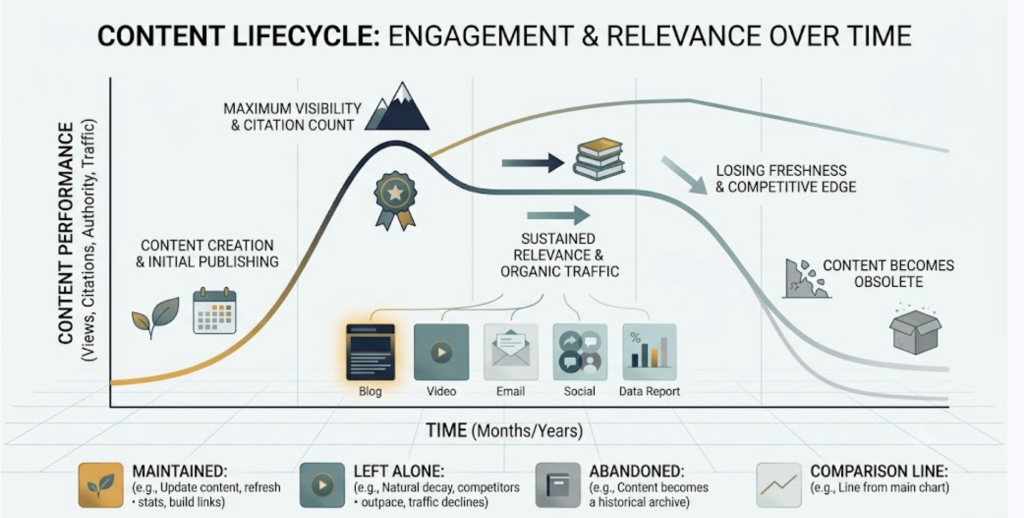
It isn’t. Let me say the quiet part out loud: “evergreen” content is mostly a myth. Every page you publish follows the same arc. It climbs, it peaks, it plateaus, and then it slides. That slide is content decay, and it’s happening to your best posts as you read this.
Most teams pour effort into the first three phases (growth, peak, plateau) and basically nothing into the last two. Ahrefs calls this the leaky bucket. You keep pouring new content in the top while your existing wins drain out the bottom, and the total never grows the way it should.
Why does it happen? A few reasons, all boring and all relentless. Competitors publish something better. Your statistics age out. Search intent shifts under your feet. Freshness signals fade. Google’s February 2026 Core Update leaned into exactly this, rewarding depth, real human experience, and regular upkeep over big archives nobody maintains.
There’s also a newer wrinkle. Decay now has two axes, not one. A page can hold its Google ranking and still vanish from AI answers — the ones ChatGPT, Perplexity, and Google’s AI Overviews serve up. AI-cited pages tend to skew fresher than standard search results, which means AI answers are even more biased toward recency than Google is.
And the cost compounds fast. The top few organic results grab the lion’s share of clicks, so slipping even a couple of positions can gut a page’s traffic.
Decay usually starts small, an easy-to-shrug-off dip. Shrug too long and half your traffic is gone before you look up.
Now the good news: decaying content is usually cheaper to fix than to replace. And the fix is a loop, not a one-off — detect, diagnose, update, re-measure.
Detect by watching those baselines you set. Pages losing clicks year over year, or drifting from position three toward eight, are your candidates. Diagnose what actually changed: did a competitor overtake you, did the stats go stale, did the intent move? Update accordingly — swap in current data, add the sections competitors now cover, re-align the intro with what people actually search for, and refresh your internal links. Then re-measure against the baseline.
Why refresh instead of writing fresh? Because the old URL already carries link equity and indexing history. You keep all of it. Refreshing is cheaper and faster than starting from zero.
One giant warning, though. Do not just change the date and call it a day. Date-only “freshness theater” can actually make things worse — a new timestamp on the same old content fools no one, least of all Google.
A real refresh (new data, filled gaps, re-aligned intent) usually shows up in your numbers within a few weeks once it’s re-indexed.Make content maintenance a habit, not an emergency. Audit your most valuable pages quarterly and use website content audit tools to determine which pages should be refreshed, consolidated, redirected or removed. The payoff is real: fixing what you already have often beats writing something new.
Common Content Marketing Mistakes
Quick gut-check. Are you doing any of these?
Publishing with no distribution plan, so great posts die in silence. Tracking traffic but never revenue, so you can’t prove any of it works. Treating content as finished at publish, then watching it decay untended. Chasing volume and format trends instead of quality. Shipping me-too content that reads like everyone else’s. Running the whole thing on a strategy that lives in your head instead of on paper.
Most struggling programs aren’t struggling because the content is bad. They’re struggling because of one or two of these. Fix them, and the content you already have starts performing better without a single new post.
Conclusion
The teams that win in 2026 aren’t the ones publishing the most. They’re the ones who treat their content like a garden instead of a monument — something you tend, not something you build once and admire. Every post you’ve published is either compounding or leaking. Pick your ten most important pages, check how they’re doing versus a year ago, and start there.
FAQs
It’s earning attention by being useful instead of buying it with ads. You create helpful content (posts, videos, emails) that attracts the people you want as customers and builds enough trust that they choose you when they’re ready. The sale is the byproduct, not the opening line.
Longer than paid ads, shorter than most people fear. As a rough rule of thumb, SEO-driven content tends to need a few months to gain real traction, since search engines need time to trust and rank it. The upside is that once it works, it keeps working for years, as long as you maintain it.
Short-form video leads on ROI, blog and SEO articles remain the organic backbone, and email is the owned channel that survives every algorithm change. But the highest-leverage move is publishing original data or research, which drives notably higher conversions and stronger rankings because competitors can’t easily copy it.
Match the metric to the goal. Awareness content is fairly judged on reach; decision-stage content should be judged on conversions and pipeline, not pageviews. Set a baseline for each important page so you can track its trend over time, and push past traffic toward revenue attribution, the thing most teams never actually measure.
Content decay is the slow decline in a page’s traffic and rankings after it peaks, as competitors improve, your data ages, and intent shifts. You stop it with a refresh loop: detect declining pages, diagnose what changed, update the content for real (not just the date), and re-measure. Audited quarterly, it’s cheaper than writing new content and often more effective.