

Here’s a number that should make you nervous. In one 16-month tracking study, programmatic pages that indexed beautifully at first — around 71% of them live in month one — had collapsed to roughly 3% still sitting in the top 100 by month three. Three months. That’s how fast a programmatic SEO win can turn into a graveyard.
Most teams don’t see it coming, because the launch looks great. You ship 400 template pages, traffic climbs, everyone celebrates. Then it quietly leaks away and nobody’s watching the graph. The thing about programmatic SEO is that the strategy that scales pages fastest also decays fastest. So let’s talk about both halves: building it, and keeping it alive.
What programmatic SEO actually is
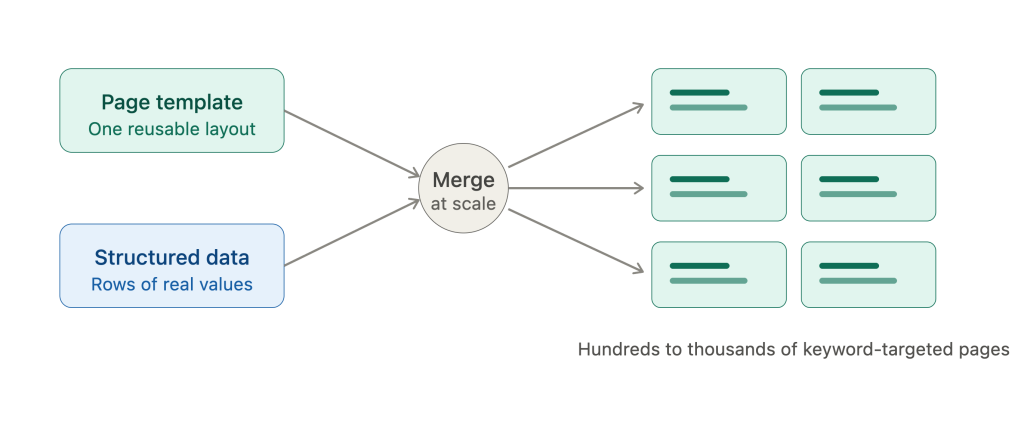
Programmatic SEO (pSEO for short) is the practice of using page templates and structured data to auto-generate a large number of keyword-targeted pages. One template, one dataset, thousands of pages. Instead of a writer producing ten blog posts a month, you build a system that spins up pages on its own.
Think about how you search. If you want a plumber, you don’t want “the 10 best plumbers of all time.” You want plumbers in your city, right now. That’s the gap pSEO fills. The endless long-tail of specific, repeatable queries that no team could write by hand.
The cheap version of this story is “more pages = more traffic.” That’s not it. The pSEO that works rests on three things: relevance (each page nails a specific intent), quality (real data, not keyword-swapped boilerplate), and structure (patterns Google can crawl and understand). Miss any one and you’ve built a liability.
The economics are genuinely appealing, which is why everyone’s chasing it. A programmatic page commonly runs somewhere in the $5–50 range to produce, against $500–2,000 for a hand-written piece. Those are ballpark figures that get repeated across the industry, not precise costs, but the order-of-magnitude gap is real. When a template can carry a thousand pages, the per-page math gets very hard to argue with.
When programmatic SEO is worth it (and when it isn’t)
pSEO earns its keep when you have a lot of one kind of page to make. SaaS companies build integration and use-case pages. Marketplaces build category and filter pages. Multi-location businesses build a page per city. Directories and aggregators cover every product or comparison their audience might type in.
The poster child is Zapier, which reportedly has 800,000+ pages indexed, most of them programmatic integration pages. Then there’s Flyhomes, which scaled from around 10,000 to 425,000+ pages in three months, with cost-of-living guides eventually driving over half its traffic. That’s the ceiling of what this strategy can do when the data supports it.
The common thread is long-tail keywords. You’re not trying to win “project management software” with a template. You’re trying to win “project management software for architecture firms” and nine hundred variations of it, each low-competition on its own, meaningful in aggregate.
Now the other side. pSEO is a bad fit when the topic needs real expertise, original research, or a point of view. A nuanced tutorial can’t be templated without going hollow. It’s a bad fit for tiny sites with nothing to template. And it’s a bad fit if you don’t have a structured dataset to pull from, because then you’re just writing boilerplate with the serial numbers filed off. If any of that describes you, put the template builder down.
There’s also a middle case worth naming: businesses that could technically template a page type but don’t have enough demand behind it. If nobody’s searching for “accounting software for left-handed dentists,” generating that page doesn’t help you. It just adds an unindexed URL to the pile. Volume without demand is how you manufacture index bloat before you’ve earned a single click. Validate that the long-tail actually exists before you scale toward it.
How to build programmatic pages that actually rank
Start with the data, not the template
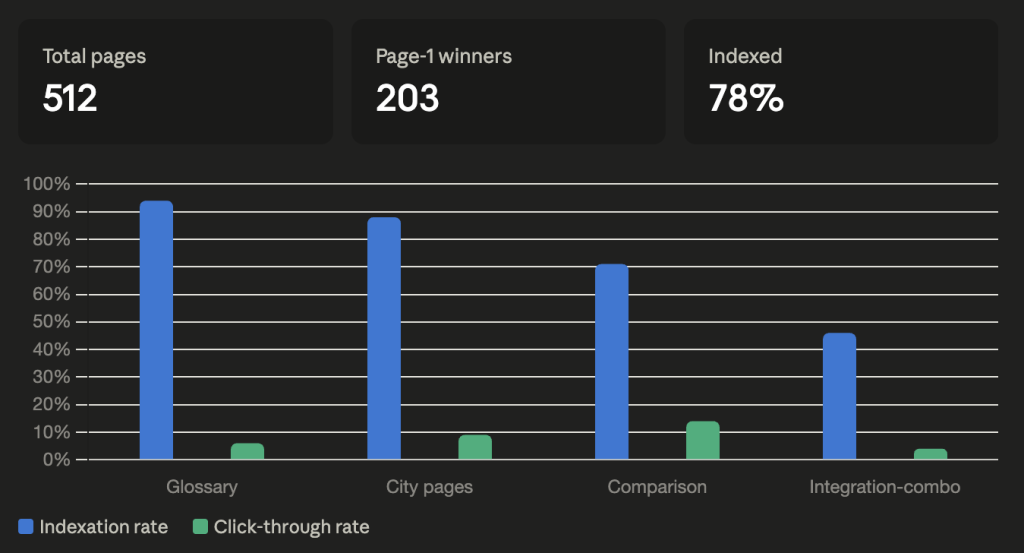
The dataset is the whole thing. In one 512-page case study tracked over 18 months, every page that landed on page one pulled at least three dynamic data points from a structured source. Pages with only one or two data points struggled to even index. So before you touch a template, ask one question. Do you have enough real, structured data to make each page truly different? If the honest answer is no, stop here.
Design the template around modular blocks
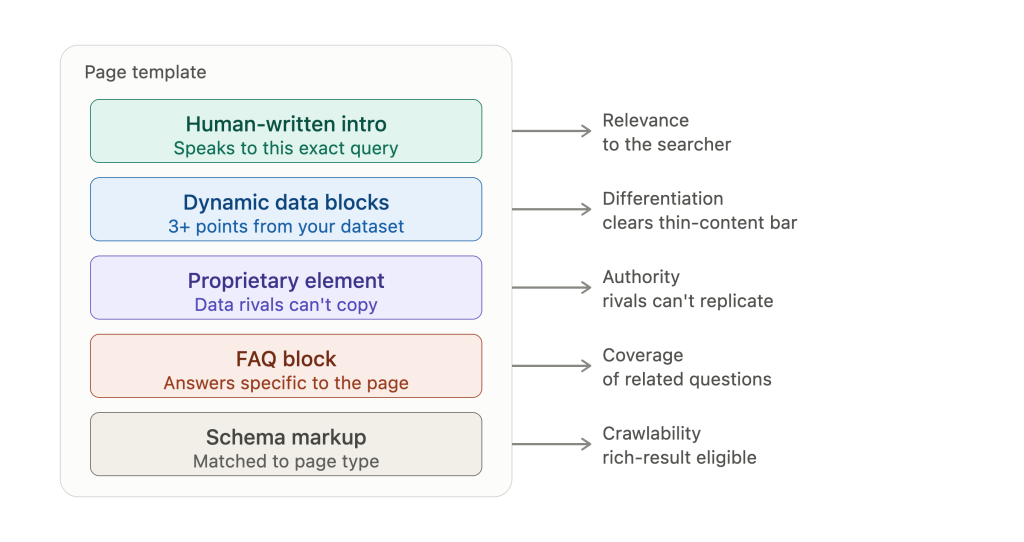
A good template isn’t a fill-in-the-blank paragraph. It’s a set of interchangeable blocks: a human-written intro that speaks to that specific query, dynamic data modules, a proprietary element competitors can’t copy (your own numbers, a calculator, real reviews), and the right schema for the page type. Product comparison pages get product schema; location pages get LocalBusiness markup.
A working rule of thumb floating around the industry: aim for at least 500 unique words and 30–40% differentiation per page against your boilerplate baseline. Below that, you’re in thin-content territory and Google knows it.
What does “differentiated” look like in practice? Say you’re building comparison pages — “Tool A vs Tool B.” The boilerplate is the framing paragraph and the section headers. The differentiation is everything pulled from your dataset. The real feature matrix. Live pricing. Current review counts. A verdict that shifts based on which two tools loaded. If you stripped the two tool names out and the page still read fine for any other pairing, you haven’t differentiated it. You’ve made a mad-lib. Google treats mad-libs as thin content, and thin content is the number-one cause of programmatic pages dying young.
Pick the right template family
Not all templates age the same. Glossary pages and city pages tend to index reliably and decay slowly. Integration-combo pages (“Tool A + Tool B”) are tempting because the math explodes. But they’re also the riskiest, and the wrong family will burn crawl budget and leave you a graveyard of pages you now have to maintain or kill. If you’re early and don’t have brand authority yet, start with the boring, reliable families.
The thin-content and index-bloat trap
The fastest way to kill a pSEO project is thin, near-duplicate content. Google’s helpful content guidance specifically targets low-value, template-generated pages, and it does not care that you made a thousand of them cheaply.
Then there’s index bloat, the slow poison. When you flood Google with pages, a lot of them are low-value variants that dilute your whole site. The fix is discipline: noindex the low-value ones, canonicalize near-duplicates to a single best version, and redirect or consolidate any page that hasn’t gained traction after about six months. Be ruthless. A page earning zero clicks isn’t neutral; it’s drag.
And this is getting stricter, not looser. One tracker logged around 25% of monitored URLs being actively removed from Google’s index at the end of May 2025, reportedly the highest active deindexation rate it had recorded. That figure comes from a single tracking panel, so take it as a signal rather than gospel. The direction is what matters.
The anecdotes match the data. One operator reported that roughly 60% of about 800 programmatic pages got deindexed after five months, with only the pages carrying real unique value surviving. That’s not independently verified either, but if you’ve run pSEO at scale, it probably rings true.
Why programmatic pages decay faster than anything else
Here’s the part almost every guide skips. Publishing is the beginning, not the end.
Content has a lifecycle: it gets indexed, climbs, plateaus, then declines. Most teams pour everything into the first three phases and basically nothing into the decline. With normal blog posts you can get away with that for a while. With programmatic pages, you can’t. Here’s why.
Your template pages share a skeleton. Same structure, same data pipeline, same internal linking pattern. So when something shifts (a competitor improves, an algorithm updates, search intent moves) your pages don’t decay one at a time. They decay in waves. A weakness in the template is a weakness in every page built from it. That’s the correlated-decay problem, and it’s unique to programmatic content.
Compare that to a normal blog. If one hand-written post slips, it’s an isolated event. The post next to it might be climbing at the same time, so the damage is contained, easy to miss but also easy to fix on its own. Programmatic pages move together. When they’re winning, that’s glorious — the whole cohort rises. When they turn, the same correlation works against you and a big chunk of your traffic can erode in the same quarter. The upside and the downside come from the exact same property.
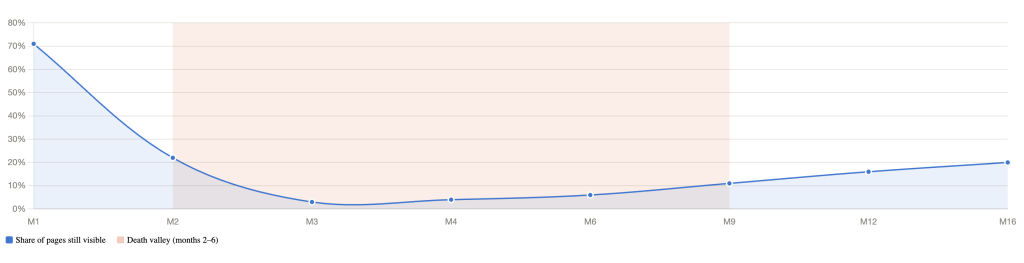
The timing is brutal, too. Remember that month-one index spike? What follows is a “death valley” between roughly months two and six, where a huge share of pages lose their rankings. In that tracking study, ranking recovered only to about 20% in the top 100 by month sixteen. The initial win was a mirage; the real story played out later, when nobody was looking.
Decay is also quiet. It usually starts as a modest 10–15% dip that’s easy to wave off as noise. And these days it has two faces: a page can slip in Google’s rankings and, separately, vanish from AI-generated answers. Two dimensions of content decay that don’t always move together. You can hold your position and still lose the click.
How to run refresh at scale (the part the SERP skips)
So you accept that pSEO needs maintenance. Great. Now try refreshing a thousand pages by hand. You can’t. That’s the wall every team hits, and it’s exactly why most programmatic content just rots.
The way through is a loop, not a cleanup project.
Detect first. You can’t fix what you can’t see. In Google Search Console, open the Performance report, switch to a date comparison, and put your last three months next to the previous three. Then read the pattern, because different patterns mean different problems. Impressions steady but clicks and CTR sliding? Something is intercepting the click, often an AI Overview answering before the user reaches you, or a competitor with a juicier title. Average position slipping while impressions fall? That’s classic ranking decay: someone out-published you. Both are fixable, but not the same way, so the diagnosis has to come before the fix. Run this at least quarterly. Weekly is better, if you can automate it. And at programmatic scale, “if you can automate it” is really “you have to automate it.”
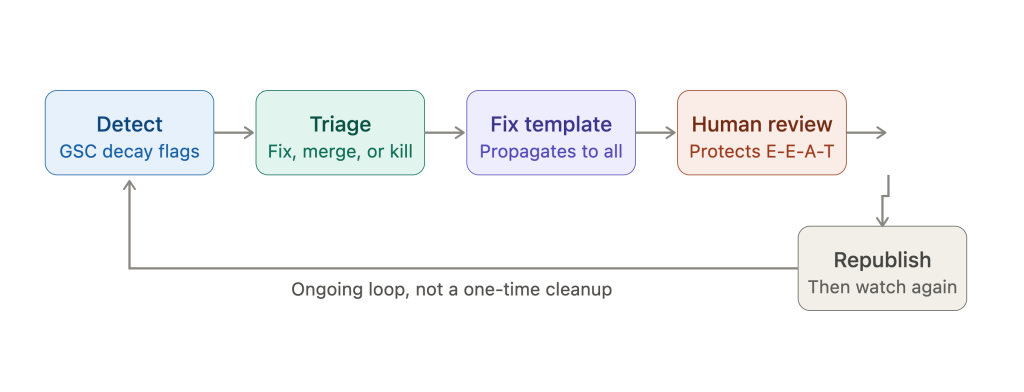
Triage, don’t refresh everything. Traffic is lopsided: the top ~20% of programmatic pages drive 80%+ of the traffic, and the bottom half often draws close to zero. So don’t spread effort evenly. Refresh the pages that matter, consolidate the mediocre ones, and kill the dead weight.
Fix the template, not just the page. This is the leverage that manual refresh can’t touch. If decay is correlated, the fix is too. Improve the template or the underlying data, and the change propagates across every page built from it. One good fix, thousands of pages healed.
This is the exact problem WordPattern was built for. Connect it to your Search Console and it watches for decay patterns at the paragraph level — flagging, say, a page losing two positions a week for four straight weeks, before the drop turns severe. It then spots the entity gaps between your slipping content and current top-ranking pages, and drafts targeted refresh suggestions. Nothing publishes on its own; every change goes through human review, which keeps you on the right side of E-E-A-T. If you want a starting framework, WordPattern’s guide to quick content refreshes that recover lost traffic is a decent template for the manual version.
Measuring programmatic SEO the right way
Measuring SEO like normal content is a mistake. You’ve got thousands of pages. You can’t read them one by one, and you shouldn’t try.
Measure at the template level. Group pages by URL pattern (GA4’s page-path rules and content groups make this easy) so you’re comparing whole families: location pages vs. comparison pages vs. integration pages. That’s how you find out which template is carrying you and which is dead weight.
The KPIs that matter for programmatic specifically: indexation rate first (are these pages even getting into the index?), then CTR, engagement, and conversions, including assisted ones, since a lot of long-tail pages influence a decision without closing it.
Keep your expectations honest. That 512-page portfolio? Over 18 months it reached about 11,840 clicks a month and ~$48k in revenue, a 14x return. But only 203 of the 512 pages were page-one winners. The other 309 underperformed. That’s a normal, healthy pSEO outcome: a strong core carrying a long tail of mediocrity you keep pruning. If you want help spotting which of your pages are slipping, there’s a solid rundown of content audit tools worth using.
And watch the AI layer, not just organic position. Being cited in ChatGPT, Perplexity, and AI Overviews is its own form of visibility now. And its own form of decay when you lose it.
Programmatic SEO is a system, not a launch
If you take one thing from all this: the teams winning at programmatic SEO aren’t the ones publishing the most pages. They’re the ones catching decay early and refreshing in waves, treating their template library as a living asset instead of a set-and-forget project.
Build the pages well. Kill the ones that don’t earn their keep. Watch the graph after launch, not just during it. As AI Overviews keep chewing into clicks, that maintenance half of the job is only going to matter more, not less. The build gets you on the board. The refresh loop is what keeps you there, and WordPattern exists to make that loop something you can actually run at scale.
FAQs
No — programmatic SEO itself is fine. What Google penalizes is thin, low-value, near-duplicate content, which pSEO makes it easy to mass-produce. If every page serves a specific intent with genuinely useful, differentiated information, you’re within the rules. The technique isn’t the problem; lazy execution is.
There’s no magic number, but the strategy only makes sense when manual creation would be unrealistic — usually hundreds to thousands of similar pages. If you’re looking at 20 or 30 pages, just write them by hand. pSEO’s payoff comes from scale and from carrying a large, repeatable dataset across one template.
They overlap but aren’t the same. Programmatic SEO uses templates plus a structured dataset to generate pages with a consistent shape. AI-generated content uses a language model to write prose, often one piece at a time, and usually needs manual review. Many teams now blend the two, but true pSEO is driven by your data, not just a prompt.
Run a decay audit at least once a quarter, and more often for your highest-traffic templates. The goal is to catch the early 10–15% dip before it compounds. Automated monitoring beats a calendar reminder, since decay doesn’t wait for your quarterly review — it starts the moment competitors or algorithms shift.