
Search stopped rewarding volume a while ago. Between 2023 and 2024, plenty of companies chased long-tail traffic by publishing thousands of near-identical pages. By 2026 that playbook mostly backfires. Search engines now favor pages that actually answer the query, and AI-powered results push original, useful content to the top while quietly burying the filler.
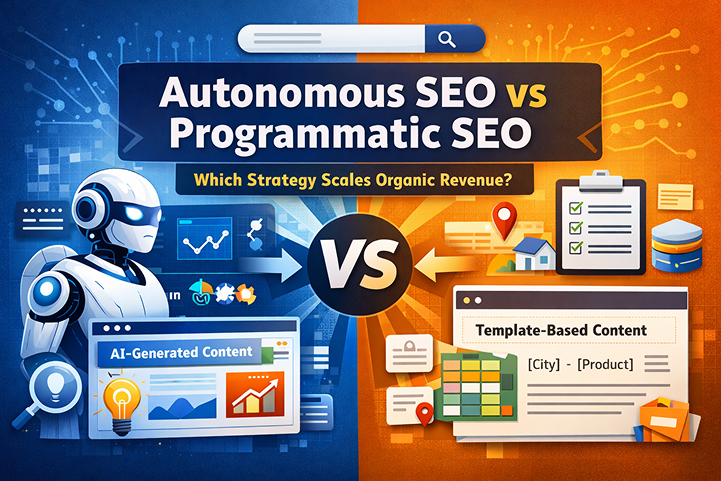
So if you’re trying to grow organic traffic at scale, you’re really choosing between two systems: autonomous SEO vs programmatic SEO. Both can produce thousands of pages. They just get there in completely different ways.
WordPattern sits on the autonomous side of that line. It watches your existing content for decay, spots the pages slipping in rankings, and rewrites them at the paragraph level using AI agents — programmatic SEO automation built for teams that need scale without a hundred manual updates a month. Here’s how the two approaches compare, and where each one earns its place.
What Is Programmatic SEO?
Programmatic SEO (pSEO for short) uses structured data and a page template to spin up large batches of search pages automatically.
Rather than writing each article by hand, you build one template and wire it to a database. The template has blanks. The data fills them. Do that across a big dataset and you get thousands of pages from a single layout.
A template might read:
“Best [Product] in [City]“
Point that at a list of cities and products and it produces thousands of landing pages in one pass.
The mechanics are simple. You collect structured data — cities, products, prices, stats. You build a page template that reads well no matter which values drop in. The system generates a page for every combination, then publishes the batch. That’s how sites end up with tens of thousands of indexed pages without a writing team behind each one.
In the autonomous SEO vs programmatic SEO debate, this is the structured-automation side. It’s built for scale, not for reasoning. The template doesn’t understand the query. It just fills the gaps and ships.
Real-World Programmatic SEO Examples
A lot of high-traffic sites grew almost entirely on programmatic SEO. Integration directories that list every software-to-software combination. Travel sites with a page per city and attraction. Real estate platforms publishing neighborhood price reports. Job boards spinning up a page per role and location.
These rank because the searcher wants a specific, structured answer — not an essay or an opinion.
Think about the intent behind “hotels in Barcelona,” “marketing agencies in Chicago,” or “average rent in Brooklyn.” Nobody’s looking for a think-piece. They want listings, numbers, and a quick comparison. When the query is that concrete, a well-built template beats a hand-written article on speed and coverage. That’s programmatic SEO working exactly as intended.
What Is Autonomous SEO?
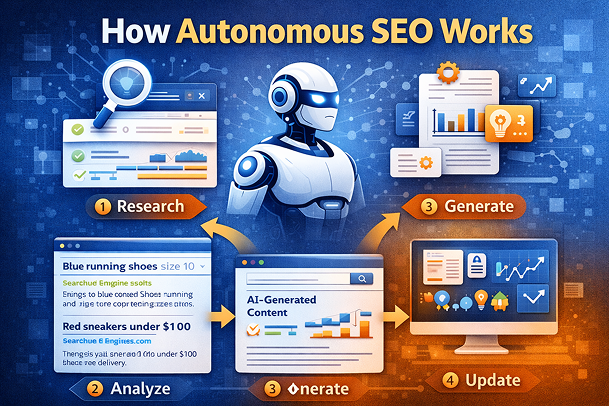
Autonomous SEO is the next step past templates. Instead of filling blanks, it uses AI agents that research, analyze, write, and update content on their own. The goal shifts from “generate a page” to “solve the searcher’s problem.”
It works less like a template and more like an autonomous SEO platform that owns the whole content lifecycle — research, drafting, publishing, and the part most tools skip: keeping the page current after it goes live.
Give an agent a goal like:
“Help users choose the best hiking boots for rainy climates.”
It doesn’t reach for a template. It reads the current search results, spots the patterns among the pages already ranking, checks what products exist right now, weighs the expert takes, and writes a guide that reflects all of it. The page comes out shaped by real intent instead of a fixed layout.
That’s the core difference. A template is frozen the moment you publish it. An autonomous system keeps looking. When the results move, so does the page.
Underneath, a few things are running at once. Research agents pull live data — search results, trending topics, competitor pages, product changes, the questions people actually ask. An intent layer reads what the searcher really wants, not just the keyword they typed. The writing is contextual, so each page carries its own explanations and comparisons instead of a repeated skeleton. And the whole thing stays on a loop: rankings get monitored, and when a page starts to slip, it gets refreshed without someone flagging it first.
Why Autonomous SEO Is Growing in 2026
Search engines increasingly reward information gain — content that adds something not already sitting across the rest of the results. Templates struggle here by design. When ten thousand pages share one structure, none of them is adding much.
Autonomous systems can push past that. They produce deeper explanations, current data, fresh comparisons, and recommendations that shift as the market does. That lines up with how modern ranking actually works.
They adapt to real-time search trends. Search behavior never sits still. New product features ship, competitors update their pages, and what people want from a query drifts month to month. A programmatic page usually stays exactly as published — right up until it quietly stops ranking. This is content decay, and it’s the slow leak behind most traffic losses nobody catches in time. An autonomous system notices the shift and rewrites the affected sections on its own, so the page stays competitive instead of aging out.
They read more like a person wrote them. Templated pages tend to feel same-y because they follow one pattern across every variation. Language models let autonomous content breathe — clearer explanations, comparisons with actual context, advice a reader can use. That tends to hold attention longer, and attention is what turns a visit into a signup.
They carry more value per page. Recycled text doesn’t move anymore. Search rewards pages with a genuine point of view: real analysis, current market context, a take a reader can’t get from the ten identical results around it. Autonomous content can carry that weight. Templates, by their nature, usually can’t.
Put those together and you get the reason adoption is climbing. The pages that win in 2026 are the ones that keep earning their ranking after launch — and that’s exactly what an autonomous approach is built to do.
Programmatic SEO vs Autonomous SEO: Key Differences
Both scale content. How they do it splits them cleanly.
| Factor | Programmatic SEO | Autonomous SEO |
|---|---|---|
| Content generation | Template based | AI reasoning |
| Data source | Structured databases | Dynamic research |
| Content style | Repetitive structure | Unique analysis |
| Updates | Manual | Automated |
| Best use case | Directories and listings | Editorial and decision content |
| Adaptability | Static | Dynamic |
Different mechanics, different jobs. One scales structured pages fast. The other keeps decision-stage content sharp over time.
The Real Winner: Hybrid SEO Strategies
Here’s the part most “X vs Y” arguments miss: the best teams don’t pick one. They run both, in layers.
Layer one is programmatic, for reach. Location pages, product variations, service directories, anything data-driven — this is where templates earn their keep, capturing long-tail search traffic at a volume no writing team could match by hand.
Layer two is autonomous, for depth. Buying guides, product comparisons, industry analysis, the educational content that helps someone actually decide. These pages build trust, and trust is what converts.
There’s a second reason to run both, and it’s the one that matters most going into 2026. People don’t only search on Google anymore. They ask ChatGPT, they read AI Overviews, they let an assistant summarize the options before they ever click. Winning now means dual discovery across SERPs and LLMs — showing up in the ranked results and in the AI-generated answer.
Programmatic pages feed the structured, factual queries that both systems pull from. Autonomous pages supply the original analysis and current context that AI answers tend to cite and surface. Run them together and you’re covered on both fronts. Lean on one alone and you leave half the discovery surface to a competitor.
Revenue Impact: Which Model Protects Margins?
Scaling SEO has a cost most teams underestimate: upkeep. Every page you publish is a page you now have to monitor, update, and re-optimize. That bill grows quietly, and it grows with your library.
| Metric | Programmatic SEO | Autonomous SEO |
|---|---|---|
| Setup cost | Low with structured data | Moderate due to AI systems |
| Scalability | Extremely high | High but resource dependent |
| Maintenance | Manual updates | Automated updates |
| Conversion potential | Moderate | Higher due to trust content |
| Algorithm risk | Higher if templates feel spammy | Lower due to adaptive content |
Programmatic SEO is cheap to start and brutal to maintain. Ten thousand template pages means ten thousand pages that go stale on the same schedule, and someone has to catch each one before it drags your rankings down. Do the math on that at scale and the “cheap” approach isn’t cheap for long.
Autonomous systems flip the cost curve. The setup runs higher because you’re standing up AI agents instead of a spreadsheet and a template. But the ongoing maintenance — the part that actually eats budget over a year — drops sharply, because the system refreshes decaying pages on its own instead of waiting for a person to notice. As your content library grows, that’s the difference between margins that hold and margins that quietly bleed out on upkeep.
Risks and Limitations of Programmatic SEO
Programmatic SEO still works. But done carelessly, it turns on you fast.
The usual failure modes: thin pages that say almost nothing, near-duplicate templates repeated across thousands of URLs, stale data that makes the whole site look neglected, and low information gain against whoever’s ranking above you. When search engines catch these patterns, rankings don’t drift down gently. They drop.
The bigger, quieter killer is index bloat and cannibalization. Push out thousands of template pages and a chunk of them end up competing with each other for the same query. Google can’t tell which one you actually want ranking, so it splits authority across all of them — or picks the weakest. Meanwhile your crawl budget gets spent on pages that were never going to rank, while the ones you care about wait in line. The result is a bloated index full of pages fighting their own siblings, and it drags down the URLs you actually wanted to win.
This is exactly the margin-killer an autonomous approach is built to prevent. Instead of firing off pages and hoping, the system watches what’s actually earning rankings, consolidates or refreshes the ones that overlap, and keeps the index lean. Fewer pages fighting each other. More authority pointed at the URLs that convert. That discipline is the difference between a content library that compounds and one that slowly eats itself.
Conclusion
SEO in 2026 isn’t a volume game anymore. It rewards relevance, originality, and pages that stay current after you hit publish.
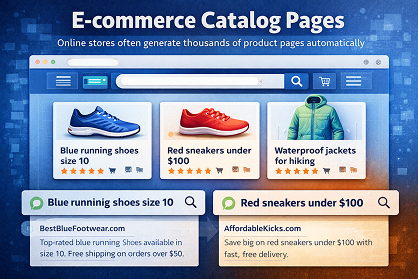
Programmatic SEO still owns the structured, high-volume corners of search — directories, marketplaces, catalogs. Nothing scales those faster. But autonomous SEO is where the field is heading: AI agents that research, write, and keep content fresh as search behavior shifts underneath it.
The smart move isn’t picking a side. It’s running programmatic scale and autonomous intelligence together — templates for reach, autonomous refresh for the pages that decay and cost you rankings. That’s the setup that keeps traffic, trust, and revenue compounding instead of leaking. If content decay is quietly costing you rankings, that’s the exact problem WordPattern was built to catch.
Ready to Scale Your SEO Content?
Most teams don’t hit a wall on publishing. They hit it on upkeep. Getting a hundred pages live is the easy part. Keeping a hundred pages — or a thousand — accurate, current, and ranking as search shifts around them is where the real work hides, and where most content libraries quietly start losing traffic.
That’s the gap WordPattern closes. It watches your published content for decay, flags the pages slipping in the rankings before the traffic drop shows up in your reports, and rewrites the weak sections at the paragraph level — not by regenerating the whole page, just the parts that have gone stale. You get the reach of programmatic scale with the upkeep handled automatically, which is the combination that actually protects your margins as the library grows.
For enterprise teams, the shift is less about publishing more and more about finally getting off the manual-refresh treadmill. Instead of a handful of hand-updated pages a month — and a long tail of decaying ones nobody has time to touch — the whole library runs on autopilot, refreshing itself as rankings move. That’s what it means to scale SEO content in practice: not just more pages, but more pages that keep working after launch.
It plugs into WordPress and Shopify, reads your Google Search Console data to find what’s actually decaying, and handles the refresh so your team can spend its time on strategy instead of chasing stale posts. If you’re scaling content and the maintenance math is starting to scare you, that’s the problem WordPattern was built to solve. See how it works.
FAQs
Autonomous SEO uses AI agents that research, generate, and update content automatically based on search intent and changing search trends.
Programmatic SEO is a strategy that uses structured datasets and templates to automatically generate large numbers of search pages.
Yes. It remains highly effective for data-driven pages such as directories, product catalogs, and location-based searches.
Not completely. Both strategies serve different purposes. Programmatic SEO scales structured pages, while autonomous SEO excels at editorial and decision-stage content.