

Content ages faster than most marketers expect. What worked a year ago may no longer rank, engage, or convert. Search engines prioritize freshness, relevance, and user intent, so updating existing content is no longer optional. That’s where LLM prompt engineering for content refreshes becomes a game-changer.
Instead of rewriting everything manually, you can guide large language models (LLMs) with precise prompts to upgrade your content efficiently. When done right, this approach saves time, improves SEO performance, and ensures your content stays competitive.
In this guide, you’ll learn how to use prompt engineering to refresh content strategically, along with actionable frameworks you can apply immediately.
What Is LLM Prompt Engineering?
LLM prompt engineering is the process of crafting specific instructions to guide AI tools in generating high-quality, relevant output.
Rather than asking vague questions, you provide structured prompts that define:
- Context
- Tone
- Format
- Objective
For content refreshes, this means telling the AI exactly how to improve an existing article instead of starting from scratch. Developing practical prompt engineering and LLM skills is becoming useful for anyone building modern AI applications and workflows.
Why Content Refreshing Matters for SEO?
Before diving into prompts, it’s important to understand why refreshing content is essential.
1. Improves Search Rankings
Search engines favor updated content. Refreshing outdated posts signals relevance and authority.
2. Enhances User Experience
Updated data, clearer structure, and better readability keep users engaged longer.
3. Boosts Click-Through Rates
Optimized titles and meta descriptions attract more clicks from search results.
4. Maximizes Existing Assets
Instead of creating new content, you extract more value from what you already have.
When Should You Refresh Content?
Not every piece needs updating. Focus on content that shows:
- Declining traffic
- Outdated statistics or references
- Poor keyword rankings
- Low engagement metrics
- High impressions but low clicks
These are prime candidates for LLM-assisted refreshes.
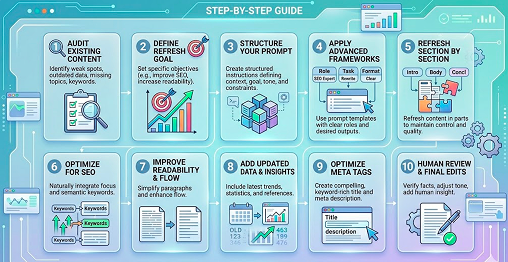
Step-by-Step Guide to Using LLM Prompt Engineering for Content Refreshes
Step 1: Audit the Existing Content
Start by analyzing your current article. Identify:
- Target keywords
- Missing topics
- Weak sections
- Outdated information
This gives direction to your prompts.
Step 2: Define Your Refresh Goal
Be clear about what you want to achieve. For example:
- Improve SEO ranking
- Increase readability
- Update outdated facts
- Optimize for featured snippets
Your goal shapes the prompt.
Step 3: Use Structured Prompts
Generic prompts lead to generic results. Instead, use structured instructions.
Example Prompt:
“Update this blog post to improve SEO. Keep the tone conversational, add updated statistics, optimize headings with keywords, and improve readability.”
This works – but it can be better.
Step 4: Apply Advanced Prompt Frameworks
To get high-quality outputs, use detailed prompts like this:
Content Refresh Prompt Template:
- भूमिका: SEO expert and content strategist
- उद्देश्य: Refresh outdated blog content
- टास्क:
- Improve keyword optimization
- Update outdated sections
- Add new insights
- Improve readability
- आउटपुट: Updated blog section with headings
This level of clarity ensures better results.
Step 5: Refresh Section by Section
Avoid overwhelming the AI. Instead, work in parts:
- Introduction
- Headings
- Body sections
- Conclusion
This improves quality and control.
Step 6: Optimize for SEO
Use prompts specifically for SEO improvements:
Example:
“Rewrite this section using the focus keyword ‘LLM prompt engineering for content refreshes’ naturally, improve readability, and add semantic keywords.”
This ensures keyword placement without keyword stuffing.
Step 7: Improve Readability and Flow
Even well-ranked content can fail if it’s hard to read.
Use prompts like:
“Simplify this paragraph, use shorter sentences, and improve flow with transition words.”
Step 8: Add Updated Data and Insights
Fresh data boosts credibility.
Prompt Example:
“Update this section with the latest trends, statistics, and insights relevant to 2026.”
Step 9: Optimize Meta Tags
Don’t forget metadata.
Prompt Example:
“Create an SEO-optimized meta title under 60 characters and meta description under 160 characters using the focus keyword.”
Step 10: Human Review and Final Edits
AI helps—but human judgment is critical.
Always:
- Verify facts
- Adjust tone
- Ensure brand voice
- Add originality
Best Practices for LLM Prompt Engineering
Be Specific
Clear instructions produce better results.
Provide Context
Include the purpose, audience, and tone.
Use Iteration
Refine outputs step by step instead of expecting perfection in one go.
Combine Prompts
Layer prompts for deeper improvements.
Maintain Brand Voice
Guide the AI to match your style.
Common Mistakes to Avoid
1. Using Vague Prompts
This leads to generic and repetitive content.
2. Over-Automating
Blindly publishing AI-generated content can harm quality.
3. Ignoring SEO Intent
Refreshing content without keyword alignment reduces effectiveness.
4. Skipping Fact-Checking
Always validate updated data.
Real-World Use Cases
Updating Blog Posts
Improve rankings for existing articles without rewriting from scratch.
Refreshing Product Pages
Update descriptions for better conversions.
Improving Evergreen Content
Keep long-term content relevant and competitive.
Repurposing Content
Turn old blogs into new formats like guides or FAQs.
Tools That Support Prompt Engineering
While many AI tools exist, the key lies in how you use them. Prompt quality matters more than the platform itself.
Look for tools that allow:
- Context input
- Long-form editing
- Iterative refinement
Future of Content Refreshing with AI
AI is not replacing content creators – it’s enhancing them.
As search engines evolve, content must:
- Stay updated
- Match user intent
- Deliver value quickly
Prompt engineering will become a core skill for SEO professionals.
Conclusion
Refreshing content is one of the fastest ways to improve SEO performance and LLM prompt engineering makes it scalable.
By using structured prompts, clear goals, and iterative improvements, you can transform outdated content into high-performing assets.
Start small. Test different prompts. Refine your process.
Over time, you’ll build a system that consistently delivers better rankings, higher engagement, and stronger content authority.
Final Thoughts
Content doesn’t need to be rewritten to perform better—it needs to be refined.
With the right prompts, you can unlock the full potential of your existing content and stay ahead in the SEO game.
Now is the time to upgrade your strategy and make LLM prompt engineering a core part of your content workflow.