
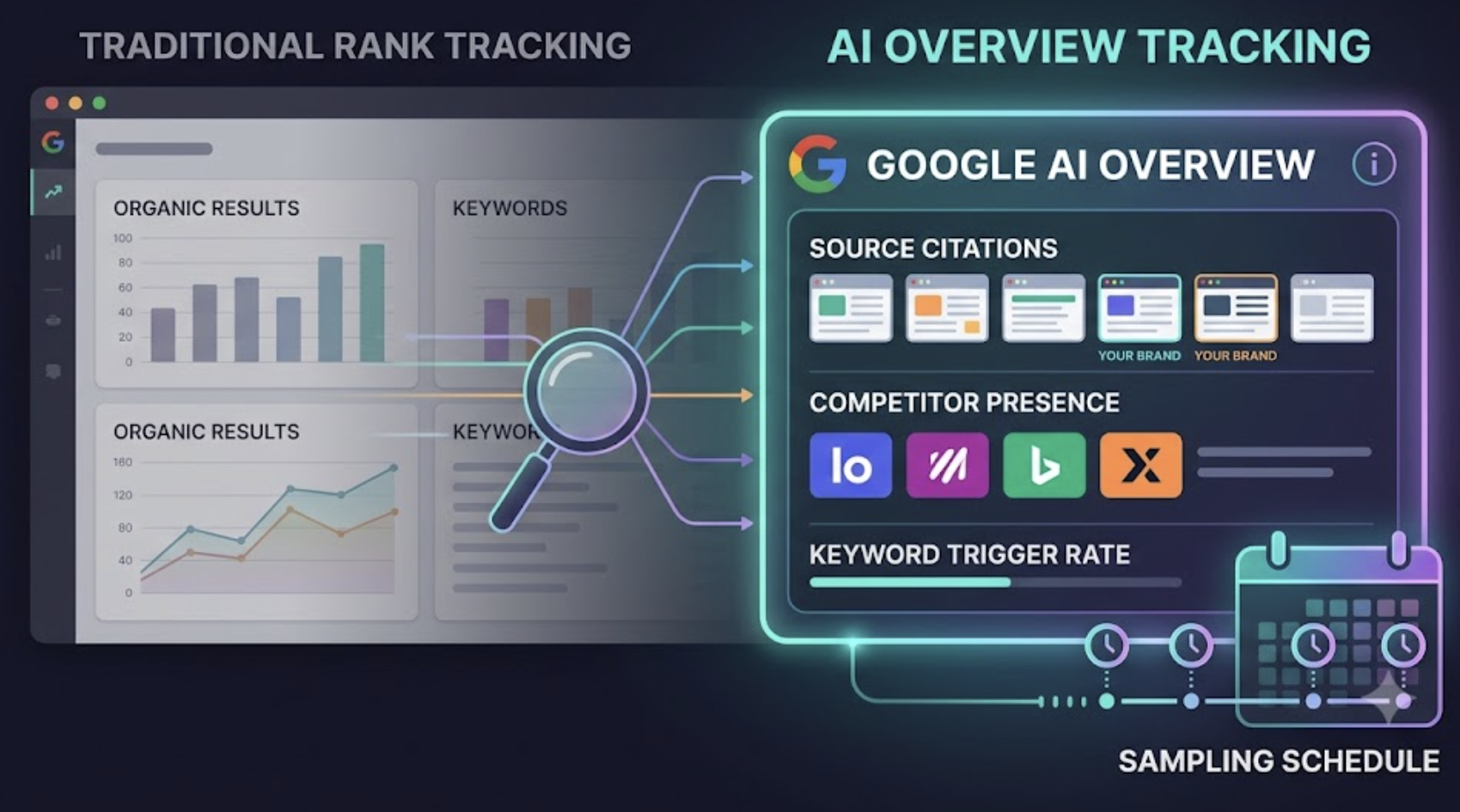
AI Overview tracking is the practice of monitoring which of your keywords trigger Google’s AI Overviews, whether your pages are cited as sources inside those summaries, and how often you appear versus competitors — sampled on a schedule so you see trends, not one-off snapshots. It’s a separate signal from rank tracking, because Google Search Console doesn’t split AI Overview data out from standard organic results.
Every “best AI Overview tracking tools” list ranks the same dashboards. Almost none tells you the thing that actually decides whether the data is trustworthy: how each tool samples AI Overviews. An AI Overview is not a fixed object. It changes by location, by whether the user is logged in, by device, and from one hour to the next. So a tool that checks once a day from a single US data center is measuring something genuinely different from one that samples per-location on your schedule — even if both show you a tidy “visibility score.”
This guide compares the tools on that basis first: sampling frequency, how they handle location, how they handle personalization, and which engines they actually query. If you only need the definition, we cover what an AI Overview is separately.
Quick Glance
| Tool | Engines queried | Refresh (stated) | Location handling | Personalization | Price / trial |
|---|---|---|---|---|---|
| SE Ranking (AI Search) | Google AI Overviews, AI Mode, ChatGPT, Perplexity | Daily | Location-specific, 188 countries | ⚠ [[test]] | Core ~$129/mo + AI Search add-on ~$71/mo; 14-day trial, no card |
| Otterly.ai | AI Overviews, AI Mode, ChatGPT, Perplexity, Copilot (Gemini add-on) | Daily | 50+ countries | ⚠ [[test]] | From $29/mo; 7-day trial, no card |
| Peec AI | Pick 3 of AI Overviews, AI Mode, ChatGPT, Perplexity, Gemini, Copilot | Daily | Unlimited countries | ⚠ [[test]] | From ~$95/mo; 7-day trial, no card |
| Semrush AI Visibility Toolkit | AI Overviews, AI Mode, ChatGPT, Gemini, Perplexity (varies by report) | Daily (stated) | 220+ countries | ⚠ [[test]] | $99/mo per domain; no standalone trial (only via Semrush One) |
| Ahrefs Brand Radar | AI Overviews, AI Mode, ChatGPT, Perplexity, Gemini, Copilot | Index-based; custom prompts scheduled | ⚠ [[verify granularity]] | ⚠ [[test]] | Add-on from $199/mo per engine (~$699 all engines) + Ahrefs base from $129/mo; no free trial |
| Profound | 10+ engines incl. AI Overviews | ⚠ [[verify]] | Custom markets (enterprise) | ⚠ [[test]] | From ~$99/mo (ChatGPT-only); full coverage custom; no free trial |
How We Tested
We built a fixed set of [[N]] buying-intent queries in our category that are known to trigger AI Overviews, then captured a manual ground-truth baseline for each — logged out, in an incognito session, with location set explicitly — on [[start date]]–[[end date]] 2026. Every day of the window we re-ran the same set and recorded whether an AI Overview appeared, which URLs it cited, and whether our brand was named.
We then pointed each tool at the identical query set and location and compared its reported AI Overview presence and citations against our same-day manual capture. For each tool we recorded three things the vendor pages don’t tell you: whether its observed refresh matched its stated cadence, whether results tracked a specific location or defaulted to a generic one, and whether a logged-in versus logged-out session changed the answer. Findings per tool are in the sections below ([[fill from test]]).
One honest limit: AI Overviews are volatile, so no tool — and no manual check — is a perfect mirror of what every user sees. Treat any single day as a sample, and weight the trend.
SE Ranking
SE Ranking folds AI Overview tracking into an established SEO suite rather than selling it as a standalone premium product. Its AI Search add-on tracks AI Overviews, AI Mode, ChatGPT, and Perplexity for prompts you define, and — usefully — when an AI Overview appears for a tracked keyword, it captures which URLs Google pulled into the answer, turning a “you’re not visible” metric into a page-level task list.
Its tracking is daily and location-specific, which matters for the sampling question at the heart of this guide: you can pin a query to a market and watch it over time rather than trusting a generic national result. The billing unit is a “check” — one prompt on one engine — so a single question across four engines consumes four checks; map your prompts, engines, and locations before choosing a tier.
Best for: teams that want AI Overview data sitting next to classic rank tracking in one login. Watch for: effective cost scales with engines × locations × prompts, so the headline price understates real spend.
Otterly.ai
Otterly is the lowest-friction entry into AI Overview monitoring that still does the real job. At $29/month it tracks AI Overviews, AI Mode, ChatGPT, Perplexity, and Copilot (Gemini and some surfaces are paid add-ons), with daily tracking, 50+ country coverage, and unlimited seats on every tier. Setup takes minutes, and there’s a 7-day trial with no credit card.
For a solo operator or a small team that needs to answer “are we in the AI Overview for our money queries, and who’s cited instead of us,” Otterly gets you looking without a procurement cycle. The trade-off is depth: fewer engines on the core plan and tighter prompt limits than the enterprise suites, so it’s a starting point rather than an endpoint for a large portfolio.
Best for: solo marketers, SMBs, and agencies wanting affordable per-engine coverage fast. Watch for: prompt caps and add-on costs once you push past a small query set.
Peec AI
Peec is the clean, report-ready option, popular with EU teams for its GDPR-first posture and its interface. It tracks brand visibility, citations, sentiment, and competitors, runs daily, supports unlimited countries and unlimited seats, and starts around $95/month with a 7-day no-card trial.
The catch is engine scope: self-serve plans let you pick three engines from a menu that includes AI Overviews, AI Mode, ChatGPT, Perplexity, Gemini, and Copilot — tracking a fourth is a paid add-on. So if AI Overviews plus two LLMs cover your buyers, Peec is excellent value; if you need five engines on one plan, price the add-ons before you commit. It’s monitoring-first — it identifies the opportunity, your team still executes.
Best for: EU agencies and SMBs that need clean, client-facing reporting. Watch for: the three-engine base cap and per-engine add-on pricing.
Semrush AI Visibility Toolkit
If Semrush is already your SEO stack, its AI Visibility Toolkit layers AI Overview and AI Mode tracking onto the platform your team already opens, with brand-performance reporting across ChatGPT, AI Overviews, AI Mode, Gemini, and Perplexity (coverage varies by report). Location support is broad — 220+ countries.
The pricing model is the thing to understand. The standalone Toolkit is $99/month per domain (25 prompts) with no free trial — the only way to test it hands-on is inside a Semrush One plan. Semrush does have a genuinely free classic account, but it doesn’t include AI visibility. So the “no second contract” convenience is real for existing Semrush customers and much weaker as a reason to adopt Semrush from scratch.
Best for: existing Semrush users who want AI Overview data without a new vendor. Watch for: per-domain pricing and prompt caps that climb fast for agencies.
Ahrefs Brand Radar
Brand Radar is Ahrefs’ AI visibility product, and its methodology is the most distinctive here — which is exactly why it belongs in a guide about how tools sample. It works largely from Ahrefs’ own indexes of AI answers (a database of 199M+ search-backed prompts), tracking six engines: AI Overviews, AI Mode, ChatGPT, Perplexity, Gemini, and Copilot. Custom prompts you add are re-run on a schedule. That index-first design trades some prompt-level, location-specific precision for breadth and for cross-referencing AI mentions with Ahrefs’ web index.
Pricing is its hardest edge. Brand Radar is an add-on requiring an active Ahrefs base plan (from $129/month), and the AI indexes are sold per engine at $199/month, or roughly $699/month for all of them — with no free trial for new customers. Realistic all-in for full coverage lands well past $800/month.
Best for: teams already deep in Ahrefs who want AI tracking beside their SEO and web-mention data. Watch for: the stacked cost, and confirm location granularity against your own test before relying on it for local queries.
Profound
Profound is the enterprise-grade option analysts point regulated and Fortune-500 teams toward. It tracks 10+ engines including AI Overviews and runs on a proprietary dataset of real user prompts that powers deeper prompt-intelligence than most trackers attempt. Entry is around $99/month for ChatGPT-only; full engine coverage is enterprise/custom, and there’s no free trial.
It’s monitoring-first and priced for teams that need SOC 2-grade reporting and depth rather than a quick self-serve check. If AI Overviews are one surface in a broad, high-stakes AI-visibility program, Profound is built for that; if you just need to know whether you’re in the AI Overview for 20 queries, it’s more tool than the job requires.
Best for: enterprise and regulated teams needing depth and prompt intelligence. Watch for: custom pricing and no trial; confirm AI Overview sampling cadence during procurement.
How to Choose an AI Overview Tracking Tool
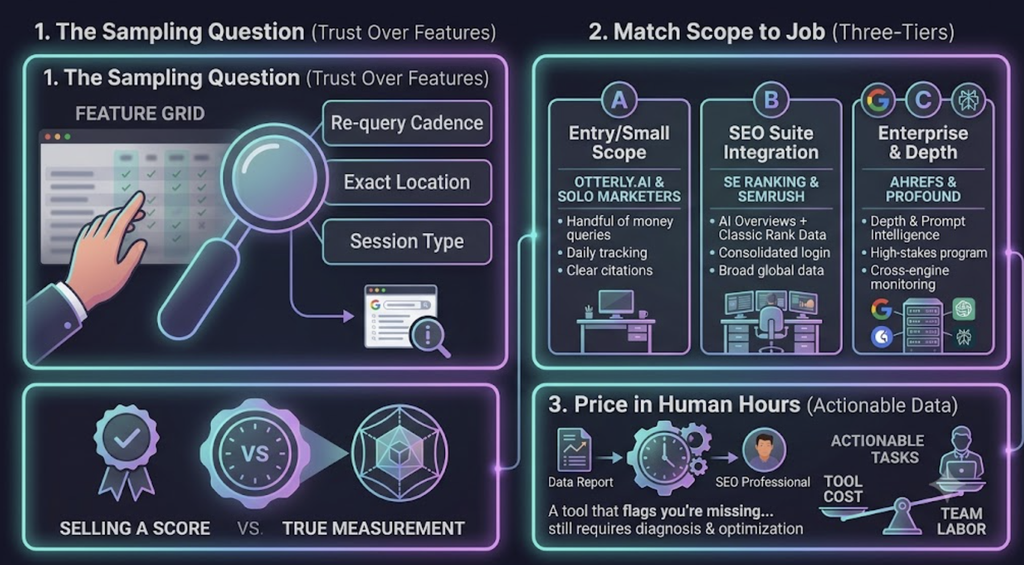
Start with the sampling question, not the feature grid. Ask each vendor directly: how often do you re-query, from what location, and logged in or out? A tool that can’t answer precisely is selling you a score, not a measurement. For local or multi-market brands, location handling is decisive — a generic national sample will quietly misreport whether you’re cited where your buyers actually search.
Then match scope to job. If you track a handful of money queries, a $29 daily tracker like Otterly is enough. If you need AI Overviews beside classic rank data, SE Ranking or Semrush consolidate the login and if AI visibility is an enterprise program, Profound or Ahrefs bring depth — at enterprise cost. Several of these also track brand mentions in ChatGPT and other engines, so if your buyers live in Perplexity or ChatGPT as much as Google, weight multi-engine coverage accordingly.
And price in the human hours. A tool that flags you’re missing from 40 AI Overviews still leaves someone to diagnose why, fix the page, and confirm it worked.
Tracking Is Half the Job — Keeping the Citation Is the Other Half
Every tool here measures your AI Overview presence. None of them keeps it. An AI Overview citation you earn this quarter can disappear the next as Google re-retrieves fresher sources and your page ages — and a tracker will simply show the score sliding without doing anything about it.
That’s the gap WordPattern is built for: detecting when the pages you’ve earned AI visibility on start to decay, and prioritizing the refreshes that recover them — so the downside of your AI-search program is based on real page-level performance, not a blanket assumption. Earning the citation in the first place is a third job again, and it is a content one. Direct answers near the top of the page, consistent entity facts across the web, and structured data an engine can lift cleanly are what AI search optimization covers, and without it, a tracker has very little to report.
FAQs
An AI Overviews checker is a tool that queries Google for your target keywords on a set schedule, detects whether an AI Overview appears, and records which URLs it cites and whether your brand is mentioned. The better ones re-run on a defined cadence and location so you see trends over time, rather than a single manual spot-check that’s true for one search at one moment.
Rank tracking measures your position in the standard blue-link results. AI Overview monitoring measures whether you appear inside Google’s AI-generated summary and which sources it cites — a separate signal, because ranking #1 doesn’t guarantee a citation and Google Search Console doesn’t split AI Overview data out on its own.
Most can. Otterly, Peec, Semrush, Ahrefs Brand Radar, and Profound all track brand mentions across ChatGPT and other engines alongside Google AI Overviews, though engine coverage and cost vary by plan — check which engines are on the base tier versus sold as add-ons.
For fast-moving or competitive queries, daily is the sensible floor, because AI Overviews change frequently. Slower categories can stretch to weekly. What matters more than frequency is consistency: same query set, same location, same session type, so week-over-week movement reflects reality rather than sampling noise.