
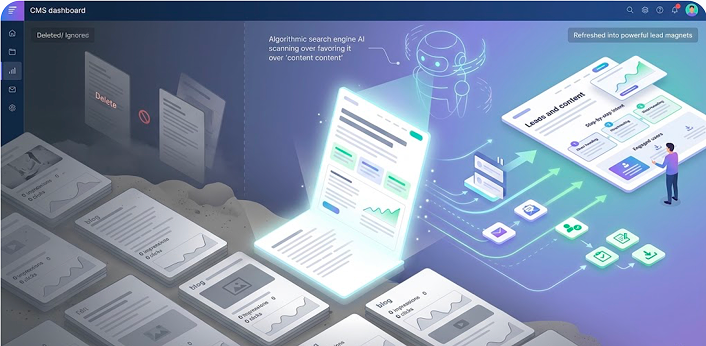
There is a graveyard inside your content library! You probably know it is there. It shows up in Google Search Console as a long tail of URLs with zero impressions, zero clicks, and a bounce rate so high it barely registers as a statistic. This sits in your CMS like furniture you moved into a new house and never found a use for. The conventional response to this graveyard is one of two things: ignore it, or delete it. Both responses are wrong. They share the same flawed premise. The Zero-Volume Refresh is a system for waking dormant content up and not just restoring it to its original purpose. But repurposing it into something more valuable than a blog post ever was! Like a lead magnet that captures audience information, builds your list, and generates pipeline from content you have already written.
Why Zero-Volume Pages Are a Linguistic Misalignment Problem?
Before the framework, the diagnosis. Zero-volume pages fail for three reasons and only one of them is the reason most content teams assume.
The assumed reason is topic selection: the page covers something nobody searches for. This is occasionally true. Genuinely obscure topics with no search demand do exist, and for those pages, the correct response is retirement. But in the overwhelming majority of cases, zero-volume pages are not covering obscure topics. They are covering real topics badly or rather, covering them in a way that fails to match the linguistic expectations of the search queries that could find them.
This is a sentence structure problem.
Search engines match queries to documents not just by keyword presence but by what computational linguists call semantic role alignment – the degree to which a document’s argument structure matches the implicit argument structure of the query. When a user types “how to write a content brief,” they are issuing an implicit request for a procedural argument: a sequence of steps, organized chronologically, with imperative verb constructions and concrete deliverables. A page that answers this query with a definitional argument — “A content brief is a document that…” — contains the right keywords but the wrong argument structure. Its semantic role alignment is low. It will not rank, regardless of how well it is written at the sentence level.
Zero-volume pages almost always suffer from one of three structural misalignments:
Intent Mismatch: The page’s argument structure (definitional, analytical, comparative) does not match the dominant intent of the queries that could theoretically find it (procedural, navigational, transactional).
Depth Deficit: The page covers the right topic with the right intent but at insufficient depth – too few subpoints, too little supporting evidence, too short a word count to satisfy the query’s informational demand.
Conversion Vacuum: The page is structurally sound and sufficiently deep but has no mechanism for capturing the reader once they arrive. It generates no leads, no subscriptions, no next step – so even if it ranks, it produces nothing of measurable value.
The Zero-Volume Refresh addresses all three misalignments in sequence. That sequencing is not arbitrary – it mirrors the order in which a reader encounters the content, and the order in which a search engine evaluates it.
Step 1: Audit Your Deadwood: Finding Pages Worth Saving
Not every zero-volume page deserves resurrection. The first step is triage: identifying which dormant assets have the structural bones to become something valuable, and which should be quietly retired.
Export your full URL inventory from Google Search Console. Filter for pages with fewer than 50 impressions over the past 12 months. This is your deadwood list – the pages that search engines are effectively ignoring.
Now apply a three-part salvage test to each page on the list.
The Topic Legitimacy Test:
Does the page cover a topic that real people actually search for? Run the page’s core noun phrase through a keyword research tool. If there is any search volume, even ten searches per month, at any level of query specificity, the topic is legitimate. If there is genuinely zero demand for the underlying topic at any keyword variation, the page should be retired. Move on. But do not assume zero volume on the page means zero volume on the topic. The two are frequently decoupled.
The Argument Quality Test:
Read the page’s body copy as an argument, not as a piece of content. Does it make a coherent claim? Does it support that claim with specific evidence, examples, or steps? Or is it a collection of loosely connected assertions padded to a word count? Pages with strong underlying arguments but poor structural presentation are the highest-value candidates for the Zero-Volume Refresh – they have done the hardest intellectual work already. They just need their argument to be restructured and re-signaled.
The Conversion Potential Test:
Could this page, if it attracted the right reader at the right moment, capture something valuable – an email address, a content download, a consultation request? Pages covering topics at the consideration or decision stage of the buyer journey have the highest conversion potential. Pages covering purely informational topics at the awareness stage can still generate leads if the right content upgrade is attached. The question is not whether the current page converts- it clearly does not but whether the underlying topic is one where a reader with a real problem would trade their contact information for a better answer.
Pages that pass all three tests go into your refresh queue. Pages that fail the topic test get retired with a 301 redirect to the most relevant surviving page on your site and the pages that fail the argument or conversion test but cover legitimate topics get flagged for a lighter-touch update rather than a full refresh.
Step 2: Restructure the Argument: Realigning Sentence Patterns to Search Intent
With your refresh queue identified, the structural work begins. This is the step that most content refresh guides skip entirely – they jump from “update your statistics” to “add internal links” without addressing the underlying reason the page failed to rank in the first place: its argument structure does not match the intent of its target queries.
The restructuring process has three components.
Component 1: Intent Reclassification
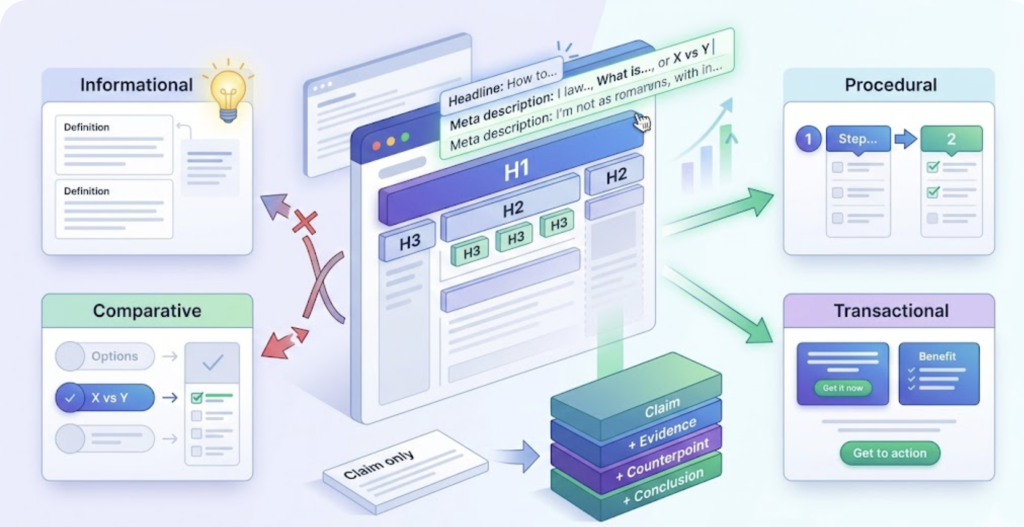
For each page in your refresh queue, determine the dominant search intent of the queries you want it to rank for. There are four intent categories, each with a characteristic sentence-pattern signature:
Informational intent favors declarative constructions. The reader wants to understand something. Effective pages serving informational intent open with definitional or explanatory sentences (“Content briefs are documents that align writers and strategists before production begins”) and use descriptive subheadings that map the conceptual territory (“What a Content Brief Contains,” “Why Content Briefs Reduce Revision Cycles”).
Procedural intent favors imperative and sequential constructions. The reader wants to do something. Effective pages serving procedural intent open with outcome statements (“By the end of this guide, you will have a complete content brief ready to send to your writer”) and use numbered subheadings with active verb anchors (“Step 1: Define the Target Query,” “Step 2: Specify the Argument Structure”).
Comparative intent favors evaluative constructions. The reader wants to choose between options. Effective pages serving comparative intent open with a framing of the decision (“The choice between a content brief and a style guide depends on three factors”) and use parallel subheading structures that allow direct side-by-side reading.
Transactional intent favors benefit-forward constructions. The reader wants to acquire or commit to something. Effective pages serving transactional intent open with value propositions and use subheadings that address objections and confirm fit.
Identify your page’s current dominant construction — what sentence type leads most of your subheadings and paragraphs — and compare it to the intent of your target queries. If there is a mismatch, restructure the subheading architecture before touching the body copy. The subheadings are the skeleton; the body copy is the flesh. Restructuring the skeleton first prevents you from rewriting body copy that will need to be reorganized again anyway.
Component 2: Depth Augmentation
Once the intent is correctly signaled through the heading structure, audit the body copy for depth. Depth, in linguistic terms, is not a function of word count — it is a function of argument completeness. A complete argument makes a claim, supports it with specific evidence, addresses the most likely counterargument, and draws a conclusion that advances the reader’s understanding.
For each major section of the restructured page, ask: does this section make a complete argument, or does it make a claim and stop? If it stops at the claim, add the support layer. If it has the claim and the support but no counterargument acknowledgment, add the nuance or if it has all three but no conclusion that connects back to the reader’s original intent, add the synthesis sentence.
This is not padding. Padding adds word count without adding argument. Depth augmentation adds argument — and argument is what both readers and search engines are evaluating.
Component 3: Headline and Meta Reconstruction
With the body restructured, rewrite the headline and meta description to signal the new intent alignment explicitly. The headline should foreground the dominant verb form that matches the target intent: “How to” for procedural, “What” for informational, “X vs. Y” for comparative. The meta description should function as a compressed argument preview — one sentence stating the problem, one sentence stating what the page delivers as a solution.
Step 3: Build the Lead Magnet Layer
The restructured page now has the argument quality and intent alignment to rank. But ranking is not the end goal. The end goal is conversion — turning the reader’s attention into a relationship, a lead, a pipeline entry. This is also one of the most practical ways to make money online through content you’ve already created: by attaching the right offer to the right page, dormant posts become active revenue assets.
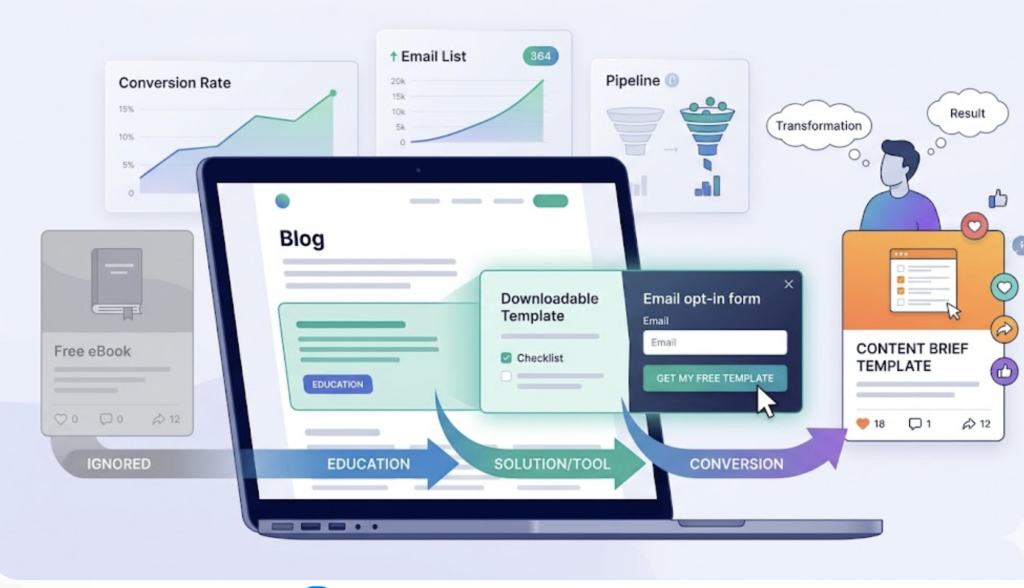
This is the step that transforms a refreshed blog post into a lead magnet system. It requires adding what content strategists call a content upgrade: a piece of supplementary content, gated behind an email opt-in, that is directly and specifically relevant to the page the reader is already consuming.
The content upgrade must satisfy three conditions to convert effectively.
Condition 1: Topical Specificity
Generic lead magnets — “Download our free eBook on content marketing” — convert at low rates because they are not semantically connected to the specific argument the reader just encountered. A reader who arrived at your page on content brief writing is in a specific problem-solving state. They want a solution to a specific problem. A content brief template is a solution to that specific problem. A general content marketing guide is not.
The content upgrade must be the logical next object in the reader’s argument chain. If the page teaches the concept, the upgrade delivers the tool. If the page delivers the framework, the upgrade delivers the worked example or if there is a checklist provided by the page, the upgrade provides the calculator. The relationship between the page and the upgrade should be: “If you found this useful, here is the thing that makes it immediately actionable.”
Condition 2: Sentence-Level Value Signaling
The opt-in copy — the headline and description that accompany the content upgrade offer — must communicate value at the sentence level with the same precision as the page’s headline. Weak opt-in copy uses generic benefit language (“Get our free template”). Strong opt-in copy names the specific transformation (“Download the Content Brief Template used to cut revision cycles by half — fill in five fields, send to your writer”).
The sentence construction that converts most reliably is the outcome-action pair: state the specific outcome first, then name the action required to achieve it. This construction is effective because it mirrors the reader’s internal monologue: they are already imagining the outcome (a completed content brief, a fixed cannibalization problem, a refreshed content library) and evaluating whether the required action (submitting an email address) is a fair trade for that outcome.
Condition 3: Placement Precision
The content upgrade offer should appear at two points in the page: immediately after the section that generates the highest reader engagement (typically the section where the core framework is delivered), and at the conclusion of the page. Placing it only at the conclusion loses readers who do not finish the article. Placing it only at the top loses readers who have not yet been convinced the content is worth their contact information.
The Dormant Asset Principle: Why Zero-Volume Pages Are Your Highest-Leverage Content Investment?
Here is the claim that most content strategists will not make directly, because it contradicts the dominant industry narrative about content production: publishing new content is almost always a lower-return investment than refreshing existing content.
The reason is linguistic sunk cost and it is a genuine advantage, not a consolation prize.
Every piece of content you have already published has already paid the most expensive costs in the content production cycle: the research cost (someone identified and investigated the topic), the argument cost (someone structured a coherent claim and developed supporting points), and the editorial cost (someone reviewed and refined the prose).
What the Zero-Volume Refresh recovers?
Zero Volume refresh recovers the return on those sunk costs! The research is already done. The argument is already structured. The prose is already written. The refresh invests a fraction of the original production cost to fix the structural misalignments – the intent mismatch, the depth deficit, the conversion vacuum that prevented the original investment from generating a return.
New content pays every cost from scratch: new research, new argument construction, new prose, new editorial review, new internal linking, new indexing wait time. And it starts with zero topical authority — no backlinks, no historical engagement signals, no crawl priority. A refreshed page starts with whatever authority it has accumulated, however modest, and benefits immediately from any internal links already pointing to it.
For every piece of new content you commission, audit whether an existing zero-volume page covers the same territory. If one exists, the refresh is almost always the higher-return investment. The exception is when the zero-volume page fails the salvage test, when the topic is genuinely illegitimate or the argument is so structurally compromised that a full rewrite would cost more than a new page.
The highest-value sentence in your content library is not the one that has never been written. It is the one that has already been written correctly but is being read by nobody. Find that sentence. Build around it. The argument is already there. The audience just hasn’t arrived yet.
Building a Zero-Volume Prevention System
The Zero-Volume Refresh is a remediation framework. But the goal is not to run it repeatedly on an ever-growing backlog of dormant content. The goal is to build an editorial system that prevents new deadwood from accumulating in the first place.
Three practices will dramatically reduce your zero-volume rate going forward.
Intent Validation Before Commission: Before any piece of content is assigned to a writer, the commissioning editor should confirm the dominant search intent of the target query and specify the corresponding sentence-pattern structure the piece should use. This takes two minutes and eliminates the most common cause of zero-volume failure: a page written in the wrong argument mode for its target query.
Depth Specification at Brief Stage: Every content brief should specify a minimum argument depth for each major section — not a word count, but an argument completeness requirement. “This section must make a claim, support it with one specific example, and address the most likely reader objection” is a more useful brief instruction than “this section should be 200-300 words.” Word count is a proxy for depth; actual depth requirements produce actual depth.
Conversion Architecture at Publication: No page should be published without a specified conversion mechanism — even if it is only an inline CTA to a related resource. A page without a conversion layer is a page that, even if it ranks and generates traffic, produces nothing measurable. Building the conversion layer at publication rather than retrofitting it during a refresh is dramatically more efficient.
Subscribe to WordPattern’s Weekly Syntax Tips for ongoing frameworks on content architecture, sentence-level optimization, and lead-generation copywriting delivered directly to your editorial team.
Common Misconceptions About Zero-Volume Content
Misconception 1: “Zero impressions means the topic has no demand.”
Zero impressions means search engines are not surfacing your page for queries related to your topic. These are different things. A page can cover a topic with genuine demand and still generate zero impressions if its intent alignment is poor, its depth is insufficient, or its internal linking is too weak to support crawl priority. The topic’s demand is measurable independently of the page’s performance — use keyword research tools to separate the two before making a retirement decision.
Misconception 2: “Refreshing old content signals to Google that the content is low quality.”
This misconception conflates the act of refreshing with the signal of the refresh. A substantive refresh — one that adds argument depth, realigns intent, and improves structural completeness — sends strong positive quality signals: increased dwell time, improved engagement rate, new internal links. A cosmetic refresh — one that changes the publication date without changing the content — sends no meaningful signal at all. The difference is in the substance, not the act.
Misconception 3: “Lead magnets only work on high-traffic pages.”
Lead magnets work wherever there is a reader with a specific problem and a solution that is worth their contact information. A page generating 50 targeted visits per month from readers actively trying to solve a specific problem will outperform a page generating 5,000 visits from readers with low intent and no specific problem state. The conversion metric that matters is not absolute traffic volume — it is the ratio of qualified readers to conversion opportunities. Zero-volume pages, once refreshed, often convert at higher rates than high-traffic pages because their specificity attracts readers with precise problem states.
Conclusion
The zero-volume pages in your content library are not evidence of strategic failure. They are evidence of structural misalignment and structural misalignment is fixable in a way that genuine topic irrelevance is not.
The three-step Zero-Volume Refresh framework – audit for salvageable assets, restructure the argument to match search intent, and build the lead magnet layer – transforms dormant content into productive content without paying the full cost of new production. It recovers the sunk investment in research, argument, and prose. It generates leads from an asset that was generating nothing. And it does so by applying the same linguistic precision to existing content that should have been applied at the point of original commission.
Your graveyard is not a problem to be managed. It is inventory waiting to be activated.
Start with your three highest-potential deadwood pages. Run the salvage test. Restructure the argument. Build the upgrade. Measure what changes.
The argument was always there. Now let it work.