

As your website grows, so does your content library but more content doesn’t always mean better performance. Over time, outdated blogs, low-traffic pages, and overlapping topics start piling up, making it harder for your best content to stand out. This is exactly where the SEO Threshold Method becomes essential.
Instead of guessing whether to update, merge, or delete a page, this method gives you a clear, data-driven framework to make smarter decisions. By focusing on performance metrics rather than assumptions, you can cut through content bloat, improve rankings, and ensure every page on your site serves a purpose.
Why outdated content harms search rankings?
Search engines prioritize helpful, relevant, and up-to-date content. When your site is filled with thin or outdated pages, it weakens your overall authority.
Even worse, these underperforming pages:
- Compete with stronger content
- Waste crawl budget
- Lower your site’s perceived quality
By applying the SEO Threshold Method, you can quickly identify and remove this dead weight, allowing your best pages to shine.
The Ongoing SEO Challenge: Refresh, Merge, or Redirect?
Most SEOs face the same question: “This post from 2019 has two visits a month. Do I rewrite it, or do I redirect it to my main service page?” Without a framework, these decisions are based on gut feelings rather than data.
How the threshold method simplifies SEO decisions?
Every content manager faces this situation:
A blog from years ago gets little traffic. It barely ranks. Now you have to decide should you improve it, combine it with another page, or redirect it?
Without a structured approach, decisions like these often rely on instinct. However, the SEO Threshold Method replaces guesswork with clear performance benchmarks, making every decision easier and more consistent.
How the SEO Threshold Method Simplifies Content Decisions?
At its core, the SEO Threshold Method is about setting measurable standards.
Each page on your site is evaluated against specific thresholds such as:
- Traffic levels
- Keyword rankings
- Backlink strength
- Engagement metrics
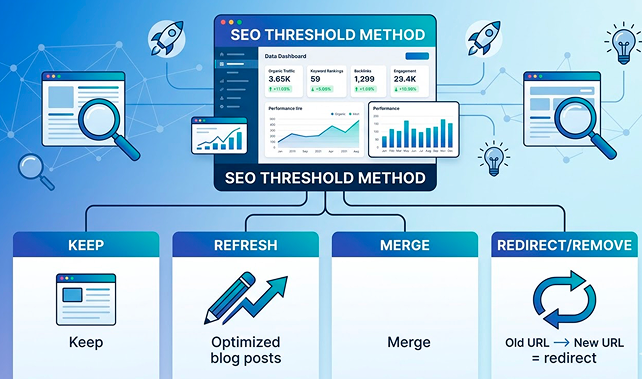
Based on where it stands, the page is assigned a clear action:
- Keep
- Refresh
- Merge
- Redirect or remove
This structured system ensures you always know what to do next.
What Is the SEO Threshold Method?
The SEO Threshold Method is a data-driven framework designed to audit and optimize existing content. It helps you determine which pages deserve attention and which ones should be removed or redirected.
Instead of treating all content equally, this method prioritizes pages based on performance and potential.
As a result, your SEO strategy becomes more efficient, focused, and scalable.
Why Data-Driven Content Decisions Improve Results?
When you rely on real data, your efforts become more strategic.
Using the SEO Threshold Method, you can:
- Identify high-potential pages quickly
- Stop wasting time on low-performing content
- Maximize return on investment from existing assets
This approach ensures that every update you make has a purpose.
Why Large Websites Depend on the SEO Threshold Method?
For websites with hundreds or thousands of pages, manual audits simply don’t work anymore.
The SEO Threshold Method makes it possible to:
- Analyze content at scale
- Automate decision-making
- Maintain a clean and optimized site structure
Because of this, many enterprise SEO teams rely on it to manage large content libraries effectively.
Why Refresh vs Redirect Decisions Matter in SEO?
Improve Crawl Efficiency
Search engines have limited resources. By removing low-value pages using this method, you help them focus on your most important content.
Preserve Link Equity
If a page has backlinks, deleting it wastes authority. Redirecting it ensures that value is passed to a more relevant page.
Prevent Keyword Cannibalization
When multiple pages target the same keyword, rankings suffer. This method helps you to identify these overlaps and consolidate them into stronger pages.
The 4 Key Metrics Behind the SEO Threshold Method
1. Organic Traffic Threshold
Set a minimum traffic benchmark. For example, pages receiving fewer than 10 monthly visits for several months may need action.
2. Keyword Ranking Threshold
Pages ranking between positions 4 and 20 are within reach of page one.
With the SEO Threshold Method, these become top candidates for content refresh rather than removal.
3. Backlink Threshold
Backlinks signal authority. Even if traffic is low, pages with quality links should never be deleted, only redirected.
4. Engagement and Conversion Threshold
Some pages drive conversions despite low traffic. These should always be preserved and optimized further.
When to Refresh Content?
Refreshing content makes sense when a page shows clear potential.
You should update content if:
- It ranks on page two of search results
- It has strong backlinks but declining traffic
- The topic is still relevant
- Users spend significant time on the page
In these situations, the SEO Threshold Method helps you focus on quick wins that can boost rankings.
When to Redirect Content Instead?
Not all content is worth saving.
According to the SEO Threshold Method, redirecting is the better option when:
- A page has zero traffic over a long period
- Topics overlap with stronger pages
- Keyword cannibalization exists
- The content is outdated or irrelevant
Redirecting ensures you preserve any remaining SEO value while improving site structure.
Step-by-Step Guide to Applying the SEO Threshold Method
Step 1: Collect Data
Export performance data from tools like Google Search Console and SEO platforms.
Step 2: Evaluate Against Thresholds
Compare each page’s performance with your defined benchmarks.
Step 3: Categorize Content
Assign each URL to a clear action group:
- Keep
- Refresh
- Merge
- Redirect
Step 4: Implement and Monitor
Apply changes and track results over the next 30–60 days to measure improvements.
Tools That Support the SEO Threshold Method
To implement this strategy effectively, use:
- Google Search Console for performance insights
- Screaming Frog for technical audits
- Ahrefs or Semrush for backlink analysis
- Google Analytics 4 for engagement tracking
These tools help you apply the SEO Threshold Method with precision.
Common Mistakes to Avoid
Even with a strong framework, mistakes can happen.
Avoid:
- Redirecting pages that still have ranking potential
- Ignoring user intent when updating content
- Deleting pages with backlinks without redirecting
Using the SEO Threshold Method correctly helps you avoid these costly errors.
Conclusion
In the end, successful SEO isn’t about publishing more content, it’s about managing it effectively. The SEO Threshold Method helps you do exactly that by turning complex decisions into a structured, repeatable process.
When you rely on data instead of guesswork, you not only improve rankings but also create a cleaner, more authoritative website that search engines trust. Over time, this leads to better visibility, stronger engagement, and more consistent growth.
If you want long-term SEO success, start refining your content not expanding it blindly and let this guide your every decision.
FAQs
No. If the content is legally required or serves a specific niche utility for existing customers, keep it but consider “no-indexing” it so it doesn’t affect your SEO.
A full content audit using the SEO Threshold Method should be done at least once a year.
A 301 redirect passes about 90-99% of link equity. As long as you redirect to a relevant topic, it is highly beneficial for SEO.