
Here’s a number that should change how you think about AI search: when the pages AI engines cite shift from one month to the next, about 87% of those changes are declines, not gains. Over half of all citation volume is tied to domains that are losing ground. So the visibility you win in March can quietly evaporate by June.
That’s the part most “best AEO tools” lists skip. Nearly every roundup you’ll find was written by a tracker vendor that ranks itself number one, hands you a dashboard, and calls it a day. You end up knowing which tool to buy and almost nothing about what to do once you own it.
This guide takes a different route. WordPattern isn’t an AEO tracker, so we’ve got no horse in that race. What follows is an honest ranking of the strongest answer engine optimization platforms in 2026, the real price of each one (not the headline number), and the thing every list leaves out: the work that has to sit underneath the tool for any of it to pay off.
The 11 best AEO tools in 2026 at a glance
| Tool | Best for | Engines covered | Real starting price |
|---|---|---|---|
| AirOps | Tracking + content execution in one loop | ChatGPT, Claude, Perplexity, Gemini, AI Overviews | Free Solo tier; paid custom |
| Profound | Widest engine coverage + crawler analytics | Up to 9 (Enterprise) | $99/mo (ChatGPT only); $399 for multi-engine |
| Peec AI | Accurate, UI-scraped citation data | 7 (choose 3 self-serve) | $95/mo |
| Otterly AI | Fast, cheap monitoring | ChatGPT, Gemini, Perplexity + more | $29/mo |
| HubSpot AEO | Free diagnostic + cheap tracking | ChatGPT, Perplexity, Gemini | Free grader; $50/mo |
| Ahrefs Brand Radar | Largest real-prompt database | 6–7 | $398/mo add-on (needs Ahrefs sub) |
| Semrush | Teams already on Semrush | ChatGPT, Gemini, Perplexity, Google AI | $139/mo (AI now in the plan) |
| SE Ranking / SE Visible | SEO + AEO in one, both Google surfaces | 5 | $89 add-on ($218 real floor) |
| Scrunch AI | Named AI-crawler analytics | 4 (Core), 9 (Enterprise) | $250/mo |
| Frase | Question research + drafting | Light AEO tracking | $49/mo |
| Surfer SEO | Structuring content for extractability | No visibility tracking | $89/mo |
Best AEO tools compared: pricing, engines and data sources
Prices and engine coverage checked in September 2026. Full reviews, with the catch on each tool, follow below.
| Tool | Best for | Engines tracked | Data source | Real starting price | Main catch |
|---|---|---|---|---|---|
| AirOps | Tracking plus content execution | Solo: ChatGPT only. Pro: ChatGPT, Google AI, Perplexity, Google AI Studio | Not publicly documented | Free plan; Solo and Pro unpublished (reported ~$200 and ~$2,000/mo) | Multi-engine starts at Pro |
| Profound | Enterprise, multi-market programs | Up to 9 (Enterprise) | Front-end answer captures; prompt volumes from consumer panels | Free trial; Enterprise custom | No self-serve brand plan since Sept 2026 |
| Peec AI | Citation accuracy, unlimited seats | 3 of 6 on self-serve | UI scraping (documented) | $95/mo | Each extra engine is a paid add-on |
| Otterly AI | Cheap, fast monitoring | ChatGPT, AI Overviews, Perplexity, Copilot | Not publicly documented | $29/mo (15 prompts) | Gemini, AI Mode, Claude cost extra |
| HubSpot AEO | Free diagnostic, cheap tracking | ChatGPT, Perplexity, Gemini | Pre-set prompts run daily | Free Grader; $50/mo (25 prompts) | No Google AI surfaces |
| Ahrefs Brand Radar | Largest search-backed prompt index | AI Overviews, AI Mode, ChatGPT, Perplexity, Gemini, Copilot, Grok; Claude via custom prompts | Search-backed prompt index plus custom prompts | $199/mo per platform; $699 all | Stacks on an Ahrefs plan |
| Semrush | Teams already on Semrush | ChatGPT, Google AI Overviews and AI Mode, Gemini, Perplexity | Real requests, not LLM APIs (per Semrush) | $99/mo per domain; Semrush One from $199 | 25 prompts, one domain per license |
| SE Ranking / SE Visible | SEO plus both Google AI surfaces | Add-on: AI Overviews, AI Mode, ChatGPT, Perplexity | Not publicly documented | $218/mo real floor (Core + add-on) | Add-on needs a Core plan |
| Scrunch AI | AI crawler and agent analytics | 7, incl. Claude and Meta AI | Browser automation plus official APIs; CDN logs for bot traffic | $300/mo ($250 annual) | Nothing below $250 |
| Frase | Research and drafting, light tracking | Starter: ChatGPT, Google AI. Scale: 5 | Not publicly documented | $49/mo ($39 annual) | Claude and Gemini need the $299 plan |
| Surfer SEO | Structuring content for extractability | Standard: ChatGPT. Pro: 5 | Not publicly documented | $99/mo annual ($119 monthly) | One engine, weekly refresh at entry |
1. AirOps
AirOps pitches a closed loop. It tracks where you’re cited, its AI agents draft the refresh that closes the gap, and then it measures whether the fix worked. Most tools on this list stop at step one. That’s why it sits first: it’s built for enterprise content teams that want tracking and execution in one place.
- Pricing: There’s a free plan to test with. AirOps doesn’t publish Solo or Pro prices on its pricing page. Independent reviews consistently report about $200/mo for Solo and $2,000/mo for Pro, with task overage billed on top. Enterprise is custom.
- Engines tracked: Solo covers ChatGPT only. Pro adds Google AI, Perplexity and Google AI Studio.
- Data source: AirOps doesn’t publicly document how it collects answers.
- Key limitation: The jump from Solo to Pro is roughly tenfold, and multi-engine tracking only starts at Pro. There’s no middle rung.
Best for: enterprise teams tired of stitching a dashboard to a separate writing tool. If all you want is a lightweight monitor, this is far more platform than you need.
2. Profound
Profound has the broadest engine coverage on this list. Its Enterprise tier tracks up to nine answer engines: ChatGPT, Perplexity, Google AI Mode, Gemini, Copilot, DeepSeek, Claude, AI Overviews and Exa. It also runs agent analytics that show how AI bots actually hit your site. That technical depth is its real edge, and investors agree: it closed a $180M Series D in September 2026.
- Pricing: This changed right after that round. The $99 Starter and $399 Growth brand plans are gone. Brands now choose between a limited free trial and a custom Enterprise contract. Agencies still get a self-serve Agency Growth plan, with each full client workspace at $399/mo.
- Engines tracked: Up to nine on Enterprise. The trial is much narrower, and reports differ on exactly what it includes.
- Data source: Profound runs prompts through each engine’s front-end interface, the way a user would. Its prompt-volume data comes from consumer panels.
- Key limitation: There’s no published brand price at all. You can’t budget it without a sales call, and third-party reviews put enterprise deployments at $2,000 to $5,000+ a month.
Best for: enterprise teams running global, multi-market programs who’ll actually use the depth. Smaller teams should start further down this list.
3. Peec AI
Peec runs prompts through the engines’ web interfaces rather than their APIs, so the citation data reflects what a real person sees in the answer. Every plan includes unlimited seats, which is rare in this category. Its country- and language-level breakdowns are among the strongest going.
- Pricing: Starter is $95/mo for 50 prompts and one project. Pro is $245/mo for 150 prompts, and Advanced is $495/mo for 350 prompts plus Looker Studio. Annual billing takes about 15% off. There’s a free trial but no free tier.
- Engines tracked: Self-serve plans let you pick three from ChatGPT, AI Mode, AI Overviews, Copilot, Perplexity and Gemini. Enterprise unlocks more models, including Claude.
- Data source: UI scraping, which Peec documents openly. Some extra Enterprise models run through APIs.
- Key limitation: The three-engine cap holds from Starter all the way to Advanced. Each extra engine is a paid add-on priced by tier, so full coverage costs well above the sticker.
4. Otterly
The fastest, cheapest way in. You’ll have data the same day you sign up, and every plan includes unlimited team members. Higher tiers now add an API and an MCP server, so the data can flow into your own reporting.
- Pricing: Lite is $29/mo for 15 prompts, Standard is $189/mo for 100, and Premium is $489/mo for 400. Enterprise is custom, and annual billing saves about 15%. Extra prompts cost $99 per 100 on Standard and Premium.
- Engines tracked: ChatGPT, Google AI Overviews, Perplexity and Microsoft Copilot are included. Gemini and Google AI Mode are add-ons at $9 to $149/mo each by tier, and Claude runs $29 to $439/mo.
- Data source: Otterly doesn’t publicly document whether it scrapes interfaces or calls APIs.
- Key limitation: That $29 covers four engines and 15 prompts. Add Gemini, AI Mode and Claude, and Lite rises to about $76/mo, while Premium climbs past $1,200.
Best for: a first honest look at where you stand. It monitors and stops there, so you’ll outgrow it once you’re running a serious program.
5. HubSpot AEO
HubSpot sells two things here. The free AI Search Grader gives a one-time snapshot of how ChatGPT, Perplexity and Gemini represent your brand, no account needed. The paid HubSpot AEO tool tracks that over time and, notably, doesn’t require a HubSpot subscription.
- Pricing: The Grader is free. HubSpot AEO is $50/mo, or $45/mo billed annually, after a 28-day free trial. It’s also included in Marketing Hub Professional and Enterprise.
- Engines tracked: ChatGPT, Perplexity and Gemini.
- Data source: The paid tool runs your 25 prompts daily across all three engines, up to 2,500 answers a month. For the Grader, HubSpot says ChatGPT and Gemini answers draw on training data while Perplexity pulls from live search.
- Key limitation: Three engines and 25 prompts, with no Google AI Overviews, AI Mode, Claude or Copilot. That leaves out the AI surface most Google searchers actually see.
Best for: anyone starting from zero. The Grader is the easiest first step on this whole list.
6. Ahrefs Brand Radar
Its differentiator is data scale. Brand Radar sits on an index of search-backed prompts drawn from real search behavior, not synthetic questions nobody actually asks. Ahrefs puts the index past 400 million prompts, though the figure keeps moving, so treat it as directional.
- Pricing: $199/mo per AI platform index, or $699/mo for all platforms, which includes 2,500 custom-prompt checks. Custom Prompts alone start at $50/mo. Most teams run it alongside an Ahrefs plan (Lite from $129/mo), putting full coverage around $828/mo.
- Engines tracked: AI Overviews, AI Mode, ChatGPT, Perplexity, Gemini, Copilot and Grok. Claude arrived in July 2026, but only for custom prompts.
- Data source: A search-backed prompt index captured as snapshots, plus custom prompts you define. Checks are metered: one prompt on one platform in one location, and a Claude update costs eight checks.
- Key limitation: Costs stack per platform, and checks run out fast. Running 100 prompts daily on two platforms uses about 6,000 checks a month.
Best for: teams already living in Ahrefs. Less so if you’d be buying Ahrefs just for this.
7. Semrush
Semrush’s AI Visibility Toolkit puts AI search performance, sentiment and custom prompts next to the keyword and backlink data you already use. One login, both jobs. For existing Semrush teams, that’s the entire argument, and it’s a good one.
- Pricing: The toolkit is $99/mo per domain with 25 tracked prompts. Semrush One bundles classic SEO with AI visibility from $199/mo (50 prompts) up to $549/mo (200 prompts). The classic SEO plans on their own don’t include it.
- Engines tracked: ChatGPT, Google AI Overviews and AI Mode, Gemini and Perplexity. No Claude or Copilot.
- Data source: Semrush says its data is captured from real requests rather than LLM APIs. That’s one of the clearer disclosures in the category.
- Key limitation: One domain per license. Every extra domain is another $99, which punishes agencies and multi-brand teams, and 25 prompts runs out quickly.
Best for: teams already paying for Semrush. If you don’t need full SEO, you’re buying a lot of overlap.
8. SE Ranking / SE Visible
SE Ranking’s AI Search add-on covers both Google AI surfaces, Overviews and AI Mode. For local and service businesses, those two matter more than the chat interfaces, and few tools at this price track both. The add-on also unlocks SE Visible, a dashboard for brand mentions, citations and sentiment.
- Pricing: The add-on is $89/mo ($71.20 annual), with prompt tiers of 200, 450 or 1,000. It sits on top of a Core plan at $129/mo ($103.20 annual). SE Visible is also sold as a standalone product, so confirm its current price.
- Engines tracked: The add-on’s AI Results Tracker names AI Overviews, AI Mode, Perplexity and ChatGPT. Base plans also list Gemini for lighter tracking.
- Data source: SE Ranking doesn’t publicly document how it collects answers.
- Key limitation: The $89 isn’t the real entry point. You pay for Core first, so the practical floor is about $218/mo on monthly billing.
Best for: teams that want SEO and AEO under one roof and care most about Google.
9. Scrunch AI
Scrunch’s standout is named crawler analytics. It connects to CDNs such as Cloudflare, Fastly, Akamai, AWS CloudFront and Vercel, and shows which bots (GPTBot, ClaudeBot, PerplexityBot) crawl which pages and how often. Its Agent Experience Platform goes further, serving AI crawlers a machine-readable version of your site. That pairs naturally with an llms.txt file strategy. Sitecore acquired Scrunch in June 2026.
- Pricing: Starter is $300/mo, or $250/mo billed annually, with 3 seats, 350 custom prompts and 1,000 industry prompts. Growth is $500/mo ($417 annual). Enterprise is custom, with a 7-day trial on Starter.
- Engines tracked: Seven: ChatGPT, Claude, Gemini, Perplexity, AI Mode, AI Overviews and Meta AI.
- Data source: Browser automation plus official platform APIs for answers, and server-side CDN logs for bot traffic. New prompts run daily for 14 days, then every three days by default.
- Key limitation: There’s nothing below $250/mo, and multi-brand tracking is Enterprise only. Packaging also changed several times in 2026, so confirm what you’re quoted.
Best for: technical SEO and enterprise teams who want to see, and shape, what AI crawlers receive.
10. Frase
Frase started as a research-and-drafting tool. It clusters the questions your audience asks and scores your content against top-ranking pages as you write. It now adds AI visibility tracking on every plan, which closes the old gap of optimizing a page with no way to see if it earned the citation and it also shows up in most content audit tool roundups for good reason.
- Pricing: Starter is $49/mo ($39 annual). Professional is $129/mo, Scale is $299/mo, and Enterprise is custom. Paid plans come with a 7-day trial.
- Engines tracked: Starter covers ChatGPT and Google AI. Perplexity joins at $129, and Claude and Gemini at $299. Enterprise goes up to eight.
- Data source: Frase doesn’t publicly document how it collects answers.
- Key limitation: Coverage is tightly tier-gated. Two engines at entry is thin, and tracking is a side feature, not the core product.
Best for: smaller teams that want research, drafting and a first read on AI visibility in one affordable subscription.
11. Surfer SEO
Surfer scores your content in real time against what’s already ranking, guiding structure, headings and semantic coverage. Since answer engines favor well-structured, extractable pages, that work quietly doubles as AEO prep. Surfer now bundles an AI Tracker into its plans, too.
- Pricing: Discovery at $49/mo has no tracker. Standard is $99/mo billed annually ($119 monthly) with 25 prompts refreshed weekly. Pro is $182/mo with 50 daily prompts, and Peace of Mind is $299/mo with 100.
- Engines tracked: Standard tracks ChatGPT only. Pro and above track ChatGPT, Perplexity, Gemini, AI Overviews and AI Mode.
- Data source: Surfer doesn’t publicly document how it collects answers.
- Key limitation: At entry you get one engine on a weekly refresh. Real multi-engine tracking starts at $182/mo, and no tier covers Claude or Copilot.
Best for: the writing half of your stack. Pair it with a dedicated tracker if AI search is a real channel for you.
The gap every AEO tool leaves open — and why visibility decays
Notice what every tool above has in common? They tell you where you’re losing. Almost none of them fix it. And the fixes, it turns out, are overwhelmingly content-side.
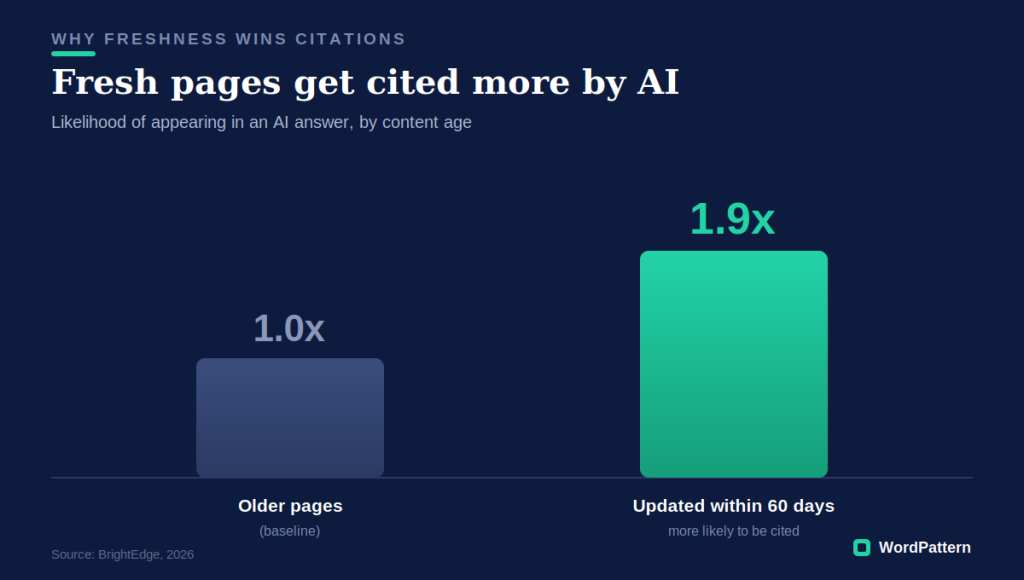
Look at what actually correlates with getting cited. Pages updated within the last 60 days are 1.9x more likely to appear in AI answers. Adding structured data and FAQ blocks drove a 44% jump in AI citations in one analysis. Author schema correlates with a 3x lift. None of that is a dashboard feature. It’s writing, structuring, and refreshing.
Now stack that against the churn. AI citation sets are stable week to week, and most cited domains don’t move. But when they do move, they mostly move down. Remember that 87% figure? A page cited this quarter isn’t guaranteed a citation next quarter unless its freshness, entity coverage, and structure hold up. Growth advisor Kevin Indig made this exact point in a 2025 AirOps webinar: content refresh isn’t a one-time event.
So here’s the honest shape of the problem. A tracker is a smoke detector. It tells you something’s wrong; it doesn’t put out the fire. Declining visibility gets fixed by refreshing the specific content that’s slipping, before the slip becomes a freefall. That’s the layer that belongs underneath whatever tracker you pick. It’s the exact problem WordPattern was built around: a tracker tells you a page’s citations dropped; a decay agent tells you which paragraph dragged it down and refreshes only that, instead of forcing a monthly manual audit that catches the problem weeks late.
How to choose the right AEO tool for your stage
Skip the “enterprise vs. small business” framing. Think in stages instead.
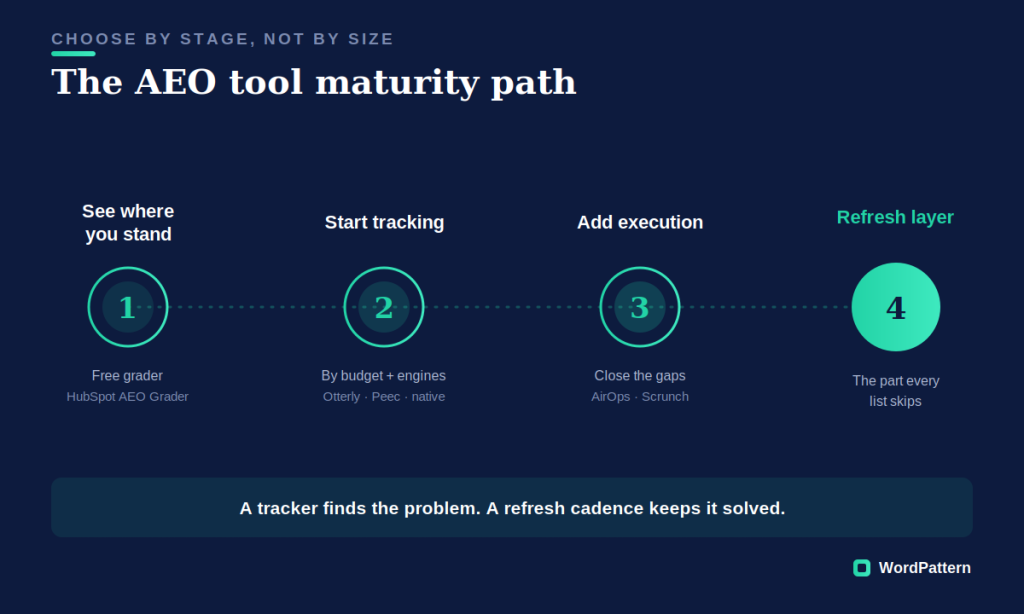
Stage one — see where you stand. Run a free diagnostic first. HubSpot’s AEO Grader gives you a real score in a couple of minutes with no account. Don’t pay for anything until you know how invisible you actually are.
Stage two — start tracking. Pick a monitor that fits your budget and the engines your buyers actually use. Otterly at $29 if you want cheap and fast. Peec if citation accuracy matters. Something Ahrefs- or Semrush-native if you already live there.
Stage three — add execution. Once you can see the gaps, you need to close them. That’s either a closed-loop platform like AirOps, or — more affordably — a tracker paired with a dedicated refresh layer that handles the content maintenance.
The through-line: match the tool to which of the four jobs you actually need, and whatever you land on, budget for the refresh cadence running underneath it. The tool that finds the problem and the work that fixes it are two different line items.
AEO best practices that actually move citations in 2026
Tools point you at the work. Here’s the work, from answer-shaped content to visual assets such as an AI poster that can make information easier to understand and share.
Write answer-shaped content. Phrase your H2s and H3s as the questions people ask, and answer them in the first sentence underneath. Keep paragraphs to one idea so an engine can lift a clean, self-contained passage without dragging in context it doesn’t want.
Add schema and FAQ blocks — that’s the 44% citation bump, not a rounding error. Put author schema on your bylines too. And publish your pricing and product facts on your own pages. If the details aren’t on your site, AI learns them somewhere else, sometimes wrong.
Earn mentions on sources engines trust: Reddit, YouTube, established publications. Citation volume is brutally concentrated. The top 1% of domains capture 64% of all citations. Authority compounds, so every credible offsite mention pulls weight.
Then refresh on a schedule. Perplexity in particular retrieves from the live web, so a stale page gets quietly deprioritized no matter how good its backlinks are. Freshness isn’t a nice-to-have here. It’s the retrieval signal, and it’s why content decay quietly erodes rankings long after you hit publish.
The bottom line
The best AEO tool for you depends on two things: which of the four jobs you actually need, and how far along you already are. Start with a free grader, add tracking when you’re ready to watch the trend, and add execution when you’re ready to move it. Verify the pricing before you commit, because half of these have a floor that’s higher than the sticker.
But hold onto the bigger idea. Every tool here is a way of seeing. None of them, on their own, is a way of fixing. The brands that stay cited through 2026 won’t be the ones with the prettiest dashboard. They’ll be the ones treating AI visibility as something you maintain, not something you buy once.
FAQs
SEO optimizes for rankings on traditional search results. GEO (generative engine optimization) optimizes for being surfaced inside generative AI like ChatGPT and Perplexity. AEO is the broadest term, covering any direct answer, including AI Overviews, featured snippets, and voice assistants. In practice the three overlap heavily and most teams work all of them at once.
Yes. HubSpot’s AEO Grader is fully free and needs no account. Ahrefs offers a free AI Visibility Checker for single lookups, and SE Ranking publishes a free checker covering five engines with a handful of checks per day. These are great for a one-time snapshot, but none replaces ongoing tracking once AI search becomes a real channel for you.
The sub-$100 tier includes Otterly AI ($29), HubSpot AEO ($50), Frase ($49), Surfer ($89), and Peec AI ($95). Profound’s $99 Starter also fits, but it tracks ChatGPT only. Watch for hidden floors — SE Ranking’s $89 add-on realistically needs its $218/mo Core plan to work.
If you only need tracking inside a platform you already pay for, their AEO modules are a reasonable start. The limitation is depth. Add-on features usually offer basic monitoring without the engine coverage or execution workflows of a dedicated tool. If AI search is becoming a meaningful channel, a specialist tool gives you more signal and more ways to act.
Most trackers show initial data within about 24 hours. Content changes that improve visibility typically take two to six weeks to register, since engines refresh their indexes gradually. Teams running continuous refresh cycles tend to see compounding gains over three to six months, which is the whole argument for treating this as maintenance, not a one-time project.