
Here’s a number that should bother anyone running SEO at scale. On the average enterprise site, only about 3.5% of pages get any organic traffic at all — and that’s across sites averaging more than ten million pages, per Botify’s analysis of 6.3 billion URLs. So the vast majority of what these companies publish never earns a single visit.
Now stack the second problem on top. Nearly every “best enterprise SEO firms” list you’ll find was written by a firm that ranked itself first. Helpful, right?
This guide does it differently. WordPattern isn’t an agency, so there’s no thumb on the scale. What follows is a vendor-neutral shortlist grouped by what each firm actually does best, a five-point way to score them, honest 2026 pricing, and the one thing almost every list skips: the reason enterprise organic growth quietly stalls after year one.
What actually makes SEO “enterprise” (and why standard agencies struggle with it)
Enterprise SEO isn’t small-business SEO with a bigger invoice. It’s different in kind, not degree.
Picture what large-scale SEO looks like day to day. You’re managing anywhere from 10,000 to over a million URLs. Multiple domains, often spread across countries and languages. A CMS that three different teams touch. And a single title-tag change that has to clear legal, brand, and product before it ships. One misconfigured crawl rule can quietly deindex 80,000 pages, and nobody notices until traffic craters and a VP starts asking questions.
That’s the coordination tax nobody warns you about. Standard agencies staff and price for tactics. Enterprises need governance, technical SEO at scale, and stakeholder wrangling happening all at once, forever.
Scale cuts the other direction too. New content won’t rescue you the way it rescues a small site. Only 1.74% of newly published pages, per Ahrefs data, crack the top 10 for even a single keyword inside a year. So the enterprise SEO company promising “40 fresh articles a month” is selling you volume dressed up as strategy. The odds are against almost all of it.
The five criteria we used to evaluate enterprise SEO firms
Enterprise SEO is really five jobs wearing one name. The strongest firms are solid at all five, not dazzling at one and hopeless at the rest.
Technical SEO at scale keeps a sprawling, tangled site crawlable and fast. Content and topical authority let you own entire categories instead of a scattering of keywords. Authority and link building earn the trust signals that compound over years. AI-search work — AEO and GEO — keeps you visible as answers migrate into AI surfaces. And documented results connect all of it to revenue, not to a screenshot of rankings.
Then there’s a sixth criterion most lists forget. Can the firm keep what you already rank for alive? Hold that thought.
A useful frame comes from Vijay Vasu, founder of Indexable and once the first SEO hire at Uber Eats. His take: execution is commoditizing while judgment is the scarce asset. AI agents now knock out audits, schema, and first-draft content at nearly zero marginal cost. So when you score an enterprise SEO agency, split the commodity work from the strategy. Pay premium rates for judgment. Don’t pay them for what a tool does in an afternoon.
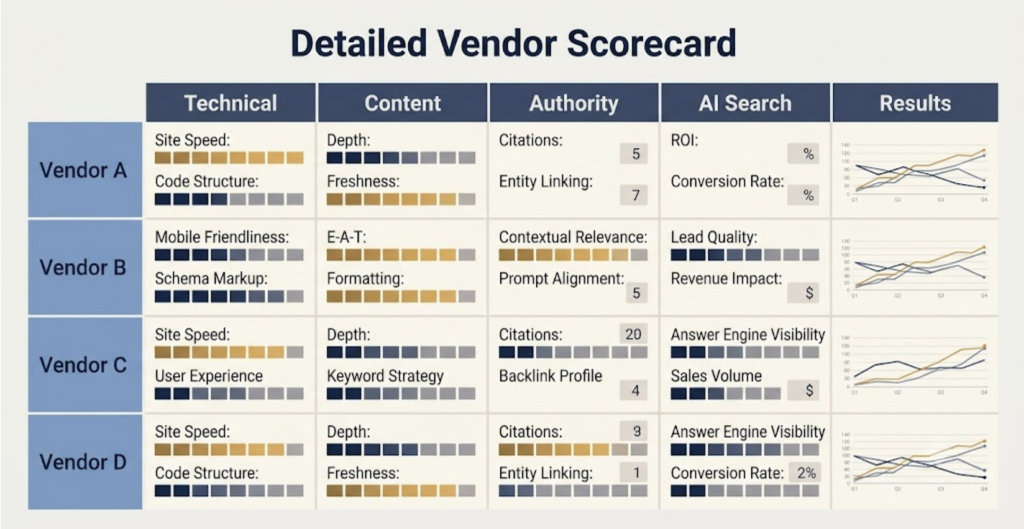
The best enterprise SEO firms in 2026, by what they’re best for
Quick note on method. These firms kept showing up across independent rankings and verified client lists. WordPattern takes no placement fees and runs no affiliate links, so nobody bought a spot. Where a firm published its own ranking, it’s flagged so you can weigh it accordingly.
- WebFX: best for full-service breadth with hard reporting. Roughly 750 specialists and a proprietary reporting platform, RevenueCloudFX, that ties organic performance back to pipeline instead of leaving you with a ranking chart. A reasonable default when you want one team owning technical, content, and analytics under a single roof and one point of contact.
- Terakeet: best for content at real scale. Built specifically to run large, complicated sites with thousands of pages across regions and domains. Their entire pitch is handling the operational mess that makes smaller agencies flinch: content governance, approval chains, consistency across huge portfolios.
- iPullRank: best for technical depth plus AI search. NYC-based, well known for relevance engineering and for doing serious AEO work before most agencies had a slide on it. Verified clients include Etsy, American Express, and SAP. A strong fit when your core problem is technical and your traffic sits squarely under AI-Overview pressure.
- Conductor: best if you’d rather build internal muscle than rent it. The one platform-first option here. You can license the software, hire the services layer, or run both together. It was named a Leader in the Forrester Wave for SEO Platforms in Q3 2025, and its client roster includes Citi, FedEx, and Mastercard. Fair warning: it’s overbuilt for companies under about $10M in revenue.
- Amsive: best for award-backed enterprise programs. Took home Search Engine Land’s Agency of the Year for SEO in 2025, along with repeat wins for enterprise initiatives specifically. That’s a track record that holds up when you actually check it.
- First Page Sage: best for thought-leadership-led B2B SEO. Content built around search-intent analysis and subject-matter experts, with clients like Salesforce and Verizon. One thing to know going in: they publish their own “top agencies” list and rank themselves at number one, so treat that particular ranking as marketing collateral, not neutral research.
- Wpromote: best for tightly integrated paid and organic. B2B clients include Adobe, Intuit, and TransUnion. The right call when your SEO can’t be planned in a vacuum away from your paid media budget.
- Searchbloom: best for founder-led, single-team accountability. A Google Premier Partner running two named frameworks, ART for SEO and MERIT for AI search. It also ranks itself first on its own list — but discloses the bias openly and scores itself by the same rubric as everyone else, which is rarer than it should be.
Firm vs. consultant vs. platform vs. in-house: which model fits your scale
Before you shortlist a single vendor, figure out what you’re buying. “Enterprise SEO” actually describes four different purchases, and the right one hinges on whether your real constraint is control, flexibility, or raw execution capacity.
An enterprise SEO consultant sells senior strategy and lets your team execute. Picture the operators who’ve run search inside big companies — a Taylor Scher or an Eli Schwartz type. Ideal when you already have a content team but they’re rowing without a map.
An enterprise SEO platform — Conductor, BrightEdge, seoClarity — sells you the tooling to do the work in-house. Best when you’re building a lasting internal function instead of renting one indefinitely.
Building in-house buys you total control at a steep fixed cost. A director-level SEO hire alone runs $180,000 to $220,000 in base salary in US markets, and that’s before you staff a single specialist under them.
An agency hands you breadth without the headcount. You give up some control in exchange for a bench of specialists you’d never justify hiring one by one.
Most large companies end up running two or three of these together. A platform for the in-house team, a consultant on retainer for strategy, an agency to absorb overflow. That’s not indecision. That’s how enterprise SEO usually looks in practice.
Why enterprise SEO stalls after year one: the content decay problem
Here’s the part the other lists skip. It’s also the most important thing on this page.
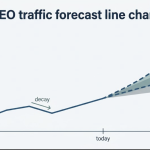
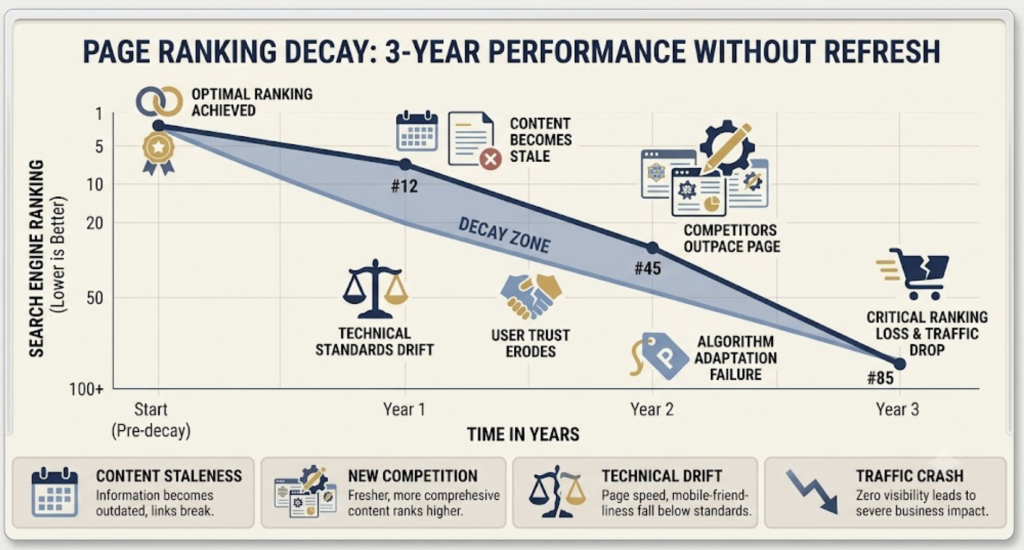
Enterprise SEO programs rarely die because they can’t rank new pages. They die because the pages already ranking quietly rot, and nobody’s watching the graveyard. Spread across 100,000 URLs, content decay stays invisible until a quarterly review shows traffic sliding and the finger-pointing starts.
The data is blunt about it. According to Ahrefs’ analysis, 72.9% of pages ranking in Google’s top 10 are more than three years old. Sit with that. The winners aren’t shiny new posts. They’re maintained ones — pages that got updated, re-optimized, and defended year after year. There’s a reason updating your best existing posts tends to beat churning out new ones at scale.
And the pain isn’t spread evenly. When Graphite measured US organic traffic heading into 2026, the top-10 sites actually grew about 1.6% while sites ranked between roughly 100 and 10,000 took the sharpest hits. Guess where the bulk of your enterprise pages live? That mid-tier. The exact band that’s bleeding.
HubSpot is the cautionary tale everyone cites, and for good reason. After scaling an enormous library of broad top-of-funnel content only loosely tied to its product, its organic traffic got cited at down 70% to 80%. Volume didn’t shield them. It turned into a liability the second AI summaries got good at compressing generic explainers into a paragraph nobody clicks past.
So the best enterprise SEO firm for you is one that treats refresh as a real discipline, not a favor it grants when a client complains loudly enough. Ask everyone on your shortlist how they monitor existing rankings and decide what to update, and when. This is precisely the gap tools like WordPattern exist to close: spotting content decay across large inventories and flagging what needs a refresh before the rankings actually slip. At enterprise scale, that kind of automated decay detection across thousands of URLs is the difference between catching a slide early and reading about it in next quarter’s report. Buy the capability or build it. Either way, you can’t skip it.
How AI search changes who you should hire
Ranking well used to guarantee you got cited. Those days are gone.
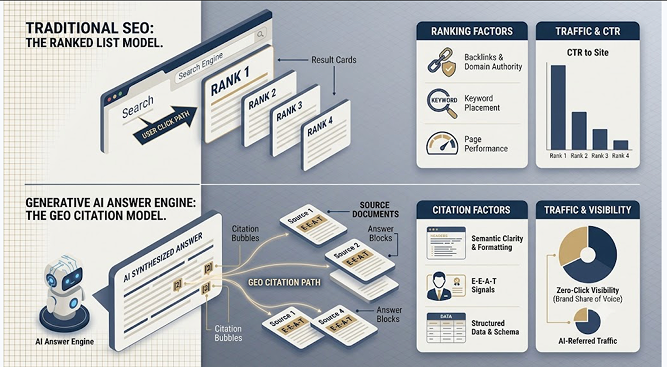
In mid-2025, around 75% of the URLs cited in AI Overviews also ranked in the organic top 10. By early 2026 that overlap had cratered to somewhere between 17% and 38%. High rankings no longer buy AI visibility. Which means your firm needs a separate playbook for earning it.
And the pressure lands hardest in the verticals enterprises actually compete in. B2B technology queries trigger AI Overviews about 82% of the time. When an Overview appears, organic click-through for even the top result falls roughly 58% to 61%, according to figures from Ahrefs and Seer Interactive. That’s not a rounding error. That’s half your clicks, gone to a summary.
So push every candidate on their AEO and GEO methodology. Do they do genuine entity and schema work? Can they point to a case where they earned AI citations, not just blue-link rankings? If the answer turns vague and buzzwordy, keep looking.
What enterprise SEO costs in 2026
Pricing is all over the place, but there are honest ranges to anchor on.
Mid-market retainers usually land between $10,000 and $30,000 a month. Full enterprise programs commonly run $30,000 to $50,000 and climb from there. Global brands carrying heavy international and technical scope can clear $60,000 a month, and total annual enterprise SEO budgets sometimes top $500,000 once tools and people are counted. AI and GEO scope typically adds another $2,000 to $7,500 monthly on top of the base.
Memorize a few red flags. Any firm guaranteeing specific rankings is either lying or planning to rank you for keywords no human ever types. “Proprietary” or “secret” tactics usually translates to link schemes that’ll earn you a penalty, not a payoff. And nobody delivers real enterprise SEO for a few hundred dollars a month, so read a suspiciously cheap quote as a warning rather than a win.
How to run your shortlist: a practical vetting checklist
Once you’ve got three or four names, run every one through the same wringer.
Check how they rank for their own competitive terms first. A firm that can’t market itself is a curious pick to market you. Then verify their case studies name actual clients with actual revenue or traffic numbers, not a vague “boosted visibility.” Ask who owns your account day to day, because at big agencies the charismatic person in the pitch meeting is almost never the person doing your work.
And ask the maintenance question outright: how do you monitor and refresh existing content, not just crank out new pages? The answer sorts the firms that grasp enterprise reality from the ones running a content mill with a nicer logo. Awards and badges? Supporting evidence at best. Never proof.
Wrapping up
The enterprise SEO firm worth your budget scores well across all five criteria, fits its model to your scale, and takes AI search and content decay every bit as seriously as it takes new rankings. That last piece is exactly where most engagements quietly fall apart.
If one idea sticks, make it this. The firms and tools that win in 2026 defend the rankings you already own as fiercely as they chase the ones you don’t. At enterprise scale, growth is mostly about not losing ground you already took. Score for that, and you’ll build a far better shortlist than the self-serving lists ever could.
FAQs
An enterprise SEO firm handles search optimization for large organizations — usually sites with 10,000-plus pages, multiple domains or regions, and layered stakeholder and compliance demands. The work centers on technical SEO at scale, content governance, and tying organic performance to revenue. That makes it a genuinely different discipline from small-business SEO, not just a bigger version of it.
Most enterprise engagements run $10,000 to $50,000 per month in 2026. Mid-market programs sit closer to $10,000–$30,000, while global, multi-market work often clears $60,000. AI-search scope (AEO and GEO) tends to add $2,000–$7,500 monthly. Total annual budgets can pass $500,000 once tools and headcount are folded in.
Neither wins outright; they solve different problems. A consultant delivers senior strategy for a team that can execute on its own. An agency delivers a full bench of specialists when you lack the internal capacity. If you’ve got a content team but no direction, hire a consultant. If you need execution at scale, hire an agency.
Expect real movement in six to twelve months and full ROI closer to twelve to eighteen, depending on your site’s health, your competition, and how much technical debt you inherited. One quiet truth: enterprise sites often see faster wins from refreshing existing high-potential pages than from publishing anything new.
Ask how they monitor and refresh decaying content, not just how many new pages they’ll publish. You can ask for case studies with named clients and hard revenue metrics. Ask who owns your account day to day. And ask specifically about their AEO/GEO approach for staying visible inside AI Overviews.