
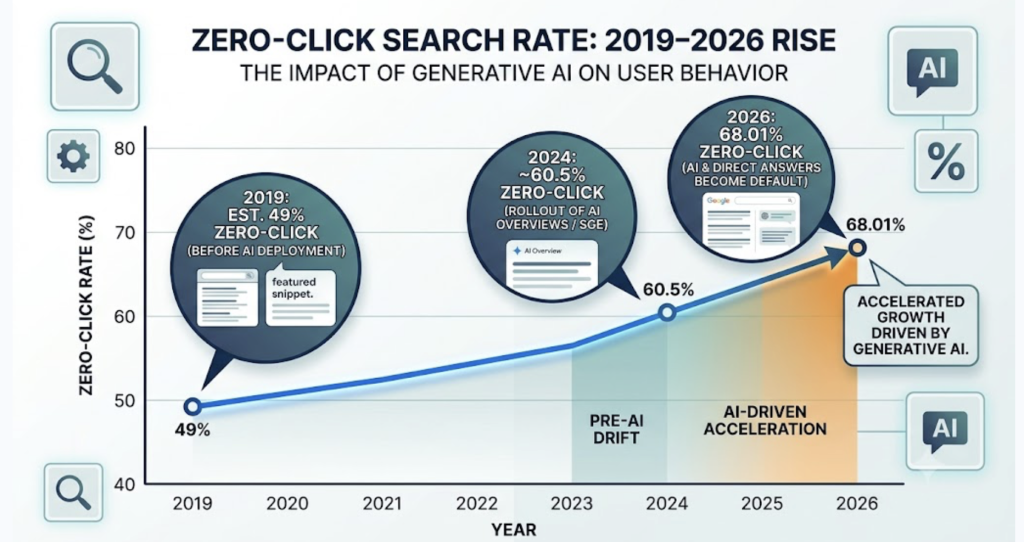
In the first four months of 2026, 68% of US Google searches ended without a single click. Not to your site. Not to anyone’s. The answer showed up right there on the page, and people moved on.
So ranking number one doesn’t mean what it used to. You can own the top spot and still watch your traffic flatten.
That’s the problem a search visibility tool is supposed to solve. The trouble is that the phrase now points at two completely different kinds of product, and if you buy the wrong one you’ll be measuring something you don’t care about. Here’s how to tell them apart, which features actually earn their price, and the part almost every guide leaves out. What you’re meant to do once the tool shows you a gap.
The two things “search visibility” now means
Ask ten marketers what a search visibility tool does and you’ll get two answers.
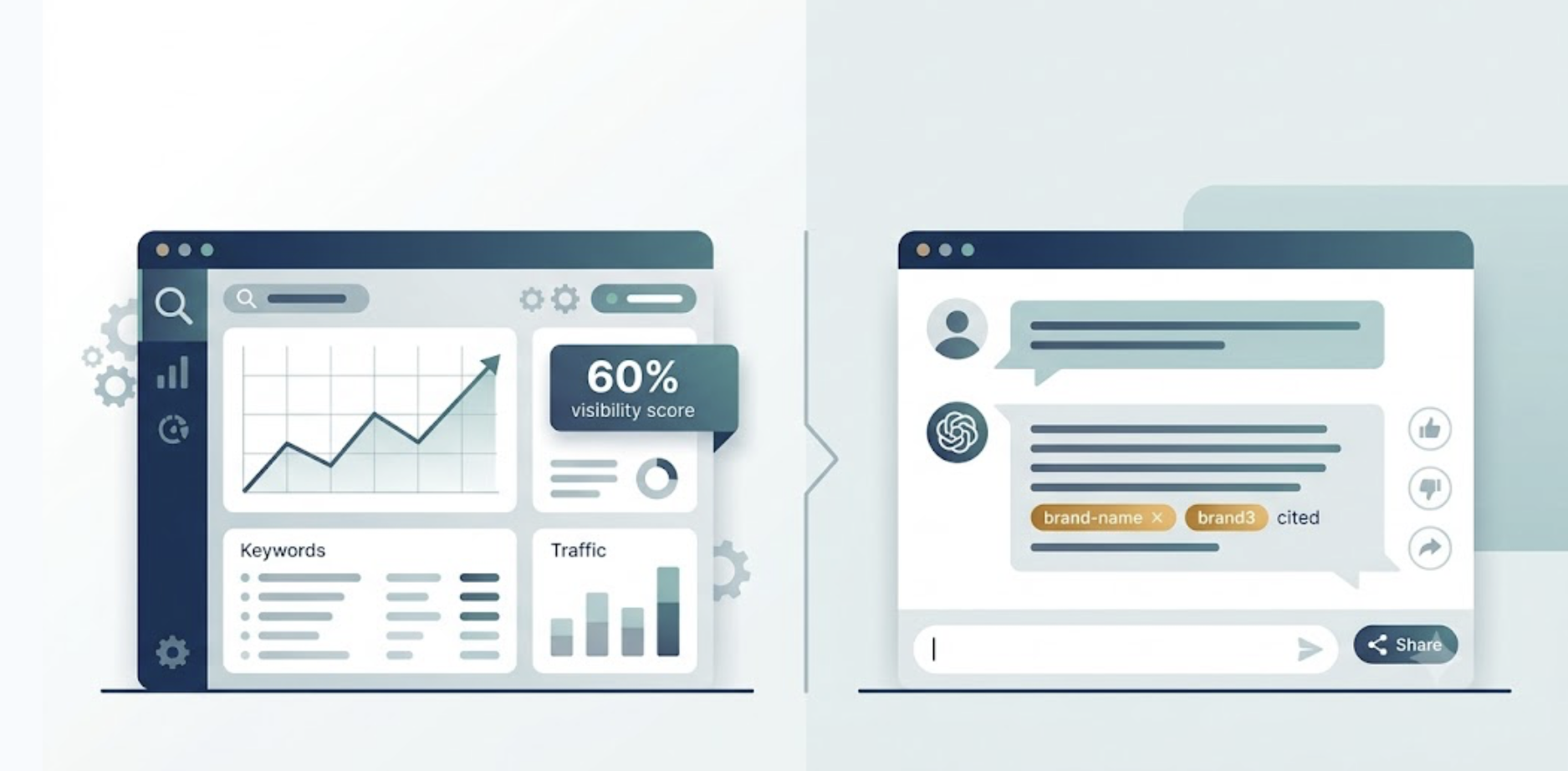
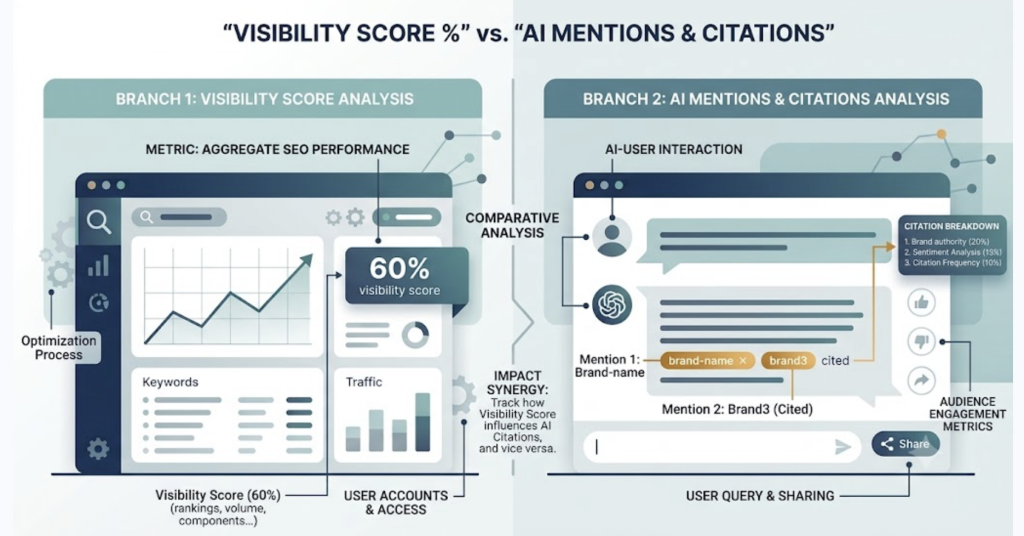
The older answer is a number. Classic rank trackers like Semrush and Ahrefs calculate a “visibility score,” a percentage that estimates how much of the available click traffic your keyword rankings could capture. Your score climbs when you rank for more terms, or rank higher for the ones you’ve already got. It’s a tidy way to watch a whole domain’s search presence move over the months.
The newer answer is about mentions. This breed of tool watches whether ChatGPT, Perplexity, Gemini, and Google’s AI Overviews actually name you, cite you, or recommend you inside their answers. No ranking involved. Either the model brings up your brand when someone asks about your category, or it doesn’t.
Search the phrase today and you’ll notice the results have flipped almost entirely toward that second meaning. AI search visibility is the category everyone’s building for. Part of the reason: per Conductor’s 2026 analysis, AI Overviews now appear on roughly one in four Google searches, up from about one in eight a year earlier.
Which one do you need? Depends on where your problem lives. If you’re losing rankings, a rank tracker still earns its keep. If you’re ranking fine but nobody in your category hears your name from an AI, that’s a different tool and a different fix.
Why AI search visibility became its own category
Zero-click search isn’t new, and it isn’t purely an AI story. The rate has been climbing for years, from around 50% in 2019 to 68% in 2026. AI Overviews poured fuel on a fire that was already burning. Featured snippets, knowledge panels, and People Also Ask boxes had been eating clicks for a decade before a single AI answer showed up.
Here’s the counterintuitive bit. AI referral traffic is tiny. Across most sites it’s about 1% of total visits. You’d be forgiven for shrugging.
Don’t shrug. Those visitors convert at roughly 4.4 times the rate of regular organic traffic. The reason is simple. Someone who clicks a citation inside an AI answer has already read a comparison, already seen you weighed against competitors, and decided you’re worth a look. They arrive pre-sold. So this channel is low volume, high value. Tracking it isn’t about chasing a flood of clicks. It’s about protecting the small stream of clicks that actually turn into money.
And a rank tracker literally can’t see any of it. The overlap between the two worlds is only partial. Around 60% of AI Overview citations come from URLs that don’t even rank in the top 20 of normal search. You could be invisible in AI answers while sitting pretty at position three, and your rank tracker would tell you everything’s fine.
That gap is the whole reason answer engine optimization (AEO) and generative engine optimization (GEO) exist as terms at all. They name the work of getting picked by a machine that summarizes instead of a machine that lists.
The features that actually matter in a search visibility tool
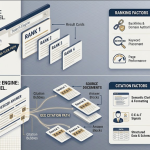
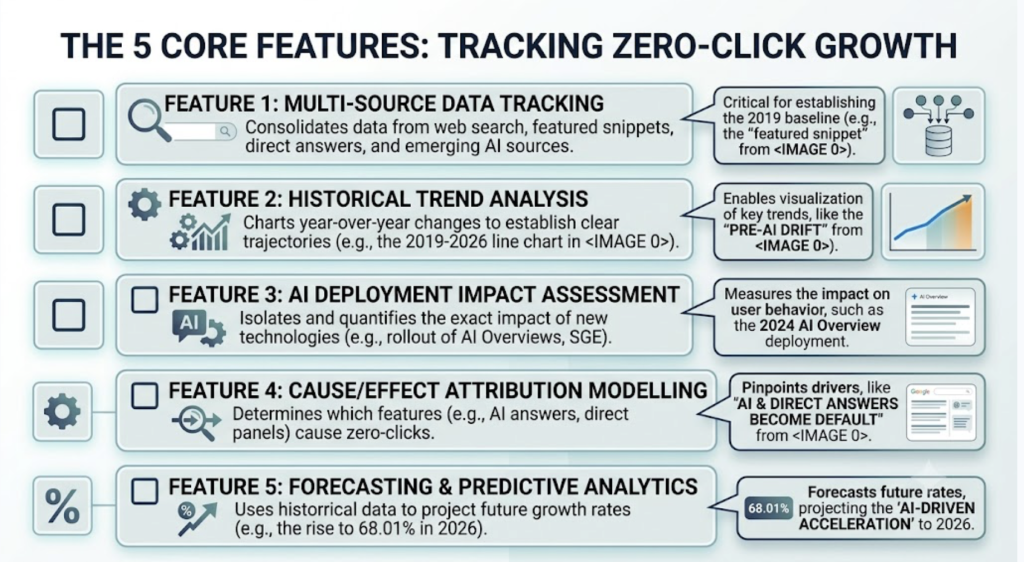
Most search visibility tools sound identical on their homepages. They all say ChatGPT, they all say “insights.” The real differences hide in the feature list. Five things are worth checking before you pay for anything.
Multi-engine coverage
One engine is not enough. The same brand’s citation count can vary wildly between platforms, by as much as 615x between two engines in one study. You could look like a star in one and a ghost in another.
That said, ChatGPT drives about 87% of all AI referral traffic, so it’s the priority. Just not the whole job. A good tool covers ChatGPT, Perplexity, Gemini, Copilot, and Google AI Overviews together, because that’s where the blind spots hide.
A yes/no “were you mentioned” is thin. You want to track specific buyer prompts, the actual questions your customers type, and see your share of voice against competitors. Getting named once in ten relevant prompts is a very different situation from getting named in eight. Only prompt-level data tells you which one you’re actually in.
Citation source tracking
When an engine cites something, which URL does it pull from? That’s your map. It shows you the pages and publications the model already trusts, which tells you what to build next or where to go earn a mention. Chase the sources, not just the mentions.
Accuracy and hallucination checks
Models get things wrong. They’ll quote an old price, invent an integration you don’t offer, or mix you up with a competitor entirely. Some tools now audit for exactly this. If a model is telling buyers your product does something it doesn’t, you want to know before your sales team finds out the hard way during a demo.
GA4 and GSC connection
Numbers in a dashboard are nice. Numbers tied to your actual traffic are useful. Look for tools that connect to Google Analytics and Search Console. And know that GA4, left to its own devices, dumps most AI referral traffic into “Direct” and hides the whole channel from you unless you set up a custom group.
A quick look at the current tools (by who they’re for)
There are more of these than anyone needs, and every roundup you’ll read has a favorite it happens to sell. So instead of ranking 22 near-identical products, here’s a rough map by who each type serves. Prices move fast here, so check them yourself before you commit to anything.
Dedicated AI-visibility platforms are the specialists. Profound sits at the enterprise end, built for big brands with deep prompt-monitoring needs and budgets to match. Peec AI, Otterly, and LLMrefs cover smaller teams that want a focused tracker without the enterprise invoice. Pick one of these when AI visibility is the actual job, not a bolt-on.
SEO suites that added AI visibility are the convenient option. Semrush’s AI Visibility Toolkit, Ahrefs’ Brand Radar, and SE Ranking’s AI features all sit tracking right next to the rank data you already watch. Good if you live in that suite already. Just confirm whether AI tracking costs extra on your plan, because it very often does.
Free checkers are how you start. Semrush and Ubersuggest both offer free AI visibility snapshots. They won’t give you ongoing monitoring, but they’ll tell you roughly where you stand in an afternoon, for nothing.
Then there’s the track-and-fix group. Tools like Frase and Rankability try to close the loop instead of stopping at the alert. Which brings up the thing most of this category quietly ignores.
Tracking shows you the gap. It doesn’t close it. That’s the layer WordPattern works on, detecting when content has decayed and refreshing it, so the pages that earn your citations don’t quietly rot. A tracker tells you that you lost a mention. Something still has to fix the page.
The part most guides skip – why visibility decays and how to win it back
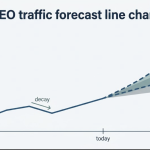
Here’s what the shiny dashboards don’t say out loud. A citation is not a trophy you keep on a shelf. You lose it the same way you lose an organic ranking. The content that earned it goes stale, a competitor writes something sharper, or your numbers quietly age out of date.
Why does this happen? Two forces are at work. First, AI engines lean hard on authority. Domain traffic is the single strongest predictor of getting cited, and higher-traffic sites pull roughly three times the citations of low-traffic ones. Second, the content that wins citations most often is comparison content. Eight of the ten most-cited URLs across AI platforms are “best X” listicles. Those are exactly the pages that rot fastest, because prices change, features ship, and new competitors show up every single quarter.
So a page cited in March can be dropped by June. Not because you did anything wrong. Because it aged, and someone else’s page didn’t.
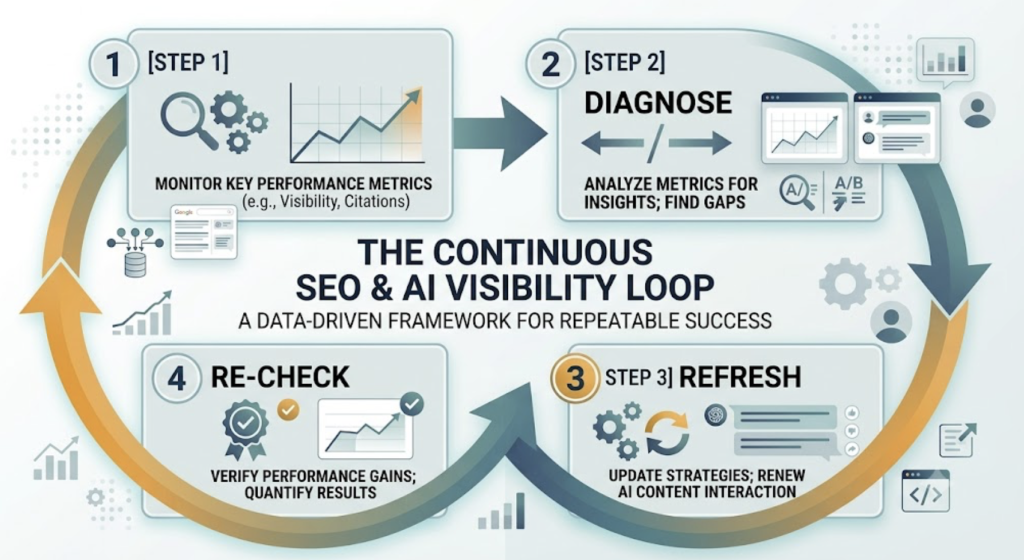
The fix is a loop, not a one-time task:
- Track. Use your tool to find the prompts where you lost a mention, or never had one to begin with.
- Diagnose. Open the competitor URLs the engine cited instead of you. What do they cover that you don’t? Is your own page carrying outdated stats, a stale year in the title, a section you quietly deleted last year?
- Refresh. Update that specific page. Current data, the coverage you were missing, a tighter passage the model can quote cleanly, and repaired schema.
- Re-check. Run the tool again after the engines re-crawl. Give it time. This lags by days or weeks, not minutes.
Do that on a rotation and visibility becomes something you maintain, not something you watch slip. Skip it, and the fanciest tracker on the market just hands you a very detailed record of your own decline. That maintenance loop is the entire idea behind WordPattern’s decay-and-refresh approach. Track once, fix on a schedule.
How to choose the right tool for your situation
You don’t need the search visibility tool with the most features. You need the one that fits how you actually work. Run any candidate past a short checklist:
- What’s the real monthly budget?
- How many prompts and competitors do you need tracked?
- Which engines matter for your audience? (B2B research crowds lean on Perplexity harder than you’d expect.)
- How often does it refresh, and how far back does the historical data go?
- Does it only monitor, or does it help you fix what it finds?
- Will it plug into GA4 and Search Console?
Then match that to your situation. Solo operator or small team watching the budget? Start with a free checker plus one affordable tracker. Agency juggling a dozen clients? You want a workflow tool with clean reporting you can hand over without editing it first. Enterprise? A dedicated platform with deep prompt monitoring will earn back its price.
One warning. Don’t buy on the visibility score alone. A single number that says “you’re at 42” feels reassuring and tells you almost nothing. Not where you’re winning, not where you’re losing, not what to do on Monday. The score is a starting point, never the answer.
And honestly, doing anything at all here puts you ahead of the pack. Only about 14% of marketers actually track AI search performance. The bar is on the floor.
Wrapping up
A search visibility tool means two things now, and the first job is knowing which problem you’re solving. Thin rankings, or a brand that AI engines never mention. Pick accordingly, and don’t let a roundup’s favorite pick it for you.
The tool is where the work starts, though, not where it ends. As Rand Fishkin put it after the latest zero-click numbers landed, SEO still matters as much as ever, it just won’t earn you traffic the way it once did. Visibility you don’t maintain will decay, whether it’s a ranking or a citation. The tools worth paying for are the ones that don’t just show you the drop. They help you climb back up.
FAQs
It’s software that measures how findable your brand is in search. Traditionally that meant a rank tracker calculating a “visibility score” from your keyword positions. Today it more often means a tool tracking whether AI engines like ChatGPT and Google AI Overviews mention or cite you in their answers. Same phrase, two very different jobs.
No. Rank tracking tells you where your pages sit in Google’s blue links. AI search visibility tells you whether AI answers name you at all, which is a separate signal entirely. Around 60% of AI Overview citations come from URLs that don’t rank in the top 20, so strong rankings don’t guarantee AI mentions.
At minimum, ChatGPT, Perplexity, Gemini, Copilot, and Google AI Overviews. ChatGPT drives the bulk of AI referral traffic, so it’s the priority, but citation counts vary enormously between engines. Tracking only one gives you a badly incomplete picture of where you really stand.
It ranges widely. Free checkers give you a one-time snapshot at no cost. Affordable trackers for small teams start in the low double-digit monthly range. Enterprise platforms can run several hundred dollars a month and up. Pricing shifts fast in this category, so always confirm current rates before you commit.
Partly. Free tools from Semrush, Ubersuggest, and others show you a snapshot of how you appear across the major AI engines. They’re great for a first read. For ongoing monitoring, prompt-level tracking, and competitor share of voice, you’ll eventually want a paid tool. But the free check is a smart place to start.