
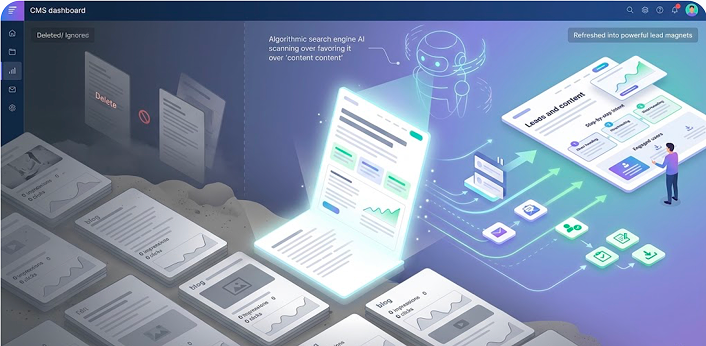
There is a graveyard inside your content library, and you probably know it’s there. It shows up in Google Search Console as a long tail of URLs with zero impressions, zero clicks, and a bounce rate so high it barely registers as a statistic. These pages sit in your CMS like furniture you moved into a new house and never found a use for. The usual response is one of two things: ignore them, or delete them. Both are wrong, and they share the same flawed premise.
The Zero-Volume Refresh is a content refresh strategy for waking dormant pages back up — not just restoring them to their original purpose, but repurposing them into something more valuable than a blog post ever was. Think a lead magnet that captures reader information, builds your list, and generates real sales conversations from content you have already written and already paid for.
Why Zero-Volume Pages Are a Linguistic Misalignment Problem?
Before the framework, the diagnosis. Zero-volume pages fail for three reasons and only one of them is the reason most content teams assume.
The assumed reason is topic selection: the page covers something nobody searches for. This is occasionally true. Genuinely obscure topics with no search demand do exist, and for those pages, the correct response is retirement. But in the overwhelming majority of cases, zero-volume pages are not covering obscure topics. They are covering real topics badly or rather, covering them in a way that fails to match the linguistic expectations of the search queries that could find them.
This is a sentence structure problem.
Put simply, it’s a sentence-structure problem. Search engines don’t just match a query to a page by keywords; they match by shape. When someone types “how to write a content brief,” they want a set of steps: do this, then this, then this. A page that answers with a textbook definition — “A content brief is a document that…” — has the right words in the wrong shape. It reads fine sentence by sentence and still won’t rank, because it’s answering a “how” question in the voice of a “what” answer.
Zero-volume pages almost always suffer from one of three structural misalignments:
Intent Mismatch: The page’s argument structure (definitional, analytical, comparative) does not match the dominant intent of the queries that could theoretically find it (procedural, navigational, transactional).
Depth Deficit: The page covers the right topic with the right intent but at insufficient depth – too few subpoints, too little supporting evidence, too short a word count to satisfy the query’s informational demand.
Conversion Vacuum: The page is structurally sound and sufficiently deep but has no mechanism for capturing the reader once they arrive. It generates no leads, no subscriptions, no next step – so even if it ranks, it produces nothing of measurable value.
It helps to see how content decay actually produces zero-volume pages, because the two are usually treated as separate problems when they’re really the same one at different stages. Content decay is rarely a single dramatic drop; it’s a slow erosion. A page ranks, then a competitor publishes something that matches searcher intent a little better, then the search engine quietly reshuffles, then the query itself shifts phrasing over a year or two, and the page slides from page one to page three to nowhere. By the time it shows zero impressions, the decay has already run its full course — the zero-volume state is the end of the decay curve, not a separate condition.
That’s why “delete it” is such a costly reflex: you’re throwing away a page that was, until fairly recently, doing real work, and that usually needs a structural fix rather than a burial. This is especially relevant for competitive service topics such as salesforce implementation partners, where search intent and buyer expectations can evolve quickly.
The Zero-Volume Refresh fixes all three mismatches, in that order — because that’s the order a reader meets your page, and roughly the order a search engine reads it.
Step 1: Audit Your Deadwood: Finding Pages Worth Saving
Not every zero-volume page deserves saving. The first step of any real content refresh strategy is triage: figuring out which dormant pages have the bones to become something valuable, and which should be quietly retired.
Export your full URL inventory from Google Search Console and filter for pages with fewer than 50 impressions over the past 12 months. That’s your deadwood list — the pages search engines are effectively ignoring.
Now run each page through two quick tests.
The Topic Legitimacy Test:
Does the page cover something real people actually search for? This is where smarter zero-volume keyword research earns its keep. Run the page’s core phrase through a keyword research tool. If there’s any search volume at all — even ten searches a month, at any level of specificity — the topic is legitimate and worth saving. If there is genuinely zero demand for the topic under any variation, retire the page and move on. The key thing: zero volume on the page does not mean zero volume on the topic. The two come apart far more often than teams assume, and that gap is exactly what this strategy exploits.
The Conversion Potential Test:
If this page attracted the right reader at the right moment, could it capture something valuable — an email address, a download, a consultation request? Pages covering consideration- or decision-stage topics have the highest potential, but even awareness-stage pages can generate leads with the right upgrade attached. The question isn’t whether the page converts today (it clearly doesn’t) — it’s whether the underlying topic is one where a reader with a real problem would happily trade their contact details for a better answer.
One practical note on the keyword research itself: don’t stop at the head term. A page titled “content brief” might show zero volume for that exact phrase and real, winnable demand for “content brief template,” “how to write a content brief,” or “content brief example.” Check the specific, long-tail variations — the questions and modifiers real people actually type — before you make any retirement call. This is the whole point of treating it as zero-volume keyword research rather than plain volume-chasing: you’re hunting for the specific phrasing that the page could realistically own, not the broad term it never had a chance at. A page that looks dead against a competitive head term is often very much alive against the three or four long-tail queries sitting one modifier away.
Pages that pass both tests go into your refresh queue. Pages that fail the topic test get retired with a 301 redirect to the closest surviving page on your site. And treat this queue as a living document, not a one-time export — the whole content refresh strategy works best as a standing quarterly habit rather than a heroic annual cleanup, because deadwood accumulates continuously and the pages easiest to revive are the ones you catch before they’ve been dormant for years
Step 2: Restructure the Argument
With your refresh queue identified, the structural work begins. This is the step that most content refresh guides skip entirely – they jump from “update your statistics” to “add internal links” without touching the actual reason the page failed: it’s written in the wrong shape for the searches it’s chasing.
Start by matching shape to intent
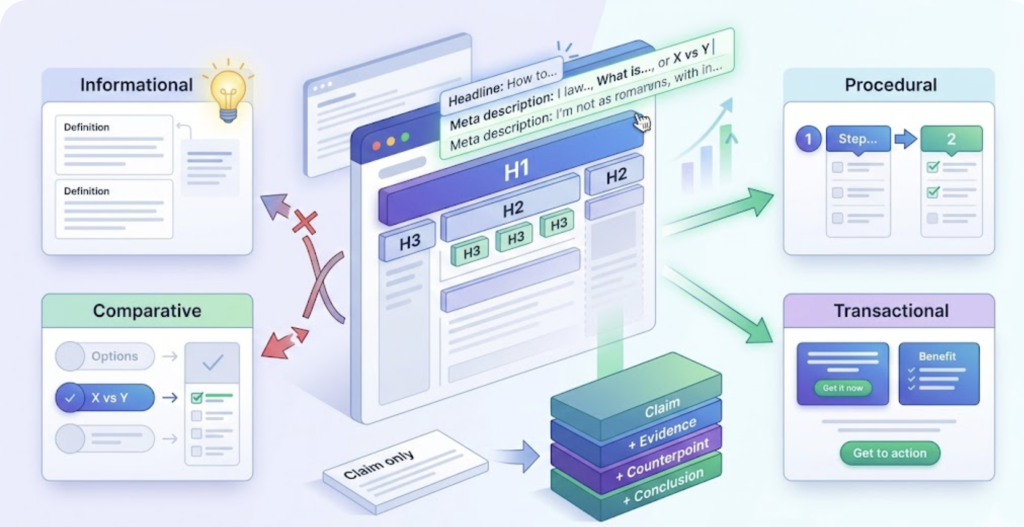
There are four kinds of searcher, and each one wants a different kind of page.
- Someone with an informational need wants to understand something. Those pages should open with a clear explanation and use descriptive subheadings that map the territory (“What a Content Brief Contains,” “Why Content Briefs Reduce Revisions”).
- Someone with a procedural need wants to do something. Those pages should open with the outcome (“By the end of this, you’ll have a finished content brief ready to send”) and use numbered, verb-first subheadings (“Step 1: Define the Target Query”).
- Someone with a comparative need wants to choose between options, so frame the decision up front and use parallel subheadings they can scan side by side.
- And someone with a transactional need wants to commit to something, so lead with the value and use subheadings that answer objections.
Figure out what your page currently sounds like, compare it to what your target searcher actually wants, and fix the subheadings before you touch a word of the body. The subheadings are the skeleton; the body is everything hanging off it. Reorganize the skeleton first, or you’ll end up rewriting body copy twice.
Then check for depth. Depth isn’t word count — it’s whether each section actually finishes its thought. A complete section makes a claim, backs it with a specific example, deals with the most likely objection, and lands a conclusion that moves the reader forward. Go section by section and ask: does this make a full point, or does it make a claim and stop? If it stops, add the missing piece. That’s not padding — padding adds words without adding an idea. This adds the idea, and the idea is what both readers and search engines are actually weighing.
Step 3: Build the Lead Magnet Layer
The restructured page now has the argument quality and intent alignment to rank. But ranking is not the end goal. The end goal is conversion — turning the reader’s attention into a relationship, a lead, a pipeline entry. This is also one of the most practical ways to make money online through content you’ve already created: by attaching the right offer to the right page, dormant posts become active revenue assets.
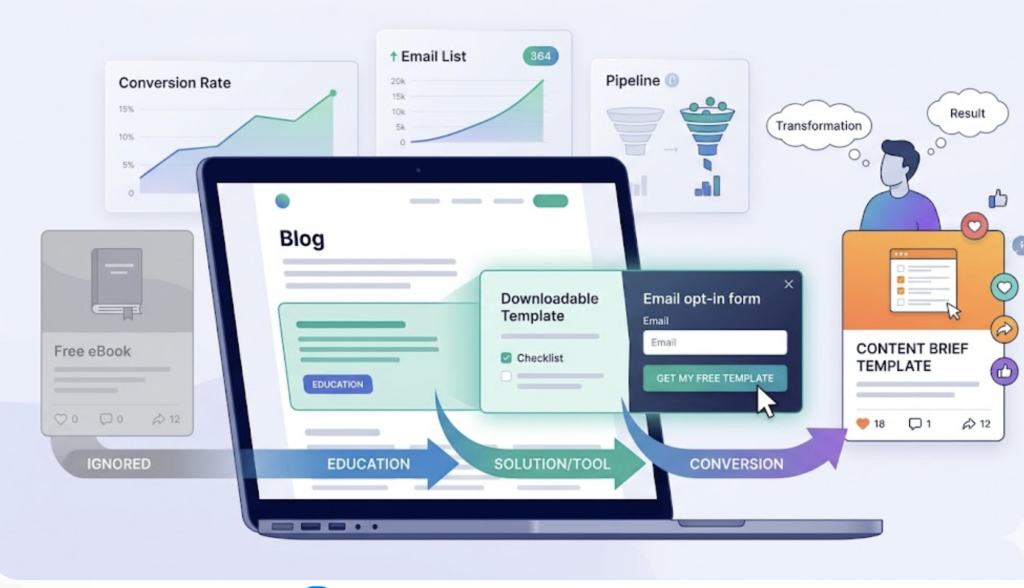
The move is to attach a content upgrade: a small, gated piece of bonus content that’s directly relevant to the exact page the reader is already on. The single rule that makes or breaks it is specificity. A generic “download our free ebook on content marketing” barely converts, because it isn’t connected to the specific problem the reader showed up with. Someone reading about content brief writing wants a content brief template – the logical next thing in their chain of thought – not a broad marketing guide.
So make the upgrade the obvious next object in the reader’s chain of thought. If the page teaches a concept, the upgrade hands over the tool. If the page gives a framework, the upgrade gives the worked example or if the page walks through a process, the upgrade gives the checklist or the calculator that makes that process one-click faster. The relationship should read as: “If you found this useful, here’s the thing that makes it immediately actionable.”
The offer copy matters as much as the offer itself. Name the specific outcome first, then the small action required — “Get the Content Brief Template that cuts revision cycles in half: fill in five fields, send to your writer” beats “Get our free template” every time, because it mirrors what the reader is already thinking.
Place the offer twice
once right after your strongest section — usually wherever the core framework lands — and again at the end. Put it only at the bottom and you lose everyone who didn’t finish. Put it only at the top and you lose everyone who wasn’t yet convinced the page was worth their inbox. Two placements catch both.
The Dormant Asset Principle: Why Zero-Volume Pages Are Your Highest-Leverage Content Investment?
Here’s the claim most content strategists won’t make out loud, because it cuts against the “always be publishing” narrative: refreshing an existing page is almost always a better investment than publishing a brand-new one.
The reason is sunk cost, and here it works in your favor. Every page you’ve already published has paid the expensive parts of the job: someone found and researched the topic, someone structured a coherent argument, someone edited the prose. A refresh recovers the return on all of that for a fraction of the original cost — it just fixes the mismatch, the thin spots, and the missing conversion layer that kept the page from earning its keep.
A new page pays every one of those costs again from scratch, and it starts cold: no accumulated authority, no historical engagement, no internal links pointing at it. A refreshed page keeps whatever standing it already has and benefits from every link already aimed its way.
This is also where the honest operational tension lives. In most teams, old-content work loses every planning meeting to shiny new production — refreshes get deprioritized because they feel less like progress. That instinct is backwards. For every new piece you’re about to commission, first check whether an existing zero-volume page already covers that ground. If one does, the refresh is almost always the higher-return play. The only real exception is a page that fails the salvage test — where the topic is genuinely dead or the writing is so far gone that a rewrite would cost more than starting over.
The highest-value page in your library isn’t the one you haven’t written yet. It’s the one already written well that nobody is reading. Find it, build around it, and let the work you already did finally pay off.
Building a Zero-Volume Prevention System
The Zero-Volume Refresh fixes what’s already broken. But the goal isn’t to run it forever against a growing backlog — it’s to stop new deadwood from piling up in the first place. Three habits will cut your zero-volume rate dramatically.
Validate intent before you commission. Before a piece goes to a writer, confirm what the target searcher actually wants and specify the shape the piece should take. It takes two minutes and kills the most common cause of zero-volume failure — a page written in the wrong mode for its query.
Specify depth in the brief. Every brief should set a minimum for each major section — not a word count, but a completeness requirement. “This section must make a claim, back it with one specific example, and answer the most likely objection” is far more useful than “make this 200–300 words.” Word count is a stand-in for depth; asking for depth directly gets you depth.
Build the conversion layer at publication. No page should go live without a way to capture the reader, even if it’s just an inline link to a related resource. A page with no conversion layer produces nothing measurable even when it ranks — and building that layer up front is far cheaper than retrofitting it during a future refresh.
Subscribe to WordPattern’s Weekly Syntax Tips for ongoing frameworks on content structure, sentence-level optimization, and lead-generation copy, sent straight to your editorial team.
Conclusion
The zero-volume pages in your library aren’t evidence of failure. They’re evidence of structural mismatch — and mismatch is fixable in a way that genuine topic irrelevance is not.
The three steps — audit for what’s worth saving, restructure the page to match what searchers actually want, and build the lead magnet layer — turn dormant content into productive content without paying the full price of new production. It recovers the research, the argument, and the prose you’ve already invested in, and it pulls leads out of an asset that was generating nothing.
Your graveyard isn’t a problem to manage. It’s inventory waiting to be switched on. Start with your three highest-potential deadwood pages: run the tests, restructure the argument, build the upgrade, and measure what changes. The work was always there. Now let it pay you back.
FAQs
It varies with the page’s existing authority and how competitive the target queries are, but a refreshed page usually moves faster than a brand-new one because it isn’t starting from zero — it keeps whatever crawl history, links, and engagement signals it already had. Expect early movement within a few weeks of re-indexing and a clearer read on results after a month or two. Refresh in batches and track the queue as a group rather than watching a single URL day to day.
Run the two salvage tests first. If the topic has any real search demand and the page could plausibly capture a lead, refresh it — that’s almost always the higher-return move. Delete-and-redirect only when the topic is genuinely dead or the writing is so far gone that a rewrite would cost more than starting fresh. “Zero impressions” alone is never enough reason to delete; it’s the end of the content decay curve, not proof the topic has no demand.
Yes, often better than on high-traffic ones. A page pulling 50 targeted visits a month from readers with a specific problem tends to convert harder than one pulling thousands of low-intent visits. What matters isn’t raw traffic — it’s how well the upgrade matches the exact problem the reader arrived with. Specificity beats volume.