
What Is Keyword Cannibalization? How to Find, Fix & Prevent It

Julian Vance Avatar
How to Spot (and Fix) Keyword Cannibalization in 3 Simple Steps

Let’s begin with the term itself, because it is doing more rhetorical work than most SEO writers give it credit for. Cannibalization. The word imports a vivid, visceral image into a domain that is usually populated by bland metaphors – traffic, funnels, pipelines. To cannibalize is to consume one’s own kind. And that is precisely what is happening when two pages on your website compete for the same keyword: your content library is feeding on itself, and the thing being consumed is your ranking potential. But here is the part of the story that most SEO guides skip over: keyword cannibalization is fundamentally a sentence structure problem before it is a strategy problem.

It emerges because writers reach for the same noun phrases, the same subject-verb constructions, and the same topical anchors when producing content in the same domain. The duplication begins at the level of the clause – in the headline, the meta description, the H2 subheading and propagates outward into the architecture of the entire site.

What Is Keyword Cannibalization in SEO?

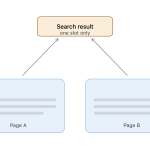
Keyword cannibalization happens when two or more pages on your site target the same keyword and satisfy the same search intent. Google can’t decide which URL to rank, so it often ranks neither well – splitting authority between them instead of stacking it on one strong page.

It’s different from simply using a keyword multiple times across your site. You can mention “content audit” on ten different pages without any issue. The problem starts when two pages are both trying to rank for “content audit” – same keyword, same intent, same audience. That’s when they start eating each other’s rankings.

The consequence is usually slow and invisible. One page inches up, the other drops, then they swap. Traffic for the keyword stays flat or drifts down. No single crash – just rankings that never quite stick.

Why Keyword Cannibalization Is a Linguistic Problem First?

Before the three-step framework, it is worth spending a moment on mechanism. Why does cannibalization happen in the first place?

The surface answer is strategic! Teams produce content without a centralized keyword map, and over time two writers independently target the same term. That is true, but it is incomplete. The deeper answer is linguistic! Writers working in the same topical domain naturally gravitate toward the same noun phrases and predicate constructions.

Consider a content team producing articles on email marketing. Writer A produces a piece titled “How to Write Email Subject Lines That Get Opened.” Writer B, six months later, produces “Email Subject Line Best Practices: A Complete Guide.” Both headlines share the same core noun phrase that is email subject lines! And both are implicitly targeting readers at the same stage of the research funnel. The syntactic surface is different; the semantic target is identical.

This is what linguists call lexical overlap — the phenomenon by which different surface forms converge on the same underlying meaning. In conversation, lexical overlap is a feature: it allows speakers to understand each other across varied phrasing. In SEO, it is a liability: search engines index meaning, not just strings, and two URLs competing for the same meaning split whatever authority either might have accumulated individually.

Step 1: How to Find Cannibalized Keywords

The first step is inventory.

You cannot fix what you have not mapped.

Begin by exporting every page title and meta description from your site into a single spreadsheet. If your CMS supports a bulk export, use it. If not, your XML sitemap will serve as a starting point, every URL paired with its title tag is the minimum viable dataset for a cannibalization audit.

With your inventory in hand, group pages by topical cluster. Atopical cluster is a set of pages that share a dominant noun phrase or keyword root. In a blog about content marketing, the clusters might be: keyword research, content audit, headline optimization, internal linking, and so on. Every page belongs to at least one cluster; pages that belong to more than one are your first cannibalization candidates.

Next, run each cluster through a keyword overlap check.

Google Search Console is the most direct tool for this: filter your Performance report by query, then check which URLs are appearing for the same search terms. If two or more URLs share a significant percentage of their top queries, you have confirmed cannibalization.

A more granular approach is to use a rank-tracking tool (Semrush, Ahrefs, or Moz) to pull keyword rankings by URL. Sort by keyword, then look for any keyword where two or more of your URLs appear in the top 20. Each instance is a cannibalization signal.

Cannibalization register

What you are building in this step is a cannibalization register – a structured record of every keyword, the URLs competing for it, and the relative ranking position of each. This register becomes the working document for Steps 2 and 3.

One linguistic note worth making here: pay close attention to headline noun phrases during this audit, not just tracked keywords. Cannibalization often precedes detection in your rank tracker – it begins as headline overlap (two pages with the same dominant noun phrase) before it manifests as ranking fluctuation. Catching the pattern at the headline level gives you earlier warning and more intervention options.

The fastest tool-by-tool method

Google Search Console (free): Go to Performance → Pages. Click on your target URL, then switch the tab to “Queries.” You’ll see every keyword that URL is appearing for. Now go back and click a second URL on the same topic and check its query list. If the same keywords appear in both lists – you have confirmed cannibalization.

Ahrefs: Pull up Site Explorer → enter your domain → go to Organic Keywords. Filter by keyword, then look for any keyword where two or more of your URLs appear in the top 20 positions. Ahrefs also has a dedicated Cannibalization report under Site Audit — run it if you’re on a paid plan. It surfaces overlapping URLs automatically.

Semrush: Open Position Tracking → Cannibalization Report. It flags every keyword where multiple pages from your domain are competing. You can see both URLs, their positions, and which one is “winning” — useful for deciding which to consolidate around.

The quick manual check: Type site:yourdomain.com "target keyword" into Google. If more than one of your URLs appears in the results, you have a cannibalization candidate worth investigating.

What the Numbers Actually Tell You

Here’s where most audits stop too early. Finding the overlap is step one – but the data tells you more than just that cannibalization exists. It tells you how bad it is and which URL is worth saving.

In GSC, look at three metrics side by side for both competing URLs:

  • Impressions — if both pages are pulling impressions for the same query, Google is actively indexing them as competitors. High impressions on both = active cannibalization.
  • Average position — if the positions for the same keyword fluctuate between two URLs week over week (one week URL A is at position 6, next week URL B is at position 8), that’s Google unable to decide. Classic cannibalization signal.
  • CTR vs. position ratio — a page sitting at position 4 with a 1.2% CTR is being outcompeted on the SERP by something above it. If that something is your own page, you’re leaving clicks on the table twice over.

Set a concrete threshold before you start: any keyword where two URLs share more than 30% of the same top-10 queries is a confirmed cannibalization pair worth actioning. Below that, monitor but don’t intervene yet.

Step 2: Diagnose the Intent Conflict

Not all keyword overlap is created equal. Once you have your cannibalization register, your next task is to determine what kind of conflict is driving each instance. There are three distinct types, and each requires a different resolution strategy.

Type 1: True Duplication

True duplication occurs when two pages cover the same topic at the same depth for the same audience. The content is substantively redundant — one page is essentially a restatement of the other. This is the most straightforward case to diagnose: read the two pages side by side, and if you could merge them without losing meaningful information, they are truly duplicated.

Linguistic signature: both pages share not just the same keyword cluster but the same argument structure — the same sequence of claims, the same supporting examples, and similar concluding assertions.

Type 2: Search Intent Mismatch

Search intent mismatch occurs when two pages target the same keyword but serve different user intents — and neither is correctly matched to the query. For example, one page might be an informational guide (“What is keyword cannibalization?”) and another a commercial comparison (“Best tools for detecting keyword cannibalization”) — yet both are optimized for the query keyword cannibalization fix, which has a strong procedural intent. Neither page fully satisfies the query, so neither ranks consistently.

Linguistic signature: the two competing pages have different dominant verb forms in their headlines and subheadings. One uses declarative constructions (“Keyword cannibalization is…”); the other uses imperative or procedural constructions (“Find keyword cannibalization by…”). The mismatch in verb mode reflects a mismatch in intent.

Type 3: Topical Fragmentation

Topical fragmentation occurs when a single topic has been split across too many pages — each covering a narrow slice — rather than consolidated into one authoritative treatment. This is common in content libraries that were built incrementally, where each new piece added a small extension of an existing topic rather than deepening an existing page.

Linguistic signature: the competing pages all contain the same core noun phrase in their headlines but differ only in their modifying elements. “Keyword Cannibalization Definition,” “Keyword Cannibalization Examples,” “Keyword Cannibalization Checklist,” and “Keyword Cannibalization Tools” are four headlines built on the same noun phrase root. Each page is thin; together they fragment the topical authority that a single comprehensive page would consolidate.

Correctly diagnosing the type of conflict in each cannibalization pair is not a bureaucratic step — it is the decision that determines which resolution you apply in Step 3. Applying the wrong resolution to the wrong conflict type is a common reason cannibalization fixes fail to produce ranking improvement.

Step 3: Apply the Correct Resolution

With your cannibalization register built and each conflict type diagnosed, you are ready to intervene. There are three resolution strategies, mapped to the three conflict types.

Resolution 1: Consolidate (for True Duplication)

Merge the two competing pages into a single, authoritative resource. Redirect the lower-performing URL to the stronger one using a 301 redirect. Before redirecting, migrate any unique content, backlinks, or internal links from the retiring page to the surviving one.

The surviving page’s headline should be rewritten to serve as the definitive treatment of the topic — broader in scope than either original but more authoritative in depth. This is where sentence-pattern precision matters: the consolidated headline should use a noun phrase construction that encompasses the full scope of the merged content, not just one of the original angles.

For example: if “Email Subject Line Tips” and “How to Write Email Subject Lines” are being merged, the surviving headline might become “Email Subject Lines: The Complete Guide to Writing, Testing, and Optimizing.” The appositive construction (“The Complete Guide to…”) signals exhaustive coverage and suppresses future fragmentation by establishing a clear topical boundary.

Resolution 2: Differentiate (for Search Intent Mismatch)

When two pages target the same keyword but serve different intents, the solution is not to merge them but to clarify each page’s intent signal so that search engines can correctly assign each URL to the right query variant.

This means rewriting each page’s title, meta description, and opening paragraph to make its intent explicit at the sentence level. The informational page should lead with definitional constructions (“Keyword cannibalization occurs when…”). The procedural page should lead with imperative or conditional constructions (“If two of your pages are competing for the same query, here is how to resolve it…”). The commercial page should foreground comparative or evaluative language (“The most effective tools for detecting cannibalization share three features…”).

Each page’s internal link anchor text should also be audited. Anchor text is a strong intent signal to search engines: if your informational page is internally linked with the anchor text “fix keyword cannibalization,” you are sending a mixed intent signal. Align anchor text to the intent of the destination page, not the topic in general.

Resolution 3: Consolidate with Canonical Signaling (for Topical Fragmentation)

Topical fragmentation is the most labor-intensive conflict to resolve because it typically involves more than two pages. The recommended approach is a hub-and-spoke consolidation: identify or create one comprehensive pillar page that covers the full topic, then either merge the fragment pages into it or use canonical tags to signal the pillar as the authoritative version.

Implementing canonical tags correctly:

A canonical tag goes in the <head> of the page you want to suppress. It looks like this:

html

<link rel="canonical" href="https://yourdomain.com/primary-page-slug" />

The URL in the href should be the pillar page — the one you want Google to rank. Every fragment page that’s staying live (rather than being redirected) gets this tag pointing to the pillar. WordPress users can set this in Yoast SEO under “Advanced” → “Canonical URL” without touching the theme.

Two things to check after implementation: first, confirm the canonical is rendering in the page source (right-click → View Page Source → search for “canonical”). Second, verify it in GSC under Coverage – canonicalized pages should shift to “Duplicate, Google chose different canonical than user” status within a few weeks.

The pillar page’s architecture should be governed by a clear sentence-pattern hierarchy. The H1 headline establishes the primary noun phrase (Keyword Cannibalization). The H2 subheadings subdivide it by aspect (What It Is, How to Detect It, How to Fix It, Tools That Help). The H3 subheadings within each section provide the granular treatments that the fragment pages previously attempted to cover independently.

This hierarchy is not merely organizational — it is a semantic map that search engines use to evaluate topical authority. A page whose heading structure reflects a coherent, complete treatment of a topic will consistently outperform a collection of fragment pages covering the same ground in isolation.

How Headline Grammar Predicts Overlap Before Your Rank Tracker Does?

The most sophisticated teams do not wait for their rank tracker to flag cannibalization. They read for it in their own headlines before a second page is ever published.

When two headlines share a dominant noun phrase, they are claiming the same territory. Whether or not the angles are different is secondary to the territorial claim. Search engines, trained on hundreds of billions of documents, have learned to identify topical territory at this noun-phrase level with remarkable precision.

This means you can audit for future cannibalization risk simply by reading your existing headlines as noun-phrase inventories. Extract the head noun and its closest modifiers from every headline in your library. Group the results. Any group containing more than one entry is a cannibalization risk zone.

Building a Cannibalization-Resistant Content System

Fixing existing cannibalization is necessary. Preventing its recurrence is the work that compounds. Three practices, integrated into your editorial workflow, will keep your content library architecturally sound going forward.

Maintain a living keyword sovereignty document:

This is a shared spreadsheet or wiki page that lists every primary keyword your site owns, the single URL assigned to own it, and the date of last review. Every new content brief must reference this document before a headline is approved. If the proposed primary keyword already has an assigned owner, the brief must be revised.

Enforce headline noun-phrase review at the commissioning stage:

Before any piece of content is assigned to a writer, the commissioning editor should extract the dominant noun phrase from the proposed headline and check it against the sovereignty document. This takes thirty seconds and eliminates the most common source of cannibalization: independent writers independently reaching for the same topical territory.

Schedule a quarterly cannibalization pulse check

Once per quarter, pull your top 50 queries from Google Search Console and check for any queries where two or more URLs appear. A quarterly cadence catches drift before it becomes entrenched — new pages will inevitably push boundaries, and early detection means simpler remediation.

Search intent

Keyword Cannibalization in Location Pages

Location pages are one of the most common places cannibalization goes undetected. If you run a service business with multiple city pages — “SEO agency London,” “SEO agency Manchester,” “SEO agency Birmingham” — and those pages share the same copy with just the city name swapped, you’re not creating unique pages. You’re creating competitors.

Google sees identical page structure, identical service descriptions, identical headings. It doesn’t know which city page to rank for a given local query, so it dilutes authority across all of them. None rank well. You’re essentially cannibalizing your own local presence.

What causes it?

The usual culprit is a template approach: one master page cloned across locations with city names replaced. It feels efficient. And it does produce indexable URLs. But from Google’s perspective, thin location pages that differ only by a proper noun aren’t satisfying distinct search intents — they’re duplicates with place names.

Internal linking makes it worse. If your main services page links to all city pages with the same anchor text, Google gets no signal about which location matters most.

How to fix location page cannibalization?

First, audit using GSC. Filter your Performance report by city-related queries (“SEO agency [city]”) and check how many of your location pages are competing for the same terms, then cross-check impressions, clicks, and CTR for each page in GA4 to confirm whether the overlap is actually splitting traffic or just splitting visibility. Any keyword where two or more location pages appear is a cannibalization signal.

The fix depends on severity:

  • If pages are thin and nearly identical: consolidate. Pick your highest-traffic city as the primary page. Redirect others to it, or rewrite them with genuinely unique content – local case studies, city-specific pricing context, local client names where possible.
  • If pages have real unique content but still cannibalize: differentiate the intent signal. Each city page’s H1, meta title, and opening paragraph should lead with something specific to that location, not just a city name replacement.
  • Canonical approach: if you must keep all pages live for UX or business reasons, set canonical tags from weaker city pages pointing to your strongest one. This consolidates ranking signals without deleting URLs. Not ideal long-term — but it stops the bleeding.

One rule that prevents it from the start: never clone a page and change only the location name. Write each city page as if it’s the only one. If you can’t do that, question whether you need that city page at all.

Common Misconceptions About Keyword Cannibalization

Misconception 1: “Having more pages targeting a keyword means more chances to rank.”

This is the intuition that produces cannibalization in the first place, and it inverts the actual mechanics. Search engines do not reward volume of coverage; they reward authority of coverage. Ten thin pages targeting the same keyword divide whatever authority each might have accumulated. One authoritative page targeting the same keyword accumulates it.

Misconception 2: “Cannibalization only affects pages with identical content.”

Identical content is the most obvious form of overlap, but it is not the most common. The more frequent pattern is semantic overlap — pages that cover different angles of the same noun-phrase territory. Two pages with completely different body copy can still cannibalize each other if their headlines, meta descriptions, and H2 structures are targeting the same underlying query intent.

Misconception 3: “A canonical tag will fix cannibalization.”

A canonical tag signals your preferred URL to search engines, but it does not resolve the underlying content architecture problem. If two pages are genuinely competing for the same query, a canonical tag on the weaker page suppresses it without strengthening the preferred one. Consolidation – merging content, redirecting URLs, and building a more authoritative single resource – produces durable improvement. Canonical tagging is a tool within a consolidation strategy, not a substitute for one.

Landing Page Cannibalization: When Your Blog Competes With Your Product Page?

Here’s a scenario that catches a lot of teams off guard. You write a blog post: “Best CRM software for small businesses.” It ranks. A year later, you build a proper product comparison landing page targeting the same keyword. Now you have two pages — a blog post and a commercial landing page — both chasing the same query.

Google has to pick one. It might rank your blog (informational intent) when searchers actually want a comparison page (commercial intent). Or it rotates between the two, so neither ever builds stable authority. Either way, you lose.

This is landing page cannibalization: your content marketing and your conversion architecture competing against each other.

How to spot it?

In GSC, look for commercial keywords (containing “best,” “top,” “vs,” “pricing,” “tool for”) where one of your blog posts and one of your landing pages both appear in the query report. Cross-reference impressions and average position for both URLs side by side; if the same keyword is driving clicks and impressions to both, with positions trading places week over week, that’s the problem.

You can also check directly in Ahrefs or Semrush: pull your landing page URL, look at its top organic keywords, then search those same keywords for your domain. If a blog post shows up in the same results – they’re cannibalizing.

How to fix it?

The cleanest fix is to decide: which page should own this keyword based on intent?

For queries where users are ready to evaluate or buy (“best project management software”), your landing page should win. Block the blog post from competing by updating its target keyword to something earlier in the funnel (“what is project management software”) and adjusting its title, meta description, and H1 accordingly.

For informational queries (“how to choose CRM software”), your blog post should win. Don’t send your landing page after that keyword — build a separate, intent-matched landing page for commercial queries, or consolidate into the blog post with a strong CTA.

Internal linking also matters here. If your blog post about “best CRM software” is internally linked with the anchor text “best CRM software” — same anchor as your landing page — you’re sending Google a mixed signal. Give the blog post a different, longer anchor text (“how to choose the right CRM for your team size”) and reserve the commercial anchor for your landing page.

The goal: every keyword in your site has one assigned owner. Blog or landing page — never both.

Conclusion: Three Steps, One Governing Principle

The three steps in this playbook – audit for overlapping clusters, diagnose the intent conflict, apply the correct resolution are tactically distinct but governed by a single principle: one keyword, one URL, one authoritative treatment.

That principle is easy to state and surprisingly hard to maintain across a content library that grows incrementally, with multiple contributors, over months and years. The linguistic gravity that pulls writers toward the same noun phrases is constant. Without a system to counteract it – a sovereignty document, a noun-phrase review, a quarterly pulse check cannibalization will re-emerge.

The sentence is where content strategy begins. The noun phrase is where topical authority is claimed or conceded. Audit at that level, and your rankings will reflect the architecture you have actually built.

Your content library is a sentence structure. Make sure it is not eating itself.

FAQs

1. What is the difference between keyword cannibalization and duplicate content?

Duplicate content means two pages share the same or near-identical text. Keyword cannibalization means two pages compete for the same search query – even if the text is completely different. You can have cannibalization without duplicate content (two unique articles targeting the same intent) and duplicate content without cannibalization (a page accessible via two URLs targeting different keywords). They’re related problems but require different fixes.

2. How long does it take to see ranking improvement after fixing cannibalization?

Usually 4–8 weeks after Google recrawls the affected pages. If you submitted the consolidated URL for re-indexing in GSC immediately after the fix, you’re looking at the shorter end of that range. Pages with strong backlinks tend to recover faster. If you don’t see movement after 10 weeks, check whether the redirect is implemented correctly and whether the consolidated page is actually stronger than either original was individually.

3. Does keyword cannibalization affect paid search as well?

Yes — running ads for a keyword while organically ranking the same keyword with two separate pages creates a quality score problem and drives up your own CPC. Google’s auction system treats your organic and paid results as competing signals, and advertisers managing both SEO and PPC campaigns on the same domain often see their cost-per-click creep upward without realizing the organic side is the cause. Fix the organic cannibalization first; your ad quality scores often improve and your paid acquisition costs typically drop as a side effect.

4. Can internal links cause keyword cannibalization?

Not directly — internal links don’t create new pages competing for a keyword. But inconsistent anchor text across your internal links sends mixed intent signals to Google, which can make an existing cannibalization problem harder to resolve. If you’re trying to consolidate two competing pages, auditing and aligning your internal link anchor text is part of the fix, not an optional extra.


Julian Vance Avatar