

Large digital platforms process thousands, sometimes millions, of user interactions every day. Traffic looks healthy, campaigns perform, dashboards show steady growth. Yet the money that should follow all that activity often doesn’t fully arrive. That gap is revenue leakage: the slow, quiet loss of income that a site has already earned the right to collect but never actually captures.
It rarely shows up as one dramatic failure. Instead, it hides across dozens of small friction points, a checkout that times out, a discount that fires when it shouldn’t, an invoice that never goes out, and each one shaves a little off the top. On a small site those losses are rounding errors. On a large one, they compound into real money.
The damage runs deeper than the missed sale, too. Every failed transaction is marketing spend that didn’t convert, so your return on ad investment quietly erodes. And every user who hits a broken flow walks away with a worse impression of your brand, which costs you the next purchase as well as this one. Because these losses stay hidden inside complex systems, the first job is simply learning to see them.
What Is Revenue Leakage in Large Websites?
Revenue leakage is the loss of income you were already positioned to collect, drained away by technical errors, clumsy user journeys, pricing mistakes, or billing gaps inside a digital platform.
In plain terms: someone arrives ready to act, they want to buy the product, start the subscription, complete the form, and something between “yes” and “paid” gets in the way.
Common sources include:
- Broken checkout flows
- Slow page loads
- Payment gateway failures
- Pricing or billing errors
- Confusing navigation
- Systems that don’t talk to each other cleanly
Large sites lean on a stack of tools, analytics, payment systems, CRMs, subscription platforms, and when those handoffs slip, revenue leaks through the seams. Some of that is a UX problem. A surprising amount of it, though, is a money problem: charges that never fire, revenue that gets recognized late, contracts that quietly under-bill. Those two halves, the experience side and the billing side, are what the rest of this guide walks through. A professional web development company can audit these areas and identify technical or UX gaps that silently reduce conversions.

Why Revenue Leakage Is Hard to Detect
Unlike a full outage, leakage happens quietly. You might see conversion dip a point or two, but the cause stays buried in the data.
Complex Technology Infrastructure
Large sites depend on many connected systems, payment gateways, inventory, content management, third-party services. When one piece fails, it often fails silently: no alarm, no error page, just a user who couldn’t finish and a sale that never posted.
High Traffic Volume
At scale, small breaks multiply. A checkout bug that only touches a sliver of visitors still adds up to serious losses across a day’s worth of traffic.
Multiple User Journeys
Customers arrive through organic search, paid ads, social, and email, and each path runs slightly differently. Tracking every route is hard, which is exactly why leaks stay hidden.
8 Signs Your Site Is Experiencing Revenue Leakage
Recognizing these warning signals can help businesses identify hidden revenue losses early.
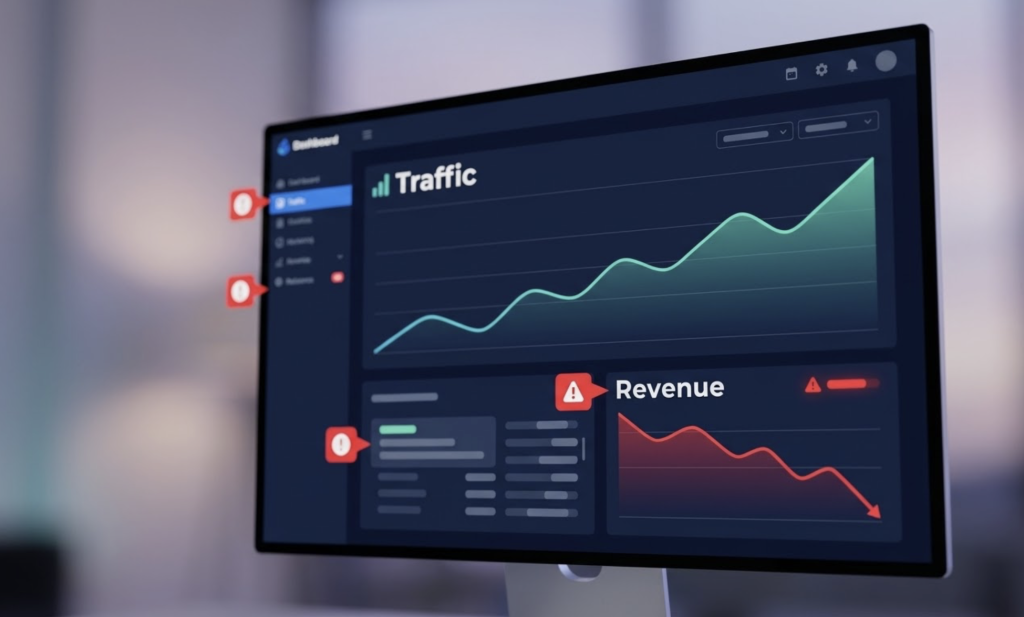
1. Conversion Rates Are Declining Without Traffic Loss
The clearest tell is conversions falling while traffic holds steady. If the same number of people show up but fewer buy, the problem lives inside the funnel, not at the top of it. Possible causes – often identified during deep audits by specialists like cyberlad—include:
- Checkout bugs
- Poor mobile experience
- Slow pages
- Broken calls-to-action
Watch traffic and conversion side by side; the divergence is the signal.
2. High Cart or Funnel Abandonment Rates
Some abandonment is normal. A sudden spike usually isn’t. Users bail when they hit:
- A complicated checkout
- Surprise fees or taxes at the last step
- Forced account creation
- Payment failures
Funnel analytics will show you the exact step where people give up.
3. Slow Page Load Times
Website speed plays a critical role in conversion rates. Speed and sales move together. Even a small delay drags engagement down, and large platforms are prone to it thanks to big catalogs, heavy media, and layered scripts. Slow pages push people to faster competitors, and that loss accumulates. Image compression, caching, and better hosting recover a lot of it.
4. Broken User Journeys
People expect to move smoothly from discovery to purchase. Dead links, bad redirects, missing pages, and navigation errors interrupt that path and send them away. Regular audits catch these before they hit large groups of users.
5. Payment Failures or Checkout Errors
Payment problems are among the costliest leaks because they stop the transaction at the finish line. Gateway errors, form validation bugs, expired sessions, device incompatibilities, any of them can end a sale. Most users won’t retry; they just leave. Monitoring failed transactions is how you find these fast.
6. Pricing or Billing Inconsistencies
Misconfigured pricing quietly bleeds money. It shows up most in sites running dynamic pricing, discount campaigns, subscriptions, or regional rates, where a single bad rule can cause undercharging, wrong discounts, or failed charges. Routine billing checks and automated monitoring keep these in view.
7. Declining Profit Margins Despite Strong Sales
When sales look fine but margins slip, suspect a leak. Discounts applying too broadly, rising refunds, creeping operational costs, and payment-processing errors all eat margin without denting the top-line numbers. Read revenue against cost to find the drain.
8. Increasing Customer Complaints About Technical Issues
Customers usually notice breakage before internal teams do. Complaints about checkout failures, broken search, vanishing cart items, or pages that won’t load each represent someone who probably didn’t buy. Treat that feedback as an early-warning system.
Revenue Assurance Strategies
Finding leaks one at a time is useful. Building a habit that catches them continuously is better. Revenue assurance is simply the practice of checking, on a schedule, that every sale you should have collected actually landed, and that the numbers on your dashboard match the money in the bank.
In practice it means a few concrete things. You reconcile transactions against fulfilled orders so you can see the ones that fell through. You watch for uncollected revenue, purchases that were initiated, and approved, but never fully charged because a session dropped or a charge silently failed. And you keep an eye on timing, because revenue that arrives late still counts as a leak while it’s missing.
The teams that do this well don’t treat it as a quarterly cleanup. They make it routine: a standing check that turns “we think we’re collecting everything” into “we know we are.”
Intelligent Billing
Most billing problems on large sites aren’t dramatic. They’re small rules quietly doing the wrong thing at scale. Intelligent billing is the shift from manual, rule-by-rule invoicing to a setup that watches its own behavior, catches the charge that didn’t fire, the proration that came out wrong, the renewal that skipped, and flags it before it reaches the customer.
The everyday win here is billing automation: the routine work of generating invoices, applying the right price to the right account, retrying a failed payment, and updating a subscription happens without someone keying it in by hand. For ecommerce businesses, a shopify development agency can help integrate these automated billing workflows with the broader storefront and payment infrastructure, reducing manual errors and slow follow-up. That removes the two most common sources of billing leakage, human error and slow follow-up. A failed charge that a person might notice next week gets retried the same afternoon.
Done well, it makes billing quiet in the good way. Charges land when they should, in the amount they should, and the exceptions, the handful that genuinely need a human, are the only ones that reach one.
Contract & Compliance Leakage
For businesses that sell on contracts rather than one-off carts, some of the largest leaks hide in the agreements themselves. A negotiated rate that never made it into the billing setup. An annual increase that was written into the contract but never applied. A usage tier the customer passed months ago while still paying for the smaller one. Each is money owed under terms both sides agreed to, simply never collected.
Closely tied to this is delayed revenue recognition, revenue that’s been earned but recorded later than it should be, or spread incorrectly across a period. On its own it’s an accounting timing issue, but at scale it distorts the picture you’re steering by: forecasts drift, and real leaks are harder to spot against numbers that are already off. Keeping contract terms and the systems that bill against them in sync is what closes this gap.
Enterprise Monetization
At enterprise scale, the goal isn’t just plugging leaks, it’s making sure the whole way you turn product into revenue holds together. Monetization covers the full path from what you charge, to how you package it, to how reliably you collect it, and a weakness anywhere on that path shows up as leakage somewhere downstream.
Two questions do most of the work. First, are we capturing everything we’ve already earned, every completed purchase, every contracted charge, every renewal? Second, is our pricing actually reaching the account it’s meant for, consistently, across regions, tiers, and campaigns? When the answer to either is “mostly,” that “mostly” is the leak. Tightening it is how large businesses protect the revenue they’ve already worked to win.
How to Identify Revenue Leakage
Detection has to be deliberate, not accidental.
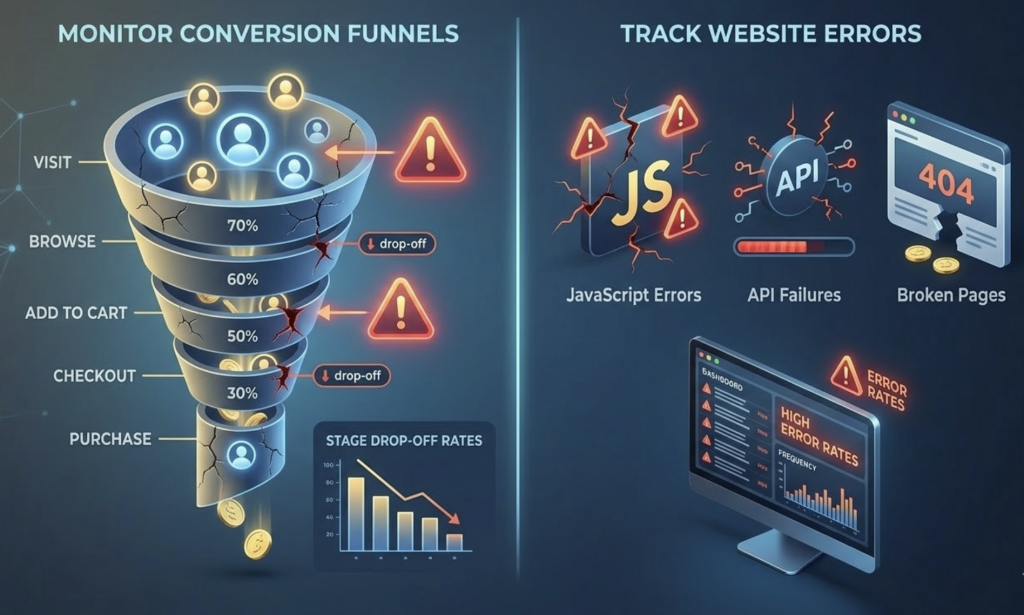
Monitor Conversion Funnels
Funnel analysis shows where people drop off on the way to purchase. Analytics and behavior-tracking tools turn that drop-off into something you can act on.
Track Website Errors
Error monitoring surfaces the JavaScript failures, service errors, and broken pages that quietly cost conversions. These are frequent, fixable sources of leakage.
Conduct Regular Technical Audits
Routine audits confirm that systems, integrations, and pages actually work end to end, and they’re where hidden leaks usually turn up.
How to Fix Revenue Leakage
Once you know the source, the fixes are concrete.
Simplify the Checkout Process
Cut steps that don’t earn their place. Offer guest checkout, trim form fields, and support multiple payment options so more people finish.
Implement Real-Time Monitoring
Automated monitoring catches errors the moment they happen instead of at the end of a reporting cycle. Pair it with follow-up that re-engages users who dropped off, so a lost session becomes a recovered sale. Teams can also use an AI chatbot for customer recovery to re-engage users who drop off, answer purchase-related questions, and reduce lost conversions in real time.
Optimize User Experience
Clear navigation, intuitive design, and fast pages remove friction across the journey. When those work together, fewer people leave before they buy. Strong web design ensures that all these elements work together seamlessly, reducing frustration and preventing revenue leakage across your website.
Final Thoughts
Revenue loss doesn’t always come from falling traffic or weak marketing. Often the problem sits inside the site itself, in checkout friction, broken journeys, a charge that never fired, a contract quietly under-billed.
Because these leaks stay hidden, they demand active attention: monitoring, routine audits, and billing you can actually trust. Catch the early signs, keep the systems honest, and you recover income you’d otherwise never have known you lost.
In the end, protecting revenue isn’t only about fixing what’s broken. It’s about making sure every person who was ready to pay you actually can, and that every dollar you earned actually arrives.
FAQs
Most organizations lose somewhere in the low single-digit percentages of annual revenue to leaks they can’t easily see. On a small site that’s negligible; at enterprise scale, a few percent of top-line revenue is a meaningful number, which is why the losses are worth actively hunting rather than writing off as noise.
A conversion problem happens before the sale, someone leaves because checkout was slow, confusing, or broken, so no charge is ever attempted. A billing leak happens after the customer has agreed to pay: the charge fails silently, an invoice never goes out, a contracted rate isn’t applied, or usage above a tier never gets billed. Both drain revenue, but you find them in different places, funnel analytics for the first, billing reconciliation and contract checks for the second.
Usually, yes. Most leaks come from gaps between systems and manual steps rather than the systems themselves. Reconciling transactions against fulfilled orders, automating routine invoicing and payment retries, and keeping contract terms in sync with what you actually bill will close the majority of leaks without a full rebuild. A replacement is worth considering only when the current setup genuinely can’t support that kind of monitoring.