
When you think about building a brand identity, your mind probably goes straight to the visuals: your logo, colors, fonts, or imagery.
All of those things do matter. But if your business primarily lives online, there is another factor worth considering: How easy is your brand to find?
A beautiful brand identity will not help much if customers cannot remember your business name, find the correct website, or recognize that your Instagram account and Google search result belong to the same company.
This is where branding and search engine optimization (SEO) start to overlap.
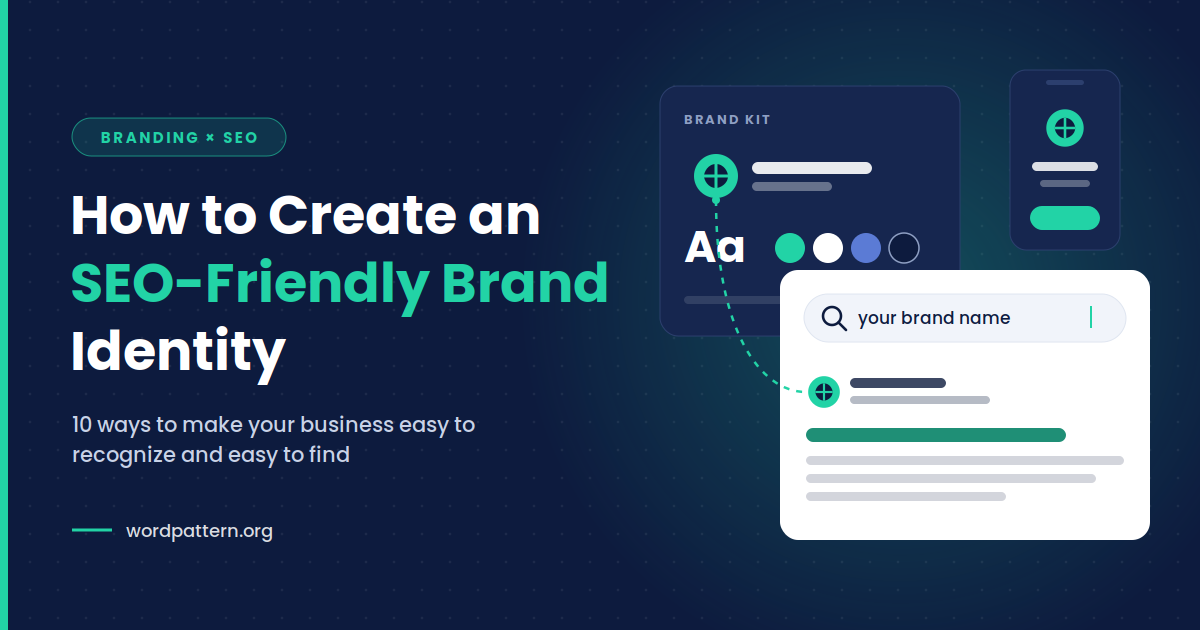
Creating an SEO-friendly brand identity does not mean designing your entire brand around keywords or Google. Instead, it means making choices that help people recognize and find your business while also making your website easier for search engines to understand.
Here are 10 ways to do it.
1. Choose a Business Name People Can Actually Search
Your business name is one of the first branding decisions that can affect how easily people find you online.
Extremely generic names can make this difficult. A company called “Clothing Store,” for example, may describe exactly what it does, but it could easily disappear among thousands of similar search results.
That doesn’t mean making your name longer either. Something like “Best Affordable Women’s Clothing Store Online” might describe your business and get those keywords in, but it is hardly memorable branding.
Instead, aim for a name that is:
● Easy to spell and pronounce
● Distinct from major competitors
● Memorable enough to search later
● Relevant to your business where appropriate
● Flexible enough to accommodate future growth
Your goal isn’t necessarily to find a completely unique word. It’s to choose a name that customers can hear once, remember later, and find easily without issue.
2. Match Your Domain and Social Handles to Your Brand
Once you have a business name, try to keep your domain and social media usernames as close to it as possible.
Let’s say your bakery is called Butter & Bloom. But the website is bestbakeryonline.com. Your Instagram is @butterbakes23. Your Facebook page says “Butter Bakery.”
Individually, none of those choices is disastrous. But if used all together, your customer will just get confused if you are the same brand.
Now compare that with:
● Business: Butter & Bloom
● Website: butterandbloom.com
● Instagram: @butterandbloom
That’s much easier.
It’s also fine if you don’t get the exact domain or username you want. That’s not always possible after all. You can just add small variations like underscore or dot or add words like “the”. The important thing is that your naming remains recognizable across the places where customers are likely to find you.
This also helps in searches. If someone remembers your company from TikTok and searches its name on Google a week later, a matching website name makes the correct result much easier to recognize.
3. Design a Logo That Works Everywhere
Your logo appears not only on your website, but also on Google Business Profile, social media pages, product images, emails, and even search results.
So don’t design it for only one setting. A highly detailed horizontal logo might look fantastic across a desktop website but become unreadable when squeezed into a small Instagram profile image or favicon.
Make sure your logo remains recognizable at different sizes by creating a few variations, such as:
● Your full primary logo
● A simplified logo mark
● A horizontal stacked and vertical stacked logo
● A full color version
● A monochrome version or reversed color version
● A favicon or small icon
This ensures that your logo will look clear and legible no matter where or what size you place your logo.
You also don’t necessarily need to hire a designer to get all these done. A logo maker can help you create multiple variations easily with their templates, while an AI logo generator can be useful for generating designs that an average template might not have.
4. Optimize Your Logo and Other Brand Images for Search
A great design isn’t just what’s important with a logo. Image optimization matters as well.
Instead of leaving your logo with a filename such as: final-logo-v8.png, it’s better to rename it to something descriptive: butter-and-bloom-bakery-logo.png
Google recommends short, descriptive filenames because filenames can provide clues about the subject of an image, thus boosting relevance and visibility.
The same applies to product photography and other important website visuals. IMG_4492.jpg tells you very little, while pink-floral-wedding-cake.jpg provides useful context.
You should also add appropriate alt text. This not only makes your site accessible to visitors using screen readers, but also helps search engines understand the image and its relationship to the page.
Keep it natural. You do not need to force keywords into every image description. The important thing is to use alt-text to make images easier to understand, not just a keyword stuffing opportunity.
For example, instead of: “Best bakery wedding cake bakery London cakes wedding cake shop”
you should write: “Three-tier floral wedding cake with pink roses.”
5. Make Sure Your Branding Works on Mobile
Your branding might look perfect on a large desktop monitor. But what happens when someone opens your website on a six-inch phone?
Your logo still needs to be readable. Your typography needs to be easy for the eyes to scan. Buttons need to be tappable, images need to resize properly, and menus need to remain usable.
This is important for customers, but it matters for SEO too. Google after all uses the mobile version of a website for indexing and ranking.
A few areas worth checking include:
● Logo size and readability
● Font sizes
● Navigation
● Buttons and forms
● Image sizing
● Page speed
● Spacing between elements
And don’t be afraid to simplify. Your desktop header might use the complete logo while your mobile version uses only the brand mark. That’s not inconsistent branding. It’s branding designed for the space it’s actually appearing in.
6. Use Your Blog to Reinforce What Your Brand Is About
Content also plays a direct role in building a brand online. In Content Marketing Institute’s 2025 research, 87% of B2B marketers said content marketing had helped create brand awareness during the previous 12 months.
This means your blog should not become a collection of unrelated topics simply because those keywords happen to receive traffic.
It also means that the subjects you cover should reinforce what you want your company to be known for.
A sustainable skincare company, for example, might write about skincare routines, ingredients, different skin types, sustainable packaging, and how particular products should be used. And that’s because those subjects make sense for its customers and its brand.
This is a useful way to approach SEO content planning. Instead of only asking: “Which keywords could bring us traffic?” ask: “What does our audience search for that our brand can genuinely help with?”
That distinction can keep your blog focused while still giving you plenty of opportunities to target relevant searches.
It also means that someone can find relevant content on your site and stay longer there and get more engagement, which is always good for SEO.
Don’t forget the content you’ve already published either. A regular content audit can show you which still fit your brand identity and which can be refreshed to fit your site’s direction.
7. Make Sure Your Content Still Sounds Like Your Brand
What you write about matters, but so does how you write it.
Develop a distinct brand voice and use it consistently across your blog posts, product descriptions, landing pages, and other website copy. Whether your voice is playful, friendly, authoritative, or straightforward, it gives your content more personality and makes your brand easier to recognize.
Just don’t let SEO get in the way of good writing. Use relevant keywords naturally rather than stuffing them into every heading or paragraph, and focus on giving readers useful, clear answers.
At the same time, keep up with how search is changing. People are now finding information through AI Overviews, AI Mode, and LLMs alongside traditional search results. You don’t need to write completely different content for these platforms, but clear explanations, original insights, useful examples, and well-structured information can make your content more valuable wherever people search.
Brand identity now extends to video too. A short launch video is. often the first place people meet a new product, and studios like Flowjam build those for AI startups.
8. Keep Your Brand Consistent Everywhere
Imagine finding a business through Google and seeing a minimalist black-and-white website.
Then you visit its Instagram page and find neon graphics, a completely different logo, and a completely different tone. You start wondering whether you have found the right account.
Consistency helps prevent that confusion. Try to use the same core visual identity across your:
● Website
● Social media accounts
● Blog
● Emails
● Product listings
● Advertisements
● Business cards and packaging
This doesn’t mean making every graphic identical. It’s just a matter of having visual consistency: using the same color palette, typography, having the same imagery style, the same tone of voice, having your logo in the same spot, and so on.
Consistency also makes every encounter reinforce the last one. Someone who discovers your blog through Google may be more likely to recognize one of your Instagram posts later if both clearly share the same identity.
9. Make Your Website Easy for People and Search Engines to Understand
Good website organization benefits both usability and SEO.
Start by making your page names and navigation clear. If you run a furniture store, labels such as “Products,” “Collection 2,” and “More” provide little information.
But categories such as “Dining Tables,” “Office Chairs,” and “Bedroom Furniture” are much easier to understand.
Apply the same thinking to your:
● Page titles
● Headings
● URLs
● Product categories
● Blog titles
● Navigation labels
You can also use internal links to connect related pages. For example, an article called “How to Choose a Dining Table for a Small Apartment” could naturally link to your dining table collection. A product page could link to a care guide. This creates clearer pathways through your website.
Now how about keywords? Keywords are indeed helpful for search engines to understand those pages. But clarity for your human customers should come first. A heading like “Handmade Leather Bags” is great. A heading like “Best Leather Bags Buy Leather Handbags Online” isn’t, even though it technically has more keywords.
10. Learn the Technical SEO Basics
You do not have to become an SEO expert to build an SEO-friendly brand, but knowing a few technical basics can help you avoid common problems.
● Use HTTPS. Your website should use a secure HTTPS connection rather than HTTP. This protects information exchanged between your site and visitors and is standard practice for modern websites.
● Keep your website fast. Large images, videos, animations, and unnecessary scripts can slow your pages down. Compress images appropriately and avoid sacrificing usability for visual effects that add little value.
● Write descriptive title tags and meta descriptions. These can help search engines and potential visitors understand what individual pages are about before they click.
● Create a logical site structure. Important pages should not be buried behind confusing menus or numerous clicks. Organize your categories and pages in a way that makes sense to your customers.
● Create an XML sitemap. A sitemap can help search engines discover important URLs on your website. Most modern website builders and content management systems can generate one for you.
● Use Google Search Console. Search Console can help you see whether Google is finding and indexing your pages and alert you to certain problems with your site.
You may also eventually come across concepts such as structured data, canonical URLs, redirects, Core Web Vitals, and schema markup. Learning how to run SEO audits should also help you ensure the site work and will continue to work. These become more important as your website grows, but you do not need to master everything on day one.
The important thing to remember is to make sure your visual branding does not come at the expense of your website’s usability, speed, or ability to be crawled and understood.
Final Thoughts
A strong brand identity makes your business recognizable. SEO makes it easier to discover. Ideally, you should be able to have those two.
This doesn’t mean you need to turn every branding decision into a keyword exercise. The goal is simple: make your business clear, recognizable, useful, and easy to find.
Most importantly, stay consistent. The easier it is for someone to recognize your business, understand what you offer, and find you again later, the stronger your brand becomes, both in search results and everywhere else online.
Meta-description: Learn how to create an SEO-friendly brand identity with the right business name, consistent branding, optimized visuals, and search-friendly content.