
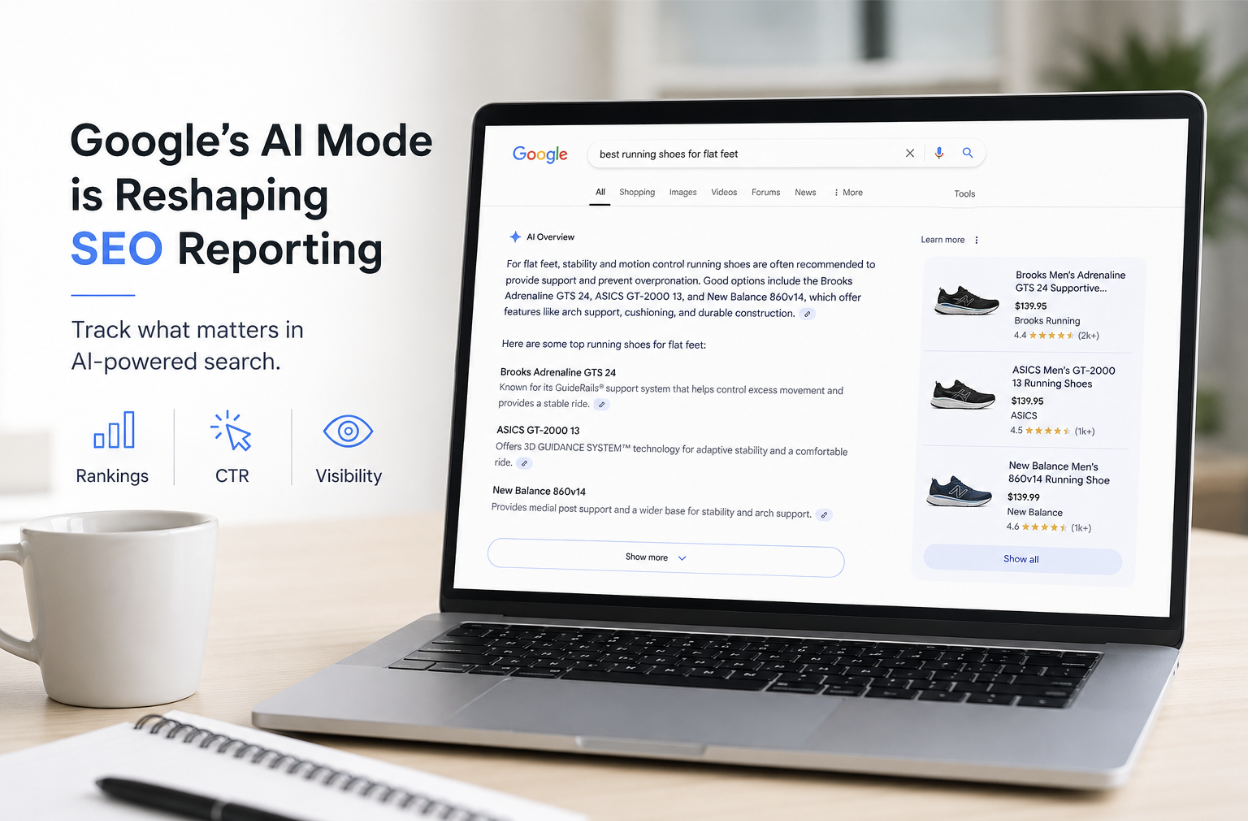
Open Google today and the first thing many users encounter is not a list of blue links. It is a fully composed AI answer that synthesizes multiple sources and resolves the query before a single website is visited.
This is Google’s AI Mode, and it is not a feature update. It is a structural change to how information flows between websites and users. For every SEO service provider and marketing team that built reporting around position tracking, CTR benchmarks, and monthly organic sessions, AI Mode has introduced a clear gap between what the data shows and what is actually happening in search.
The problem is not that your tools are broken. The search experience has fundamentally changed, and the metrics your analytics platform captures were built for a world where every resolved query produced a click. That world is shrinking fast.
Key Takeaways
- Google’s AI Mode has fundamentally shifted how search results are assembled and displayed, making traditional rank tracking an incomplete measure of actual search visibility.
- Zero-click behavior has accelerated in 2026, with AI-generated answers resolving user queries directly on the SERP, which means organic CTR data no longer tells the full performance story.
- SEO reporting must now include AI citation tracking, brand mention monitoring in AI answers, and prompt-level visibility analysis alongside conventional metrics like impressions and position.
- The distinction between featured snippets and AI answers is no longer cosmetic; AI answers pull from multiple sources simultaneously, changing how content authority is evaluated by Google’s systems.
- LLM search behavior rewards content that is structured, entity-rich, and contextually deep rather than content optimized purely around keyword density or backlink volume.
- Businesses that adapt their reporting frameworks now will have a significant measurement advantage as AI Mode becomes the default experience for a growing share of Google users.
- Tools like Google Search Console, third-party AI visibility platforms, and structured data validators are evolving rapidly and must be part of every modern SEO reporting stack in 2026.
What Google AI Mode Actually Is and How It Works?
AI Mode is Google’s most significant evolution of the search interface since the introduction of featured snippets in 2014. Rather than displaying a ranked list of results for a query, AI Mode generates a synthesized response using Google’s Gemini models, drawing from indexed content across the web and presenting it as a unified, conversational answer.
How AI Mode Differs from Traditional Search?
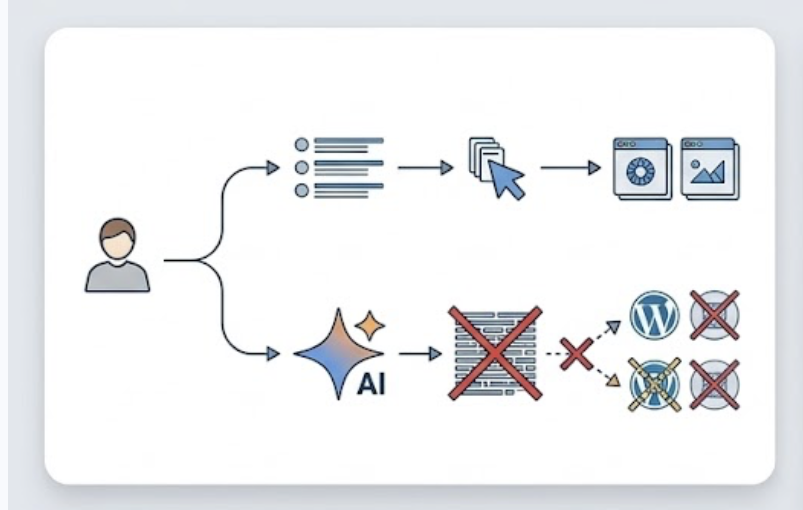
Traditional Google search operates on a retrieval and ranking model. A query triggers a crawl of the index, documents are scored against hundreds of ranking signals, and the top results are surfaced in order. The user selects a result and visits a website.
AI Mode operates on a generation model. The query is interpreted as an intent, relevant content from multiple sources is processed, and a generated response is constructed. Source citations may appear, but the user’s need is often satisfied without ever clicking through.
This is the core tension for SEO in 2026: your content may be contributing to an AI answer, and your analytics will show no session, no pageview, and no conversion from that interaction.
The Role of Google AI Overviews
AI Overviews, which rolled out broadly in 2024 and matured significantly through 2025, are the visible output of this generative layer. They appear above traditional organic results for informational and transactional queries alike. Studies tracking SERP behavior in early 2026 show AI Overviews appearing on 40 to 65% of queries depending on category, with informational queries seeing the highest saturation.
The distinction between AI Overviews and AI Mode is worth clarifying. AI Overviews are the answer boxes that appear within the standard search interface. AI Mode is a dedicated search experience, accessible via a tab in Google Search, that treats the entire interaction as a multi-turn AI conversation. Both affect how content is consumed and how traffic flows, but through different mechanisms.
How AI Mode Google Search Is Disrupting SEO Reporting?
![Diagram showing how AI Mode intercepts search queries before reaching organic results, with citation sources highlighted]
The disruption to SEO reporting is not theoretical. It is showing up in dashboards across industries right now. Understanding the specific mechanisms helps teams diagnose what they are seeing and respond appropriately.
The CTR Collapse in Informational Queries
Click-through rates on informational queries have declined significantly since AI Overviews became dominant. When a user asks “how does compound interest work” or “what are the symptoms of vitamin D deficiency,” the AI answer resolves the query completely. There is no reason to click.
This does not mean your content failed. It may mean your content was used to generate the answer without attribution in the form of a click. Traditional CTR benchmarks are therefore no longer valid for measuring informational content performance.
Position Data Losing Predictive Value
Ranking position 1 for a keyword used to reliably predict a certain traffic volume. That relationship has weakened substantially. A page ranking position 1 beneath an AI Overview may receive 60 to 70% less traffic than the same position received 18 months ago, depending on query type and competitive landscape.
Position data still matters, but it must be interpreted alongside AI Overview presence data for the same queries. A rank tracking tool that does not surface whether an AI Overview is present for a given keyword is giving you an incomplete picture.
Brand Visibility Without Traffic Attribution
One of the most structurally challenging aspects of AI Mode for reporting is that your brand can appear in AI-generated answers without any traffic signal reaching your analytics platform. Google’s AI may cite your content, summarize your research, or quote your expertise, and your GA4 dashboard will show nothing.
This creates a new category of value that traditional SEO reporting has no standard metric for, which is exactly the gap an ai overview tracker is designed to fill. Teams that ignore this are systematically underreporting the actual reach and influence of their content.
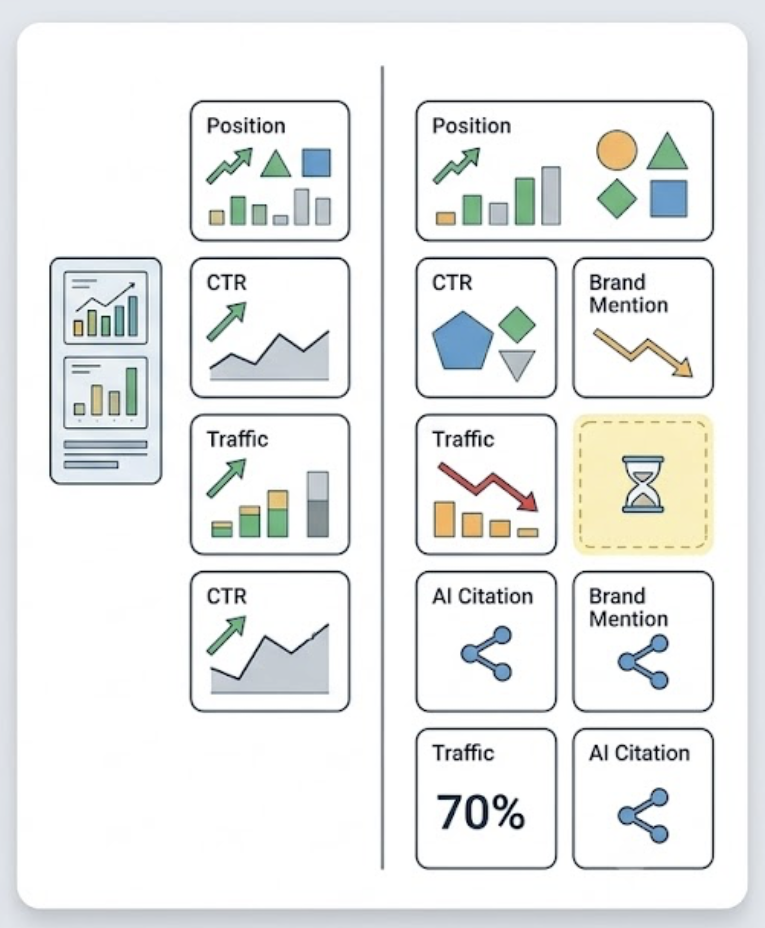
AI Mode vs Traditional Search: What Has Actually Changed for SEO?
The shift is not simply about where links appear on a page. It runs deeper into how Google’s systems evaluate and use content.
Content Evaluation Signals Are Evolving
Traditional ranking algorithms heavily weigh backlinks, on-page keyword relevance, Core Web Vitals, and domain authority. These signals are not disappearing, but a new layer of evaluation is now relevant: how well does this content serve as a source for AI-generated answers?
Content that performs well as an AI source tends to share specific characteristics:
(A) Factual density: Specific claims, statistics, named entities, and verifiable data points that a language model can extract and cite with confidence.
(B) Structural clarity: Clear H2 and H3 hierarchies, concise paragraphs, and logical flow that allows automated systems to identify the most relevant section for a given query.
(C) Entity completeness: Content that comprehensively covers a topic’s related entities rather than targeting a single keyword phrase performs better in LLM-driven retrieval.
(D) Authorship signals: Content attributed to identifiable human experts, with verifiable credentials, is more likely to be cited in AI answers where trustworthiness of source matters.
Featured Snippet vs AI Answer: A Critical Distinction
Featured snippets and AI answers look similar to users but function very differently. A featured snippet pulls a verbatim or near-verbatim passage from a single source and displays it. The source URL is clearly visible. Clicking through remains a natural user behavior.
An AI answer synthesizes information from multiple sources. The source citations, when shown, are secondary to the generated text. The user is reading Google’s interpretation of your content, not your content itself.
For SEO reporting, this distinction matters because:
- Featured snippet wins are attributable to a single URL and appear in Search Console data
- AI answer citations are harder to track, appear inconsistently across users, and do not correlate directly with click data
- Optimizing for featured snippets and optimizing for AI answers require overlapping but not identical content strategies
SEO Metrics That Matter in AI-Powered Search
Reporting frameworks built for 2022 are misrepresenting performance in 2026. Here is what a modern SEO reporting stack needs to measure.
New Metrics Required for AI Search Visibility Tracking
| Metric | What It Measures | Tools |
| AI Overview Presence Rate | % of target keywords triggering an AI Overview | SE Ranking, Semrush AI features |
| AI Citation Share | How often your domain appears as a source in AI answers | Profound, AI Rank Tracker |
| Brand Mention in AI Answers | Unlinked brand references inside generated responses | Manual auditing, BrandWatch |
| Prompt Visibility Score | Visibility across specific question-based queries | Emerging tools in 2026 |
| Zero-Click Query Exposure | Volume of impressions on queries resolved without clicks | Google Search Console + custom segmentation |
Google Search Console in the AI Mode Era
Search Console remains the most authoritative source of first-party search data. In 2026, its usefulness for AI Mode analysis depends on how you segment and interpret the data:
- Filter queries by question format (who, what, how, why, when) to identify AI Overview-dominated query clusters
- Monitor impression-to-click ratios by query type to identify where AI answers are suppressing CTR
- Use the Search Appearance filter to identify pages appearing in rich results, which correlates with AI source eligibility
- Track new query impressions over time to identify emerging topics where your content is gaining AI visibility before traditional rankings consolidate
How to Optimize Content for Google AI Mode?
Adapting your content strategy for AI Mode is not about abandoning SEO fundamentals. It is about layering additional signals that make your content more useful to generative systems.
Structured Data Is No Longer Optional
Schema markup was always recommended. In the AI Mode context, it is operational infrastructure. Structured data helps Google’s systems accurately identify what your content is about, who authored it, what claims it makes, and how it relates to other entities.
Priority schema types for AI Mode visibility:
- Article and NewsArticle schema with author entity markup linking to a verified Google Knowledge Panel
- FAQPage schema for question-and-answer content that directly maps to conversational query formats
- HowTo schema for instructional content that AI systems frequently synthesize
- Speakable schema for content intended to be read aloud by voice and AI interfaces
- Organization and Person schema to establish entity identity and build trust signals
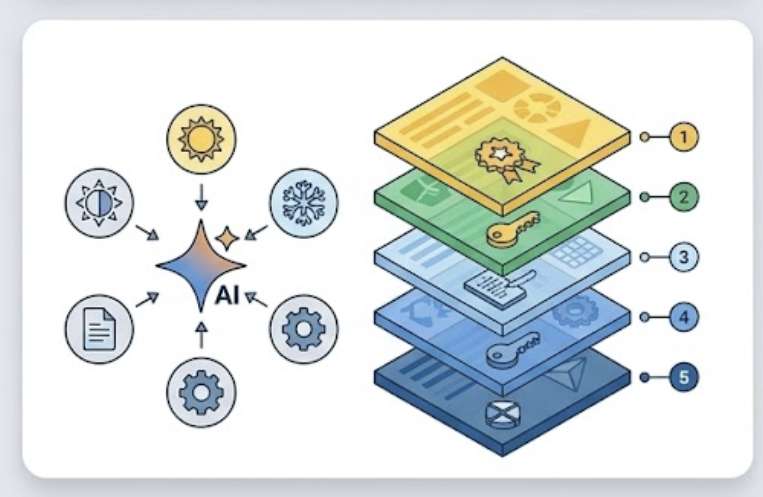
Writing for LLM-Powered Search Results
LLM search behavior favors content that reads as definitive, well-sourced, and comprehensive. The following writing principles align with how language models evaluate and extract content:
Lead with the direct answer. AI systems are trained to surface the most direct response to a query. Content that buries the answer three paragraphs into a section is less likely to be extracted as a source.
Use named entities generously. Mention specific tools, companies, technologies, frameworks, and people by name. Vague language (“some tools” or “many experts”) does not give AI systems the factual anchors they need to cite your content confidently.
Structure for extraction. Write sections that can stand alone as answers to specific questions. A section titled “How to Track AI Search Visibility in 2026” with a clear, self-contained answer will perform better as an AI source than a section with the same information buried in narrative prose.
Cite your sources within the content. When you reference statistics, studies, or external claims, name the source inline. This mirrors how AI systems themselves present information and signals that your content is operating at a research-quality standard.
Topical Authority Over Keyword Targeting
Google’s AI Mode draws from sources it considers authoritative on a topic, not just sources that rank for a specific keyword. For businesses building topical authority, a professional link building service can complement content efforts by earning relevant references from authoritative websites. This shifts the competitive advantage toward websites that have built comprehensive coverage of a subject area rather than targeting isolated keywords.
A website that has published 40 well-structured articles covering every meaningful subtopic within “B2B SaaS marketing” is a stronger AI source candidate than a website with one highly optimized page for a single keyword, even if that page currently ranks position 1.
This is the Generative Engine Optimization (GEO) principle applied to content strategy: build topical depth and entity coverage at a domain level, not just at a page level.
Google AI Mode SEO 2026: Industry-Specific Impact
The impact of AI Mode is not uniform across industries. Understanding how it affects your specific sector helps prioritize where to adapt reporting and content strategy first.
1. Publishing and Media
News and content publishers have seen the most immediate impact on traffic. AI Overviews on news-adjacent queries (explainers, definitions, background context) have significantly reduced clicks to editorial content. Publishers in this space are investing in proprietary data, original research, and exclusive expert commentary that AI systems cannot replicate from existing indexed content.
2. eCommerce and Retail
Transactional queries remain relatively click-driven because users need to visit a site to complete a purchase. However, AI Mode is reshaping the consideration phase. Users are asking AI to compare products, explain differences, and recommend options before they ever reach a category page. Brands that appear in AI-generated comparison answers are influencing purchase decisions earlier in the funnel.
3. B2B Technology and SaaS
B2B buyers frequently use search to research solutions, compare vendors, and understand technical concepts before engaging with a sales team. AI Mode is increasingly resolving these informational queries. Companies like HubSpot, Salesforce, and Atlassian have responded by publishing deeply technical, entity-rich content that serves as reliable AI source material while also demonstrating expertise that builds direct brand preference.
4. Healthcare and Legal
These sectors face additional complexity because Google applies higher scrutiny to AI-generated answers in Your Money or Your Life (YMYL) categories. Healthcare and legal content from established institutions (Mayo Clinic, WebMD, ABA-affiliated sources) continues to receive preferential citation in AI answers. For smaller publishers in these spaces, EEAT signals (verifiable author credentials, institutional affiliation, citation of peer-reviewed sources) are more important than ever.
Tools to Track AI Search Visibility in 2026
The tooling landscape has evolved rapidly to address the measurement gap created by AI Mode. While many professionals rely on the best SEO reporting tools to monitor search performance and rankings, organizations investing in enterprise AI product deployment also need platforms that provide insights into how AI-generated search results affect visibility. Here is where the most useful capabilities currently exist:
Google Search Console remains essential. While it does not yet provide a dedicated AI Mode report, the combination of query-level impression data, Search Appearance filters, and CTR analysis by query type gives experienced analysts significant insight into AI Mode impact.
Google Search Labs provides early access to AI Mode features and allows SEOs to manually test how different content types appear as AI sources.
Third-Party AI Visibility Platforms
Semrush has added AI Overview tracking to its position monitoring suite, showing which keywords in your tracked set trigger AI Overviews and whether your domain appears as a source.
SE Ranking offers AI Overview presence data integrated into standard rank tracking workflows, making it practical for teams that do not want to manage a separate tool.
Profound is a purpose-built AI visibility platform that tracks brand and content citation across multiple AI search engines including Google, Perplexity, and ChatGPT Search. It is the closest available tool to a dedicated AI citation analytics platform as of 2026.
BrightEdge and Conductor have both updated their enterprise SEO platforms with AI search visibility modules designed for large-scale content operations.
Structured Data and Schema Validation
Google’s Rich Results Test and Schema.org Validator are the standard for confirming that structured data is correctly implemented and eligible for rich result inclusion.
Conclusion
Google’s AI Mode is not a future disruption to prepare for. It is a present reality that is actively reshaping how search delivers value to users and how that value flows to the websites that create content.
The SEO teams and businesses that are navigating 2026 most effectively are not abandoning what worked before. They are expanding their definition of search visibility to include dimensions that traditional reporting never designed to capture. Brand presence in AI answers, citation share across generative search engines, and content eligibility as an AI source are the new performance frontier.
Adapting your reporting framework is not a technical project. It is a strategic decision to measure what actually matters in the search environment your audience is using today. The data is available, the tools are maturing, and the competitive advantage of acting now is real.
FAQs
Google AI Mode is a search experience powered by Google’s Gemini AI models that generates synthesized answers to user queries rather than displaying a traditional list of ranked results. It affects SEO primarily by intercepting traffic that would previously have flowed to organic results, particularly for informational queries. Content that previously earned clicks through high rankings may now be contributing to AI answers without generating measurable website visits, making traditional CTR and session metrics less reliable as performance indicators.
AI Mode is not fully replacing traditional search results in 2026, but it is restructuring the SERP significantly for a large share of queries. Traditional blue-link results still appear below AI Overviews, and for many transactional and navigational queries, AI Overviews are less prevalent. However, the trajectory is clearly toward an AI-first search experience, and SEO strategies that do not account for this shift will become progressively less effective.
The core metrics to track in 2026 include: organic impressions and CTR segmented by query type, AI Overview presence rate for target keyword sets, AI citation share at the domain and page level, zero-click query exposure volume, Core Web Vitals scores, structured data coverage and error rates, and topical authority depth measured through content coverage analysis. Relying solely on position and traffic without the AI visibility layer creates a significant blind spot in performance reporting.