
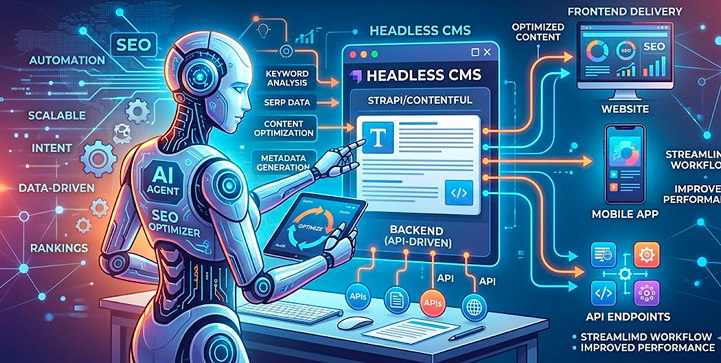
AI SEO agents with headless CMS are changing how teams handle search optimization. Instead of juggling manual updates across scattered tools, you can hand the repetitive work to agentic workflows that automatically update metadata and keep content aligned with search intent. Less time spent editing pages one by one. More time on the strategy that actually moves rankings.
As SEO gets more involved, automation earns its place on the data-heavy tasks: keyword analysis, metadata, and ongoing content updates. Pair that with a headless CMS and your AI SEO agents can push optimizations across every channel you publish to, from your main site to mobile apps, all from one source of content. When combined with a headless CMS, AI SEO agents can seamlessly push optimizations across multiple platforms, from websites to mobile apps.
The result is a system that keeps content optimized and up to date without burning out your team.
Why automation is becoming essential for SEO teams?
SEO has grown far beyond keyword stuffing and backlinks. Today it involves technical audits, content optimization, and constant updates. That complexity is why automation stopped being optional. It saves time, cuts errors, and frees your team to think about strategy instead of execution.
How headless CMS platforms enable scalable SEO?
Headless CMS platforms separate the backend from the frontend. That flexibility lets you push optimized content across websites, apps, and more without duplicating work. SEO becomes something you can scale instead of something you chase.
What Are AI SEO Agents?
AI SEO agents are agentic workflows that autonomously read, write, and publish. They’re not just software that flags a problem and waits for a human to fix it. Using machine learning and data analysis, they act on what they find to improve how content performs in search.
What they take off your plate:
- Content optimization: sharpening readability, relevance, and keyword usage
- Keyword clustering: grouping related keywords by search intent
- Metadata generation: writing optimized titles and descriptions
- Internal linking suggestions: improving site structure and navigation
Why Headless CMS Platforms Need AI SEO Automation?
A headless CMS delivers content across many platforms at once. Managing SEO for each channel by hand gets overwhelming fast. AI automation applies consistent rules everywhere, so quality doesn’t drift from one channel to the next.
There’s a speed angle too. Traditional CMS setups often pile on plugins to bolt SEO features onto the frontend, and that plugin bloat drags down page speed and Core Web Vitals. Headless sidesteps the problem: a lean frontend, with the optimization logic handled by agents instead of a stack of plugins fighting each other.
And on large sites, consistency is the hard part. AI agents audit and optimize pages in bulk, so a thousand-page site holds the same standard as a ten-page one, without editing each page by hand.
Overview of Popular Headless CMS Platforms
Strapi
Strapi is an open-source headless CMS known for flexibility. It allows developers to customize SEO fields, integrate plugins, and manage structured content efficiently. It allows AI developers to customize SEO fields, integrate plugins, and manage structured content efficiently. Its built-in MCP server is what makes it interesting for automation: AI agents can read, write, and publish content directly, with permission controls that scope exactly what each agent is allowed to touch.
Contentful
Contentful offers a cloud-based solution with powerful APIs. Its structured content modeling lets you build reusable SEO components once and apply them across large content operations, which is what makes it easy to layer automation on top.
Either way, the payoff for SEO-driven sites is the same: faster content delivery, better scalability, easier API integrations, and consistent SEO across platforms.
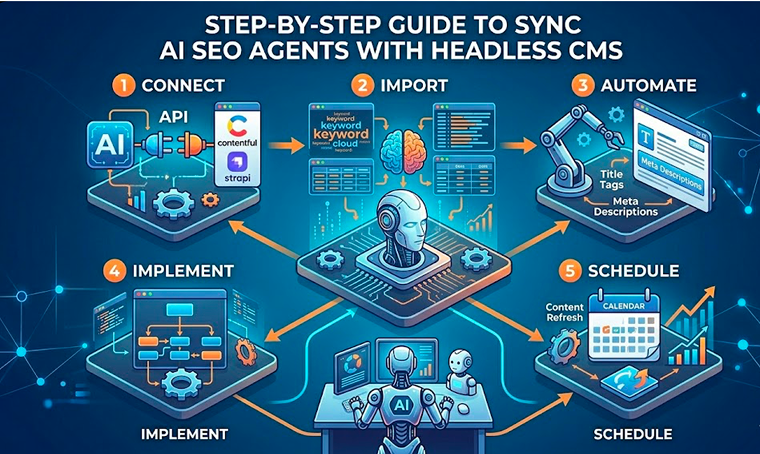
Step-by-Step Guide to Sync AI SEO Agents with Headless CMS
Step 1: Connect your CMS APIs
Integrate your CMS APIs with your AI SEO tool so data can move between them.
Let AI generate optimized metadata for every page.
Step 3: Add AI-driven internal linking
AI spots linking opportunities across your content and strengthens site structure.
Step 4: Schedule content refresh triggers
Set triggers that update content based on performance, so pages stay relevant.
Here’s how that plays out in practice. The system watches performance data and flags pages with slipping click-through. It rewrites the metadata to lift engagement, then pushes the change straight into the CMS through the API, no manual step in between.
Benefits of Syncing AI SEO Agents with Headless CMS
Faster optimization cycles, for one. Automation cuts the time between spotting an issue and shipping the fix. And it scales: consistent optimization across hundreds or thousands of pages, holding the same standard everywhere. Trusted Salesforce Consulting Partners streamline SEO with AI-powered optimization and a headless CMS.
Best Practices for AI-Driven SEO Workflows
AI should assist, not replace, human judgment. Keep an editor in the loop, feed the models clean keyword data, and test your API setups before you trust them, since a bad integration can quietly break your workflow. Build dedicated SEO fields inside the CMS for titles, descriptions, and keywords, and audit what the AI ships on a regular cadence.
Conclusion
As sites grow, manual SEO stops being sustainable. By syncing AI SEO agents with headless CMS platforms, you get a setup that keeps content optimized as you scale, without the workload growing with it.
FAQs
No. While AI can handle many tasks, human input is still needed for strategy and quality control.
Indirectly, yes. It enhances scalability and performance, which contribute to better SEO outcomes.
Both are strong options. Strapi offers flexibility, while Contentful excels in enterprise-level scalability.
Popular tools include SEO automation platforms, API-based AI services, and custom-built integrations.