
A writer hands back a draft. It’s clean, it’s well-written, and it’s aimed at completely the wrong reader. Now you’re staring down a rewrite that eats another week. That gap between what you pictured and what showed up? It almost always traces back to one missing document.
The content brief.
These days most teams don’t wing their content anymore. Around 73% of B2B and 70% of B2C marketers now work off a documented content strategy, and the brief is the thing that carries that strategy from your head to the person actually writing. Skip it, and even a great writer is guessing.
So let’s get specific about what a content brief is, what belongs in one, and the part nearly every guide leaves out: how a good brief keeps paying you back long after the post goes live.
What is a content brief?
A content brief is a documented set of instructions that tells a writer what to create and how, before they write a single word. Title, keywords, audience, angle, the works.
The key word there is documented. A hallway conversation isn’t a brief. A scattered Slack thread isn’t a brief. Your notes from a call where everyone nodded along? Also not a brief. A real content strategy document is written down, lives in one place, and stays put so anyone on the project can point to it.
You can write briefs for pretty much anything: blog posts, landing pages, whitepapers, case studies, email sequences. They matter most for SEO content that has to earn a ranking and hold it, because that’s where a wrong turn costs you the most.
Worth clearing up what a brief is not. It’s not just an outline (though it usually contains one). It’s not a pile of keywords. And it’s not your style guide, even though a good brief links out to it. Think of it less as any single one of those things and more as the one page that ties them together.
What to include in a content brief
Here’s the part people screenshot. The elements below are what to include in a content brief that a writer can actually run with:
- Working title: a starting point, not a final answer. It’ll probably change.
- Primary and secondary keywords: the main term plus the semantic variants you want covered.
- Search intent: the why behind the query. Are people trying to learn, compare, or buy?
- Target audience: who’s reading, and how much they already know. “SEO leads at B2B SaaS companies” beats “marketers.”
- Recommended word count: tied to intent and the SERP, not a number you pulled from the air.
- Outline: suggested H2s and a line on what each section does.
- Internal and external links: the pages you want linked, plus the sources worth citing.
- Meta title and description: so the writer frames the piece for search from the start.
- Tone and style: plus a link to the full style guide.
- The goal and the success metric: and this one’s the sleeper. More on it in a second.
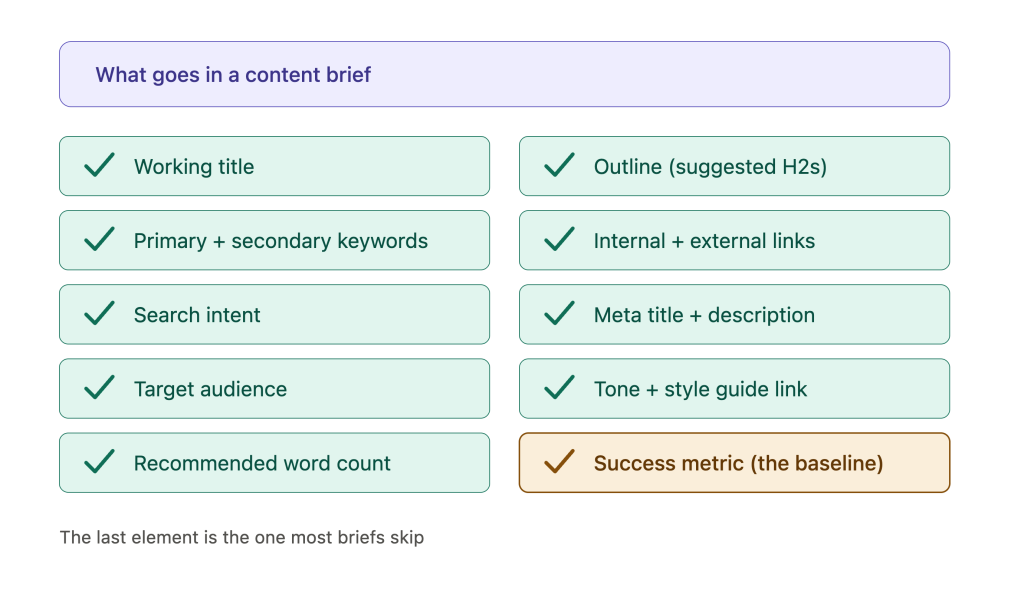
Notice that last one, because most briefs skip it. The success metric is what “winning” looks like for this specific page: the target keyword position, the traffic band you’re aiming for, maybe the AI-citation you want. Write it down. It’s the baseline you’ll measure against later, and without it you’ve got no way to tell six months from now whether the page did its job or quietly fell apart.
On length: the average blog post runs about 1,400 words, though 2,000-plus tends to perform better for competitive terms. That’s a reason to set word count off intent and the SERP, not a template default. Go a little overboard on detail in the brief if you’re unsure. Just keep the whole thing to a page or two, or nobody reads it.
Why content briefs matter
The obvious payoff is fewer rewrites. When everyone agrees on audience, intent, depth, and angle before the writing starts, you stop discovering misalignment at the draft stage, which is the most expensive place to find it.
There’s a real operational cost hiding here. Teams consistently name slow approvals and revision drag among their top constraints, right up there with measurement. A brief is about the cheapest fix available for both.
Then there’s the single-source-of-truth part. No more scavenger hunt across three meetings, two docs, and a Slack channel to figure out what was decided. It’s in the brief. Somebody asks a question in week three? Point them at the brief.
And it protects your SEO. The brief carries the intent, the keywords, and the content gaps the SERP is demanding, so a writer who isn’t an SEO doesn’t accidentally leave out what the page needs to rank. That’s the whole point of an SEO content brief: bake the search strategy in so the writer doesn’t have to reverse-engineer it.
Content brief vs creative brief
People mix these up constantly. Quick untangling.
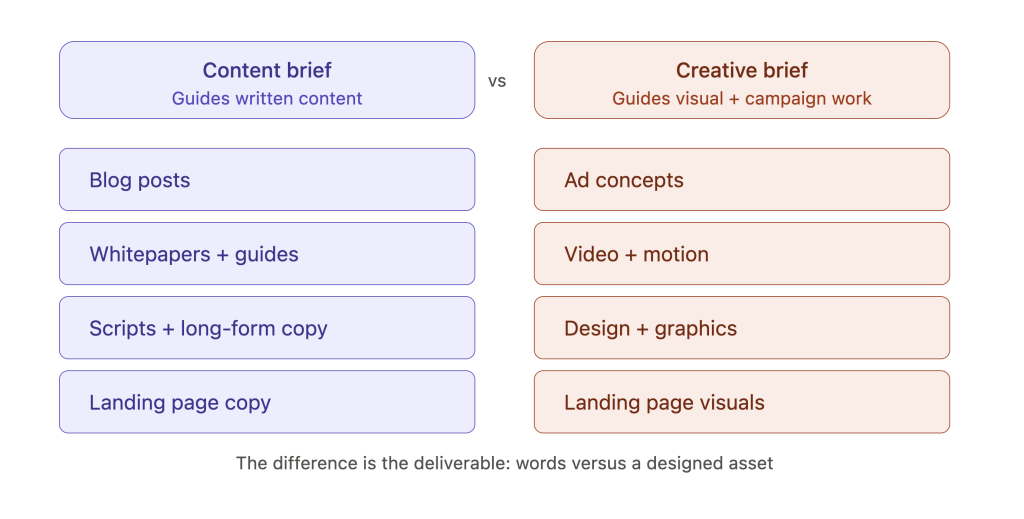
A content brief guides written, long-form content. Blog posts, whitepapers, scripts, that kind of thing. A creative brief guides visual or campaign work. Ad concepts, design, video, landing-page visuals.
Yes, they overlap, and plenty of projects need both. The line that matters is the deliverable: words on a page versus a designed asset. When someone asks for a content brief vs creative brief distinction, that’s really all it comes down to.
How to write a content brief
You don’t need a three-hour ritual. Here’s the fast version.
Start with the target keyword and confirm its intent. Get that wrong and everything downstream is off. Next, pull your secondary and semantically related keywords so the writer knows the full territory to cover. For example, if your primary topic is CRM implementation, related terms like salesforce consulting services can help strengthen topical relevance.
Then do a quick SERP scan. Look at what’s ranking, note the structure everyone shares, and spot the gaps nobody’s filling. That’s your opening. Draft a tentative outline from it: title, main H2s, a note on each section.
Now layer in the rest. Audience, internal and external links, meta title and description, word count, and the success metric. Last, write down the specific angle you want versus what’s already ranking, because “same as the top result but ours” has never outranked anything.
One caution: don’t over-specify. Give the writer the guardrails and the target, then let them write. A brief that dictates every sentence isn’t a brief, it’s a straitjacket.
If you’re doing this more than occasionally, build a reusable content brief template. A template means you’re not rebuilding the structure every time and you stop forgetting things like the buyer’s funnel stage or the internal links. Fill in the specifics per piece and go. A good content brief example is just your template with real answers plugged in.
The part most content briefs get wrong
Here’s where nearly every guide stops: they treat the brief as a pre-production document. You write it, the post ships, you file the brief away and never open it again.
That’s the miss.
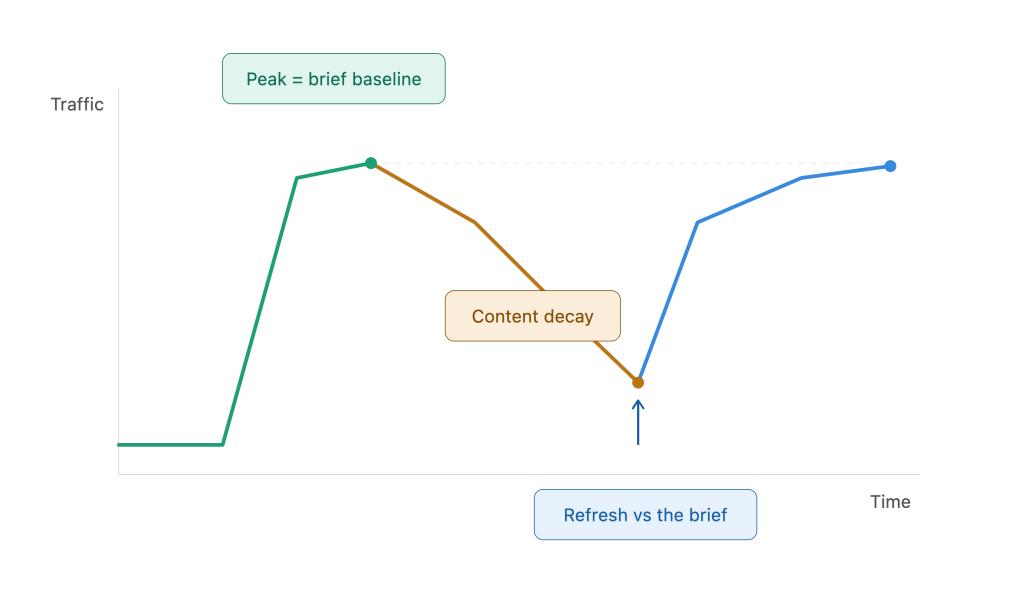
Your brief recorded the original intent, the target keywords, and the success metric. That record is exactly what you diff against when the page starts slipping. And it will slip, because content decay isn’t a maybe. It’s a slow erosion, not a cliff. A page slides one position at a time over months, and most teams only clock it after real ground is gone. The reason it hides so well is that everyone’s pouring effort into new content while the old stuff quietly loses altitude.
And the cost of not catching it is brutal, because ranking drops aren’t linear. Animalz research found that slipping from position 1 to position 2 can cut your traffic roughly in half, and falling to position 6 can wipe out about 90% of it. Practitioner estimates put decay’s total toll at 30 to 40% of blog traffic for teams that never audit. That’s not a rounding error. That’s a chunk of your pipeline evaporating in slow motion.
One modern wrinkle to write into your brief:
organic search and AI Overviews are now separate visibility layers. A page can hold its Google ranking while losing its AI citations, or the reverse. So the success metric in your brief should say which layer you actually care about.
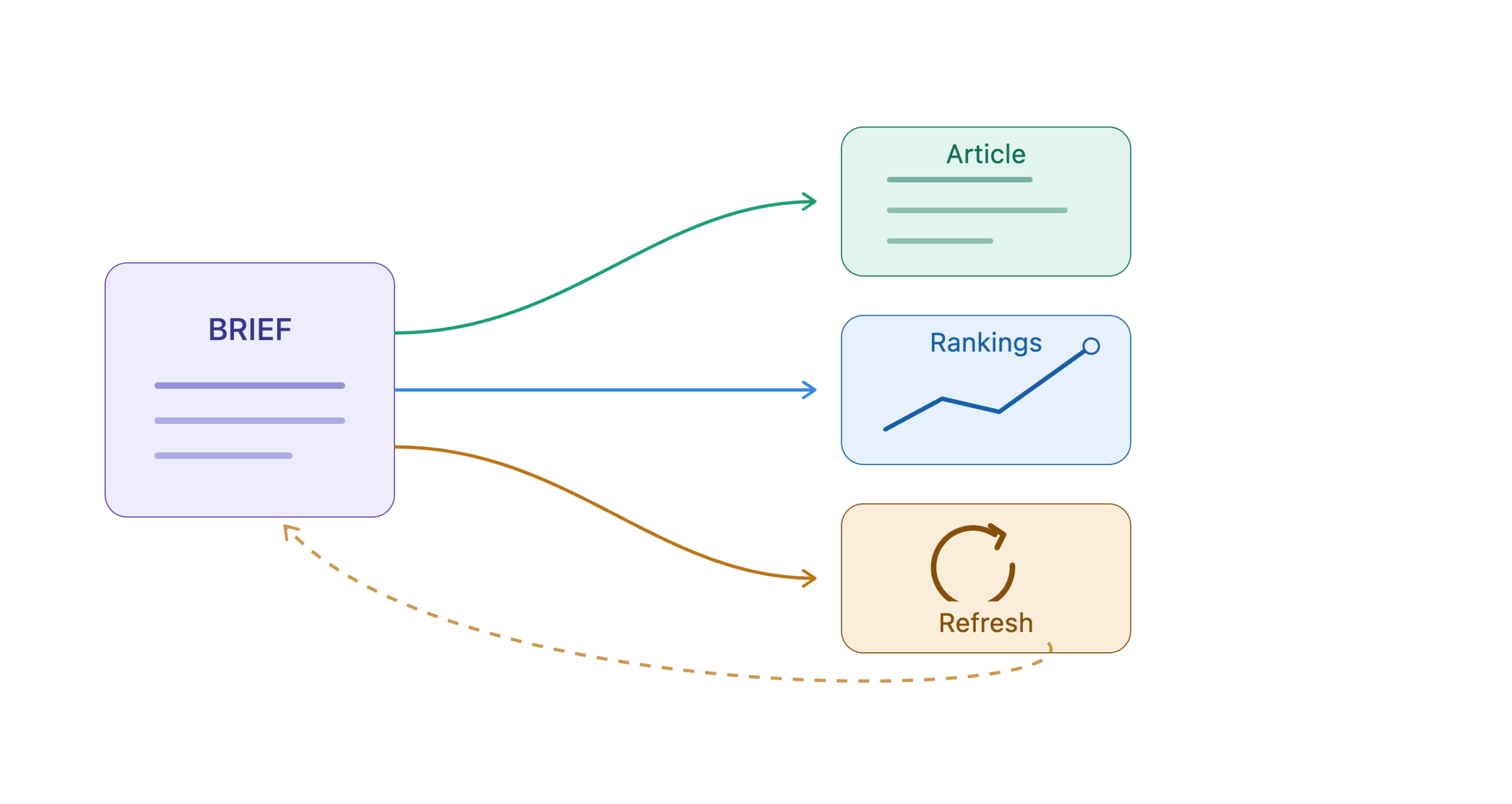
Here’s the payoff. When a page decays, you don’t start from scratch. You reopen the brief, see what “winning” was supposed to mean, check what the SERP wants now against the intent you recorded then, and run a targeted refresh. A substantive one, not a cosmetic “last updated” date swap, which engines increasingly see right through. Done right, refreshes recover fast: one agency’s dataset across 150-plus sites reported 60 to 80% of lost rankings back within 30 to 45 days. Treat that figure as one team’s numbers rather than a law of physics, but the direction is clear.
This is exactly the loop WordPattern is built for: it watches your live rankings for decay against the baseline you set and drives paragraph-level AI refreshes, so the brief you wrote on day one becomes the thing you’re measuring against on day ninety. The brief stops being a filing-cabinet artifact and starts being an instrument.
Common content brief mistakes
A few ways briefs go wrong, so you can dodge them.
Over-specifying is the big one. Dictate every sentence and you’ve hired a typist, not a writer. Give direction, not a script.
Padding the brief with arbitrary requirements is another. Made-up stats you insist the writer include, word counts with no logic behind them. If you don’t have a real number, don’t fabricate one, and don’t ask the writer to. A bad content brief example is usually one stuffed with requirements nobody can justify.
Then there’s leaving out the success metric, which means nobody can tell later whether the page won or lost. And skipping intent, briefing the keyword without the reason behind the search, which is how you get technically-optimized content that still misses what people actually wanted.
The one that quietly costs the most? Treating the brief as one-and-done. You already know why.
Conclusion
A content brief is the cheapest instrument you’ve got for getting the right draft the first time. That alone justifies writing one.
But the version worth writing does double duty. It guides the writer today and gives your future self a baseline to measure against when the page starts to fade, which it will. Write the brief for the person drafting this week and for the you who’ll be staring at a slipping traffic graph three months from now. Same document. Twice the payoff.
Next time you’re tempted to fire off a topic and a word count and call it a brief, don’t. The extra twenty minutes is the best content insurance you can buy.
FAQs
It’s a short written document that tells a writer what to create and how: the topic, keywords, audience, angle, and goal, all in one place before they start writing. Think of it as the blueprint that keeps a piece of content on track.
At minimum: a working title, primary and secondary keywords, search intent, target audience, recommended word count, a rough outline, internal and external links, meta title and description, tone notes, and the success metric you’ll measure the page against later.
A content brief guides written content like blog posts and whitepapers. A creative brief guides visual and campaign work like ads, video, and design. The difference comes down to the deliverable — words versus a designed asset.
Usually a page or two. Long enough to cover the essentials a writer needs, short enough that they’ll actually read it. If your brief runs longer than the article, you’ve overdone it.
Usually the strategist or SEO lead, since they own the keyword research and the plan. But on smaller teams the writer often builds their own brief and shares it for sign-off before drafting, which works fine as long as it’s written down.