
Here’s an uncomfortable number to start with. If you’re still building traffic projections on the click-through-rate curves everyone used a few years ago, you’re probably overstating what a #1 ranking delivers by 30 to 40 percent.
That gap has ended more than a few SEO careers. You promise leadership a number in Q1, do the work, watch your rankings hold steady, and somehow the traffic still never shows up. By Q3 you’re the person explaining why the forecast was wrong.
The math usually isn’t the problem. Two silent assumptions are: that CTR curves stay put, and that the traffic you already have will still be there next quarter. Both are shakier than they used to be. So let’s do the standard forecasting methods properly, then add the one adjustment that keeps your number honest.
What SEO forecasting actually is
SEO forecasting is the practice of using historical data, keyword data, and search trends to project your future organic traffic, rankings, and ideally the revenue behind them.
It does two jobs. It sets expectations you can actually hit, and it wins you budget. A forecast is how you walk into a room and say “give me three writers and I’ll get you 40,000 more sessions by Q4” with numbers behind it instead of a vibe.
There’s a difference between a forecast and a wish, though. A wish is a single hopeful number. A forecast is a range with the assumptions written down next to it. One of those survives scrutiny in a meeting. The other gets you cornered.
One more distinction before the methods. Forecasting for a site with history is a different exercise than forecasting a brand-new project. An existing site gives you real data to lean on; a new project has none, so you’re borrowing signals from competitors instead. The stakes are real either way. By late 2025, the cumulative decline in organic search clicks had reached roughly 42 percent against pre-AI-Overview baselines. Nearly half the clicks that used to exist are gone. Your organic traffic forecast has to account for a moving floor.
First-party vs third-party data: what to forecast from
Every forecast starts with data, and there are two kinds.
First-party data is yours. It lives in Google Search Console, GA4, and your CRM: real clicks, your actual conversion rate, average order value, the seasonality your business already knows about. If you have it, use it. Nothing predicts your site better than your site.
Third-party data comes from SEO suites and describes everyone else. Competitor rankings, their estimated traffic, which URLs pull it, their backlink profiles. You need this in two situations: when you’re forecasting a new project with no history of your own, and when a client hasn’t handed over GSC access yet (happens more than you’d think).
Most experienced SEOs use both. First-party for accuracy, third-party to sanity-check and fill the gaps. But notice what the two have in common. They describe the past. And the past, as we’re about to see, is quietly decaying underneath you.
Method 1: Keyword-based forecasting, step by step
This is the method most people mean when they say forecasting. The logic is simple:
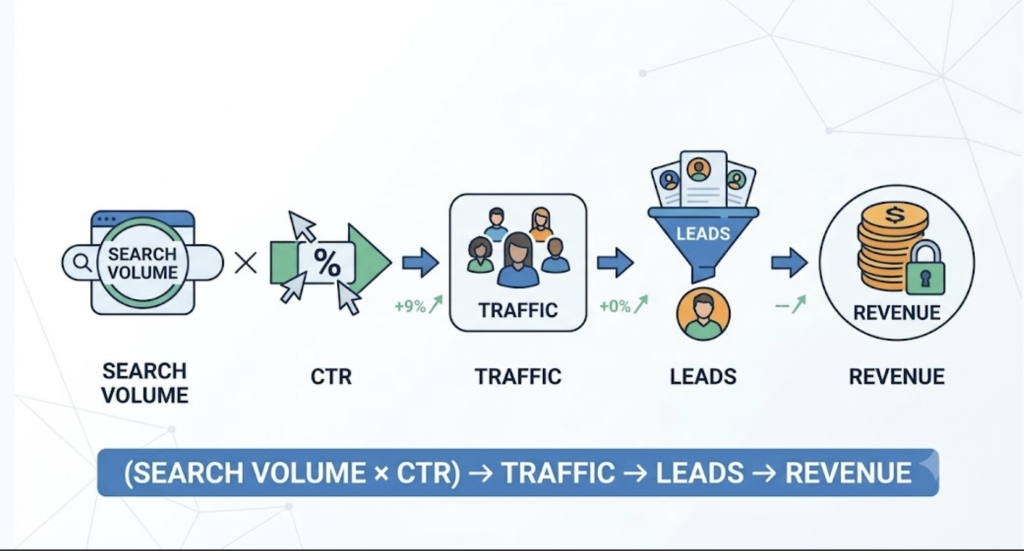
Estimated monthly traffic = target keyword search volume × expected CTR at your target position.
Here’s how it runs.
Step 1 – Pull your keywords and rankings. Get everything you already rank for out of Search Console (Performance → Search results → Queries), plus the target keywords you want to win. Your rank tracker fills in current positions.
Step 2 – Get search volume. GSC won’t give you volume, so pull it from a keyword tool. Use one that adjusts for seasonality, or your holiday-season forecast will be a lie in July.
Step 3 – Apply a CTR curve. This is where forecasts quietly go wrong, so pay attention to which curve you grab.
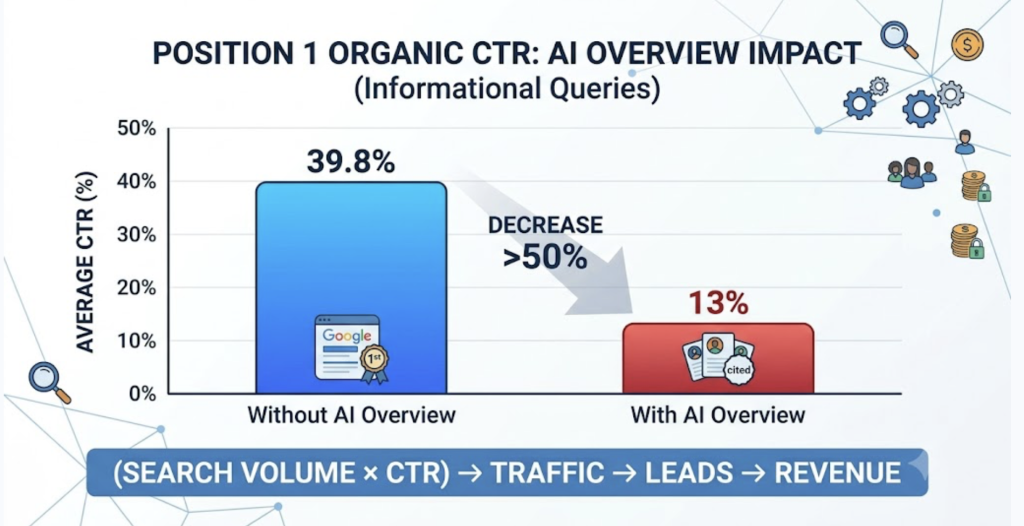
The curve the industry leaned on for years looked clean. The top three organic results took about 68.7 percent of all clicks, with position one around 39.8 percent. Predictable and steep.
That curve is stale now. A study of 200,000-plus keywords found position-one CTR fell about 32 percent year over year, from 28 percent down to 19 percent, with position two dropping close to 39 percent. Plug the old number into your model and you’ve baked in a 30-to-40 percent overshoot before you’ve written a word of content.
Now the part most guides skip. Don’t stop at traffic. Chain it forward.
Say a target page has 8,000 monthly searches and you’re aiming for a realistic 5 percent CTR at your target spot. That’s 400 visitors. Multiply by your conversion rate (say 5 percent) and you get 20 leads. Apply your lead-to-sale rate and average deal value, and now your forecast is speaking in dollars. That’s the version a CFO signs off on. Keyword-based forecasting that ends at “visitors” ends one step too early.
Method 2: Historical and statistical forecasting
The other SEO forecasting model ignores individual keywords and reads your trend line instead.
You take twelve or more months of your own traffic and project it forward with a model. At the simple end, that’s a moving average or a trendline dragged across your GSC clicks in a spreadsheet. At the serious end, it’s a time-series model like Prophet or ARIMA running in a script, catching seasonality and year-over-year patterns a straight line would miss.
The strength here is honesty about your real trajectory. Your actual growth curve, not a keyword fantasy.
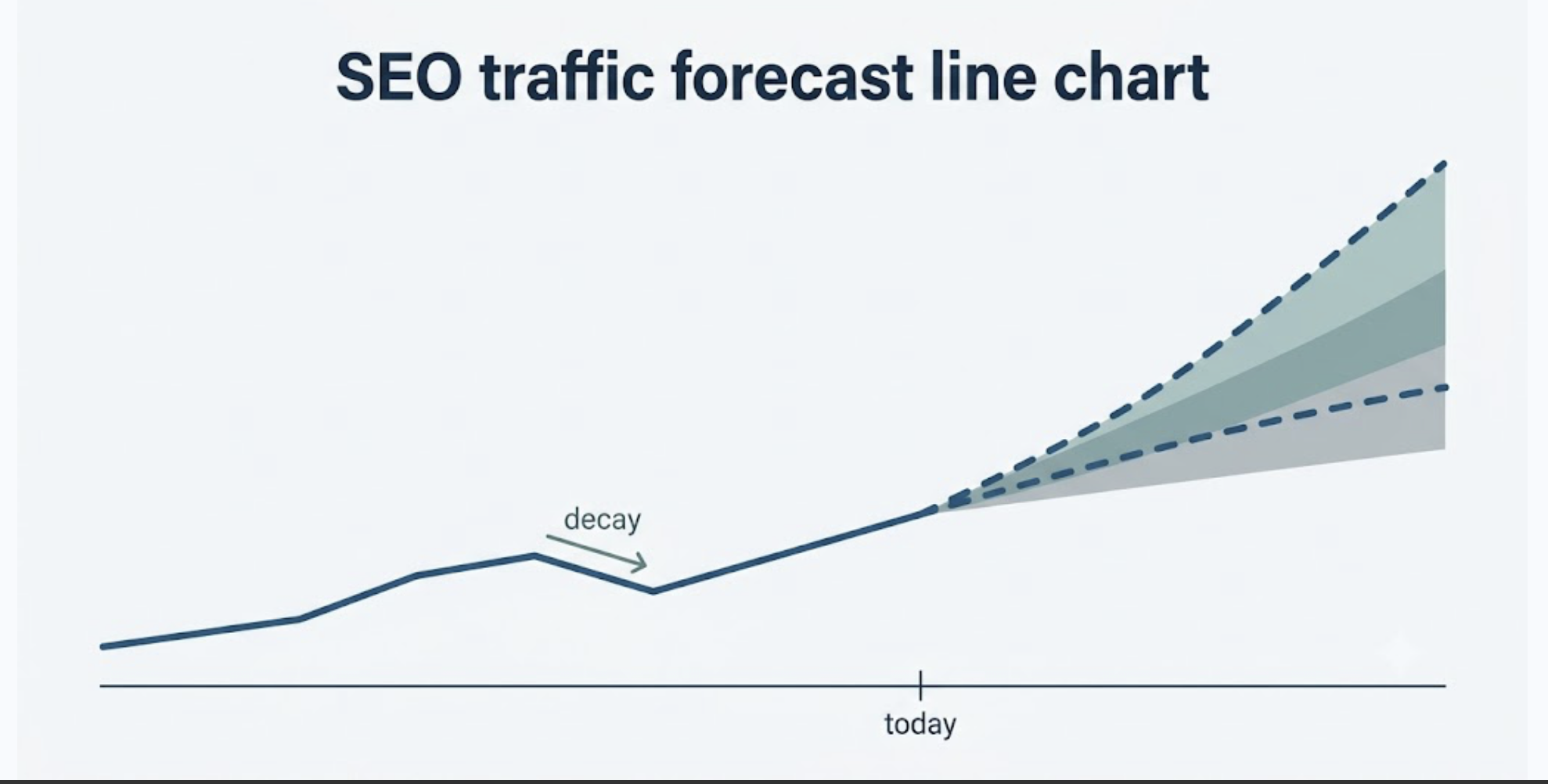
The weakness is subtle, and it’s the whole reason this article exists. A trendline extrapolates whatever it’s fed, decay included. If your baseline is sliding, a naive projection either rides the slide down or, worse, a smoothed average papers over it and hands you a number that looks stable while the ground gives way. Think about how common “rankings stable, impressions up, clicks down” has become. Your positions can sit perfectly still while a trend-based forecast still misses badly. Rank isn’t the thing that pays you. Clicks are.
The mistake every SEO forecast makes: a decaying baseline
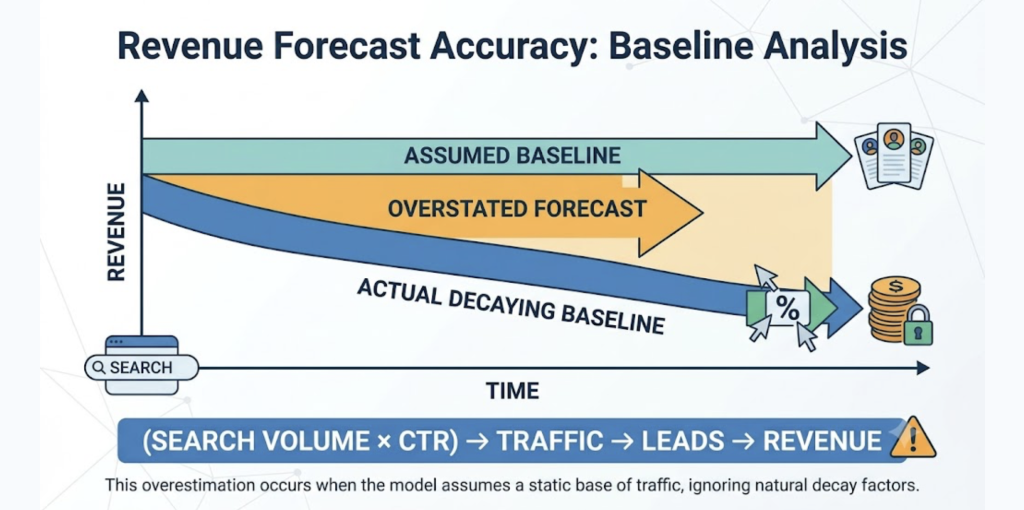
Both methods above share one blind spot. They start from a baseline of existing traffic, add projected gains on top, and quietly assume the baseline holds.
It doesn’t. This is content decay, and it’s the difference between a forecast that lands and one that embarrasses you.
Content decay is the slow leak. An existing page loses somewhere between 10 and 30 percent of its organic traffic over months as it ages and competitors publish fresher work. It’s gradual, which is exactly why it’s dangerous. You barely notice it, especially because the new posts you’re publishing mask the decline of the old ones.
AI Overviews made it worse. Pages that haven’t been touched in 90 or more days are about three times more likely to lose their AI citations, so the traffic you’re forecasting from those pages is more fragile than the spreadsheet suggests.
Here’s the fix. Build a decay-adjusted forecast in three moves.
First, split your baseline. Separate the pages holding steady from the ones already sliding. Second, subtract expected decay from the baseline before you add a single new gain. If a cluster of aging pages is shedding 15 percent a year, that loss goes in the model as a negative number, not a rounding error. Third, add your projected new-keyword capture on top of the corrected baseline, not the fantasy one.
Do that and your single hopeful line becomes a defensible range. Downside case: the baseline decays and your gains land slowly. Upside case: you arrest the decay through refreshes and the gains show up. This is exactly the erosion that a decay-detection tool like WordPattern is built to quantify, so the number you subtract is measured, not guessed. (More on the mechanics in this breakdown of how content decay works and how to fix it.)
Adjust your CTR assumptions for AI Overviews
If one line item wrecks 2026 forecasts, it’s the CTR assumption. Specifically, using a pre-AI-Overview curve on queries that now trigger one.
The hit is steep. When an AI Overview sits above the results, the top page’s CTR runs about 58 percent lower, per Ahrefs’ 300,000-keyword analysis. Pew Research, tracking real browsing behavior instead of tool estimates, found people clicked a traditional result only 8 percent of the time with an AI Overview present, versus 15 percent without. Roughly half.
What this means in practice: you can’t apply one CTR to your whole keyword list anymore. Check each target keyword for whether it triggers an AI Overview (the SERP-features filter in most rank trackers shows this), and discount your click-through rate by position hard on the ones that do. Informational queries especially.
Don’t over-correct into doom, though, because the picture is messier than “everything collapsed.” Positions six through ten actually saw CTR rise about 30 percent in that same GrowthSRC study as people scroll past the AI box hunting for real sources. Queries without an AI Overview are getting more valuable, not less. And earning a citation inside an AI Overview claws back a chunk of the lost clicks. The curve didn’t just fall. It flattened and shifted. Model the AIO-affected keywords with a discounted floor and a cited-case ceiling, and you’ve got a range instead of a guess.
Forecast the refresh, not just the new content
Almost every forecast models one lever: new pages. That leaves the better lever on the table.
Refreshing a decaying page is usually higher ROI than publishing a new one, and here’s the part that matters for forecasting: it’s more predictable. The page already has authority, backlinks, and a ranking history. You’re not rolling the dice on a cold URL.
Speed is the clincher. Refreshed content tends to move in rankings within 2 to 4 weeks and recover traffic within 4 to 8 weeks, while new content often needs 3 to 6 months to do anything at all. That difference decides whether a gain lands inside your forecast window or slips past the deadline you promised.
The results back it up. Mailbutler pulled roughly 1,300 extra clicks out of just four posts by fixing meta titles, descriptions, FAQ schema, and internal links, no rewrite involved. Seer documented a client whose AI-referred traffic jumped around 300 percent purely from refreshing existing content, not from publishing more.
So split your projected growth in two: “recovered from refresh” and “new capture.” Weight refresh heavier for anything inside the next quarter. It lands faster and it’s easier to defend. The case for this is strong enough that updating your best existing posts often beats writing new ones, and working out which decaying pages to prioritize first is where automation earns its keep.
Tools for SEO forecasting
You don’t need an enterprise contract to do SEO forecasting well. Here’s the honest stack.
Free and first-party: GSC and GA4 give you the clicks and conversion data any forecast should start from. Plenty of teams then build a Sheets or Excel model on top, and that’s fine. Some of the best SEO forecasting tools around started life as one person’s spreadsheet before anyone bothered turning them into software.
Third-party suites cover volume, rankings, competitor data, and usually a built-in traffic forecast feature. Handy, but treat their projections as one input, not gospel.
For the CTR curve, pull a current one (Advanced Web Rankings publishes an updated organic CTR study) rather than reusing a number you memorized in 2020.
And for the decay layer, a detection tool quantifies which of your existing pages are eroding and how fast, so the downside half of your forecast is measured instead of hand-waved. (If you want to compare options, here are several tools that monitor and auto-refresh decaying content.)
One caveat worth saying out loud: no tool predicts traffic with total accuracy. Treat any forecast as a compass, not a GPS. It points you the right way. It won’t hand you the exact address.
Pitfalls that wreck a forecast
A quick field guide to the ways an SEO forecasting effort goes sideways.
- Using a stale CTR curve. This is the big one, worth 30 to 40 percent of overshoot on its own.
- Forecasting a single number. Ranges with stated assumptions survive; point estimates get picked apart.
- Ignoring baseline decay. If you only add and never subtract, your forecast is fiction.
- Assuming full CTR on every keyword when a growing share now trigger AI Overviews.
Never reconciling forecast against actual. Set a monthly or quarterly check, compare what you predicted to what happened, and update your assumptions. Seer’s analysts suggest planning around high-funnel query CTRs running 20 to 30 percent lower than today as a starting hedge. A forecast you never check is just a number you once wrote down.
The forecast that actually holds up
The strange thing about SEO forecasting right now is that the math hasn’t changed. The ground under it has.
A defensible forecast is still simple to state. Take your standard method, subtract the decay you can measure, add the realistic AI-Overview-adjusted gains you can support, and hand over a range instead of a single brave number. That’s the whole trick.
If you do only one new thing before your next forecast, do this: segment your baseline and subtract expected decay before you add anything on top. Most SEOs never take that step. That’s exactly why their forecasts miss and yours won’t.
FAQs
It’s predicting how much organic traffic, and ideally revenue, your site will earn from search over a future period. You use past performance, keyword search volume, and expected click-through rates to project forward, so you can set goals and justify budget with numbers rather than guesses.
Not perfectly, and anyone promising certainty is selling something. Algorithm updates, competitor moves, and shifting search behavior all interfere. A good forecast is a range with clear assumptions, treated as a compass for direction rather than a guarantee of an exact figure. Reconciling it against actuals each quarter tightens it over time.
Not a 2020 curve. Position-one CTR has fallen sharply, and any keyword triggering an AI Overview should be discounted heavily. Pull a current CTR-by-position study, check which of your keywords trigger AI Overviews, and model those with a lower floor. Use a range, since published CTR figures vary a lot by study.
Both, but forecast them separately. Refreshes are faster and more predictable because the page already has authority and history, often recovering within weeks. New content takes months and carries more risk. For near-term forecasts, weight refresh gains more heavily; they’re far likelier to land inside your window.
Yes, but you lean on third-party data instead of your own. Analyze competitor rankings, their traffic, and keyword search volumes to estimate what’s achievable, then apply realistic CTR and ranking-timeline assumptions. Expect wider uncertainty bands than an established site, since you have no first-party baseline to anchor to.