
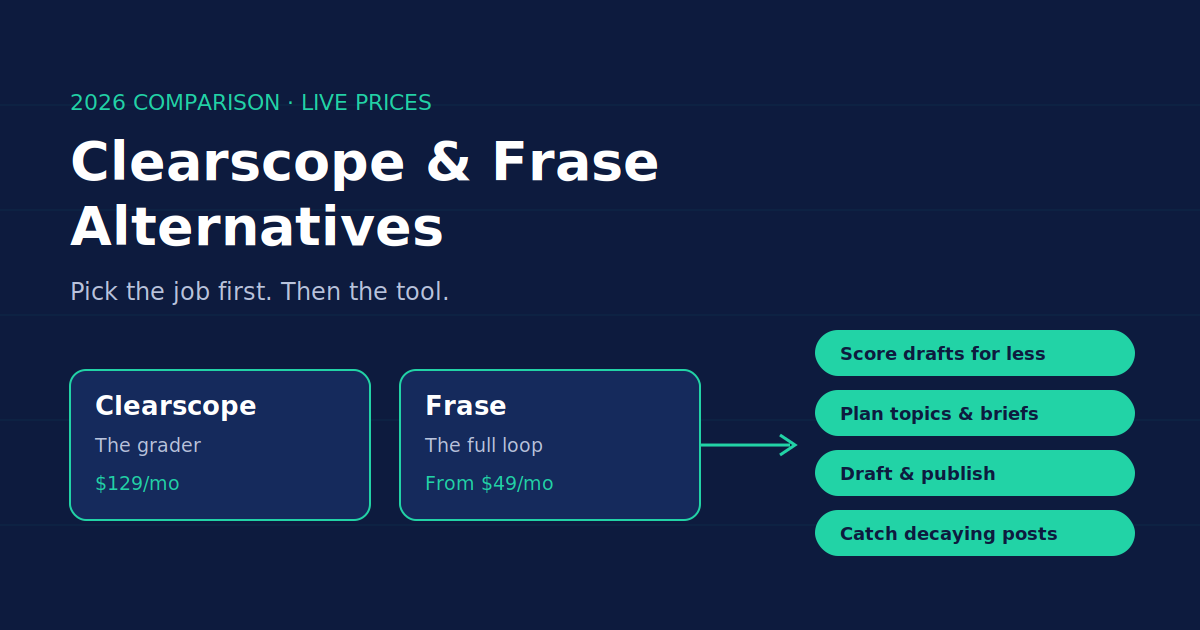
Here’s a pricing quirk nobody points out. Clearscope’s Essentials plan and Frase’s Professional plan both cost $129 a month. Same number. Completely different products.
For years, the two sat on the same shelf. You picked one, wrote against a score, and moved on. That’s no longer true. Clearscope is still a grader at heart, with AI query tracking and page monitoring added on. Frase has rebuilt itself into a research-to-publish platform with monthly caps on articles.
So when your renewal email lands, “what’s the best Clearscope alternative?” is the wrong first question. The right one is simpler.
What were you actually using it for?
The short version: every alternative in one table
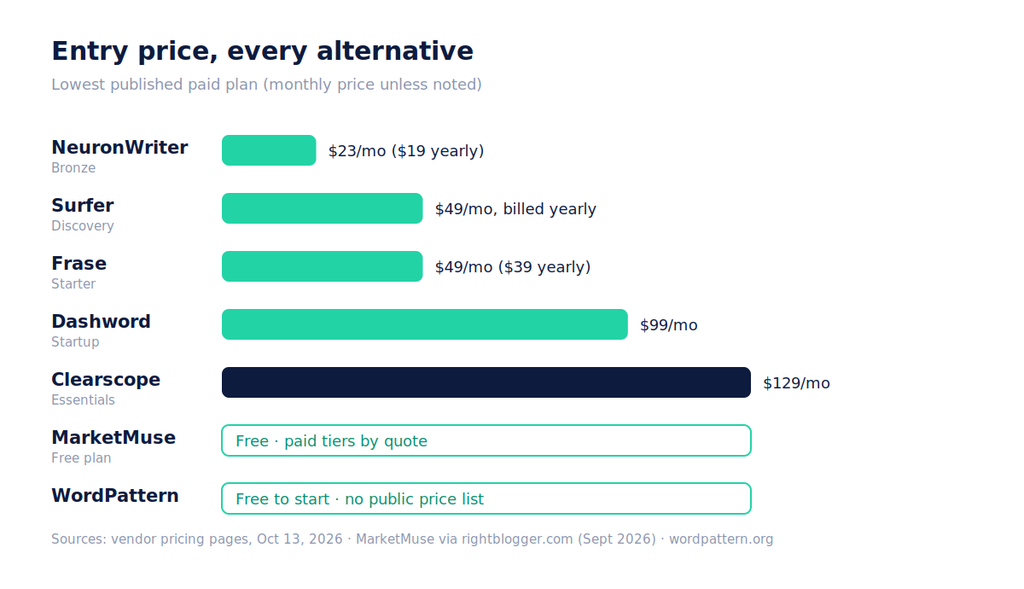
Here are the Clearscope alternatives and Frase alternatives side by side. Prices come from each vendor’s live pricing page, checked in October 2026. “Replaces” tells you which tool it’s a sensible swap for. Some content optimization tool alternatives only make sense for one side.
| Tool | Replaces | Entry price | What the entry plan gets you | Best for |
|---|---|---|---|---|
| Surfer | Clearscope, Frase | $49/mo billed yearly | 120 documents a year, 1 seat, 10 tracked pages | Writers who want a polished scoring editor |
| NeuronWriter | Clearscope, Frase | $23/mo ($19 yearly) | 25 content analyses, 2 projects | Budget optimization for solo writers |
| Dashword | Clearscope | $99/mo | 30 content reports, 5 seats, briefs | Small teams who need seats more than features |
| MarketMuse | Frase (research side) | Free plan; paid by quote | 10 queries a month free | Site-wide topic planning |
| Frase | Clearscope | $49/mo ($39 yearly) | 10 articles, 1 seat, 1 site, decay watch on 10 pages | Teams who want drafting and CMS publishing too |
| Clearscope | Frase | $129/mo | 20 drafts, 50 pages, unlimited users | Editorial teams handing briefs to many writers |
| WordPattern | The monitoring slice of both | Free to start | GSC-based decay detection and paragraph refreshes | Libraries where old posts are losing clicks |
Two things jump out. NeuronWriter undercuts everything on price. And Clearscope includes unlimited users on every plan, which is rare in this group and matters more than it sounds once you add freelancers.
Which one are you actually replacing?
Start with what each tool is now, not what it was when you signed up.
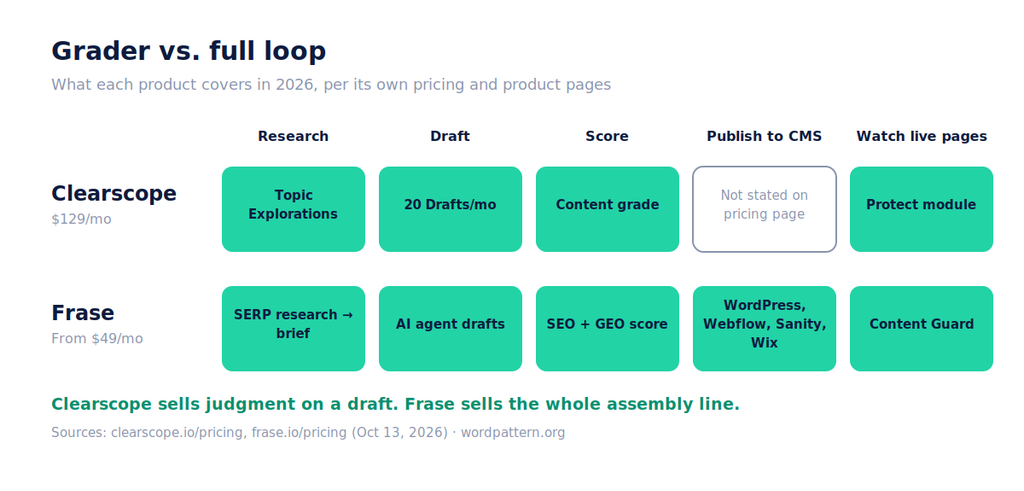
Clearscope in 2026 grades a draft against the pages that rank and tells your writers which terms to cover. On top of that, every plan includes query tracking across ChatGPT and Gemini, and the product menu now has a “Protect” module for ongoing content monitoring. It does draft with AI, but drafts are metered at 20 a month even on the $399 Business plan. The pitch is still the clean score.
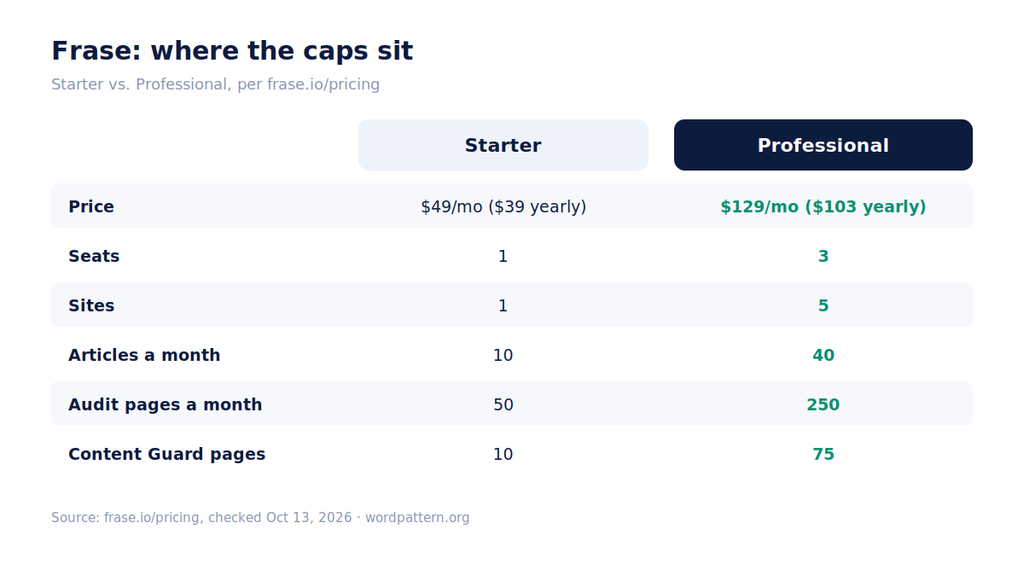
Frase in 2026 calls itself a “content operating system for AI search.” It researches the SERP, drafts, scores, publishes straight to WordPress, Webflow, Sanity or Wix, and runs a feature called Content Guard that drafts a fix when a live page starts losing rank. The catch? The $49 Starter plan stops at 10 articles a month, one seat and one site.
That’s the real frase vs clearscope split. One sells judgment on a draft. The other sells the whole assembly line.
Now find your row:
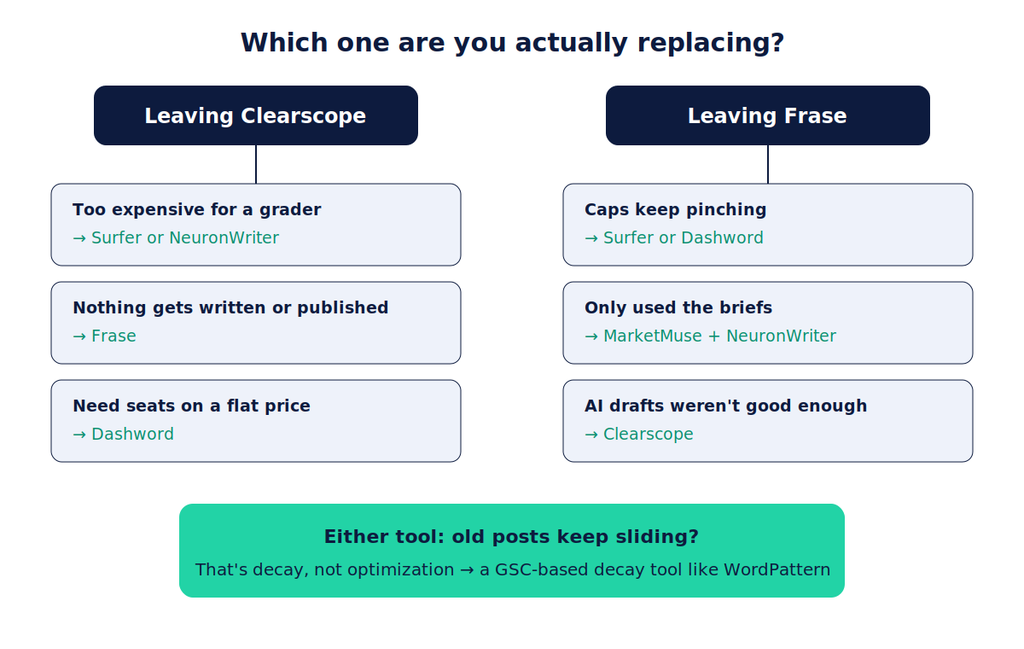
- Leaving Clearscope because of price → you want the same grader, cheaper. Look at Surfer or NeuronWriter.
- Leaving Clearscope because nothing gets written or published → you’ve outgrown a grader. Frase is the obvious move.
- Leaving Frase because the caps keep pinching → count your real monthly volume (rewrites included) before anything else. Surfer’s yearly document pool or Dashword’s 30 reports may fit better.
- Leaving Frase because you only ever used the briefs → MarketMuse for planning, NeuronWriter for the editor. You don’t need a platform.
- Leaving Frase because the AI drafts weren’t good enough → Clearscope, and keep your writers.
- Leaving either because old posts keep sliding → that’s not an optimization problem. It’s decay. A grader won’t spot it, and WordPattern is built for exactly that job.
Pretty clarifying, right? Chances are you’ve been paying for one row and ignoring the rest.
What a good Clearscope alternative has to get right
Before the list, a quick filter. A Clearscope alternative is only worth a trial if it clears three bars.
Start with the recommendations. Run a keyword you know cold. If the suggested terms look odd to you, they’ll look odd to your writers, and they’ll stop trusting the score within a week.
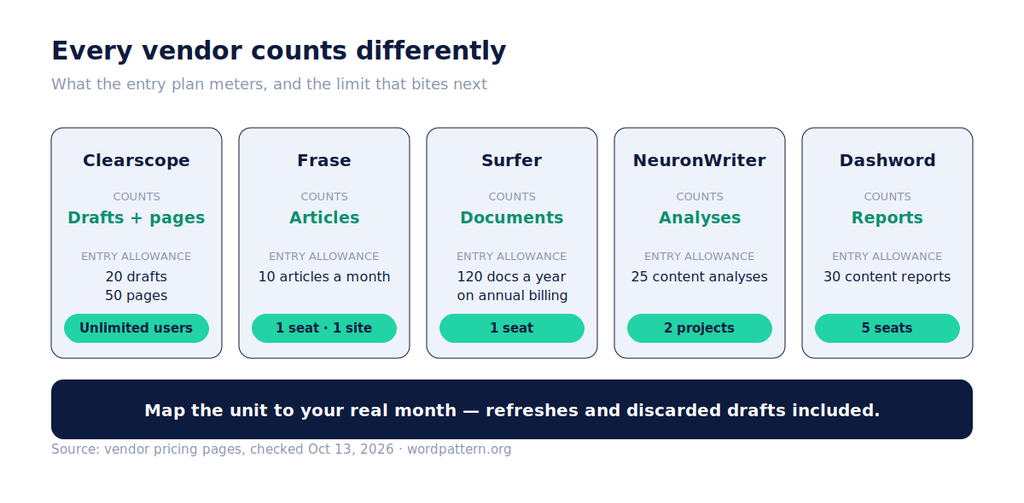
Then check the pricing unit, because every vendor counts differently. Clearscope meters drafts and pages. Frase meters articles. Surfer meters documents, and on yearly billing that pool resets once a year. NeuronWriter counts analyses; Dashword counts reports. Map that unit to your real month, refreshes included.
Seats come last, but they bite hardest. A cheap plan with one seat isn’t cheap when three people need the editor.
Frase alternatives get one extra question: does the tool cover the slice of Frase you used, or are you about to pay for the whole loop again?
The 7 alternatives, by job
1. Surfer: the closest Clearscope swap
If your writers live in the scoring editor and you just want it cheaper, Surfer is the default answer. Its Discovery plan is $49 a month billed yearly for 120 documents, one seat and 10 tracked pages. Standard, at $99 a month billed yearly, adds three seats, 360 documents and rank drop detection.
Watch the fine print, though. On annual billing, Surfer’s document credits reset yearly, not monthly. A busy quarter can drain them early.
Surfer also pushes AI visibility hard now, but prompt tracking only starts at Standard (25 ChatGPT prompts, refreshed weekly). We compared it against the rest of the field in our guide to Surfer SEO alternatives if you want the deeper teardown.
Pick it if: you want a Clearscope alternative that keeps a scoring editor your writers already understand, and you don’t need unlimited seats.
2. NeuronWriter: the cheaper Clearscope alternative
Nobody buys NeuronWriter for its looks. They buy it for the math. Bronze is $23 a month, or $19 on annual billing, for 25 content analyses and two projects. That’s term coverage scoring and SERP benchmarking for under a fifth of Clearscope’s entry price.
The trade-offs are real. The interface is busier. Integrations and the plagiarism checker don’t arrive until the Gold plan at $69. It’s built for one writer, not a team of ten.
Pick it if: you’re a solo writer or freelancer who used Clearscope or Frase mainly for the optimization editor.
3. Dashword: team seats on a flat price
Dashword is the quiet one on this list. Its Startup plan is $99 a month for 30 content reports, five user seats, content briefs and an AI writer capped at 100,000 words. Your first report is free, no card needed.
Five seats at $99 is the hook. Clearscope gives you unlimited users but costs more; Frase Starter gives you one seat. Dashword lands in the middle. It also lists content monitoring among its features, so you get a light post-publish check.
Pick it if: you want a Clearscope alternative for a three-to-five-person team, and 30 reports covers your month.
4. MarketMuse: for the planning half
MarketMuse doesn’t replace the editor. It replaces the thinking before the editor: content inventories, topic gaps and what to write next. If your Frase habit was mostly building briefs, this is a stronger research layer.
The free plan gives you 10 queries a month. Paid tiers are sold by quote, with no public dollar prices, so budgeting means a sales call. For a sense of how it handles refresh work against an execution tool, see our breakdown of AirOps vs MarketMuse for content refreshing.
It pairs well with a cluster plan. Our piece on building topical authority covers the strategy side.
Pick it if: you’re replacing Frase’s research and briefs, not its writer.
5. Frase: if you’re leaving Clearscope for the full loop
Here’s the flip side. If Clearscope felt like a checkpoint in a workflow you had to assemble yourself, Frase is the assembled version. Starter is $49 a month, or $39 billed yearly, with a 7-day trial and no card. It researches, drafts, scores, publishes and watches 10 pages for decay.
The limits are tight at that price: one seat, one site, 10 articles. Professional ($129, or $103 yearly) lifts that to three seats, 40 articles and Content Guard on 75 pages.
Pick it if: your bottleneck is getting posts written and live, not grading them.
6. Clearscope: if you’re leaving Frase for a cleaner grader
Some teams leave Frase because they want less, not more. Clearscope gives you a score writers understand in minutes, unlimited users and projects, and a 14-day trial. Essentials is $129 a month for 20 drafts, 50 tracked queries, 50 pages and 20 topic explorations. Business is $399.
It’s expensive for one person. For an editor managing eight freelancers, unlimited seats change the math quickly.
Pick it if: humans write your drafts and you want one trusted bar for all of them.
7. WordPattern: if the real job is keeping old posts alive
Look again at Frase’s Content Guard and Clearscope’s Protect module. Both vendors are now selling monitoring of pages you’ve already published. That tells you where the pain is.
WordPattern does only that slice. It connects to Google Search Console, looks across 90 days of data for steady downward trends, pinpoints the paragraphs that went stale and drafts a refresh you approve before it goes anywhere. Pushes happen through the WordPress or Shopify integrations, or you export manually. It’s free to start, and there’s no public price list on the site.
It doesn’t grade new drafts. Pair it with any editor above. For how it stacks up against other monitoring tools, see our list of content decay tools for high-traffic sites.
Pick it if: your library is big and the traffic you’re losing is on posts that already ranked.
How to switch without losing a month
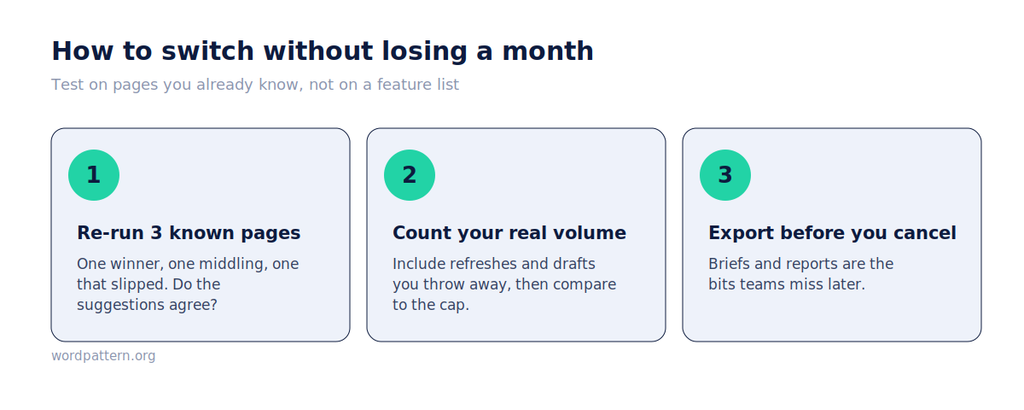
Don’t migrate on a feature list. Migrate on pages you already know.
Pick three posts you optimized in your current tool: one winner, one middling, one that slipped. Run all three through each Clearscope alternative on your shortlist. Do the term suggestions roughly agree? Does the score move in the right direction for the winner?
Then do the volume check that’s easy to skip. Count your real monthly output, including refreshes and drafts you throw away. A 10-article cap feels roomy until you notice how much of your month goes to updating old posts. Our content decay guide explains why that share keeps growing.
Finally, export what you can before you cancel. Briefs and reports are the bits teams miss later.
Pick the job, then the tool
Clearscope and Frase stopped being twins a while ago. One is a grader that added monitoring. The other is a platform that added caps. Choosing between Clearscope alternatives or Frase alternatives starts with being honest about which part you used.
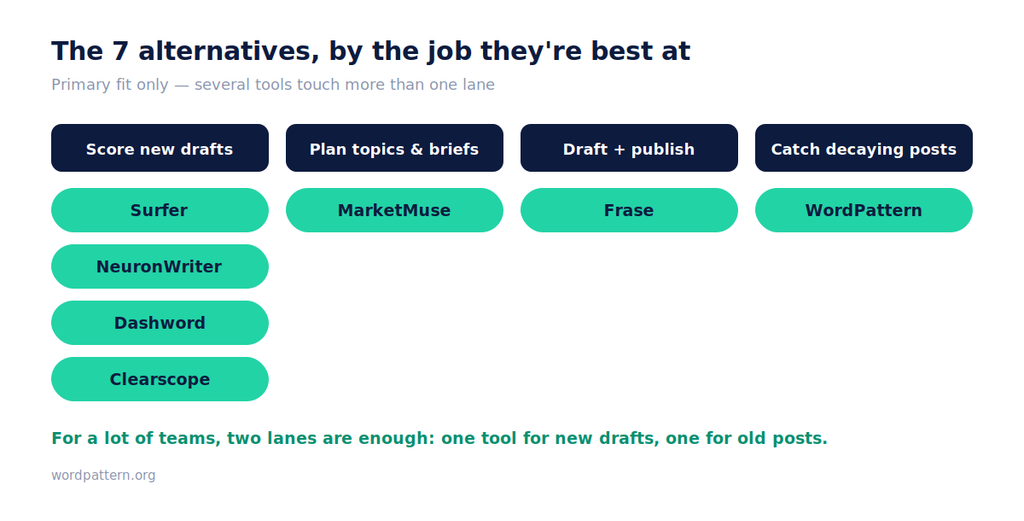
For a lot of teams, the sensible setup is two tools: something to score new drafts, and something to catch old posts before they slide. It’s also easier to swap one piece later than to rip out a whole platform.
What’s yours going to be?
FAQs
NeuronWriter, by a distance. Its Bronze plan is $23 a month, or $19 billed yearly, for 25 content analyses. Surfer’s Discovery plan is the next step up at $49 a month billed yearly. Both cover the core scoring job. Neither gives you Clearscope’s unlimited users, so the gap narrows if you need several seats.
MarketMuse has a free plan with 10 queries a month, which covers occasional brief-building. Dashword gives you one free report when you sign up. Nothing free replaces Frase’s full research-to-publish loop, so free options work best for testing whether a tool’s recommendations match your instincts.
They do different jobs now. Clearscope is better if humans write your drafts and you want one consistent score across many writers. Frase is better if you want the tool to research, draft and publish too. Clearscope Essentials and Frase Professional both cost $129 a month, so the choice comes down to workflow, not budget.
Clearscope’s Essentials plan is $129 a month, with 20 drafts, 50 tracked queries, 50 pages and 20 topic explorations. Business is $399 a month. Enterprise is custom and adds SSO. Every plan includes unlimited users, and there’s a 14-day free trial. Older articles quoting $170 or $189 are out of date.