


In the world of digital publishing, managing a large-scale WordPress site is a constant battle against entropy. As your content library grows—crossing the 1,000-post mark—traditional SEO methods start to fray at the edges. You update a category, delete an outdated guide, or change a URL slug, and suddenly, your XML sitemap is a graveyard of 404 errors and broken promises to Google. Enter the self-healing sitemap: the next frontier for technical SEO in 2026. This isn’t just a list of links; it’s an automated, proactive system that maintains your site’s health while you sleep.
The Problem: The High Cost of “Crawl Decay”
For a site like wordpattern.org, which manages over 1,400 posts, crawl budget is your most precious resource. When Googlebot encounters a 404 error or a redirect loop in your sitemap, it doesn’t just stop crawling that page—it loses “trust” in your site’s architecture.
Static sitemaps often suffer from:
- Ghost Links: URLs that no longer exist but remain in the XML.
- Stale lastmod Tags: Telling search engines a page is “new” when only a typo was fixed, or worse, failing to signal a major content refresh.
- Index Bloat: Including “NoIndex” pages that confuse crawlers.
What is a Self-Healing Sitemap?
A self-healing sitemap is a dynamic SEO infrastructure that uses automation—often powered by AI agents or server-side scripts—to audit itself in real-time. Instead of waiting for a weekly plugin update, a self-healing system detects a change in your WordPress database and instantly reflects it in the XML.
1. Automatic 404 Pruning
The moment a post is trashed or a URL is changed, a self-healing system removes the old link from the sitemap. This ensures that every single URL you present to search engines is 200 OK.
2. Dynamic lastmod Validation
Not all updates are created equal. A self-healing sitemap can distinguish between a minor CSS tweak and a 500-word content addition, updating the <lastmod> tag only when the “Content Decay” has been meaningfully addressed.
3. Intelligent Redirect Integration
If you move a post, the sitemap should immediately point to the new destination. A self-healing system bridges the gap between your redirection plugin and your XML file, ensuring Google never hits a “middle-man” redirect when it could go straight to the source.
The Architecture of a Self-Healing System
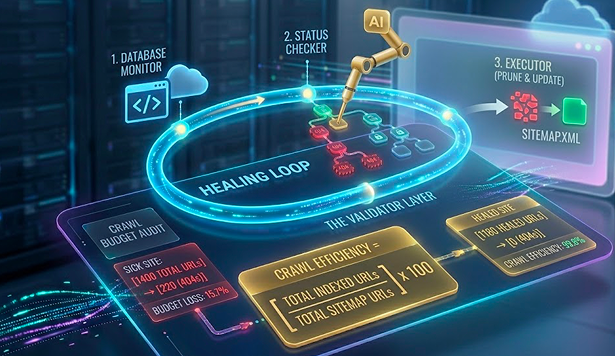
Building a self-healing sitemap is less about a single “plugin” and more about creating a closed-loop ecosystem. In a standard WordPress environment, the sitemap is a static reflection of the database. If the database has an error, the sitemap carries that error to Google. A self-healing architecture introduces a “Validator” layer between your database and the search engine.
This loop operates on three distinct pillars:
- The Event Listener: This monitors your WordPress hooks (like
save_postorwp_trash_post). The moment a change occurs, the healing process is triggered. - The Status Validator: Before the sitemap is rewritten, a background process (often a cron job or an AI agent) pings the URL. If it returns anything other than a
200 OK, the URL is quarantined and excluded from the public XML. - The API Broadcast: Once the “clean” sitemap is generated, the system doesn’t wait for Google to find it. It uses the IndexNow protocol to push the update to Bing and Yandex, and the Google Indexing API for high-priority pages.
Why This is the Next Frontier for 2026?
We are moving away from reactive SEO (fixing errors found in Google Search Console) and toward proactive SEO(preventing errors from being indexed).
With the rise of AI-driven search, “clean” data is more important than ever. When LLMs crawl your site to synthesize answers, they rely on your sitemap to understand your site’s authority. A “noisy” sitemap with broken links suggests an unmaintained site, potentially lowering your visibility in AI-generated overviews.
Solving “Content Decay” at Scale
With over 1,400 posts on any sites, “Content Decay” is an inevitability. Most sitemaps treat a post from 2021 the same as a post from 2026 unless the lastmod date changes. A self-healing sitemap, however, uses Dynamic Priority Weighting.
In a traditional sitemap, priority is often guessed:
- Homepage: 1.0
- Categories: 0.8
- Posts: 0.5
A self-healing system replaces these static numbers with Performance-Based Logic. By connecting your sitemap generator to your Search Console data via API, the system can automatically boost the <priority> of posts that are losing “clicks” but still have high “impressions.” This signals to Google that these specific pages have been refreshed and need an immediate recrawl to “heal” their ranking position.
How to Implement Self-Healing Logic on WordPress?
While standard plugins do the basics, achieving a truly “self-healing” state requires a more integrated approach:
- API-Driven Pings: Use the Google Search Console API to “push” sitemap updates the second a post is edited, rather than waiting for a “pull.”
- Database Triggers: Set up custom functions in your functions.php that trigger a sitemap rebuild specifically when a 404 is detected via your site’s logs.
- Edge SEO: Using platforms like Cloudflare Workers to “clean” your sitemap at the server level before it even reaches the crawler.
The Technical Implementation Blueprint
For the developers and technical SEOs, the “healing” happens in the logic. You can implement this using a headless approach or a custom WordPress function. The core logic follows a strict “if-this-then-that” protocol:
The Healing Logic Flow:
- IF a URL returns a
404 Not Found:- Search for a close match in the database (Fuzzy Matching).
- IF a match is found: Create a
301 Redirectand update the sitemap to the new URL. - ELSE: Remove the URL from the sitemap and add it to a “To-be-fixed” log for the admin.
- IF a URL returns a
301 Redirect:- Immediately update the sitemap entry to the destination URL to avoid “Redirect Chains” which waste crawl budget.
By implementing this, you move from a site that reports errors to a site that resolves them before they are even crawled.
Conclusion
If you are managing a high-volume site, you can no longer afford to treat your sitemap as a “set it and forget it” file. The transition to a self-healing sitemap represents a shift in philosophy: from manual maintenance to automated excellence.
By ensuring your site’s map is always accurate, you aren’t just helping Google; you are protecting your crawl budget, improving your indexation speed, and future-proofing your content for the next generation of search.