

In the fast-paced world of digital content creation, the period of 2025–2026 is witnessing an unprecedented explosion of online information. The sheer volume of content being produced is staggering, making it more challenging for content to stand out amidst the noise. This surge in digital content has led to a significant shift in how content is perceived, where speed has become a critical factor in determining its visibility and rankings.
With the growing gap between manual editing workflows and the demands of modern publishing, human editors are finding it increasingly challenging to keep up with the pace required to stay relevant. The traditional editing process, once the cornerstone of content quality control, is now being outpaced by the rapid influx of information.
This shift has paved the way for the question of whether AI can replace human editors to step in and bridge the divide between the manual editing constraints and the demands of the digital age. AI tools are not only capable of processing vast amounts of content at unparalleled speeds but also possess the ability to analyze data and trends to optimize content for search engine visibility.
The Content Velocity Problem in 2026:
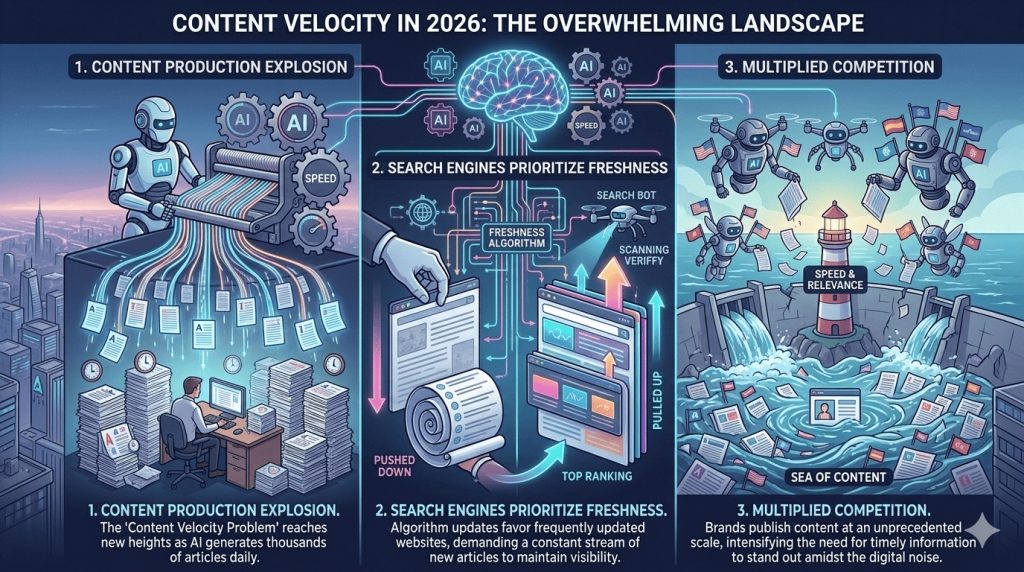
1. Content Production Has Exploded:
The Content Velocity Problem has reached new heights as AI tools are now generating thousands of articles daily. The demand for fresh and updated content is on the rise, posing a significant challenge for human editors to keep up with the pace set by AI.
2. Search Engines Prioritize Freshness:
Search engines have adapted to this rapid content production environment by prioritizing freshness. Algorithm updates now favor websites that frequently update their content, pushing brands to constantly churn out new articles to maintain their ranking positions.
3. Competition Has Multiplied:
With the increasing competition in the digital space, brands are now publishing content at an unprecedented scale. This proliferation of content not only adds to the noise but also intensifies the need for timely and relevant information to stand out amidst the sea of articles flooding the internet.
In this landscape where speed and relevance are paramount, the role of human editors is being overshadowed by AI-driven content production. The efficiency and scalability of AI tools in generating mass content have made them the go-to solution for brands looking to keep up with the Content Velocity Problem in 2026.
Why Traditional Human Editing Workflows Are Too Slow:
- Multi-Stage Editorial Pipelines: In the traditional workflow, content goes through multiple stages – from the writer to the editor, then the reviewer, and finally the publisher. Each handoff introduces delays as the content moves along the pipeline.
- Limited Scalability: Human editors have a finite capacity and can only review a certain number of articles per day. This limitation hampers the scalability of the editorial process, especially when there is a high volume of content to be reviewed.
- Bottlenecks in Content Teams: Large editorial backlogs often occur due to the slow pace at which human editors can work. These backlogs lead to publishing delays, impacting the overall efficiency of the content production process.
- Cost Constraints: Hiring more human editors to speed up the editorial workflow is a viable solution, but it comes with increased operational costs. Many companies now rely on AI recruiting software to streamline the hiring process and identify qualified editorial talent more efficiently.
The Real Cost of Slow Editing:
With the question of whether AI can replace human editors, the need for swift and efficient content management has never been more crucial.
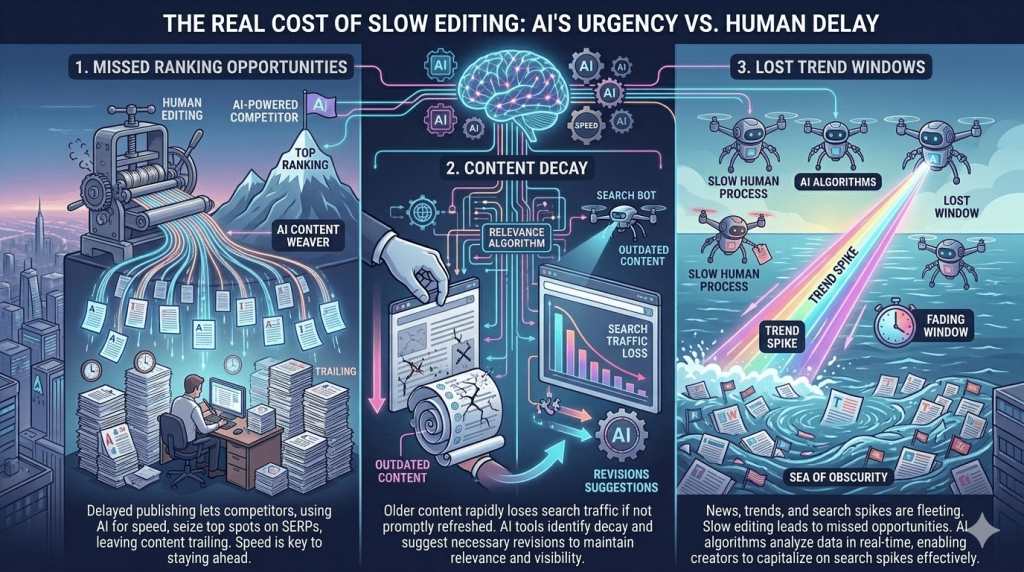
1. Missed Ranking Opportunities
The first consequence of slow editing is missed ranking opportunities. Delayed publishing allows competitors to swoop in and claim the top spots on search engine results pages (SERPs), leaving your content trailing behind. In the age of AI replacing human editors, speed is key to staying ahead of the competition.
2. Content Decay
Another significant impact of slow editing is content decay. In the ever-evolving realm of online content, older pieces can lose search traffic rapidly if not refreshed and updated promptly. AI-powered tools can quickly identify outdated content and suggest necessary revisions to maintain relevance and visibility.
3. Lost Trend Windows
Furthermore, slow editing leads to missed trend windows. News, trends, and search spikes come and go swiftly in the digital sphere, making it essential to capitalize on them before they fade into obscurity. AI algorithms can analyze data in real-time, enabling content creators to align their strategies with current trends and capitalize on search spikes effectively.
The Rise of AI-Assisted Editing:
AI-assisted editing is revolutionizing the way we refine and update our content. This advanced technology is not only streamlining the editing process but also enhancing the overall quality of our work.
1. Real-Time Content Optimization
Real-Time Content Optimization is a game-changer, with AI suggesting edits in real time. Gone are the days of waiting for human editors to meticulously comb through every word. AI algorithms can now analyze text in real time, offering valuable suggestions to improve clarity, conciseness, and overall impact.
2. Automated Content Refresh
Automated Content Refresh is another key aspect where AI shines. By updating statistics, links, and outdated sections autonomously, AI ensures that our content remains relevant and up-to-date. This eliminates the need for manual checks and revisions, saving time and resources.
3. SEO-Aware Editing
SEO-Aware Editing takes content optimization to the next level. AI can identify keyword gaps and optimization opportunities, helping to boost search engine rankings and drive more organic traffic to our content. This proactive approach ensures that our content is not only engaging but also strategically optimized for maximum visibility.
Where Humans Still Win:
Here are three critical domains where humans still outshine artificial intelligence:
1. Strategic Editing
Human editors excel in maintaining a brand’s unique voice and crafting compelling storytelling that resonates with the target audience. While AI can help automate certain editing tasks, it often falls short in capturing the essence and emotion behind the words. Human editors possess the creativity and intuition necessary to enhance the authenticity and impact of content, ensuring that the brand’s message is effectively communicated.
2. Fact Checking
When it comes to verifying complex claims and ensuring accuracy, human editors play a crucial role. While AI algorithms can assist in detecting basic factual errors, human judgment is indispensable in navigating nuanced information and detecting subtle inaccuracies. Human fact-checkers bring a depth of understanding and critical thinking skills that are essential for upholding the integrity and credibility of content in an era of misinformation.
3. Editorial Judgment
The ability to discern context, nuances, and tone is where human editors truly shine. AI may excel in grammar and spell-checking, but it often lacks the contextual understanding and sensitivity needed to interpret subtle nuances in language. Human editors possess the cultural awareness and editorial judgment required to tailor content to specific audiences, ensuring that the tone remains appropriate and resonates with readers on a deeper level.
Hybrid Workflow: Human + AI
A hybrid workflow that merges the capabilities of both AI and human editors is gaining prominence. In this setup, AI takes charge of tasks that require speed, such as generating content rapidly, implementing SEO updates efficiently, and ensuring impeccable grammar and structural accuracy. On the other hand, humans play a crucial role in handling strategic decisions, injecting creativity into the content, and conducting final quality control checks.
1. AI Handles:
The synergy between AI and human editors in a hybrid workflow presents a harmonious blend of efficiency and creativity. AI algorithms excel in swiftly churning out content, ensuring that deadlines are met without compromising on quality. Their ability to handle SEO updates adeptly also contributes to enhancing the visibility of the content in search engine rankings.
2. Humans Handle:
However, the realm of strategy formulation and creative input remains firmly within the domain of human editors. Their capacity to devise innovative content ideas, infuse a unique tone and style into the writing, and tailor the content to resonate with the target audience is unparalleled. Human editors bring a personalized touch to the content, making it engaging and relatable to readers.
Moreover, the final quality control stage is where human editors shine. Their meticulous eye for detail allows them to catch nuances that AI might overlook, ensuring that the content is flawless in terms of coherence, tone, and overall impact. By combining the strengths of AI in speed and efficiency with the human touch in creativity and quality assurance, the hybrid workflow maximizes the strengths of both entities to deliver exceptional content.
How Modern Content Teams Are Adapting:
Using AI Editing Agents
In today’s fast-paced digital landscape, modern content teams are embracing innovative strategies to stay ahead of the curve. With the rise of AI editing agents, the traditional role of human editors is being redefined. These intelligent agents are revolutionizing the editing process, making it more efficient and accurate than ever before.
Implementing Continuous Content Updates
Implementing continuous content updates has become a cornerstone of content team strategies. By regularly refreshing and refining content, teams can ensure that their material remains relevant and engaging for their audience. This proactive approach not only boosts SEO but also fosters a culture of continuous improvement within the team.
Shifting Editors to Strategic Roles
Furthermore, content teams are shifting their editors from merely proofreading to more strategic roles. Instead of focusing solely on grammar and syntax, editors are now tasked with analyzing data, identifying trends, and developing content strategies that align with the brand’s goals. This strategic shift allows content teams to create more impactful and targeted content that resonates with their audience.
What the Editorial Workflow of 2026 Looks Like:
The editorial workflow of 2026 has undergone a significant transformation with the integration of AI technologies. The step-by-step modern workflow involves AI handling various tasks traditionally performed by human editors.
Step-by-step modern workflow:
AI generates a draft
Firstly, AI plays a pivotal role in generating initial drafts for articles. By utilizing advanced algorithms and natural language processing, AI can produce high-quality content quickly and efficiently, thereby expediting the content creation process.
Performs SEO optimization
Next, AI takes charge of SEO optimization, ensuring that articles are tailored to rank higher in search engine results. This optimization is crucial for enhancing the visibility and reach of the content, ultimately driving more traffic to the website.
Updates existing articles
Moreover, AI is also employed to update existing articles regularly. By analyzing data trends and user preferences, AI can suggest relevant updates to keep the content current and engaging for the audience.
Human editor reviews strategically
Despite the extensive use of AI in the editorial workflow, human editors still hold a strategic position. They review the content generated by AI, adding a human touch by ensuring accuracy, coherence, and relevance. This human oversight is vital in maintaining the quality and authenticity of the content.
Automated publishing and monitoring
Automated publishing and monitoring systems further streamline the workflow. AI-driven tools manage the scheduling and distribution of content across various platforms, while also monitoring performance metrics to optimize content strategies.
Future of Editing Beyond 2026:
One of the key developments driving the shift towards AI-driven content optimization is the emergence of autonomous systems that can independently analyze, edit, and optimize content for various platforms and audiences. These systems can adapt to changing trends in real-time, ensuring that content remains relevant and engaging in an ever-evolving digital landscape.
Moreover, AI content refresh systems are redefining the concept of content longevity. By continuously monitoring user engagement metrics and feedback, these systems can automatically update and refresh content to maintain its relevance and effectiveness over time. This proactive approach to content maintenance ensures that brands stay ahead of the curve and remain competitive in the digital space.
As AI continues to streamline the editing process, the role of human editors is gradually shifting towards becoming content strategists rather than line editors. Instead of focusing on tedious tasks like grammar and syntax, human editors are now able to leverage their creativity and strategic thinking to shape the overall content strategy of a brand or publication.
Conclusion:
The fastest content teams in 2026 will be those that adeptly combine AI automation with human expertise. By leveraging artificial intelligence for tasks like grammar checks, spell checks, and even basic editing, human editors are freed up to focus on higher-level responsibilities. This strategic oversight allows human editors to ensure that content aligns with brand voice, resonates with the target audience, and meets broader business objectives.
While AI can certainly streamline certain aspects of the editing process, it lacks the intuitive understanding, creativity, and critical thinking skills that human editors bring to the table. Human editors possess the ability to discern subtleties in tone, context, and messaging that AI algorithms may overlook. This human touch is invaluable in creating content that truly connects with readers on a deeper level, which is why AI cannot completely replace human editors.
By working in tandem with AI, human editors can elevate the quality of content, drive engagement, and ultimately deliver greater value to both readers and brands.
FAQ
Because modern content production is extremely high-volume, and manual editing workflows cannot keep up with the speed required for real-time publishing and SEO updates.
No. AI is mainly replacing repetitive editing tasks, while humans remain essential for strategy, tone, and complex editorial decisions.
AI-assisted editing uses machine learning tools to automatically check grammar, optimize SEO, suggest improvements, and update content faster than manual processes.
Search engines reward fresh, frequently updated content. Faster editing and publishing help websites stay competitive in rankings.