


SEO automation has become a pivotal aspect of digital marketing strategies, especially for businesses leveraging professional SEO services to stay competitive. With the rise of ‘ghost traffic,’ the right SEO automation software — platforms that combine content audits, rank tracking, and workflow dashboards into a single tool — can help recover lost traction without expanding the writing team. Let’s delve into the top 5 SEO automation hacks that can combat ghost traffic effectively in this blog.
What is “Ghost Traffic” and why is it Haunting Your Site?
“Ghost Traffic” refers to website traffic that appears in your analytics but doesn’t actually result in any meaningful interactions or conversions on your site. This phenomenon can be quite frustrating for website owners as it gives a false sense of success while failing to generate any valuable outcomes. Ghost traffic can be caused by various factors such as bots, irrelevant keywords, or even misconfigured tracking codes.
Understanding and addressing ghost traffic is crucial for optimizing your site’s performance and ensuring that your resources are focused on genuine engagement. This is where a digital marketing agency can play a vital role by helping identify and filter out this ghost traffic. By doing so, you can gain a more accurate picture of your site’s actual performance and make informed decisions to improve its effectiveness.
The Definition of a “Zombie Page”
A “Zombie Page” refers to a webpage on your site that receives little to no organic traffic and fails to contribute to your overall SEO efforts. These pages often remain stagnant, neither driving valuable traffic nor leading to conversions. Zombie pages can negatively impact your site’s overall SEO health by diluting your domain’s authority and reducing the visibility of your more valuable content.
Identifying and reviving zombie pages is essential for optimizing your site’s SEO performance and ensuring that every page serves a purpose. By updating content, optimizing keywords, or consolidating low-performing pages, you can breathe new life into these zombie pages and improve your site’s overall search engine rankings.
Why the Traditional “Write More” Strategy is Failing Enterprise Sites?
The traditional SEO strategy of “write more” is no longer sufficient for enterprise sites looking to drive significant organic traffic and conversions. Simply churning out more content without a strategic approach can result in a bloated site with low-quality pages that fail to engage users or rank well in search engine results.
Instead of focusing solely on quantity, enterprise sites should prioritize quality content that resonates with their target audience, addresses pain points, and provides valuable insights. By creating in-depth, authoritative content that showcases expertise and offers solutions, enterprise sites can establish themselves as industry leaders and attract high-quality organic traffic that leads to conversions.
In conclusion, optimizing your site for ghost traffic, revitalizing zombie pages, and focusing on quality over quantity are essential strategies for improving your site’s SEO performance and driving meaningful results without the need to hire more writers.
5 Automation Hacks for Lean SEO Teams
For lean SEO teams struggling to recover ‘Ghost Traffic’ without expanding their writing team, automation is the key. By implementing these 5 automation hacks, your team can efficiently manage and optimize your website’s SEO performance.
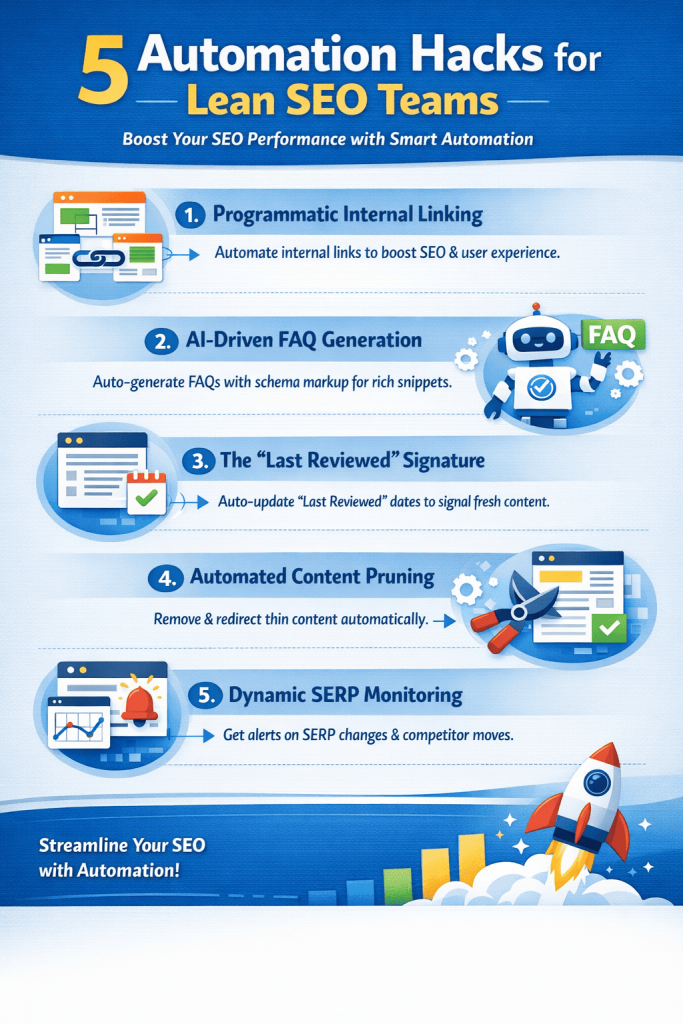
1. Programmatic Internal Linking:
Automate the distribution of “link juice” within your website using internal-linking software that scans your content library and suggests links inside your CMS dashboard. Most platforms integrate directly with WordPress or offer an API, so the tool implements links across pages without manual work. This ensures that your pages are interconnected in a way that boosts SEO ranking and enhances user experience.
2. AI-Driven FAQ Generation:
Use AI content software to automatically generate FAQ sections and inject schema markup. These tools plug into your publishing platform as an app or integration, and many bundle the feature into a broader content-optimization suite. This not only improves your chances of appearing in featured snippets but also enhances the overall visibility of your content.
3. The “Last Reviewed” Signature:
Automate the process of updating the “Last Reviewed” date on your content pages to signal freshness to search engines like Google. This simple hack can positively impact your SEO performance by showing that your content is up-to-date and reliable.
4. Automated Content Pruning:
Identify and redirect “thin” content using a content-audit platform that scores page quality inside a single dashboard. Configure the tool’s pruning rules once, connect it to your site, and the software flags and redirects low-value pages automatically. By automating this process, you can ensure that your website only hosts high-quality content that drives organic traffic.
5. Dynamic SERP Monitoring:
Stay ahead of competitors by configuring automated alerts in your rank-tracking software. Most SEO platforms let you set up these alerts in the dashboard settings and push notifications through Slack or email integrations. By monitoring competitor moves and automatically updating your strategies, you can adapt quickly and maintain your competitive edge.
By incorporating these automation hacks into your SEO strategy, your lean team can effectively optimize your website for search engines. Embrace the power of automation to streamline your processes and maximize your SEO results.
Building the “Self-Healing” Content Library
When it comes to optimizing your website for search engines and attracting more organic traffic, having a robust and dynamic content library is crucial. In this blog post, we will delve into the concept of building a “Self-Healing” content library. From choosing the right AI agent for autonomous updates, and setting performance “Guardrails” for your automation to enhance your SEO strategy and recover ‘Ghost Traffic’ without the need to hire more writers.
Building the “Self-Healing” Content Library involves creating a system where your content can adapt and evolve on its own. By connecting an AI tool to your content management system — whether that’s WordPress, Webflow, or a headless CMS via API — you can ensure your content stays relevant and up-to-date. Most platforms offer a free tier for testing and paid plans that unlock automation features as you scale. This not only saves time but also ensures that your website remains competitive in the ever-evolving digital landscape.
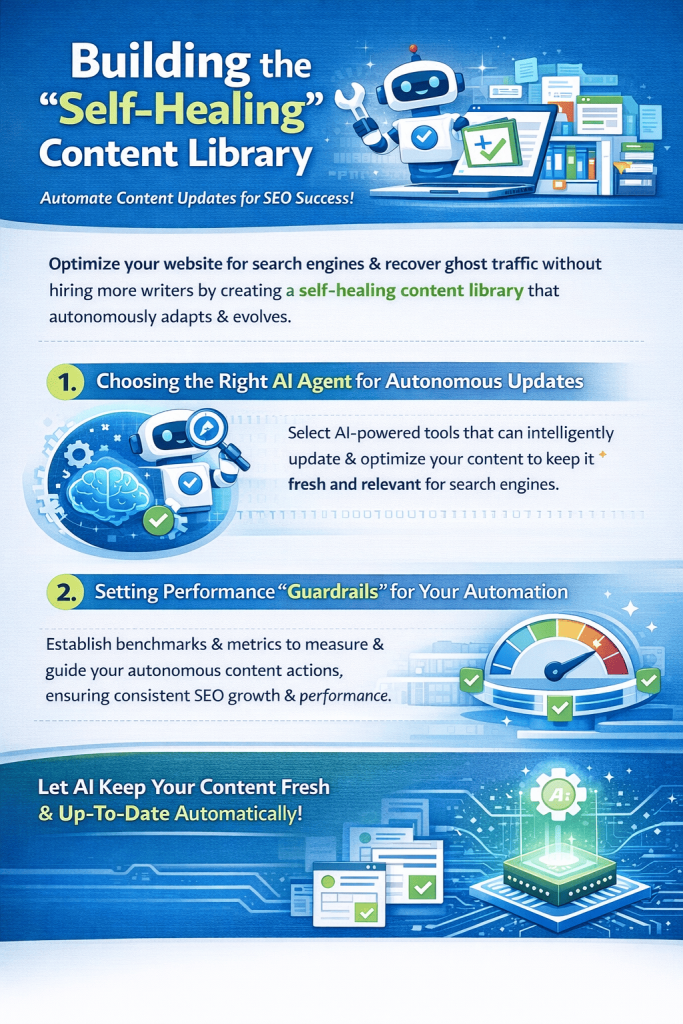
Choosing the Right AI Agent for Autonomous Updates
Choosing the Right AI Agent for Autonomous Updates is essential in ensuring that your content remains fresh and engaging. By leveraging AI-powered software, you can automate content updates and optimization. When evaluating platforms, compare features, pricing tiers, and available integrations, and check that the tool connects to your existing CMS and analytics stack. This not only improves the overall quality of your content but also helps in attracting more organic traffic to your website.
Setting Performance “Guardrails” for Your Automation
Setting performance “guardrails” for your automation involves configuring benchmarks and metrics inside your software’s settings panel to measure the success of your automated processes. Most SEO platforms let you define these thresholds in the dashboard and sync results to Google Sheets or a BI tool through native integrations. By defining clear goals and KPIs, you can monitor the performance of your AI agents. You can ensure that they are delivering the desired results. This allows you to make informed decisions and adjustments to optimize your SEO strategy and recover any ‘Ghost Traffic’. As a result, you can remove pages that are affecting your website’s performance.
Conclusion
By implementing these top 5 SEO automation hacks, you can take your website to the next level without the need to hire more writers. Embracing AI technology, setting clear performance metrics, and focusing on building a self-healing content library are key steps. Through these methods, recovering lost traffic and improving your website’s visibility in search engine results is easy.
Frequently Asked Questions
SEO automation tools can streamline processes like keyword research, content optimization, and monitoring rankings. This helps to identify and rectify issues causing ‘Ghost Traffic’ without the need to hire more writers.
Implementing strategies such as automated content updates, AI-driven keyword targeting, automated link building, and data-driven decision-making can significantly improve website visibility and traffic without increasing the workforce.
While premium software tiers offer advanced features like unlimited crawls and team seats. There are several free and low-cost SEO automation tools available with entry-level plans that still cover the core dashboard and integration features. These can also deliver substantial results in recovering ‘Ghost Traffic’ effectively.
The timeline for observing improvements in traffic and visibility after implementing SEO automation strategies can vary. This is based on the website’s current state, competition, and the specific hacks employed. However, consistent efforts usually yield positive results over time.
SEO automation can significantly enhance efficiency and effectiveness. But still, human input remains crucial for creating high-quality content, engaging with the audience, and adapting strategies based on real-time analytics to ensure sustained traffic recovery and growth.