


Semrush’s biggest self-serve plan tracks 5,000 keywords. Go one keyword past that and you’re not picking a plan anymore. You’re booking a sales call. That’s straight from Semrush’s own pricing page, where the Advanced tier runs $549 a month and everything above it is a custom Enterprise quote.
That ceiling is why so many teams go shopping for Semrush alternatives. Not because the tool is bad. Because the bill gets weird once your keyword list grows, and it’s now an Adobe product after a deal that closed in April 2026.
Here’s the problem with most lists of Semrush alternatives. They compare starting prices. A $29 plan and a $129 plan look wildly different until you learn neither can track the keywords you actually have.
So we priced one job instead: tracking 10,000 keywords. Plus what each extra seat costs.
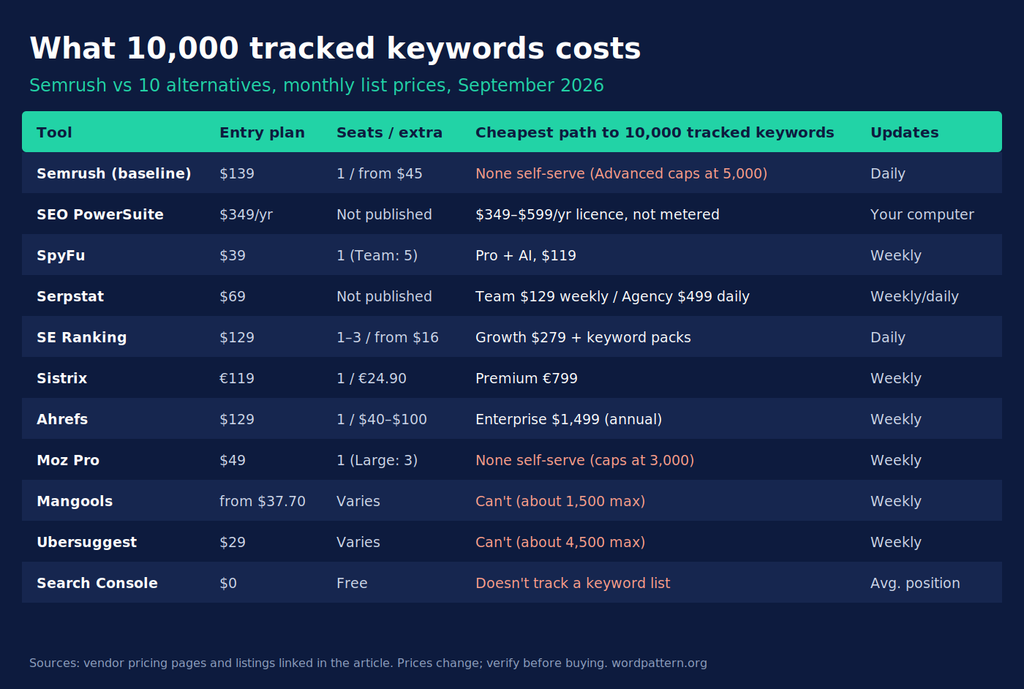
The cost table: what 10,000 tracked keywords really costs
Every price below for Semrush and its alternatives is the monthly list price published on the vendor’s pricing page (or the most recent third-party listing where the vendor hides it), captured in September 2026.
| Tool | Entry plan (monthly) | Seats included / extra seat | Cheapest published path to 10,000 tracked keywords | Update speed at that price |
|---|---|---|---|---|
| Semrush (baseline) | $139 | 1 / from $45 | None self-serve. Advanced ($549) stops at 5,000; beyond that is an Enterprise quote | Daily |
| SEO PowerSuite | $349 per year | Not published | $349 to $599 per year licence; tracking isn’t metered by keyword | Runs on your own computer |
| SpyFu | $39 | 1; Team plan ($249) has 5 | Pro + AI at $119 (15,000 slots) | Weekly |
| Serpstat | $69 | Not published | Team at $129 for weekly checks; Agency at $499 for daily | Weekly or daily |
| SE Ranking | $129 | 1 on Core, 3 on Growth / from $16 | Growth at $279 (5,000) plus add-on keyword packs, or a custom plan | Daily |
| Sistrix | €119 | 1 / €24.90 | Premium at €799, or Professional (€419) plus paid overage | Weekly |
| Ahrefs | $129 | 1 / $40–$100 | Enterprise at $1,499, annual commitment required | Weekly (daily costs extra) |
| Moz Pro | $49 | 1 (3 on Large) | None self-serve. Large ($299) stops at 3,000 | Weekly |
| Mangools | from $37.70 | Varies by plan | Can’t. Top plan tracks about 1,500 | Weekly (daily on Agency) |
| Ubersuggest | $29 | Varies by plan | Can’t. Enterprise tops out near 4,500 | Weekly |
| Google Search Console | $0 | Free | Doesn’t track a keyword list at all | Average position, not rank |
Read the fourth column first. That’s the one that decides your bill.
Some tools in the “can’t” rows are still great buys. They just aren’t built for this job. Meanwhile, the cheapest cloud route to 10,000 keywords costs $119 a month, less than Semrush’s entry plan. A desktop tool does it for under $50.
How we priced the same job
The rules were simple, and we kept them the same for every tool.
We used monthly billing so nobody wins by hiding behind an annual prepay. Where a vendor offers a discount for paying yearly, we mention it in that tool’s section.
We counted a “tracked keyword” as one keyword in the rank tracker, checked on a schedule. Keyword research lookups don’t count. They’re metered differently and rarely force an upgrade.
Some tools don’t sell keyword slots at all. Serpstat sells position checks. Sistrix sells SERP updates. For those, we assumed one check per keyword per update. Tracking 10,000 keywords weekly works out to roughly 43,000 checks a month. Daily is about 300,000.
Finally, frequency matters. Weekly and daily tracking of the same list are not the same job, and some tools charge very differently for each. We flag it every time.
Prices change. Check each linked page before you buy.
The 10 Semrush alternatives, cheapest path first
The first six Semrush alternatives can track 10,000 keywords on a published plan. The last four can’t, and we’ll say why.
1. SEO PowerSuite: no meter on keywords
This one plays by different rules. SEO PowerSuite is desktop software for Windows, Mac and Linux, and it stores your data locally. Paid licences run $349 a year for Professional and $599 a year for Enterprise.
Because checks run from your own machine, keyword tracking isn’t sold in slots. That’s how you get 10,000 keywords for less than $50 a month.
The trade-off is real, though. Your computer does the work, so scheduling and scale depend on your setup. In our view the learning curve is also steeper than the web-based suites.
Best for: technical SEOs who don’t mind running their own rank checks.
2. SpyFu: the cheapest cloud route to 10,000 keywords
SpyFu is the surprise here. According to TechRadar’s SpyFu review, the Pro + AI plan includes 15,000 weekly tracked keywords, and it lists at $119 a month (or $89 a month billed annually). Basic, at $39, covers 5,000.
That’s 10,000 keywords with room to spare, for under $120.
The catch? SpyFu was built for competitor and PPC research, and its rank tracking updates weekly. Don’t expect the technical audit depth of a full suite. If you need 5 logins, the Team plan at $249 raises the cap to 50,000 weekly keywords.
Best for: small teams who mostly need rankings plus competitor ad history.
3. Serpstat: frequency decides the bill
Serpstat sells position checks, not keywords. Originality.ai’s review, citing Serpstat’s pricing page, lists Individual at $69 with 10,000 checks a month, Team at $129 with 50,000, and Agency at $499 with 500,000.
Do the math on your schedule. Weekly tracking of 10,000 keywords (about 43,000 checks) fits inside Team. Daily tracking (about 300,000) pushes you to Agency.
Same list. Nearly four times the price.
Heads up: other pricing trackers list slightly lower figures ($59, $119 and $479), so confirm on Serpstat’s site before you budget.
Best for: teams happy with weekly rankings who want a full suite for about $130.
4. SE Ranking: daily tracking with add-ons
SE Ranking’s pricing page shows two main plans. Core costs $129 a month for 2,000 daily keywords and 1 seat. Growth costs $279 a month for 5,000 daily keywords and 3 seats. Extra seats start at $16.
To reach 10,000, you add keyword packs on top of Growth (from $32) or ask for a custom plan. SE Ranking doesn’t publish a flat 10,000-keyword price, so your number will come from the app or from sales.
Of all the Semrush alternatives here, it’s one of the closest in feature spread. Annual billing saves 20%.
Best for: agencies that want daily tracking without Semrush’s seat costs.
5. Sistrix: strong European data, euro pricing
Sistrix lists four packages: Start at €119, Plus at €239, Professional at €419 and Premium at €799, all cancellable monthly.
Here’s the useful bit. Sistrix now meters SERP updates. Its SERP-update notes shows Premium used to include 10,000 weekly-tracked keywords and now includes 100,000 SERP updates. Professional’s 40,000 updates fall just short of a weekly 10,000-keyword list, though Sistrix bills extra updates on your next invoice from the Plus plan up.
Seats are generous. Premium includes 12 users, and each extra user costs €24.90, per SE Ranking’s Sistrix review.
Best for: teams focused on European markets.
6. Ahrefs: the $1,499 jump
Among Semrush alternatives, Ahrefs is the most complete like-for-like swap. It’s also where the 10,000-keyword math hurts most.
Ahrefs’ pricing page shows Lite at $129 (750 keywords), Standard at $249 (2,000), and Advanced at $449 (5,000). Tracking 10,000 keywords requires Enterprise at $1,499 a month with an annual commitment. That’s $17,988 a year.
And every plan updates rankings weekly. Daily updates need the Project Boost add-on.
Enterprise does include 3 users. Below it, extra seats cost $40 to $80 each depending on the plan.
Best for: link-heavy SEO programs that can justify the price for the backlink data.
7. Moz Pro: stops at 3,000
Moz Pro is friendly and cheap to start. TechRadar’s Moz Pro review lists Starter at $49, Standard at $99, Medium at $179 and Large at $299. Large tracks 3,000 keywords with 3 users.
That’s the ceiling for self-serve. Past 3,000, you’re talking to Moz’s enterprise team, the same wall you hit at Semrush, just lower.
Best for: a single brand tracking a few thousand keywords that values Moz’s link metrics.
8. Mangools: cheap, simple, capped
Mangools pitches itself hard as one of the friendliest Semrush alternatives, and its comparison page lists plans from $37.70 a month. Rank tracking is weekly, with daily updates only on the Agency plan.
The ceiling is low, though. Plan listings on Capterra show tracked keywords topping out at 1,500. So 10,000 isn’t on the menu.
For a blogger doing keyword research, it’s a lovely tool. For this job, no.
Best for: solo creators who mostly need KWFinder.
9. Ubersuggest: the lifetime-deal option
Ubersuggest costs $29, $49 or $99 a month, or $290, $490 or $990 once for a lifetime plan. That lifetime option is genuinely rare.
But tracking scales per project. The top plan allows 300 keywords per project across 15 projects, so about 4,500 in total, updated weekly.
Best for: beginners who want to pay once and stop thinking about it.
10. Google Search Console: free, but not a rank tracker
It’s free. It’s first-party data. And it’s the one tool every Semrush alternative on this list plugs into anyway.
It won’t track a keyword list, though. Search Console shows the queries you already get impressions for, as an average position. Its UI and exports cap at 1,000 rows, low-volume queries are hidden for privacy, and history stops at 16 months.
Use it as your baseline, not your tracker. It’s also the data layer tools like WordPattern read to spot pages losing clicks before rankings fully drop.
Best for: everyone, alongside a real tracker.
What a three-person team actually pays
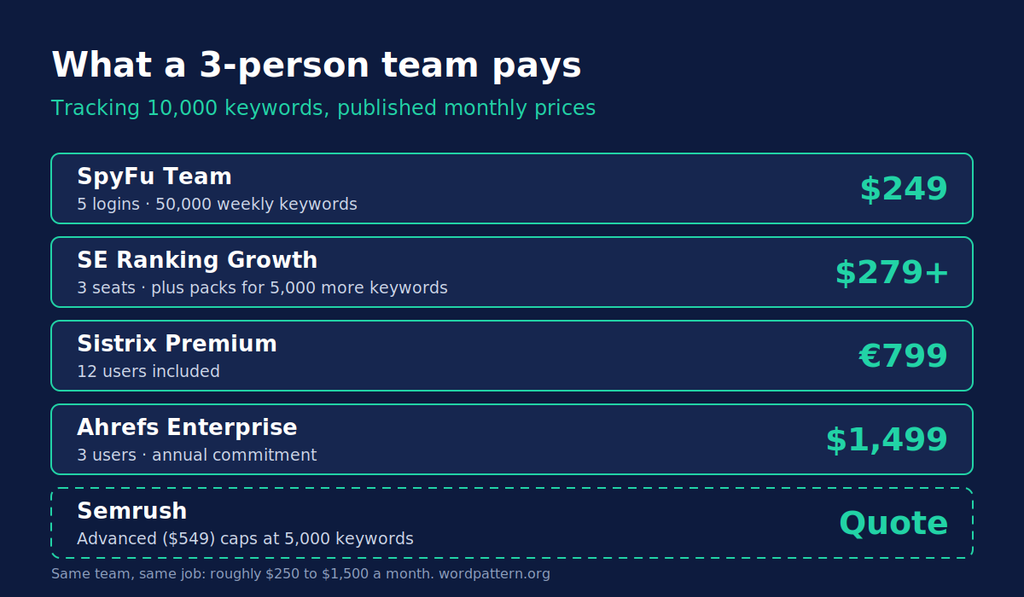
Seats are where “cheap” Semrush alternatives stop being cheap. Here’s a team of three tracking 10,000 keywords, using only published prices.
- SpyFu Team: $249 a month, 5 logins, 50,000 weekly keywords.
- SE Ranking Growth: $279 a month with 3 seats included, plus whatever the extra 5,000 keywords cost you.
- Sistrix Premium: €799 a month, 12 users included.
- Ahrefs Enterprise: $1,499 a month, 3 users included, annual commitment.
- Semrush: a custom quote. For context, even the Advanced plan at $549 only covers 5,000 keywords, and two extra users start at $45 each.
See the spread? The same team, the same job, and a bill that ranges from about $250 to $1,500 a month. That’s why entry prices are the wrong column to compare.
Hidden costs to budget before you switch
List prices rarely match the invoice. A few line items to check on any shortlist:
- Annual lock-ins. Ahrefs Enterprise requires a yearly commitment, and SE Ranking only offers free assisted migration on annual plans.
- Daily updates. Ahrefs tracks weekly on every plan unless you add Project Boost. Serpstat’s daily tracking needs roughly seven times the checks of weekly.
- Overage. Sistrix bills SERP updates beyond your package on the next invoice. Ahrefs charges pay-as-you-go credits once you enable them.
- Add-on toolkits. On Semrush, Local, Content, Social, Advertising and Traffic & Market are separate subscriptions.
None of these are deal-breakers. They just belong in the spreadsheet.
What Semrush does that none of these do
It’d be dishonest to stop at price. Semrush still has things nobody on this list matches.
The big one is breadth. Semrush sells specialist toolkits for Traffic & Market, Local, Content, Social, Advertising and AI PR, all on one account. None of the 10 Semrush alternatives here offers that full spread under one login.
The Advertising Pro toolkit adds AdClarity for competitor display, video and social ads. SpyFu’s ad history is excellent, but it’s focused on Google Ads.
Semrush’s Traffic & Market toolkit covers audience and market benchmarking that the SEO-first tools here don’t sell. (It’s pricey. Extra users on it start at $289 a month.)
Semrush also bundles AI visibility tracking into its plans, with dedicated prompt-tracking quotas from the Starter tier up.
If AI visibility is the main thing keeping you on Semrush, it’s worth comparing dedicated AI Overview tracking tools first.
So here’s the honest split. If your team runs SEO, PPC, social and PR out of one tool, Semrush’s price buys something real. If you mainly track rankings and research keywords, you’re likely paying for toolkits you never open.
Which cheaper alternative to Semrush fits your job
Start with your keyword count and your update speed. Everything else is a tiebreaker.
- Under 3,000 keywords, weekly is fine: Moz Pro or Mangools will do the job for far less.
- Around 10,000 keywords, weekly: SpyFu or Serpstat Team is the cheaper alternative to Semrush with the least compromise.
- 10,000 keywords, daily, multiple seats: SE Ranking Growth plus add-ons.
- You want Semrush-level data, whatever the cost: Ahrefs Enterprise.
- You need client reports, not just data: look at dedicated SEO reporting tools for agencies and pair them with a cheaper tracker.
One more tip. Run a two-week overlap before you cancel Semrush. Rank trackers differ on location settings and SERP features, so compare the same 100 keywords side by side.
Price the job, not the plan
Switching tools is easy. Switching tools and actually saving money takes one extra step: price the job you do, not the plan you see first.
For most teams tracking a large keyword list, the right Semrush alternatives cost a fraction of an Enterprise quote. For teams running every marketing channel from one dashboard, Semrush can still earn its bill.
Either way, rankings are only half the picture. If you’re trying to cut manual work across the whole workflow, our guide to the best SEO automation software covers the tools that act on this data, not just report it.
FAQs
Google Search Console is the best free option because the data comes straight from Google. It won’t track a custom keyword list, and it only shows 16 months of history. Ahrefs also offers a free plan with limited Site Explorer and Site Audit access for sites you own.
At entry level, yes: Ahrefs Lite is $129 versus Semrush’s $139 SEO plan. At high keyword volumes it flips. Ahrefs needs its $1,499 Enterprise plan for 10,000 tracked keywords, while Semrush quotes that volume as custom Enterprise pricing.
Two reasons: seats and keyword caps. Each extra Semrush user starts at $45 a month, and self-serve plans stop at 5,000 tracked keywords. Add-on toolkits like Traffic & Market are billed separately on top.
On published pricing, SEO PowerSuite is cheapest because its desktop licence ($349 to $599 a year) doesn’t meter tracked keywords. Among cloud tools, SpyFu Pro + AI at $119 a month covers 15,000 weekly keywords. If you need daily updates, expect to pay more.
Usually, yes. Export your tracked keywords and position history as CSV before cancelling. Some tools help with imports; SE Ranking, for example, offers free assisted migration on annual plans.